

Understanding the Refinancing Landscape
Refinancing a home loan is more than just finding a lower interest rate; it is a strategic financial decision that can optimise your debt structure and support your long-term wealth objectives. In Australia’s dynamic lending market, borrowers must look beyond the headline rate to assess the total value of a loan, including its features, fees, and flexibility. For many homeowners, particularly those who have been on variable rates or are approaching the end of a fixed-term period, the current environment presents a valuable opportunity to reassess their mortgage.
An experienced finance broker plays a critical role in this process. They provide access to a wider range of lenders and products than any single bank can offer, helping you navigate the competitive landscape to find a structure that genuinely aligns with your financial position.
The RBA Cash Rate and Market Sentiment
The Reserve Bank of Australia’s (RBA) cash rate decisions are a primary driver of interest rate movements and lender competition. When the RBA adjusts the official cash rate, lenders typically follow, but often with a lag. This delay can create windows of opportunity where some lenders offer highly competitive "special offers" to attract new customers before the rest of the market catches up.
Attempting to time the market perfectly by waiting for the absolute bottom of an interest rate cycle is a common but often costly mistake. The savings lost while waiting for a marginal future rate drop can easily outweigh the potential benefit. A more effective strategy is to act when a compelling offer that meets your needs becomes available.
Identifying the Refinancing Sweet Spot
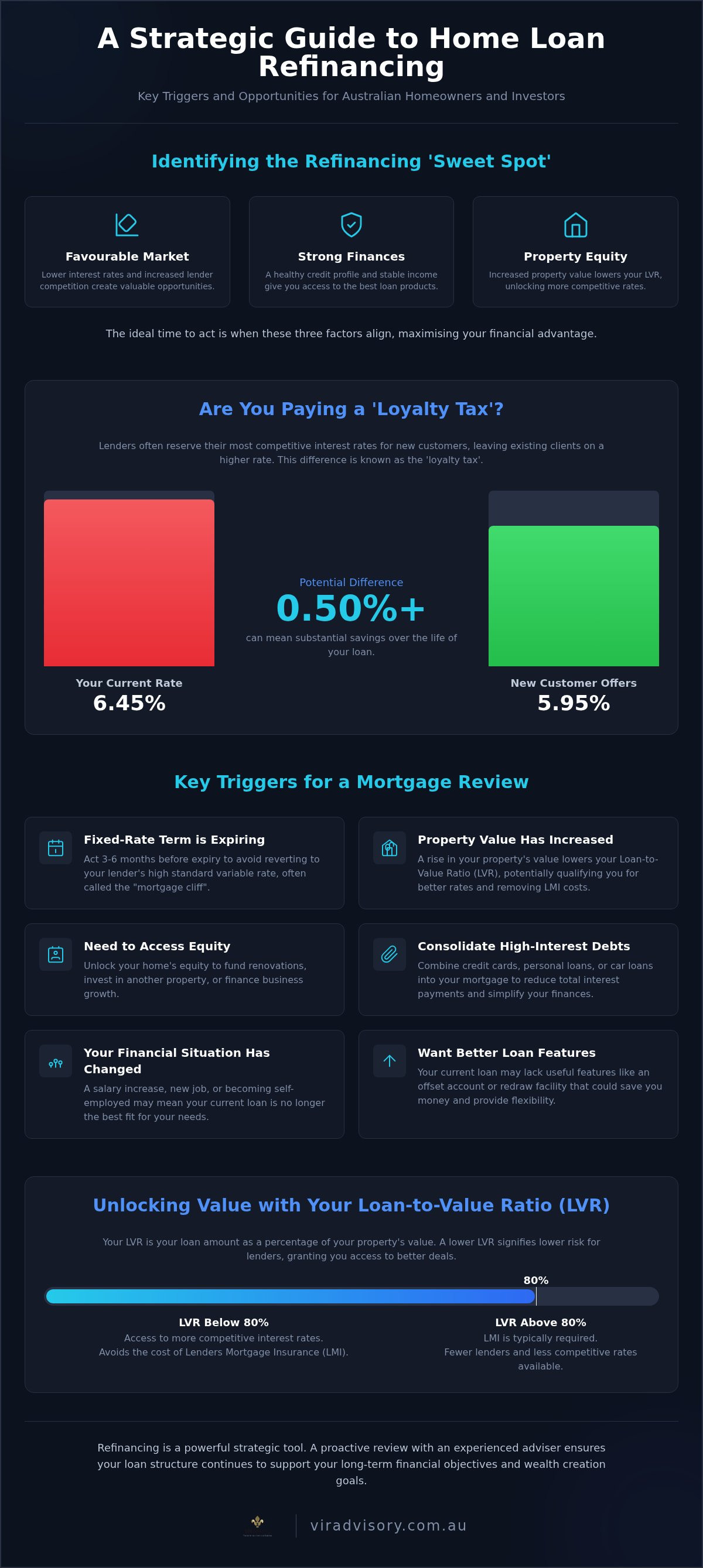
The ideal time to refinance is at the intersection of favourable market rates, your personal financial situation, and your property’s equity. A strong credit profile and a healthy amount of equity in your home will give you access to the most competitive loan products. For many borrowers, the two-year mark of a mortgage is an excellent time for a comprehensive review. By this point, any introductory offers may have expired, and your circumstances may have changed.
This is also when many borrowers start paying a "loyalty tax," which is the cost of remaining with a lender who no longer offers competitive terms to existing clients compared to what they offer new borrowers.
Signs It May Be Time to Refinance
Deciding when to refinance can be complex, but several clear signals indicate that a mortgage review is warranted. If you identify with one or more of the following situations, it may be the best time to explore your refinancing options in Australia.
- Your interest rate is no longer competitive: If your current interest rate is significantly higher than what new customers are being offered, you are likely paying a loyalty tax. A rate difference of even 0.50% can translate into substantial savings over the life of the loan.
- Your fixed-rate term is expiring: As your fixed-rate period comes to an end, your lender will typically roll your loan over to a standard variable rate, which is often much higher. It is crucial to review your options at least three to six months before expiry to secure a better deal.
- Your property value has increased: A significant rise in your property's value lowers your Loan-to-Value Ratio (LVR). Once your LVR drops below 80%, you may qualify for more competitive interest rates and have the option to remove the ongoing cost of Lenders Mortgage Insurance (LMI) if you paid it initially.
- You want to access equity: Refinancing can be an effective way to unlock the equity in your home. This capital can be used for renovations, investing in another property, funding a business, or other significant financial goals.
- You need to consolidate debt: If you have high-interest debts such as credit cards, personal loans, or car loans, consolidating them into your home loan can significantly reduce your total interest payments and simplify your finances into a single repayment. This is a core component of effective debt optimisation.
- Your financial circumstances have changed: Life events like a salary increase, a new job, starting a family, or becoming self-employed can change your financial needs. Your current home loan may no longer be the best fit, and refinancing allows you to switch to a product with more suitable features, such as an offset account or redraw facility.
Key Market Triggers: When the Economy Signals a Move
Beyond your personal circumstances, broader economic factors and market conditions create distinct opportunities for refinancing. Staying aware of these trends allows you to act decisively and secure a more favourable financial position. A proactive approach, guided by market intelligence, is superior to a reactive one.
Navigating Interest Rate Cycles and Fixed-Term Expiries
Understanding where we are in the interest rate cycle is fundamental. When rates are stable or falling, lender competition heats up, resulting in better deals for borrowers. For those with a fixed-rate loan, the period six months before expiry is a critical window. This is the time to start comparing fixed versus variable options in the current market and prepare your application to avoid reverting to your lender's high standard variable rate. This transition, often called the "mortgage cliff," can cause a sharp increase in repayments if not managed proactively.
Capitalising on Property Value Growth
The Australian property market's performance directly impacts your refinancing power. As your home's value increases, your LVR decreases. Crossing the 80% LVR threshold is a significant milestone, as it often unlocks access to lower interest rate tiers and eliminates the need for LMI on a new loan. A professional valuation, organised as part of the refinancing process, can formally recognise this growth and be used to negotiate better terms or remove existing LMI, potentially saving you thousands.
Strategic Personal Triggers: Aligning Your Loan with Your Financial Goals
The most effective financial strategy is one that adapts to your evolving personal and professional life. A home loan that was perfect when you were a first-home buyer may be inadequate for a seasoned property investor or a self-employed professional. Refinancing allows you to realign your largest financial commitment with your current objectives, ensuring your debt structure actively supports your goals rather than hindering them.
This is particularly important for high-income professionals and business owners, whose complex financial structures demand sophisticated lending solutions. Expert advice can help structure your finances within a broader strategic framework, addressing unique challenges and unlocking opportunities that standard lenders may overlook. For a detailed look at specialised lending, see our guide for professionals.
Optimising Debt Structure for Investors and Business Owners
For property investors and business owners, refinancing is a powerful tool for capital management and growth. By accessing the equity in your residential property, you can secure funds for a new investment property, inject working capital into your business, or acquire commercial premises. A key strategy is to separate investment and owner-occupied debt correctly for tax purposes, ensuring you maximise potential deductions. A knowledgeable broker can help structure these facilities to maintain financial clarity and compliance.
Life Transitions: When Your Loan No Longer Fits
Major life events should always prompt a review of your mortgage. Whether you are expanding your family, changing careers, or planning for retirement, your home loan needs to adapt. For professionals with variable income streams, features like an offset account become invaluable for reducing interest costs. Similarly, if you have accumulated personal debts, refinancing offers a structured way to consolidate them into your mortgage at a much lower interest rate, improving cash flow and reducing financial stress.
Evaluating the True Cost of Refinancing
While the prospect of a lower interest rate is appealing, a successful refinance requires a thorough cost-benefit analysis. It is essential to identify all potential costs to ensure the long-term savings justify the switch. Hidden fees and charges can erode your gains if not properly accounted for.
The main costs to consider include:
- Discharge Fees: Charged by your current lender for closing your loan account.
- Application Fees: Charged by the new lender to process your application.
- Government Charges: Including mortgage registration and deregistration fees, which vary by state.
- Valuation Fees: The cost for the new lender to value your property.
A comprehensive "Mortgage Health Check" from a finance professional can uncover these costs and compare them against the potential savings, giving you a clear picture of the net benefit.
Calculating the Breakeven Point
The breakeven point is the time it takes for your savings from a lower interest rate to cover the total cost of refinancing. A simple formula can help you determine this:
Total Refinancing Costs ÷ Monthly Savings = Months to Break Even
If you plan to stay in your property longer than the breakeven period, refinancing is likely a financially sound decision. It's also important to factor in the non-financial "time cost" of gathering documents and completing the application. For example, a 0.5% rate reduction on a $600,000 loan can potentially save a borrower over $3,000 in interest annually, making the upfront effort worthwhile.
Avoiding the Pitfalls of "Honeymoon" Rates
Be wary of unusually low introductory or "honeymoon" rates. These offers typically last for a limited time before reverting to a much higher variable rate. The key is to look at the Comparison Rate, which is legally required to be displayed alongside the headline rate. It provides a more accurate picture by factoring in most of the known fees and charges over the life of the loan.
Sometimes, a loan with a slightly higher rate but better features—such as a full offset account, flexible repayment options, or a redraw facility—can offer greater long-term value than the loan with the absolute lowest rate.
How VIR Advisory Helps Homeowners Review and Refinance Their Loans
Navigating the refinancing process requires expertise, market knowledge, and a focus on your specific financial circumstances. At VIR Advisory, we provide a structured and professional assessment to determine if refinancing is the right move for you. Led by Raina Doshi, who brings over 15 years of banking and finance experience, our approach is built on detailed analysis and a commitment to securing optimal outcomes for our clients.
Why an Expert Broker Is More Effective Than a Comparison Site
While comparison websites can provide a starting point, they cannot replace the personalised service of an experienced finance broker. An algorithm cannot understand your long-term goals or negotiate on your behalf. We offer several distinct advantages:
- Access to a Wider Market: We work with a diverse panel of lenders, including major banks, smaller institutions, and non-bank lenders, giving you access to products not always advertised to the public.
- Personalised Negotiation: We leverage our industry relationships to negotiate interest rates and terms that are often better than what you could secure by approaching a lender directly.
- Professional Support: We manage the entire process, from initial assessment and document preparation through to application submission and settlement, saving you time and reducing complexity.
Your Next Steps Toward Financial Optimisation
The first step to a successful refinance is a thorough assessment of your current loan and financial goals. Preparing documents such as payslips, bank statements, and details of existing debts will ensure a seamless and efficient process.
Your financial future is too important for a one-size-fits-all solution. For a tailored assessment and clear, professional advice on whether now is the best time to refinance your home loan in Australia, we invite you to contact a professional. Let's work together to build a more secure and prosperous financial position.

Article by
Raina Doshi
Raina Doshi has worked in banking and finance since 2011, including experience with major Australian lenders. She helps homeowners, property investors, business owners and professionals secure and structure lending solutions across home loans, refinancing, commercial finance and business lending.
Areas of expertise include residential lending, investment property finance, debt recycling, commercial property finance, equipment finance, construction finance and strategic debt structuring.
Drawing on extensive banking and finance experience, Raina helps clients navigate lender requirements, improve borrowing outcomes and structure effective finance solutions.
Disclaimer
The information in this article is general in nature and does not take into account your personal objectives, financial situation or needs. Before acting on any information, consider whether it is appropriate to your circumstances and seek professional advice.


