

An online borrowing capacity calculator can produce a precise-looking figure that differs from what a lender assesses. A borrowing capacity Australia calculator is an estimate: lenders apply their own policies to income, living costs, existing debts and proposed loan repayments.
That difference can be frustrating, particularly if you’re self-employed, a company director, earning variable income or carrying a HELP debt. Calculators may treat the same figures differently, while a lender will verify your circumstances and assess whether repayments remain manageable. APRA’s serviceability buffer also requires lenders to assess repayments at least 3 percentage points above the actual interest rate.
This article explains why estimates vary and which details can shift the result, from accepted income to credit limits and regular commitments. You’ll learn what lenders assess, how to interpret an estimate without mistaking it for approval, and what records to organise before discussing your options.
Key Takeaways
- Separate an estimated loan size from your property budget, repayment comfort and formal approval.
- Assess your finances as a whole. Income alone won’t show how existing commitments and household costs affect an application.
- Compare calculator estimates with a lender assessment, then consider whether the resulting repayments fit your cash flow.
- Before discussing options, gather current income records, debt and credit-limit details, regular expenses and your intended loan purpose.
- Different lender assessments can produce different results. Understanding the assumptions behind each figure helps you compare options more clearly.
Why borrowing capacity in Australia is an estimate, not a guaranteed loan amount
Borrowing capacity is an estimate of the loan amount a lender may consider, not a loan approval. A calculator can help you test a rough borrowing range, but it can’t verify your documents, confirm a lender’s assessment or promise a particular interest rate or loan terms.
That distinction matters because a borrowing figure is only one part of a property purchase. Your deposit, purchase costs and the repayments you’re comfortable managing also shape what you can realistically spend. Calculators can return different estimates from the same financial details because they may use different inputs and assumptions.
For a broader explanation of how borrowing estimates work, watch this video:
Borrowing capacity is an estimate of how much a lender may consider lending after assessing your financial circumstances. It is not approval, a confirmed interest rate or a final loan offer.
What does borrowing capacity mean for a home loan?
It’s a lender’s assessment of the amount you may be able to borrow based on your finances and proposed loan. The result depends on a fuller application, including the information and supporting documents the lender reviews. An online result doesn’t establish that you’ll qualify or what rate and loan terms will apply.
Keep these four figures distinct:
- Borrowing capacity: the potential loan amount a lender may assess.
- Property budget: the amount available for a purchase after considering the loan, deposit and purchase costs.
- Repayments: the ongoing amount due under a loan, which you’ll need to weigh against your cash flow.
- Formal approval: a lender’s decision after assessing the application and relevant details.
A higher estimated loan limit doesn’t automatically make a higher purchase price manageable. Your own repayment comfort is a separate consideration.
Why can Australian borrowing capacity estimates differ?
Calculators can ask for different information, group expenses differently or apply different assumptions to income and commitments. If one estimate uses lower monthly living costs than another, it may return a higher result even when you enter the same income. Credit card limits, personal loans, dependants and other regular commitments can also affect the calculation.
Lenders assess applications under their own criteria. In Australia, APRA’s serviceability requirements influence how lenders test whether repayments remain manageable if rates rise. The Australian Prudential Regulation Authority (APRA) sets a serviceability buffer of at least three percentage points above the actual loan rate for this assessment. A calculator’s assumptions may not reflect a lender’s full assessment.
Treat borrowing capacity Australia estimates as starting points, not competing promises. Compare the information each calculator requests, enter expenses and commitments consistently, and use the result to identify questions for a lender-specific assessment.
What Australian lenders assess when reviewing borrowing capacity
Lenders assess the full application, not income in isolation. They consider relevant income, household costs, dependants and financial commitments to understand your capacity to meet repayments. The evidence required depends on your circumstances and the lender’s current requirements.
The calculation mechanics behind these inputs, including how income and commitments affect an assessment, are explained in how borrowing capacity is calculated in Australia. These categories can help you organise the information a lender may need.
Income, expenses and financial commitments
Start with income you can support with records, and use consistent figures in any calculator. A salaried applicant might organise payslips and account records. A self-employed applicant or company director might prepare business and personal financial records. These are examples rather than a universal document list. Lenders assess variable income differently, and the records they request depend on their current policy and the application.
Record regular spending accurately, including household costs and commitments that are easy to overlook. Existing loan repayments and credit facilities affect the funds available for a proposed repayment. For example, leaving a credit limit or repayment out of your figures can make an estimate less representative of your finances.
Interest rates can also affect repayment calculations. The Reserve Bank of Australia (RBA) sets the cash rate, which can influence interest rates offered by lenders and, in turn, the repayments considered in an assessment. The rate and assumptions a lender uses depend on its current criteria and your application details.
How borrower circumstances can change the assessment
A salaried employee may have regular employment income to document, while a self-employed borrower may need records showing business income over time. An investor’s application may include rental income, property expenses and existing investment loan commitments. Lenders can assess these income sources differently, so a calculator’s treatment may not match a lender’s approach.
For a joint application, both applicants’ relevant income and commitments are considered. Combining incomes doesn’t remove either applicant’s liabilities or household costs. Include both applicants’ loans, credit limits and regular outgoings when preparing your figures.
Infographic: organise your borrowing capacity information
- Income: payslips, account records or business financial records, as relevant.
- Expenses: a current breakdown of household and regular living costs.
- Dependants: an accurate record of dependants and related household commitments.
- Financial commitments: records for existing loans, credit facilities and other regular repayments.
- Investor details: rental income records and property-related expenses, if applicable.
Document requirements vary by lender and applicant. Prepare records that reflect your circumstances and the application being assessed.
For a more useful borrowing capacity Australia estimate, update your figures before comparing results and use the same income and expense assumptions across calculators. This makes it easier to spot which inputs are driving differences and what needs clarification in a lender-specific assessment.
How to compare a borrowing capacity estimate with your real borrowing position
Compare four separate measures before deciding what a loan amount means for you: the calculator estimate, a lender’s assessment, formal approval and the repayments that fit your cash flow. Each answers a different question. A calculator gives an indicative result based on your inputs. A lender assessment considers your application and supporting information under its criteria. Approval is the lender’s decision, while repayment comfort depends on your ongoing commitments and priorities.
Calculator estimate: What a tool suggests using the details and assumptions entered. It can help with an initial comparison, but incomplete or outdated inputs can distort the result.
Lender assessment: How a lender evaluates the application using its current criteria and the information provided. Another lender may assess the same circumstances differently.
Approval: The lender’s formal decision after considering the application. An estimate or preliminary discussion isn’t a substitute for approval.
Personally manageable repayments: The repayments you believe your household or business cash flow can sustain alongside other priorities. A calculator can’t decide this for you.
Calculator estimate versus lender assessment
A calculator processes what you enter. It doesn’t verify those details or assess your full application. A lender may review supporting documents and apply its own criteria to income, expenses, liabilities and the proposed loan. If your information is incomplete, or a calculator’s assumptions don’t match your circumstances, the result may differ from an assessment.
For a fair comparison, record the inputs behind each estimate, including how income, expenses and existing commitments were entered. Compare those assumptions with information you can document. Don’t treat the highest calculator result as the most accurate. Without knowing its inputs and assessment method, a larger figure alone says little about its suitability. Consumer information from the Australian Securities and Investments Commission (ASIC) can also help clarify the distinction between credit information and an individual lender’s decision.
Borrowing limit versus a comfortable repayment
A lender’s assessed limit is not automatically a sensible purchase budget. Your loan purpose and cash-flow priorities matter. A first home buyer may want to leave room for household costs after settlement. An investor may need to account for existing property commitments. A business owner may need to preserve funds for operating expenses. These priorities can affect the amount you’re comfortable committing, even if a lender assesses a higher limit.
Use this comparison process:
- Standardise the inputs. Use current, consistent income, expense and liability figures for each calculator.
- Record the assumptions. Note what each estimate includes or excludes instead of comparing headline amounts alone.
- Test your cash flow. Consider proposed repayments alongside regular household or business costs and your intended loan purpose.
- Separate capacity from budget. Factor in your deposit and purchase costs, then set a borrowing target based on repayments you can manage.
This approach makes borrowing capacity Australia estimates more useful without treating them as a promise of lending. Compare like with like, identify gaps in the assumptions and distinguish what may be assessed from what suits your finances.
A practical checklist to prepare for a borrowing capacity assessment
A useful estimate starts with a complete, current snapshot of your finances. Before using a calculator, organise income, expenses, debts, credit limits and the purpose of the proposed loan. This reduces avoidable differences between estimates and gives you clearer questions for a lender-specific assessment.
Information to organise before using a calculator
Use records rather than memory where possible. Include income from relevant sources, regular household spending, current loan repayments and credit limits. If your income varies through self-employment, company earnings, commission or rental income, gather records showing how it is received and changes over time. Lenders can have different documentation and assessment requirements, so prepare information that reflects your circumstances and application.
Don’t omit a commitment because you rarely use it or expect to repay it soon. An incomplete picture can make an estimate look stronger than your actual position. Likewise, don’t enter unusually low household expenses just to increase the result. The goal is a realistic comparison, not the largest possible figure.
Steps to make an estimate more useful
- Gather the figures. Record income amounts and frequency, regular household expenses, dependants, debt repayments and credit limits. Note whether figures are weekly, fortnightly or monthly.
- Check every commitment. Review current statements and records so loans, credit cards and other ongoing obligations aren’t missed. For joint applications, include both applicants’ relevant income and commitments.
- Estimate expenses realistically. Use a representative view of household spending, including recurring costs that don’t occur every month. If an expense varies, use a reasonable average based on your records rather than ignoring it.
- Compare results consistently. Check each calculator’s fields and enter equivalent figures using the same time periods. Record what each tool asks for or leaves out, and note questions for a lender assessment discussion.
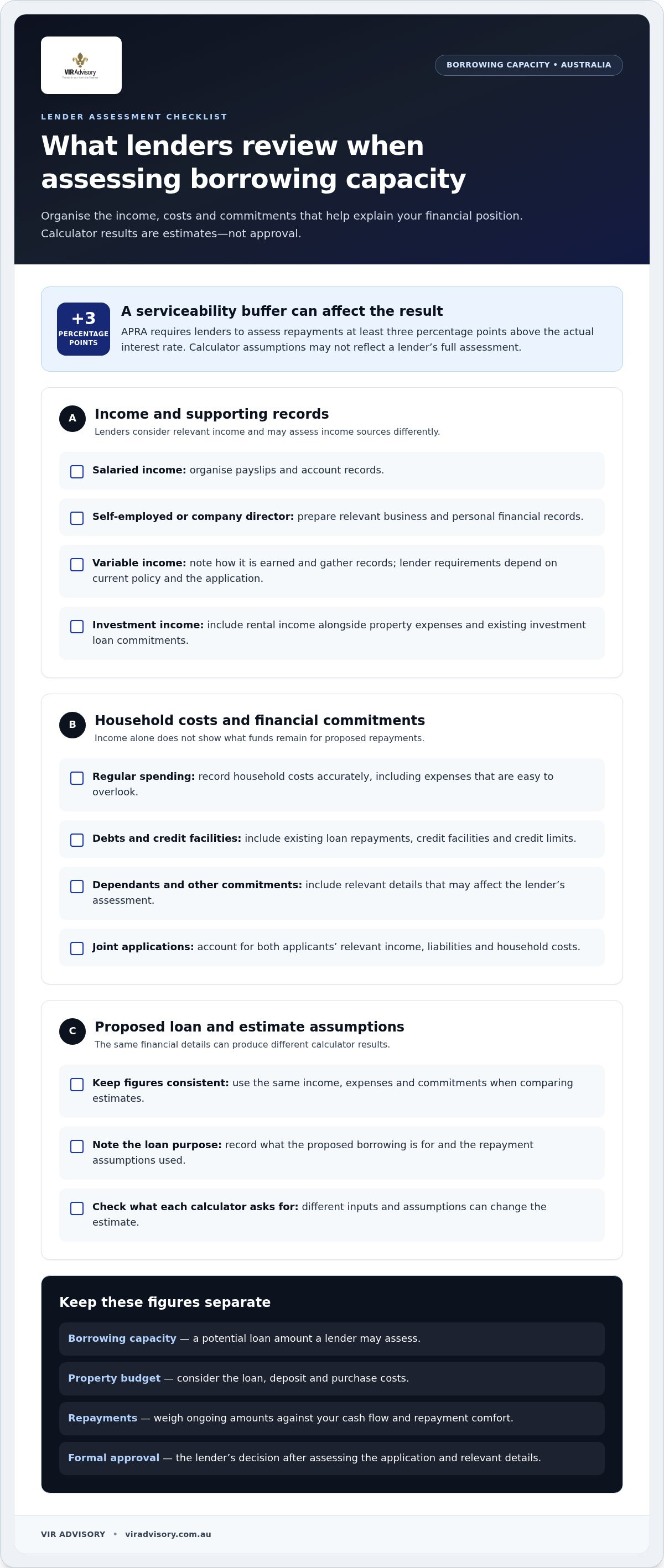
Checklist infographic: organise these four categories
- Income: current records for employment, business or other relevant income sources.
- Liabilities: existing loan repayments, credit limits and other financial commitments.
- Expenses: regular household costs, dependants and less frequent spending.
- Intended loan purpose: whether the borrowing relates to a home purchase, refinance or investment, and any relevant property or business commitments.
Use changes in a calculator as a sensitivity check, not a way to disguise obligations. You can see how the estimate responds when a commitment changes, but keep the actual commitment in your main comparison unless it has genuinely changed. Save the inputs and outputs, then list unclear fields, questions about income treatment and records you may need to provide. Keeping a dated copy also makes it easier to explain later changes, such as a new repayment or a change in income.
Discuss your borrowing capacity with VIR Advisory
A calculator result can be a useful starting point. The next practical question is how it fits your circumstances and intended loan purpose. VIR Advisory is a finance and mortgage brokerage that connects clients with a broad lender network. A discussion can help you understand how lender assessment approaches differ and which details about your income, commitments or cash flow need closer attention. It can’t guarantee a borrowing limit or approval.
What a borrowing capacity discussion can clarify
Bring the estimate you received, the figures you entered and questions about how those details may be assessed. A broker can review the result alongside your financial commitments and priorities, then explain which lender criteria may be relevant. A salaried applicant, a company director and a property investor may need different questions explored because their income and commitments can be structured differently.
Raina Doshi has over 15 years of banking and finance experience, including more than a decade with one of Australia’s leading banks. That background informs practical discussions about lender assessment and the information that may be needed to understand your options. VIR Advisory focuses on clear, tailored explanations rather than promising a lending outcome.
Depending on your circumstances, a discussion may cover a home loan, refinancing or investment property finance. VIR Advisory’s home loan and finance services connect this assessment with relevant brokerage support. The value is in understanding how lender-specific criteria relate to your application, rather than assuming every lender will reach the same result.
A clear next step after reviewing your estimate
Before a conversation, note what you want the borrowing to achieve and what remains unclear. Useful questions include:
- Which income details or records may be relevant to my circumstances?
- How should I account for current loans, credit limits and household or business expenses?
- What lender assessment differences could affect this type of application?
- How can I compare a potential loan amount with repayments that fit my cash flow?
These questions keep the discussion focused on your actual position. If you’re comparing borrowing capacity Australia estimates, bring the calculator inputs as well as the results so the assumptions can be considered alongside your goals and commitments. Any lender assessment remains subject to its criteria and the information provided.
Use your estimate to set a considered next step
Before making an application, consider what may change in your finances over the coming months. A new role, a shift in business income, planned time away from work or a debt nearing repayment could affect a borrowing capacity Australia assessment. Note what is changing and when, so your next finance discussion reflects your expected circumstances rather than an outdated snapshot.
Identify any decisions affected by timing, such as when you expect to purchase or whether you’re planning to refinance. You don’t need every detail resolved before seeking clarity. Raina Doshi’s banking and finance experience can inform a practical discussion about the questions to address and lender approaches that may be relevant, without promising approval or a particular amount.
A clear view of timing and upcoming changes gives you a more useful basis for deciding what to explore next.
Frequently Asked Questions
How much can I borrow for a home loan in Australia?
There’s no single borrowing amount that applies to every applicant. A lender assesses your income, regular costs, dependants, existing commitments and proposed repayments under its own criteria. Two people with similar incomes may receive different assessments if one has more debt or higher household expenses. Use an estimate for initial planning, then consider your deposit, purchase costs and repayment comfort before setting a property budget.
Does HECS-HELP debt affect borrowing capacity?
Yes, a HECS-HELP debt can reduce borrowing capacity because lenders may take it into account when assessing serviceability. Its effect depends on your circumstances and the lender’s current assessment policy. Include the debt when entering information into a calculator, even if you’re not making voluntary repayments. Keep your details accurate and account for how the lender may treat the obligation rather than assuming the balance has no bearing on an application.
Do credit card limits affect borrowing capacity if I do not owe anything?
They may. A lender can consider an available credit limit as a financial commitment, even if the card balance is currently nil, although treatment varies by lender. List each card’s limit as well as its balance when preparing your figures. If you’re considering reducing a limit, weigh that against your access to credit and don’t change commitments solely to produce a higher calculator result.
Can two people increase their borrowing capacity with a joint home loan?
They may be able to borrow more jointly if both applicants’ accepted incomes strengthen the application. However, lenders also assess both people’s debts, credit limits, expenses and dependants, so the combined result isn’t simply two individual estimates added together. A second applicant’s income, for example, may be offset by existing loan repayments. Record both applicants’ circumstances clearly when comparing the joint position.
Can self-employed borrowers get a home loan in Australia?
Yes, self-employed borrowers can apply for home loans, although lenders may assess business income and supporting records differently. A business owner should be ready to explain how personal income relates to business performance, particularly if earnings vary between periods. The evidence required depends on the lender and application. Organise current business and personal financial information to help establish which records are relevant to the assessment.
Is a borrowing capacity calculator the same as pre-approval?
No. A calculator provides an estimate based on the information entered. Pre-approval involves a lender reviewing an application, with its scope and conditions depending on the lender. Neither should be treated as a guarantee that a particular property or final loan will be approved. Before relying on a pre-approval, understand what information the lender has assessed, what conditions apply and whether further checks are required.
Does having a larger deposit always increase borrowing capacity?
No. A larger deposit can reduce how much you need to borrow and may increase your purchase budget, but it doesn’t automatically increase the maximum amount a lender assesses you can repay. That assessment still depends on your financial position and the proposed loan. Account for purchase costs when working out the funds available. A deposit affects the overall funding picture, not just the borrowing estimate.

Article by
Raina Doshi
Raina Doshi has worked in banking and finance since 2011, including experience with major Australian lenders. She helps homeowners, property investors, business owners and professionals secure and structure lending solutions across home loans, refinancing, commercial finance and business lending.
Areas of expertise include residential lending, investment property finance, debt recycling, commercial property finance, equipment finance, construction finance and strategic debt structuring.
Drawing on extensive banking and finance experience, Raina helps clients navigate lender requirements, improve borrowing outcomes and structure effective finance solutions.
Disclaimer
The information in this article is general in nature and does not take into account your personal objectives, financial situation or needs. Before acting on any information, consider whether it is appropriate to your circumstances and seek professional advice.


