

A low doc home loan doesn’t remove the need to show you can repay the debt. It changes the evidence a lender may use to assess your income. For a self-employed borrower considering a low doc home loan Australia, that distinction matters: recent tax returns may not reflect current business cash flow, but using alternative documents does not guarantee approval.
Lenders may consider evidence such as BAS, business bank statements or an accountant’s declaration, depending on their policies and your circumstances. They still assess repayment capacity, credit history, existing debts, deposit and the property. The practical first step is to match the evidence you have to how your income is earned, then identify any gaps or inconsistencies.
This article explains low-doc and alt-doc lending in Australia, the income records a lender may consider, and how to prepare an application. It also covers trade-offs such as potential differences in pricing, deposit requirements and lender choice. Use the checklist to organise your records and get a clearer view of your financial position before an application is assessed.
Key Takeaways
- A low doc home loan Australia application still needs to demonstrate repayment capacity. “Low doc” and “alt-doc” can mean different things between lenders.
- Match income evidence to your business structure and keep records clear, consistent and ready for lender assessment.
- Compare flexibility with potential trade-offs in deposit, LVR, pricing and lender choice before deciding whether this loan type suits your needs.
- Prepare in order: assemble income records, list existing commitments, clarify the loan purpose and check that application details align.
- A mortgage broker can help organise your circumstances and assess how they may fit different lender policies, without guaranteeing approval.
What is a low doc home loan in Australia, and who may consider one?
A low doc home loan Australia application uses alternative evidence of income instead of relying only on conventional documents such as payslips and personal tax returns. The lender still assesses whether the proposed repayments are supportable. The difference is how the borrower’s income and financial position may be evidenced, not whether they need to be assessed.
Low doc and alt doc: what the terms mean
“Low documentation” and “alternative documentation” describe applications where a lender considers a different mix of information to assess income. In practice, lenders may use “low doc” and “alt doc” as separate product labels or as broader terms for similar assessment approaches. There is no universal definition that sets the documents or criteria for every lender.
Product names and application requirements can change, so the label alone won’t tell you what evidence a lender accepts. A general account of the low-doc loan in Australia provides background, but a lender’s current policy determines how an application is assessed.
Which borrowers may need alternative income evidence?
This approach may suit self-employed applicants, business owners and company directors whose income doesn’t appear as a straightforward salary on payslips. Contractors with variable earnings may also find that conventional records don’t capture the full pattern of their income. For example, a director who receives wages and business-related income may find that personal taxable income alone doesn’t show the current cash flow picture.
That doesn’t automatically make a low-doc application suitable. A lender considers the complete financial position, including income, existing commitments, credit history, deposit and the requested loan. Requirements differ between lenders, and your business structure and income history can affect which evidence is relevant.
The key distinction is between difficulty presenting income in a conventional format and being unable to demonstrate repayment capacity. If tax returns show lower income because of the timing of deductions, while recent business activity appears stronger, you may need to explain the difference with clear, consistent supporting records. Those records don’t guarantee that a lender will use a particular income figure; the lender applies its own assessment method.
Alternative documentation doesn’t mean an application is unverified or that approval is automatic. A lender may ask about the source, stability and continuity of income, and compare information across the application. Inconsistencies, unexplained changes or missing details can make the position harder to assess, even where business revenue is healthy.
Think of low-doc lending as a different evidence route, not a shortcut around assessment. Before considering one, identify what makes your income difficult to present conventionally, how your earnings are generated and which records support the wider financial picture. That helps you focus on the next question: which documents might a lender consider?
Which income documents may support an Australian low doc home loan?
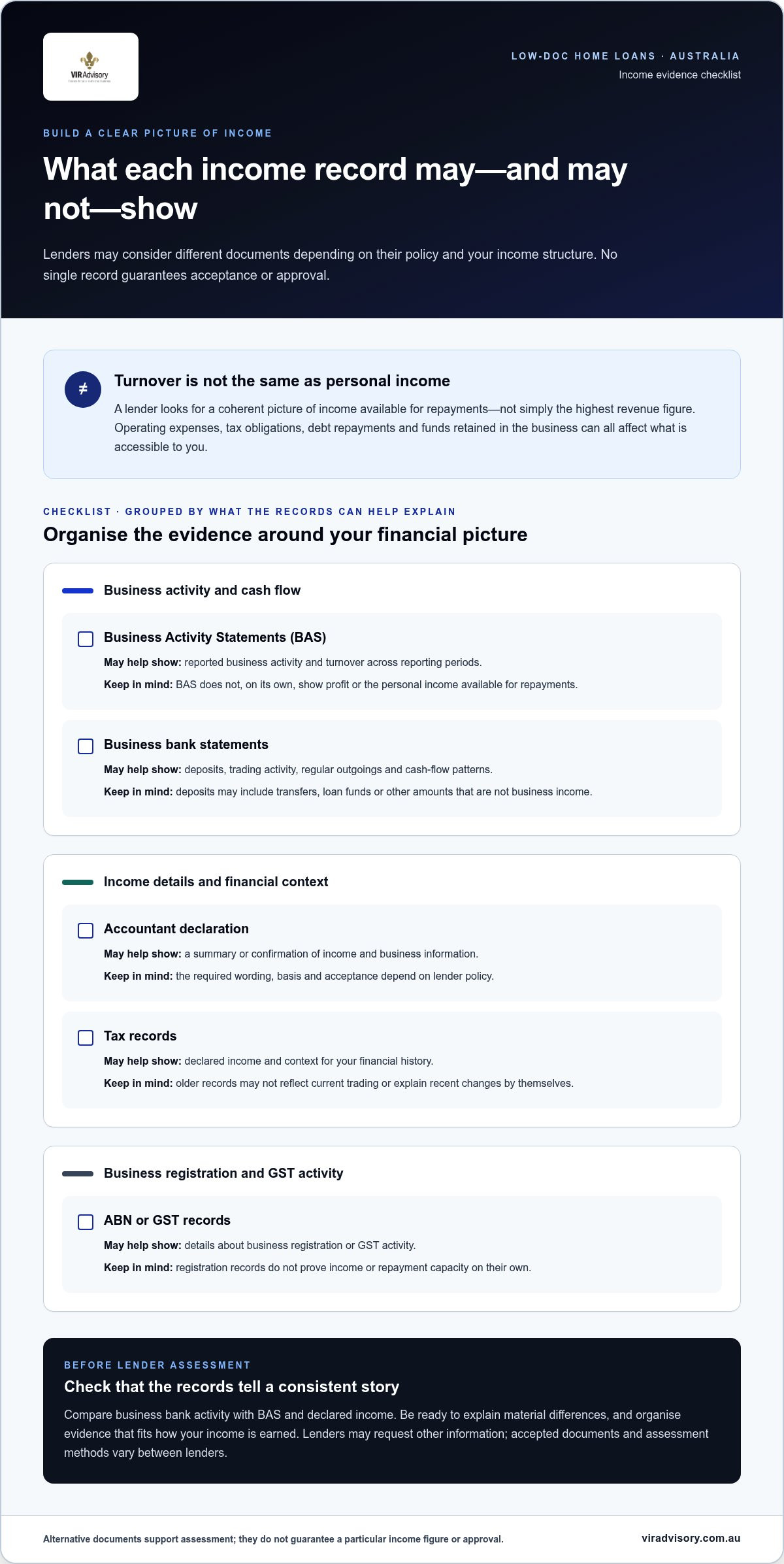
There isn’t one document set for every low doc home loan Australia application. Depending on the lender’s policy and your income structure, evidence may include Business Activity Statements (BAS), business bank statements, an accountant’s declaration and available tax records. These are examples, not a guaranteed or exhaustive checklist. A lender may also request other information to understand your business activity, personal income and financial commitments.
The aim is to build a coherent picture, not simply submit the highest revenue figure. Business turnover is not the same as personal income available for mortgage repayments. Operating expenses, tax obligations, debt repayments and funds retained in the business can all affect what is accessible to you.
Alternative evidence lenders may consider
Each document can explain a different part of your financial position. Acceptance, format and assessment periods vary between lenders, so organise records that support your circumstances rather than assuming one item will be sufficient.
| Evidence | Potential use | Limitations |
|---|---|---|
| BAS | May indicate reported business activity and turnover across reporting periods. | Doesn’t, on its own, show profit or the personal income available for repayments. |
| Business bank statements | Can show deposits, trading activity, regular outgoings and cash-flow patterns. | Deposits may include transfers, loan funds or other amounts that aren’t business income. |
| Accountant declaration | May provide a summary or confirmation of income and business information. | The required wording, basis and acceptance depend on lender policy. |
| Tax records | May help evidence declared income and provide context to financial history. | Older records may not reflect current trading or explain recent changes by themselves. |
| ABN or GST records | May support details about business registration or GST activity. | Registration records don’t prove income or repayment capacity on their own. |
Match evidence to the way you earn
For a business owner, compare bank activity with BAS and declared income, then be ready to explain material differences. For instance, a large deposit could be a customer payment, a transfer between accounts or borrowed funds. The statement alone may not show which. Business expenses and tax obligations matter too, because gross receipts aren’t equivalent to personal earnings.
If your income varies, records covering the periods relevant to the lender’s assessment may help show whether deposits are recurring, seasonal or one-off. Keep statements complete and make unusual transactions easy to identify. A strong recent month needs context if the broader record shows a different pattern.
Company directors should separate company finances from personal finances. Salary, dividends or other income may be treated differently, and company cash isn’t automatically personal income. List personal and business debts and regular commitments clearly, taking care not to count the same liability twice.
For easier review, name files by document type and period, then keep related records together. A brief note beside an unusual entry can identify its source, such as a transfer between accounts, without changing the original record. This makes it easier to respond if a lender asks for clarification.
Are low doc home loans easier to get, cheaper or riskier?
Not automatically. A low doc application may let a lender consider different income evidence, but it doesn’t remove the need to assess affordability or whether you meet the lender’s criteria. Alternative evidence may be more flexible for someone whose income isn’t well represented by standard documents. Eligibility, deposit, loan-to-value ratio (LVR) and pricing can still involve trade-offs.
What low-doc lending changes, and what it does not
The main change is how income may be evidenced. A lender still needs to assess repayment capacity and may consider income consistency, credit history, liabilities, loan purpose and your wider financial position. Different lenders can apply different policies, so the same evidence or circumstances may not produce the same assessment everywhere. “Low doc” shouldn’t be read as “easier approval”.
For example, strong business turnover doesn’t necessarily mean a director has the same amount available personally for mortgage repayments. Business expenses, existing debts and income variability remain relevant to the overall assessment.
Potential benefits and trade-offs to weigh
Alternative evidence can help where conventional records don’t clearly reflect current income. The trade-off is that fewer lenders may suit a particular application, and lender policies can differ on acceptable evidence, deposit, LVR and pricing. A low-doc option may cost more than a comparable standard loan, but that isn’t a universal rule. Compare the full loan structure and conditions rather than relying on a single headline feature.
| Area | Potential benefit | Risk or question to investigate |
|---|---|---|
| Income evidence | Alternative records may better explain self-employed or variable income. | Which records will the lender use, and how will it assess income consistency? |
| Eligibility | A lender’s policy may accommodate an income profile that doesn’t fit standard documentation. | What other criteria apply, including credit history, liabilities and loan purpose? |
| Deposit and LVR | A suitable structure may help align the loan with the available deposit and property value. | Could the required deposit or maximum LVR differ from a standard loan? |
| Pricing and features | A broader assessment can help compare options against the borrower’s needs. | How do the rate, fees, features and conditions compare over the expected loan term? |
| Application process | The evidence can be organised around the borrower’s income source. | Will additional documents or explanations be needed to resolve gaps or inconsistencies? |
For a low doc home loan Australia application, weigh the potential benefit against the total borrowing cost and conditions. Consider whether the repayment structure suits your cash flow, how the lender treats existing commitments and whether the proposed loan purpose fits its policy. Avoid choosing an option solely because it accepts alternative evidence or appears to offer a simpler application. A useful comparison looks at eligibility, repayments, deposit, LVR and loan features together.
How to prepare a low doc home loan application: a practical checklist
Preparation makes your financial position easier for a lender to assess. For a low doc home loan Australia application, organise your evidence, commitments and loan details into a consistent picture before submission. Don’t change or edit original records to make figures appear aligned. If something doesn’t match, keep the source documents intact and prepare a clear explanation.
A step-by-step application readiness check
- Gather income and business records. Collect relevant tax records, BAS, business and personal bank statements, ABN or GST details, and any accountant information available. Keep complete documents for the periods being considered rather than selecting only the pages or months that appear strongest.
- Reconcile income figures. Compare income shown across records and note differences, such as timing, one-off receipts, transfers between accounts or changes in trading. Record what each amount represents and retain the supporting source. Don’t label turnover as personal income unless it accurately reflects what is available to you.
- List commitments and expenses. Include personal and business debts, repayment amounts, credit facilities and regular expenses. Separate business obligations from personal commitments, but disclose both where requested. Check that balances and repayments are current and consistent across your application information.
- Define the loan request. Set out whether the property is for owner-occupation or investment, the amount sought and the loan structure you’re considering. Note your available deposit or equity and how it will contribute to the purchase or refinance.
- Review borrowing capacity before applying. Consider whether the proposed repayments remain manageable alongside existing obligations and normal business cash-flow demands. A lender’s assessment may differ from your own estimate, so identify uncertainties and explain unusual transactions before submission.
Application readiness snapshot
- Evidence: income records gathered, figures compared and differences explained.
- Liabilities: personal and business debts, limits and regular expenses listed.
- Loan details: property purpose, requested structure and deposit or equity clarified.
- Consistency: application details match source records, with no unexplained gaps.
Common application obstacles and how to reduce them
Unexplained differences between bank deposits, BAS and declared income can prompt follow-up questions because the lender needs to understand what the figures represent. Incomplete statement periods or missing pages can also leave gaps in the assessment. Check documents for completeness and prepare factual explanations for variations before lodging, rather than waiting for questions.
Avoid mixing personal and business cash flow, overstating income or leaving out debts. These mistakes can create inconsistencies and affect how the application is assessed. Before taking on new debt, increasing credit limits or changing financial arrangements, consider how this may affect your commitments and borrowing capacity. Provide accurate, consistent information throughout. If a figure is uncertain, resolve it against the original record instead of estimating.
Before lodging, review the application and supporting records side by side. Confirm that the loan amount, property purpose, income details and disclosed commitments are consistent, and keep a copy of what you submit. If a material change occurs after submission, such as a new liability or a change in business income, disclose it promptly so the assessment is based on current information.
How VIR Advisory can help assess a low doc home loan application
VIR Advisory is a national mortgage and finance brokerage, not a lender. For a low doc home loan Australia application, a broker can help organise your financial position, identify relevant evidence and assess how it may fit different lender policies. This is an assessment of potential fit, not a guarantee of approval or particular terms.
What a tailored brokerage review can cover
A review starts with how you earn and what your available records show. The focus is on understanding the relationship between business activity, personal income and funds available for repayments. Where figures differ across records, the review can identify what needs clarification and help you prepare a clear explanation without changing source documents.
The assessment can also consider existing liabilities, regular expenses, available deposit or equity, borrowing capacity and the proposed loan structure. For example, a company director may need to distinguish personal income from company turnover while accounting for business commitments that affect cash flow. The property purpose and amount requested matter too, as lender criteria may vary according to the application and proposed use.
Raina Doshi brings more than 15 years of banking and finance experience, including over a decade with one of Australia’s leading banks. That experience informs a methodical review of the information lenders may assess, while recognising that each lender sets its own requirements. Evidence accepted by one lender may not be assessed in the same way by another, and the outcome depends on the full application.
A broker’s role is to help present your circumstances clearly and assess policy fit, not to replace the lender’s assessment. A review can flag missing information, inconsistencies or commitments that may affect borrowing capacity before an application is progressed. It can also help distinguish a document gap from a broader affordability concern, so the next steps are based on the actual lending position rather than assumptions.
Discuss your circumstances with VIR Advisory
Before an initial conversation, prepare a brief outline of your business or income structure, available records, existing debts and property purpose. You don’t need to have every detail resolved. A discussion can clarify which information is relevant to your circumstances and what practical steps may follow, including whether further evidence or a closer borrowing-capacity review is needed.
Every application is assessed on its own merits, and lender policy can change. The aim is to establish a clear, realistic view of the requirements and options that may apply. View the appointment page to discuss your circumstances with VIR Advisory.
Set your next lending decision on clear information
Before choosing a loan structure, identify the decision you need to make next: whether your current evidence supports an initial assessment, whether a gap needs explaining, or whether the proposed repayments fit your broader cash-flow commitments. This keeps discussions focused on factors that can affect borrowing capacity, rather than the product label alone.
A low doc home loan Australia application is assessed against individual lender requirements, so examine your circumstances as a whole. Bring a clear outline of your income sources, existing commitments, available deposit or equity and intended property use. This gives the assessment practical context and helps clarify what information may be needed to consider potential options.
You don’t need every question resolved before seeking a conversation. A measured review can help identify what to clarify and support an informed decision about how to proceed.
Frequently Asked Questions
What is a low doc home loan in Australia?
It’s a home-loan application assessed using income evidence that may differ from standard payslips or recent tax returns. For a low doc home loan Australia application, treat “low doc” as a broad label, not a complete description of a lender’s criteria. Clarify which income period is assessed, how fluctuating earnings are treated and whether differences between records need explanation.
Can self-employed people get a low doc home loan?
Yes, self-employed borrowers may be considered, subject to the lender’s criteria and the full application. If you have income from more than one source, such as contracting alongside a business, set out each source separately and show how reliably it is received. For a joint application, consider how each applicant’s income and commitments contribute to the overall position. Business ownership by itself doesn’t establish eligibility.
What documents can I use for a low doc home loan?
Useful records depend on the lender’s current requirements and your income setup. Clarify the requested date range, file format and whether documents must cover complete reporting periods. If a record contains transfers or one-off credits, note their nature so they aren’t mistaken for recurring earnings. Keep original documents available, as a lender may seek clarification or further information during assessment.
Are low doc home loans harder to get approved for?
There’s no single answer for every borrower. The lender’s criteria and the strength of the complete application matter. To reduce avoidable delays, check that the requested loan amount and purpose are consistent across your application, and that unusual deposits or income changes can be explained. If the lender raises a question, respond with the relevant source record and a concise factual explanation rather than an estimate.
Do low doc home loans have higher interest rates?
Some may have different pricing, but the rate depends on the lender, product and application. Compare options using the same proposed loan amount, term and repayment type, then consider applicable fees and features alongside the rate. This makes the comparison more useful than relying on an advertised starting figure. Use current lender information, as product pricing can change and examples may not reflect your circumstances.
Is a low doc home loan the same as a no doc loan?
No. The terms aren’t interchangeable, although providers may use low-doc and alt-doc labels differently. Treat claims such as “minimal paperwork” as a prompt to read the product’s actual eligibility and evidence requirements, not as confirmation that income information won’t be requested. Establish what the lender expects you to provide and how it will assess the application, rather than relying on the product name alone.
To discuss your income evidence, existing commitments and home loan requirements, book a conversation with VIR Advisory.

Article by
Raina Doshi
Raina Doshi has worked in banking and finance since 2011, including experience with major Australian lenders. She helps homeowners, property investors, business owners and professionals secure and structure lending solutions across home loans, refinancing, commercial finance and business lending.
Areas of expertise include residential lending, investment property finance, debt recycling, commercial property finance, equipment finance, construction finance and strategic debt structuring.
Drawing on extensive banking and finance experience, Raina helps clients navigate lender requirements, improve borrowing outcomes and structure effective finance solutions.
Disclaimer
The information in this article is general in nature and does not take into account your personal objectives, financial situation or needs. Before acting on any information, consider whether it is appropriate to your circumstances and seek professional advice.


