

What if your teaching role matters less to a lender than the evidence behind your income? A search for “Home loan for teachers Australia” often starts with questions about whether permanent, contract or casual work will count. Lenders assess these income types differently, so working as a teacher alone doesn’t guarantee approval or a particular loan feature.
It’s understandable to be unsure how payslips, contracts, variable income, existing debts and your deposit will affect your borrowing capacity. This guide explains what evidence lenders may request, how their assessment policies can differ and which home loan features may suit your circumstances. It also covers common issues to check before applying, including how debts and purchase costs affect your budget.
You’ll learn how to compare loan structures, rates, features and risks, and why some teachers may be eligible for a lender-specific Lenders Mortgage Insurance waiver, subject to that lender’s criteria. A practical checklist will help you organise documents and prepare useful questions for a broker or lender.
Key Takeaways
- A Home loan for teachers Australia is generally a standard residential home loan. Your occupation alone doesn’t guarantee a discount, special product or approval.
- Check how each lender assesses your employment type, income continuity and supporting evidence before deciding where to apply.
- Compare rates alongside fees, repayment flexibility and eligibility conditions. A lower advertised rate may not mean a lower overall cost.
- Review debts and expenses, organise income and deposit evidence, and assess repayments against your budget before applying.
- Before using a broker, ask which lenders they can compare, how fees and commission are disclosed, and what support they provide after submitting your application.
Home loans for teachers in Australia: what options are actually available?
Teachers generally apply for standard residential home loans, and lender criteria determine which options may suit their circumstances. A “teacher home loan” is a home loan taken out by someone working as a teacher, not a separate loan type in itself. The occupation alone doesn’t guarantee a discount, special product or approval. If you’re searching for a Home loan for teachers Australia, start by checking how a lender assesses your income, deposit, debts and intended property use.
Whether you’re buying a home to live in or a property to rent out affects the purpose of the application. Be clear about your plans when comparing loans, as owner-occupied and investment lending may be assessed differently. The broader context of homeownership in Australia may help frame the decision, but suitable loan terms depend on your finances and the lender’s criteria.
This video discusses questions borrowers can raise when reviewing a home loan deal:
Do Australian lenders offer special home loans for teachers?
Some lenders may have occupation-based offers or policies, including potential Lenders Mortgage Insurance (LMI) waivers for eligible teachers. These are lender-specific, not automatic entitlements. Before relying on an offer, confirm its eligibility rules, pricing, property requirements and required documents directly with the lender or through a broker. Check the current criteria: a headline offer doesn’t mean every teacher, employment type or property will qualify.
Which home loan purpose and structure should teachers compare?
For an owner-occupied loan, compare options intended for a home you’ll live in. If the property will be rented out, disclose that intended use and compare loans assessed for investment purposes. Don’t choose a loan purpose based only on an advertised rate.
Variable rates can offer flexibility, but repayments may rise if the rate changes. Fixed rates can provide repayment certainty for the fixed period, but may restrict flexibility and involve costs or conditions if you change the loan. Compare the actual terms, fees and repayment features rather than assuming one structure suits every borrower.
How lenders may assess teacher income and employment evidence
There’s no single income rule for teachers across Australian lenders. Each lender sets its own assessment policy, so a Home loan for teachers Australia application may be assessed differently depending on employment type, income pattern, existing commitments and the evidence supplied. A lender may consider more than your salary figure, so check its current requirements before applying.
Lenders assess applications using verified income, financial commitments and their own policies. Confirm how a lender treats your specific mix of salary, allowances or additional work instead of assuming another teacher’s experience will apply to you.
Permanent, fixed-term and casual teaching work
Permanent employment may be supported by recent payslips and confirmation of your role. A fixed-term or casual arrangement may require clearer evidence of income history and continuity. The lender may ask for contract dates or details of successive engagements. Requirements vary, so don’t assume a particular length of employment or income history will meet every lender’s criteria.
For example, if you’re moving from one fixed-term contract to another, you could provide your current contract and relevant employment details to help explain continuity. If you also earn income from relief teaching, additional duties or allowances, ask how the lender will assess each component. Variable income may be treated differently from regular salary, and acceptance depends on the lender’s policy.
Documents teachers may need to prepare
Ask the selected lender or broker for its document list before submitting an application. Depending on your employment arrangement and the lender’s requirements, it may request:
- Recent payslips and employment details, such as your role and start date.
- A current contract, including relevant end dates, if you’re employed on a fixed-term basis.
- Further evidence to support casual, relief or variable income, if requested.
- Bank statements and details of existing debts, where the lender asks for them.
Keep the information consistent across your forms and supporting documents. If your income varies between pay periods, be ready to explain the pattern and provide any evidence the lender requests. Disclose your financial commitments, as they may affect the assessment. For more on the factors lenders may consider, read this borrowing capacity guide.
Compare teacher home loan features by cost, flexibility and risk
A useful comparison looks beyond the advertised rate. If you’re searching for a Home loan for teachers Australia, compare the total costs, repayment options and eligibility conditions that apply to your circumstances. A lower rate may come with fees or fewer features, while a more flexible loan may cost more or have conditions that affect how useful its features are.
| Feature | What to compare | Potential benefit and risk |
|---|---|---|
| Rate type | Fixed, variable or a combination, and the period or loan portions each covers. | Fixed repayments can assist budgeting, but may limit changes. Variable rates can move up or down, changing repayments. |
| Fees | Applicable application, ongoing, package or transaction fees, plus any costs for changing or repaying the loan. | A low advertised rate may not mean the lowest overall cost once fees are included. |
| Repayment flexibility | Whether extra repayments, redraw or an offset account are available, and the conditions and charges that apply. | Flexibility may help manage surplus cash, but access rules, account fees or other conditions may reduce its value. |
| Eligibility | Income assessment, deposit or equity requirements, property criteria and any conditions attached to a specific offer. | A feature or offer may be useful only if you meet the lender’s current criteria. |
Fixed or variable: which trade-offs should teachers weigh?
A fixed rate can make repayments more predictable during the fixed period, which may help with budgeting. The trade-off is that the loan may restrict repayment changes or other actions. Costs can also apply if you alter or repay it early. Check the product terms before fixing.
A variable rate can change under the lender’s terms, so repayments may rise or fall. It may offer different repayment options, but don’t assume every variable loan includes the features you need. Compare repayment limits, break costs, fees and conditions across the actual loan offers.
Deposit, equity and lender’s mortgage insurance
Your deposit, or available equity if refinancing, affects how much you need to borrow and may influence which options a lender considers. A smaller deposit can mean a higher loan-to-value ratio and may involve Lenders Mortgage Insurance (LMI), depending on the lender and your circumstances. LMI is a potential cost, not a guarantee of approval. Ask whether a waiver applies, what eligibility rules come with it and how it affects the overall cost.
Before deciding, compare the written loan terms and costs with your cash-flow needs. Confirm any uncertain feature or eligibility condition with the lender.
Prepare a stronger teacher home loan application with this checklist
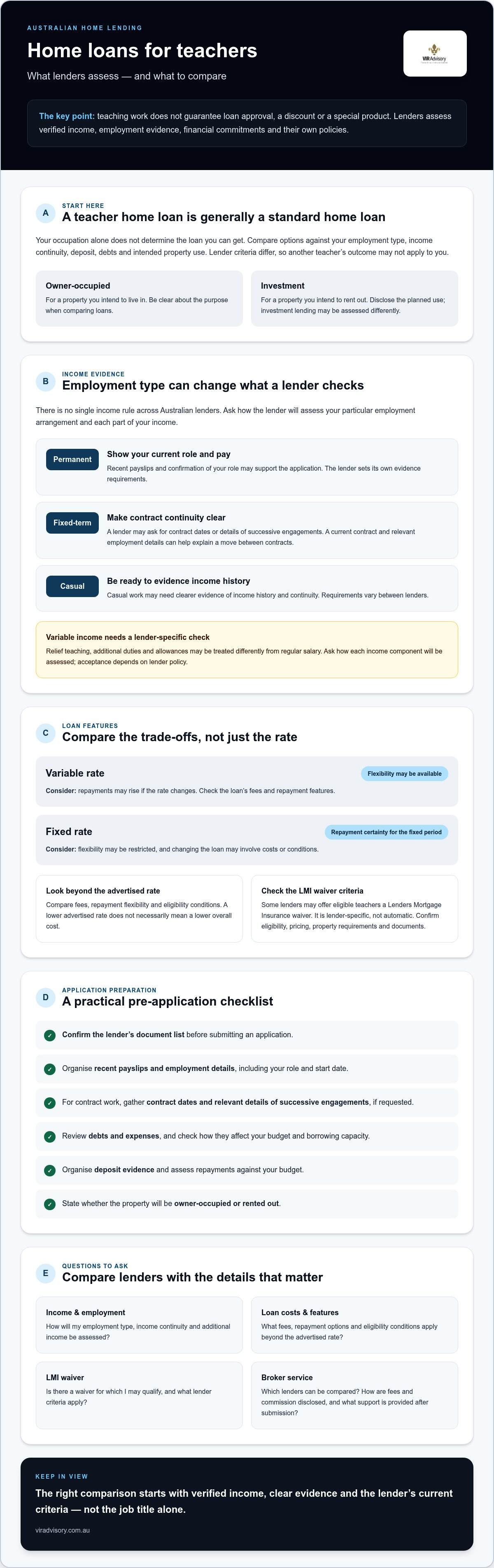
A well-prepared application gives the lender clearer information to assess against its own criteria, but it can’t guarantee approval or a particular borrowing amount. Use this five-step framework to check your finances, organise evidence and compare options before applying for a Home loan for teachers Australia.
- Review your finances. List existing debts, credit card limits and regular household expenses. Set out your deposit or available equity, and consider whether repayments would remain manageable if costs rise or your circumstances change.
- Check your evidence. Match income records against recent payslips and employment details. If you’re on a fixed-term contract, make sure the contract dates and role information are clear. Ask the lender what additional documents it needs for variable income.
- Compare lender policies. Confirm how each lender assesses your employment arrangement, income components, commitments and deposit or equity. Don’t assume one lender’s requirements apply elsewhere.
- Assess the loan features. Compare written terms, fees, repayment options and conditions against your cash-flow needs. Consider how repayments could fit your budget under different rate or income circumstances.
- Submit consistently. Provide complete information and check that application details match your supporting records. Before lodging several applications, understand the lender and credit-reporting implications.
Complete, consistent documents help lenders assess an application against their own criteria.
Before applying: documents and cash-flow checks
Check that your income records align with payslips, contracts and any statements the lender requests. A realistic budget should include regular household commitments, existing debt repayments and room for changing loan repayments. If you’re using savings for a deposit, check how the lender wants you to evidence the funds. If refinancing, confirm what equity information or supporting documents will be needed.
Check your credit-file details with the relevant credit reporting provider before applying. If you spot information you don’t recognise, follow the provider’s process to query it rather than assuming the file will be corrected automatically.
During assessment: avoid delays and unexpected changes
Incomplete documents or income records that don’t reconcile can lead to follow-up questions. Respond promptly to lender requests and check that each file is complete and legible. If your employment changes or you’re considering taking on new debt during assessment, tell the lender and ask how it may affect the application before acting. Assess the lender’s written terms, not just headline claims.
Use this checklist to prepare your application, then confirm the selected lender’s current evidence requirements before submission.
Compare lenders with a broker and decide on your next step
A mortgage broker can compare lender policies relevant to your employment type, explain differences in loan features and help organise application documents. This can be useful if your income includes contract, casual or relief work, as lenders may assess those arrangements differently. A broker’s comparison is limited to the lenders they can access, and neither a broker nor a lender can promise approval.
For a Home loan for teachers Australia application, ask how the lender would assess your income evidence and what else could affect the application, including existing commitments, deposit or equity and the property. Request relevant criteria and costs in writing where possible, then compare them with your budget. Don’t rely on a general claim that teachers receive favourable terms.
Questions to ask before choosing a lender or broker
Use these questions to understand the comparison and support being offered:
- Which lenders are included? Ask which lenders the broker can access and which will be considered for your employment type and income pattern.
- How are fees and commission disclosed? Ask whether you may pay any fees, how the broker is remunerated, and where the relevant disclosures are set out.
- What are the limits of the comparison? Find out whether recommendations cover the full lender panel available to the broker or a narrower selection, and why those options were chosen.
- What application support is included? Clarify who will coordinate documents, respond to lender requests and keep you informed during assessment.
Read the written disclosures and ask for clarification if a fee, commission arrangement or comparison limit isn’t clear. You can also review information about Raina Doshi and her professional background.
A practical next step for teachers comparing home loans
For an initial discussion, have recent payslips, employment details and contract evidence ready where applicable. Bring a summary of existing debts and regular expenses, along with details of your deposit or available equity and the property purpose you’re considering. Note any questions about how the lender treats allowances, additional duties or relief work. The exact documents required will depend on the lender and your circumstances.
VIR Advisory arranges residential home loans as a mortgage and finance brokerage, acting as an intermediary rather than a direct lender. Led by Raina Doshi, the firm offers personalised finance guidance across Australia. Raina has over 15 years of banking and finance experience, including more than a decade with one of Australia’s leading banks. A discussion can help clarify lender options and possible next steps, without guaranteeing an outcome.
Book a 30-minute finance discussion with VIR Advisory to talk through your circumstances and questions.
Prepare your next home loan decision
A teacher’s occupation doesn’t automatically secure a discount, a special loan or approval. For a Home loan for teachers Australia application, lender policy, verified income, employment evidence and existing commitments all matter. Organising documents and confirming how the lender assesses your income can make your application clearer. Comparing fees, repayment features and conditions helps you assess the cost and flexibility of each option.
Before applying, review your debts, regular expenses and available deposit or equity, then check that repayments fit your budget. Ask lenders or a broker to explain their criteria and any limits on the options being compared. No comparison can guarantee approval, but clear information can help you make a more informed decision.
VIR Advisory arranges residential home loans and refinancing across Australia. Raina Doshi has over 15 years of banking and finance experience. A discussion can help clarify which questions to raise about your circumstances and possible next steps.
With your documents and questions prepared, you can approach lender discussions with greater clarity and confidence.
Frequently Asked Questions
Do teachers get special home loan rates in Australia?
Not automatically. A Home loan for teachers Australia search may reveal lender offers or policies for eligible teachers, but that doesn’t mean every teacher receives a lower rate or qualifies. Some lenders may offer an Lenders Mortgage Insurance waiver, subject to their criteria, but that isn’t the same as a discounted interest rate. Confirm current eligibility, pricing, property conditions and application requirements directly with the lender or through a broker.
Can casual teachers get a home loan in Australia?
Casual teachers can apply, but whether their income is accepted and how it’s assessed depends on the lender. The lender may look for evidence of income consistency, employment history and existing financial commitments. Recent payslips and records of relief teaching may help support an application, but requirements vary. Ask the lender what evidence it needs and how it treats variable income before submitting an application.
How do lenders assess fixed-term teacher contracts?
Lenders set their own criteria. They may review your current contract, role, income and contract dates, as well as evidence of employment continuity or previous contracts. The remaining contract term may be relevant to the lender’s assessment, but there’s no single rule across all lenders. Ask how the lender will assess your employment history and whether it needs additional documents to verify income continuity.
Can a teacher apply for a home loan while on a temporary contract?
Yes, a teacher on a temporary contract can apply, although an application doesn’t guarantee approval. The lender may consider the contract dates, your work history, income evidence and other commitments. If you’ve moved between contracts or schools, prepare clear records that explain your employment timeline. Before applying, check whether the lender accepts your employment arrangement and what documents it needs to assess your income.
What documents might a teacher need for a home loan application?
Depending on the lender and your employment type, you may be asked for recent payslips, employment details and a current contract or other contract evidence. Casual teachers may need further records to support variable income. Lenders may also request bank statements and details of existing debts. Confirm the lender’s current checklist before applying, then ensure the dates and income figures are consistent across the documents you provide.
Does a larger deposit guarantee home loan approval for a teacher?
No. A larger deposit can reduce the amount borrowed relative to the property value and may affect whether Lenders Mortgage Insurance applies, depending on the lender and your circumstances. It doesn’t guarantee approval. The lender will also assess factors such as verified income, existing debts, expenses, credit information and the property. Check how the deposit is assessed and what other approval requirements apply before relying on it to strengthen an application.
Should teachers choose a fixed or variable home loan?
There isn’t one right choice for every teacher. A fixed rate can make repayments more predictable during the fixed period, but may limit flexibility and involve costs if you change or repay the loan early. A variable rate can change under the lender’s terms, so repayments may rise or fall. Compare fees, repayment options, break costs and product conditions against your budget before selecting a loan structure.

Article by
Raina Doshi
Raina Doshi has worked in banking and finance since 2011, including experience with major Australian lenders. She helps homeowners, property investors, business owners and professionals secure and structure lending solutions across home loans, refinancing, commercial finance and business lending.
Areas of expertise include residential lending, investment property finance, debt recycling, commercial property finance, equipment finance, construction finance and strategic debt structuring.
Drawing on extensive banking and finance experience, Raina helps clients navigate lender requirements, improve borrowing outcomes and structure effective finance solutions.
Disclaimer
The information in this article is general in nature and does not take into account your personal objectives, financial situation or needs. Before acting on any information, consider whether it is appropriate to your circumstances and seek professional advice.


