

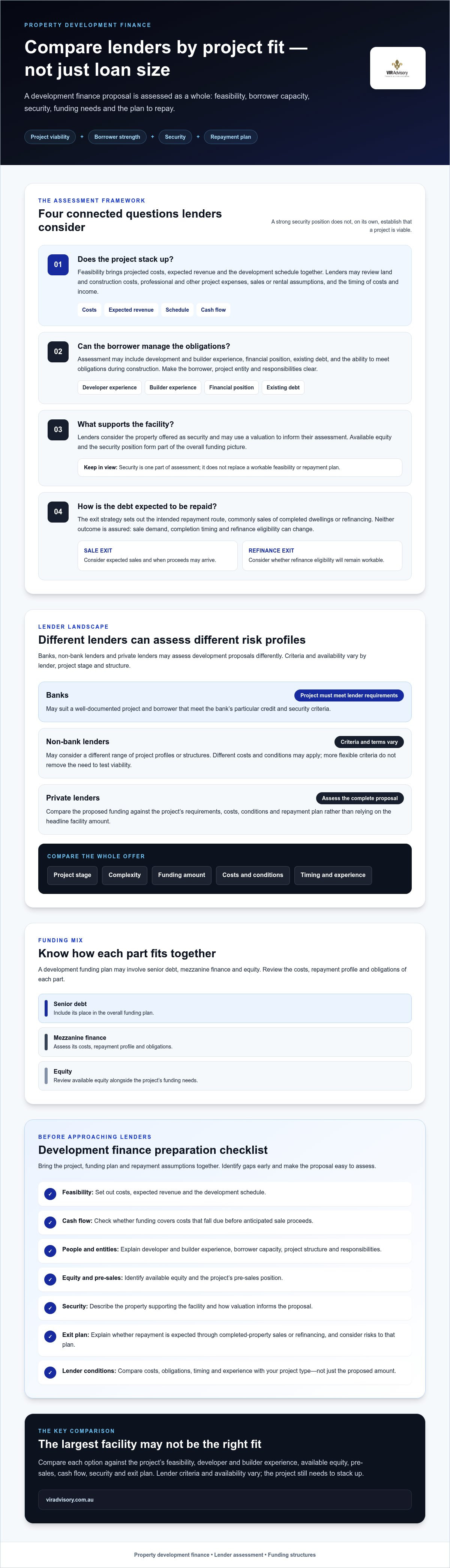
The lender offering the largest facility may not be the right fit for your project. Banks, non-bank lenders and private lenders assess property development finance applications differently, but approval still depends on whether the project stacks up. When comparing property development finance lenders, look at the feasibility, developer and builder experience, available equity, pre-sales, cash flow and exit plan.
It’s understandable to be unsure which criteria apply, particularly when a single-home construction loan is assessed differently from a multi-unit development facility. A bank may suit a well-documented project that meets its requirements, while a non-bank or private lender may consider a different risk profile, often with different costs and conditions. More flexible criteria don’t remove the need to test the project’s viability.
This article explains lender categories and funding structures, what lenders may require, and where applications can fall short. You’ll also learn how to review equity, pre-sales, construction funding and cash flow before approaching lenders, so you can compare options on more than the headline loan amount.
Key Takeaways
- Property development finance lenders assess project feasibility, borrower capacity, security and funding needs, not just the requested loan amount.
- Compare banks and non-bank lenders against your project’s stage, complexity and requirements. Criteria and availability vary.
- Understand how senior debt, mezzanine finance and equity fit together, and check the costs, repayment profile and obligations of each.
- Prepare a clear feasibility, funding plan and supporting project information before approaching lenders, and identify gaps early.
- Review lender conditions, timing and experience with your project type as well as the proposed funding amount.
What property development finance lenders assess before considering a project
Property development finance lenders assess four connected areas: project feasibility, borrower capacity, security and funding requirements. They want to understand whether the development can be completed within the proposed budget and timeframe, whether the borrower can meet obligations, what assets support the facility and how the debt is expected to be repaid.
Development finance generally funds a project’s costs as property is built or redeveloped. It differs from a standard commercial property loan, which typically finances the purchase or refinance of an existing income-producing or business-use property. Because development involves construction and delivery risk, lenders may examine the project plan, costings and completion arrangements in more detail. For a high-level overview of the stages involved, see Real estate development.
This video provides an overview of the development process:
Development finance assessment at a glance
- Project viability: Do the costs, expected revenue and timing make sense together?
- Borrower strength: Can the borrower and project entity meet obligations and manage risks?
- Security: What property supports the loan, and how does its valuation inform the assessment?
- Exit strategy: Is repayment expected from completed-property sales or a refinance?
How lenders assess project feasibility and borrower capacity
A feasibility assessment brings projected costs, expected revenue and the development schedule together. Lenders may review land and construction costs, professional and other project expenses, sales or rental assumptions, and the timing of costs and income. For example, if construction payments fall due before anticipated sale proceeds, the funding plan needs to cover that cash-flow gap. Cost overruns or delays can also affect whether the original repayment plan remains workable.
Borrower capacity is assessed alongside the project. Lenders may consider development experience, financial position, existing debt and the ability to meet obligations during construction. They may assess the borrower, the applying entity and the project as a whole, so make the entity structure and responsibilities clear. Criteria vary by lender, project stage and structure. There is no single threshold that applies to every proposal.
What security and exit strategy mean in development lending
Property offered as security gives the lender recourse if the loan is not repaid. The lender’s valuation and view of the asset can influence its assessment, but security alone doesn’t establish that a project is viable. The exit strategy explains how the facility is intended to be repaid, commonly through selling completed dwellings or refinancing. Neither option is assured: sale demand, completion timing and refinance eligibility can change. For a related overview of commercial property finance services, compare how funding needs differ between a completed asset and an active development.
Which property development finance lenders and funding structures may fit?
The right funding mix depends on the project’s stage, risk profile, borrower capacity and repayment plan. Banks, non-bank lenders and other capital providers can assess these factors differently. Compare the complete proposal rather than assuming one lender category will suit every development.
Bank and non-bank property development finance lenders
Banks may suit projects and borrowers that meet their particular credit and security criteria. Non-bank lenders may consider a different range of project profiles or structures, but non-bank finance isn’t automatically easier to obtain or a better fit. Availability and assessment criteria vary. A lender’s appetite may depend on the project stage, borrower profile and proposed funding structure.
Compare written proposals side by side. Check conditions, fees, repayment arrangements, security obligations and the expected timing of approvals and drawdowns. A facility that appears flexible may still have conditions that affect cash flow or the project schedule. For eligible social and affordable housing projects, Housing Australia is a government funding source to investigate, subject to its specific programme requirements.
| Lender or funding type | Possible fit | Evidence to prepare | Questions to verify |
|---|---|---|---|
| Bank | A project that aligns with the bank’s criteria and risk appetite | Feasibility, financial position, project and security information | What conditions, timing and repayment terms apply? |
| Non-bank lender | A project requiring a different lender appetite or structure | Project details, borrower capacity, costings and exit plan | How do fees, conditions, security and drawdowns compare? |
| Mezzanine provider | A possible additional layer where senior debt and equity don’t meet the funding need | Full capital stack, repayment source and security details | What priority, repayment and security terms apply? |
| Equity investor | A project where an investor contributes capital under agreed terms | Ownership proposal, project feasibility and governance arrangements | How are control, returns and exit decisions handled? |
Senior debt, mezzanine finance and equity
These are distinct layers in a capital stack, and not every project can access each one. Senior debt is the primary loan and has priority for repayment under the agreed structure. Mezzanine finance may sit behind senior debt to add funding, but its lower repayment priority can mean greater risk for its provider and additional obligations for the borrower. Equity is capital contributed by the developer or an investor. It doesn’t operate as a standard loan, but may involve shared returns, ownership or decision-making rights.
Before selecting a structure, model how repayments and project proceeds would flow if costs rise, sales are delayed or refinancing isn’t available as expected. Confirm each provider’s terms in writing and assess the whole funding arrangement, not just the amount offered.
How to compare development finance lenders without overlooking project risk
Compare the whole facility, not just the proposed loan amount or headline rate. Review which costs the funding covers, when it can be drawn, how repayments are structured, which assets are required as security and what conditions must be met. The financing of residential development in Australia involves varied funding structures, so assess each offer against your project’s actual costs, schedule and repayment plan.
Also consider whether the lender has appetite for your project type and current stage. A lender familiar with similar developments may understand the funding requirements, but its criteria still need to fit your proposal. Flexible terms can help address a project’s specific needs, but they can also involve different costs, conditions or security obligations. Verify the details in the written offer rather than relying on general descriptions.
Questions to ask before choosing a lender
- Which project stages and costs can the facility fund, and are any costs excluded?
- What conditions must be met before approval, first drawdown and later progress payments?
- What valuation information, invoices or other evidence are required to access funds?
- What review milestones apply, and how could a variation, delay or cost overrun affect drawdowns, repayments or other obligations?
- How and when is repayment expected, and what happens if the planned sale or refinance is delayed?
Ask for responses in writing. This makes it easier to compare the operational details of offers from property development finance lenders, not just their initial indications.
Compare benefits and risks together
| Feature | Potential benefit | Risk or point to verify |
|---|---|---|
| Flexible structure | May accommodate particular project stages or cash-flow needs | Check conditions, costs, drawdown rules and security requirements |
| Staged drawdowns | Funding can be released in line with agreed project progress | Confirm the evidence required and how delays affect access to funds |
| Repayment terms | May align repayments with the planned project exit | Test the plan if sales or refinancing take longer than expected |
Common comparison mistakes to avoid
A lower headline rate may not mean a lower overall funding cost if fees, conditions or repayment arrangements differ. Compare the full facility terms and their effect on cash flow. Treat indicative terms as an initial assessment, not final approval or a guarantee that funds will be available.
Stress-test the feasibility rather than relying only on the expected outcome. Model a delay, higher costs or slower sales, then check whether the project can still meet its obligations. If the funding plan only works under the most optimistic assumptions, identify that gap before selecting a lender.
Development finance application checklist for Australian borrowers
A well-organised application helps property development finance lenders assess the project, borrower and proposed funding together. Prepare the material in a logical order, check that assumptions agree across documents, then confirm each lender’s current requirements before submitting. Document lists and approval criteria vary, so use this as a preparation framework rather than a universal lender checklist.
Application-readiness snapshot
- Evidence: Feasibility, cost plan, timeline, borrower finances, liabilities and proposed security.
- Approvals and delivery: Project approval status, construction arrangements and relevant supporting documents.
- Questions: Confirm lender requirements, pre-sale expectations, drawdown evidence and contingency arrangements.
Documents and project information lenders may request
Use this numbered process to organise the application:
- 1. Review the project: Prepare the feasibility, development costs, timeline, revenue assumptions and the basis for each estimate. Make sure the funding request aligns with the project cash flow.
- 2. Set out borrower capacity: Gather relevant personal or company financial information, details of existing liabilities and information about the proposed borrower or project entity.
- 3. Clarify equity and security: Explain the equity available and when it can be contributed. If refinancing or other lending forms part of the structure, show how it fits with the project funding. Identify proposed security and provide valuation material if available or requested.
- 4. Check delivery readiness: Assemble relevant approval information, construction contracts or cost details, and the proposed drawdown process. Ask what evidence the lender needs to verify progress and cost-to-complete.
- 5. Compare and apply: Match the project information to each lender’s stated criteria, confirm outstanding requirements, then submit a consistent application with assumptions clearly identified.
This list is indicative, not exhaustive. Confirm the exact documents, valuation approach and application requirements with each lender. Avoid sending inconsistent versions of the feasibility or cost plan, as unexplained differences can prompt further questions.
Pre-sales, approvals, construction and contingency planning
Pre-sale expectations and approval requirements can differ by lender and project. Ask what evidence is acceptable, whether any project approvals remain outstanding and how those items affect assessment or funding. Where construction finance is involved, clarify contract requirements, drawdown evidence and review milestones before relying on the proposed facility.
Test the plan against practical downside scenarios. If construction is delayed, costs increase or sales assumptions change, identify the effect on cash flow, available equity and the expected exit. Record how any funding shortfall would be managed, and confirm with the lender how variations could affect drawdowns or obligations.
When a finance broker can help compare property development finance lenders
A finance broker can help clarify what funding a development needs, identify potential lender fit and organise the information required for an application. This can be useful when a project has several funding stages, involves a company or other entity, or needs construction finance alongside other project funding. A broker can help compare options, but can’t guarantee a lender will offer terms or approve the application.
What to expect from a development finance brokerage discussion
An initial review should establish the project’s objectives, current stage, proposed structure, timing and funding requirements. For example, a project nearing construction may need a different facility structure from one still finalising costs or approvals. The discussion can also clarify how equity, existing debt, security and the intended exit fit into the proposed finance.
Before approaching lenders, a broker may check whether key information is available and consistent, such as the feasibility, cost assumptions, construction arrangements and cash-flow plan. This can surface gaps that may prompt lender questions or delay assessment. It also supports a more focused comparison of lender appetite, conditions and application requirements.
Ask what information will be needed, which lenders may be considered and how indicative feedback differs from a formal offer. Lender availability, terms, conditions and approval remain the lender’s decisions. A broker cannot ensure that a particular lender will assess the project or provide funding.
How VIR Advisory supports commercial property finance enquiries
VIR Advisory is a finance brokerage operating across Australia, not a direct lender. Led by Raina Doshi, who has over 15 years of banking and finance experience, the business provides tailored commercial property and construction finance brokerage based on the borrower’s circumstances and project requirements. Its role is to help clarify the funding need, consider lender fit and organise an application for assessment, not to make the lender’s decision.
Before a discussion, it can help to have a short project summary, current feasibility and cost plan, proposed funding structure, timing, available equity and any known information gaps. This gives the review a practical starting point. You can also review VIR Advisory’s commercial finance services to see the areas of finance support available.
To discuss your project’s finance requirements, book a conversation with VIR Advisory.
Prepare your project for a clearer lender comparison
Choosing between property development finance lenders means looking beyond the headline rate. Compare the full funding structure, conditions, drawdown timing, repayment profile and security obligations, then check how well the lender’s requirements match your project stage and risk profile.
A clear application brings the feasibility, borrower capacity, available equity, construction plan and exit strategy together. Test the figures against delays, cost increases or changed sales assumptions, and confirm each lender’s current document, pre-sale and approval requirements before applying.
VIR Advisory provides finance brokerage across Australia and doesn’t lend directly. Led by Raina Doshi, who has over 15 years of banking and finance experience, the brokerage can help clarify funding requirements, compare lender appetite and organise project information. Lender availability, terms and approval remain the lender’s decision.
A well-prepared comparison can make the next steps clearer and help you assess funding options with greater confidence.
Frequently Asked Questions
What do property development finance lenders assess?
Lenders assess project feasibility, borrower capacity, security and funding requirements. They may examine projected development costs, revenue assumptions, timing, the borrower’s financial position and experience, existing liabilities, proposed security and the intended repayment method. They can also consider the project entity and delivery arrangements. Requirements differ by lender and project, so prepare a consistent feasibility and funding plan, then confirm which documents and conditions apply to each application.
How much equity do I need for property development finance in Australia?
There’s no single equity requirement that applies to every Australian development. The amount depends on the lender’s criteria, project risk, security, borrower circumstances and proposed funding structure. Equity may come from funds contributed to the project or available assets, but its source and timing can matter. Ask each lender how it assesses equity, what contribution is expected and whether existing debt or refinancing affects the funding calculation.
Are non-bank property development finance lenders easier to qualify for?
Not necessarily. Non-bank lenders may assess different project types or borrower profiles, but each has its own eligibility criteria, risk appetite and conditions. Flexibility in one area doesn’t mean a lender will accept every project or offer a better overall fit. Compare written terms, including fees, security, drawdown conditions and repayments. Check that the lender’s experience and appetite align with your project stage and funding needs.
Do property development finance lenders require pre-sales?
Some lenders may require pre-sales, while others may assess a project without them. Expectations can vary with the lender, project type, risk profile and funding structure, so don’t assume one lender’s policy applies elsewhere. Ask how pre-sales are assessed, what evidence is required and whether contract terms or deposits must meet specific conditions. Include confirmed requirements in your funding plan and test cash flow if sales take longer than expected.
Can development finance cover both land acquisition and construction?
It may, depending on the lender, project and facility structure. Some funding proposals may include land acquisition as well as construction costs, while others may cover only particular stages or eligible expenses. Confirm what the facility can fund, how the land is treated as security, when funds may be drawn and what equity is required. If you already own the land or plan to refinance it, explain that clearly in the application.
How are construction funds released during a development project?
Construction funds are commonly released in stages under the facility’s agreed drawdown process, rather than paid as one unrestricted amount. The lender may require evidence such as progress information, invoices or updated cost-to-complete details before releasing a drawdown. Requirements differ, so confirm the evidence, review points and timing in writing. Align the expected funding schedule with construction payments, and clarify how variations, delays or cost increases could affect access to funds.
Can a finance broker help me compare property development finance lenders?
Yes. A finance broker can help clarify funding needs, compare potential lender appetite and organise project information for an application. They may identify gaps in the feasibility, borrower details or funding structure before approaching lenders. A broker doesn’t make the lending decision, and lender availability, terms and approval aren’t guaranteed. VIR Advisory operates as a finance brokerage across Australia, not a direct lender, and can assist with commercial property and construction finance enquiries. To discuss your project, book a development finance conversation with VIR Advisory.

Article by
Raina Doshi
Raina Doshi has worked in banking and finance since 2011, including experience with major Australian lenders. She helps homeowners, property investors, business owners and professionals secure and structure lending solutions across home loans, refinancing, commercial finance and business lending.
Areas of expertise include residential lending, investment property finance, debt recycling, commercial property finance, equipment finance, construction finance and strategic debt structuring.
Drawing on extensive banking and finance experience, Raina helps clients navigate lender requirements, improve borrowing outcomes and structure effective finance solutions.
Disclaimer
The information in this article is general in nature and does not take into account your personal objectives, financial situation or needs. Before acting on any information, consider whether it is appropriate to your circumstances and seek professional advice.


