

If your property portfolio is currently restricted by cross-collateralised assets or the 2026 debt-to-income (DTI) caps, simply chasing a lower interest rate won't solve your growth stagnation. With the RBA cash rate sitting at 4.35% and lenders applying a mandatory 3.0% serviceability buffer, mortgage refinancing for investors must be viewed as a tactical debt restructure rather than a simple administrative switch. Many sophisticated borrowers find their expansion plans halted by high interest rate premiums and rigid lender assessment criteria that fail to account for complex income structures or self-employed status.
We understand the pressure of managing cash flow when negative gearing benefits are increasingly restricted to new builds and DTI ratios limit your next move. This guide provides a technical framework to help you unlock equity, untangle risky loan structures, and improve your borrowing capacity under current Australian credit policies. You'll learn how to navigate the 20% high-DTI quota system and implement a cleaner debt strategy that facilitates future acquisitions. We will detail the specific lender requirements you must satisfy to reduce your monthly repayments and prepare your portfolio for the 2027 capital gains tax transitions.
Key Takeaways
- Learn how Australian lenders apply the 3.0% serviceability buffer and 2026 debt-to-income (DTI) caps to evaluate your current borrowing capacity.
- Discover how mortgage refinancing for investors can be used to untangle cross-collateralised loans and unlock equity for new property acquisitions.
- Evaluate the technical differences between interest-only and principal and interest structures to optimise your portfolio’s monthly cash flow and tax position.
- Identify the hidden costs of switching lenders, such as discharge and valuation fees, to ensure your debt restructure provides a genuine financial advantage.
- Understand how a professional finance strategy can help you navigate complex lender requirements for self-employed and high-net-worth investor applications.
Why Property Investors are Refinancing in the 2026 Lending Environment
Investment mortgage refinancing is the technical process of replacing an existing credit facility with a new one to achieve specific financial goals. Understanding what refinancing is helps you identify whether your current loan remains fit for purpose or if it has become a drag on your portfolio performance. In the current 2026 market, investors should refinance when their existing loan structure no longer supports their acquisition strategy or when serviceability can be improved with a different lender. This often occurs when a borrower reaches a plateau in their borrowing capacity or when the cost of debt exceeds the current market competitive rates.
The 2026 Australian economic climate presents a unique set of variables for professional borrowers. While the RBA cash rate held steady at 4.35% in June 2026, national median dwelling values reached $922,838 in February, representing a 9.9% year on year increase. This growth has created significant equity positions, particularly in high performing capital city markets where values rose by as much as 13.3% over the past year. Mortgage refinancing for investors is now a primary tool for cash flow management, equity access, and debt consolidation. By restructuring debt, investors can mitigate the impact of high interest rate premiums and the 3.0% APRA serviceability buffer that currently constrains many portfolios.
The Shift in Investor Interest Rate Premiums
Australian lenders typically apply a premium to investment loans compared to owner occupier rates, often ranging from 0.50% to 1.00%. However, 2026 lender competition has seen the lowest advertised variable rates drop to 5.69% p.a. for high quality applicants. Many long term investors remain on older products, effectively paying a "loyalty tax" because their lender has not passed on competitive pricing available to new customers. Reviewing your interest rate against the market average of 6.92% p.a. is a necessary step in maintaining portfolio health. VIR Advisory specialises in identifying these discrepancies and implementing refinancing solutions that align your interest costs with current market benchmarks.
Unlocking Equity for Portfolio Expansion
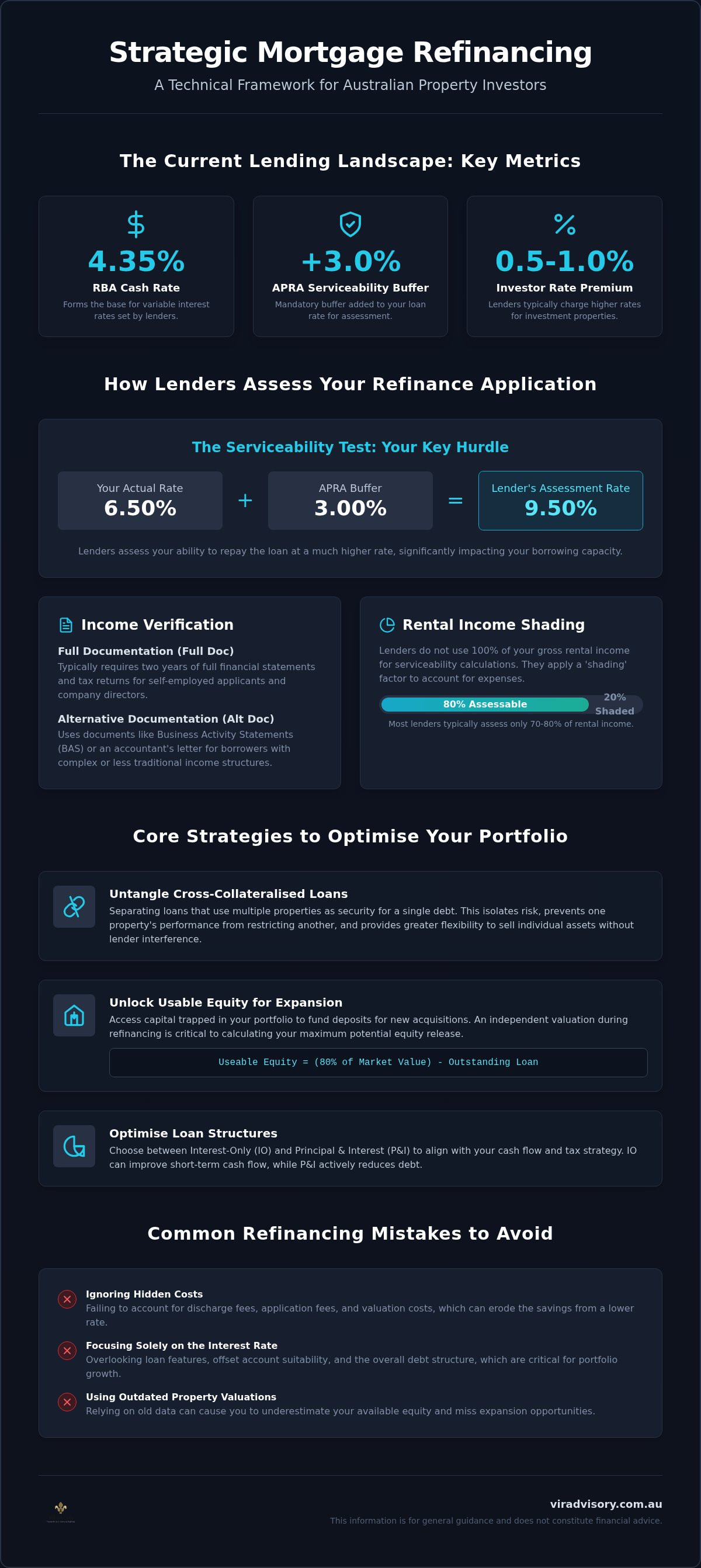
Useable equity is the difference between 80% of your property's current market value and your outstanding loan balance. Accessing this capital through a "top up" or "equity release" allows you to fund deposits for subsequent properties without depleting your cash reserves. Because property valuations have shifted significantly across different states, an independent valuation is essential during the refinance process. This ensures your borrowing capacity is calculated based on current market data rather than outdated purchase prices. Successful equity release provides the liquidity needed for further acquisitions, provided the new loan structure maintains a sustainable debt to income ratio.
How Australian Lenders Assess Investor Refinance Applications
Lenders have shifted their focus significantly in the 2026 credit environment. While your property's value provides the security, your serviceability determines the approval. Australian Authorised Deposit-taking Institutions (ADIs) currently apply a 3.0% serviceability buffer. This means if your actual interest rate is 6.50% p.a., the lender assesses your ability to repay at 9.50% p.a. This high assessment floor is often the primary reason mortgage refinancing for investors fails in the current market.
Self-employed investors and company directors face additional scrutiny regarding their income stability. Depending on your business structure, you may need to provide two years of full financial statements (Full Doc) or utilise alternative documentation (Alt Doc) such as accountant letters or Business Activity Statements (BAS). Successfully navigating these requirements is essential to optimise the equity you've built across your portfolio. Managing these technical details requires a precise approach to documentation that many generic retail banks overlook.
Net Rental Income and Shading Factors
Lenders do not treat rental income as a dollar-for-dollar offset against your mortgage. Most Australian banks apply a "shading" factor, typically counting only 70% to 80% of the gross rent. This reduction accounts for property management fees, maintenance, and vacancy periods. Some lenders may include negative gearing benefits in their calculators, which can bolster your serviceability if you have a high taxable income. To improve your prospects, provide a formal rental appraisal from a local agent rather than relying on historical lease agreements.
Debt-to-Income (DTI) and Serviceability Limits
DTI is the ratio of total liabilities to gross annual income used by lenders to measure risk. As of February 2026, APRA has mandated that ADIs limit new lending at high DTIs to 20% of their total loan book. Most lenders now enforce a hard cap at 6 or 7 times your gross annual income. If your total debt exceeds this threshold, you may need to look toward specialised lending solutions from non-bank lenders who aren't bound by the same APRA restrictions.
Reducing your DTI before applying for a refinance can involve closing unused credit card limits or consolidating high-interest personal debt. If you are unsure how your current liabilities affect your capacity for mortgage refinancing for investors, you can book a technical review to assess your position against current lender calculators. This methodical approach ensures you don't trigger unnecessary credit enquiries before your structure is ready for assessment.
Strategic Loan Structures: Interest-Only, Offsets, and Equity Release
Effective debt optimisation requires a clear distinction between non-deductible personal debt and deductible investment debt. Mixing these facilities often leads to tax inefficiencies that hinder your long term borrowing capacity. When executing mortgage refinancing for investors, the primary objective is to create a structure that protects the deductibility of interest while providing maximum flexibility for future acquisitions. This process involves moving away from basic loan products toward sophisticated facilities that allow for separate accounting of each asset's debt.
Choosing between Principal and Interest (P&I) and Interest-Only (IO) repayments is a technical decision based on your current cash flow requirements and tax position. While P&I loans eventually reduce the total debt, they also increase your monthly outgoings and reduce the amount of deductible interest over time. Conversely, IO structures preserve cash for other purposes, such as paying down a non-deductible home loan or building a deposit for a subsequent purchase. We help clients evaluate these options through detailed investment loan structuring to ensure the chosen path supports their specific growth targets.
Maximising Cash Flow with Interest-Only Terms
Interest-only terms are a staple for professional investors seeking to maintain liquidity. In the 2026 lending environment, most Australian banks restrict IO terms to five years, with total Loan-to-Value Ratio (LVR) limits typically capped at 80%. Extending these terms requires a fresh serviceability assessment under current 3.0% buffer rules. Borrowers must prepare for the eventual transition back to P&I repayments to avoid "repayment shock," where monthly obligations can increase by 30% or more. Proactive refinancing allows you to reset these terms with a new lender, maintaining your cash flow stability for another cycle.
Offset Accounts vs. Redraw for Investment Strategy
The choice between an offset account and a redraw facility has significant tax implications for property investors. An offset account on an investment loan reduces interest while keeping funds accessible, as the money sits in a separate linked transaction account. Because these funds are not technically considered a loan repayment, withdrawing them for personal use does not affect the deductibility of the underlying loan interest. This makes offsets an essential liquidity tool for managing future deposits or emergency buffers without compromising your tax position.
Redraw facilities carry a high risk of tax "contamination". If you pay extra funds into your investment loan and later redraw them for a non-investment purpose, the interest on that portion of the loan may no longer be tax deductible. This creates a messy "mixed purpose" loan that is difficult and costly for accountants to untangle. Maintaining a strict separation between deductible and non-deductible funds is a core component of a professional finance strategy. Using multiple offset accounts allows you to organise your capital efficiently while ensuring every dollar of interest remains working in your favour.
Common Refinancing Mistakes and How to Manage Lending Risk
Successful debt management requires a meticulous assessment of the total cost of switching lenders. While a lower headline interest rate is attractive, mortgage refinancing for investors often carries transactional friction that can erode initial savings. Typical costs range from $500 to $2,000; this includes discharge fees from your current lender, application fees, and property valuation costs. Rate chasing without calculating the break-even point is a frequent error. If the monthly interest saving is $100 but the upfront costs are $2,000, it takes 20 months just to recover your investment. During this period, market conditions or your personal circumstances might change, rendering the move counterproductive.
Risk management involves more than just finding a cheaper product. It requires maintaining adequate liquidity buffers to withstand interest rate fluctuations. With the RBA cash rate at 4.35% and lenders assessing applications with a 3.0% buffer, your financial structure must be resilient. Frequent applications can also damage your credit profile. Every formal enquiry is recorded, and multiple entries in a short period can signal credit stress to future lenders, potentially limiting your approval prospects for subsequent acquisitions.
The Danger of Cross-Collateralisation
Cross-collateralisation occurs when a lender uses more than one property as security for a single loan or a group of loans. While banks prefer this structure because it increases their security and control, it significantly limits an investor's flexibility. If one property is "crossed" with another, you cannot sell or refinance a single asset without the lender re-evaluating your entire portfolio. This often leads to the bank withholding sale proceeds to pay down other debts. During a restructure, we prioritise "un-crossing" these assets into standalone structures. This ensures that equity in one property can be accessed independently, providing you with greater control over your capital movements.
Valuation Discrepancies and LMI Traps
Valuation shortfalls are a common obstacle in a shifting market. If a new lender's valuation comes in lower than expected, your Loan-to-Value Ratio (LVR) might exceed the 80% threshold. This triggers Lenders Mortgage Insurance (LMI), a significant upfront cost that provides no protection to the borrower. Avoiding LMI is a core objective of mortgage refinancing for investors, as it preserves your capital for future deposits. If you encounter a valuation discrepancy, strategies include providing comparable sales data to the valuer or delaying the refinance until market growth improves your equity position. Professional oversight ensures you don't proceed with a loan that introduces unnecessary costs or restricts your long term growth.
Implementing a Professional Finance Strategy for Portfolio Growth
Establishing a resilient finance strategy requires more than just securing the lowest available interest rate; it demands a comprehensive alignment of your debt structure with your long term acquisition targets. A specialist broker provides the technical oversight necessary to navigate the diverse credit policies of over 30 Australian lenders. Because each institution has a different appetite for risk and varying interpretations of the 2026 debt-to-income (DTI) caps, your choice of lender can either facilitate or halt your expansion. Mortgage refinancing for investors should be viewed as a tactical reset that ensures your portfolio remains scalable in a shifting economic climate.
We recommend a comprehensive "Mortgage Health Check" every 12 to 24 months to ensure your facilities remain competitive and fit for purpose. This periodic review allows you to capture valuation growth and identify opportunities for equity release before you're ready to purchase your next asset. Preparing for a professional assessment involves gathering current lease agreements, up-to-date financial statements, and a clear summary of your total liabilities. This methodical preparation reduces the likelihood of processing delays and ensures your application is presented in the strongest possible light to prospective lenders.
The VIR Advisory Framework for Investor Refinancing
Our approach to debt optimisation follows a structured sequence designed to provide clarity and precision throughout the restructuring process. This framework ensures no technical detail is overlooked:
- Step 1: Comprehensive Portfolio Audit. We perform a detailed assessment of your current debt and equity positions across all assets to identify "lazy" equity and inefficient loan structures.
- Step 2: Lender Policy Matching. We identify specific lenders whose current DTI limits and serviceability buffer rules align with your specific income profile and professional status.
- Step 3: Structure Optimisation. This involves separating cross-collateralised assets, setting up multiple offset accounts, and ensuring your tax deductibility is protected.
- Step 4: Application and Settlement Management. We manage the end-to-end process with the lender to ensure a smooth transition and timely funding.
Why Technical Expertise Matters for Professional Borrowers
Raina Doshi brings over 15 years of experience in managing complex lending environments, including a decade spent within a major Australian bank. This deep understanding of internal credit assessment criteria allows us to anticipate potential obstacles before they lead to a loan rejection. A methodical approach is essential for business owners and self-employed investors whose income may not fit into a standard retail bank's calculator. By providing a high degree of customisation and meticulousness, we help you navigate complex approval requirements with confidence. You can explore our full range of VIR Advisory Services to understand how we tailor lending solutions to support your specific growth objectives.
Optimising Your Debt Structure for Scalable Growth
Successfully navigating the 2026 lending environment requires a shift from passive debt management to active portfolio optimisation. Transitioning away from cross-collateralised assets toward standalone structures and managing the 3.0% serviceability buffer are essential steps for maintaining your future borrowing capacity. Technical mortgage refinancing for investors ensures that your debt remains tax-effective while providing the liquidity needed for subsequent acquisitions through the strategic use of offset accounts.
Led by Raina Doshi, who brings over 15 years of banking and finance experience, VIR Advisory provides national coverage across Australia for professional borrowers. We specialise in complex investment and commercial structures that require a methodical approach to lender policy matching. Ensuring your debt is correctly structured today provides the stability needed to expand your portfolio tomorrow with complete confidence.
We look forward to helping you implement a precise finance strategy that supports your long term growth objectives.
Frequently Asked Questions
Can I refinance my investment property to buy another house?
Yes, you can use an equity release or top-up to fund the deposit and costs for a subsequent purchase. This process involves a new valuation to determine your useable equity, which is typically capped at 80% of the property value to avoid Lenders Mortgage Insurance. Lenders assess your serviceability using the 3.0% buffer and current debt-to-income caps to ensure you can support the increased debt across your entire portfolio.
Is it better to have interest-only or principal and interest for an investment loan?
The choice depends on your cash flow goals and tax strategy. Interest-only repayments maximise monthly liquidity and preserve tax deductibility, which is often preferred when you have non-deductible debt like a home loan to pay down first. Principal and interest loans reduce the debt over time but increase monthly outgoings. Lenders often restrict interest-only terms to five years and apply stricter serviceability assessments due to the higher future repayments.
How much equity do I need to refinance my investment property in Australia?
Most lenders require you to maintain a Loan-to-Value Ratio (LVR) of 80% or less to avoid Lenders Mortgage Insurance (LMI). Useable equity is calculated as 80% of the property's current value minus the existing debt. For example, on a $1,000,000 property with a $600,000 mortgage, you have $200,000 in useable equity. While some specialist lenders allow refinancing up to 90% LVR, this usually incurs significant and non-refundable LMI costs.
What are the tax implications of refinancing an investment mortgage?
Refinancing does not change the deductibility of your interest, provided the loan purpose remains for investment. However, if you top up and use funds for personal purposes, that portion of the interest becomes non-deductible. Using an offset account is technically superior to a redraw facility because withdrawing funds from an offset doesn't change the loan balance or its tax status. Always ensure your loan structure keeps deductible and non-deductible debt strictly separate.
Will refinancing my investment loan affect my borrowing capacity for future loans?
Refinancing can significantly improve your borrowing capacity if you switch to a lender with more flexible serviceability calculators or higher debt-to-income thresholds. Mortgage refinancing for investors allows you to untangle cross-collateralised assets and reset interest-only terms, which can lower your monthly outgoings and improve your surplus cash flow. However, frequent applications may negatively impact your credit score, so a technical assessment of lender requirements is essential before proceeding with a new application.
How long does the refinancing process typically take for an Australian investor?
A standard refinance typically takes between four and six weeks from application to settlement. This includes approximately one to two weeks for the lender to assess your documentation and conduct a property valuation. Once approved, your current lender has up to 30 days to process the discharge of the existing mortgage. Complex applications involving multiple properties or self-employed income structures may require additional time for a detailed technical credit assessment.
What documents do I need to provide for an investor refinance application?
You generally need to provide the following documentation for a standard assessment:
- Two recent payslips and your most recent Australian tax return.
- Current lease agreements or a formal rental appraisal for all properties.
- Six months of statements for all loans being refinanced.
- Two years of financial statements and tax returns if you are self-employed.
Lenders use these documents to verify your serviceability against the 3.0% buffer and current debt-to-income limits.
Are investor interest rates always higher than owner-occupier rates?
Investor interest rates are typically 0.50% to 1.00% higher than owner-occupier rates due to the higher risk profile assigned by lenders. In the current 2026 market, competitive variable rates for mortgage refinancing for investors start from 5.69% p.a., while the average variable rate is approximately 6.92% p.a. Regularly reviewing your rate ensures you don't pay a loyalty tax on older products that no longer reflect the competitive landscape.

Article by
Raina Doshi
Raina Doshi has worked in banking and finance since 2011, including experience with major Australian lenders. She helps homeowners, property investors, business owners and professionals secure and structure lending solutions across home loans, refinancing, commercial finance and business lending.
Areas of expertise include residential lending, investment property finance, debt recycling, commercial property finance, equipment finance, construction finance and strategic debt structuring.
Drawing on extensive banking and finance experience, Raina helps clients navigate lender requirements, improve borrowing outcomes and structure effective finance solutions.
Disclaimer
The information in this article is general in nature and does not take into account your personal objectives, financial situation or needs. Before acting on any information, consider whether it is appropriate to your circumstances and seek professional advice.


