

A median-income Australian household can now afford only 12% of homes sold nationwide, which is the lowest proportion on record. This stark reality means that meeting first home buyer loan requirements in 2026 is no longer just about saving a deposit; it requires a precise understanding of how lenders view your entire financial profile. You're likely facing conflicting information regarding what constitutes "genuine savings" versus a gifted deposit, while also navigating the impact of HECS debt on your total borrowing capacity under the latest APRA guidelines.
It's natural to feel concerned about how the current 3% interest rate serviceability buffer affects your actual funding outcomes. This guide provides a technical breakdown of the statutory, financial, and credit requirements Australian lenders demand from first home buyers in the current market. We'll move through a clear checklist of required documents, explain the current Lenders Mortgage Insurance (LMI) thresholds, and outline specific strategies to improve your risk profile. By the end of this analysis, you'll have a methodical framework to assess your readiness and address potential approval obstacles before engaging with a lender.
Key Takeaways
- Identify the core first home buyer loan requirements, including Australian residency status and the eligibility criteria for current government deposit schemes.
- Learn the specific employment benchmarks lenders demand, ranging from PAYG tenure requirements to the two years of tax returns required for self-employed borrowers.
- Distinguish between gifted deposits and 'genuine savings' to ensure your funds meet the mandatory three-month accumulation rule used by most Australian banks.
- Understand how Comprehensive Credit Reporting and living expense verification directly impact your borrowing capacity and the interest rate buffers applied by lenders.
- Master the sequential steps required to move from an initial financial assessment to a conditional pre-approval before participating in the property market.
Core Eligibility and Australian Government Schemes
Meeting first home buyer loan requirements in 2026 involves passing both statutory benchmarks and lender-specific serviceability tests. Essential requirements include Australian citizenship or permanent residency, a minimum 5% deposit, and proof of stable income that aligns with current interest rate buffers. While government schemes offer a lower entry point, they don't replace the need for a disciplined financial profile. Banks still scrutinise your capacity to manage repayments if rates rise beyond the current 4.35% cash rate.
Understanding the Australian property market structure is vital because state-based concessions and federal guarantees are often capped by specific property price thresholds. These thresholds were adjusted in late 2025 and 2026 to reflect rising median values, ensuring that entry-level buyers aren't priced out of the very schemes designed to assist them. If you're unsure how your specific situation fits these schemes, reviewing our home loan services can provide clarity on available funding structures.
To better understand the potential risks associated with low-deposit lending and market fluctuations, watch this report on equity considerations:
Statutory Eligibility Criteria
Lenders and government bodies define a "first home buyer" strictly to ensure support reaches those who need it most. You must be at least 18 years of age and have never previously owned or held an interest in a residential property in Australia, whether as an owner-occupier or an investor. For joint applications involving partners or siblings, most schemes require all participants to meet this criteria. However, some state stamp duty concessions may offer proportional relief if only one party has owned property before, provided the other meets all first home buyer loan requirements.
Leveraging Government Support
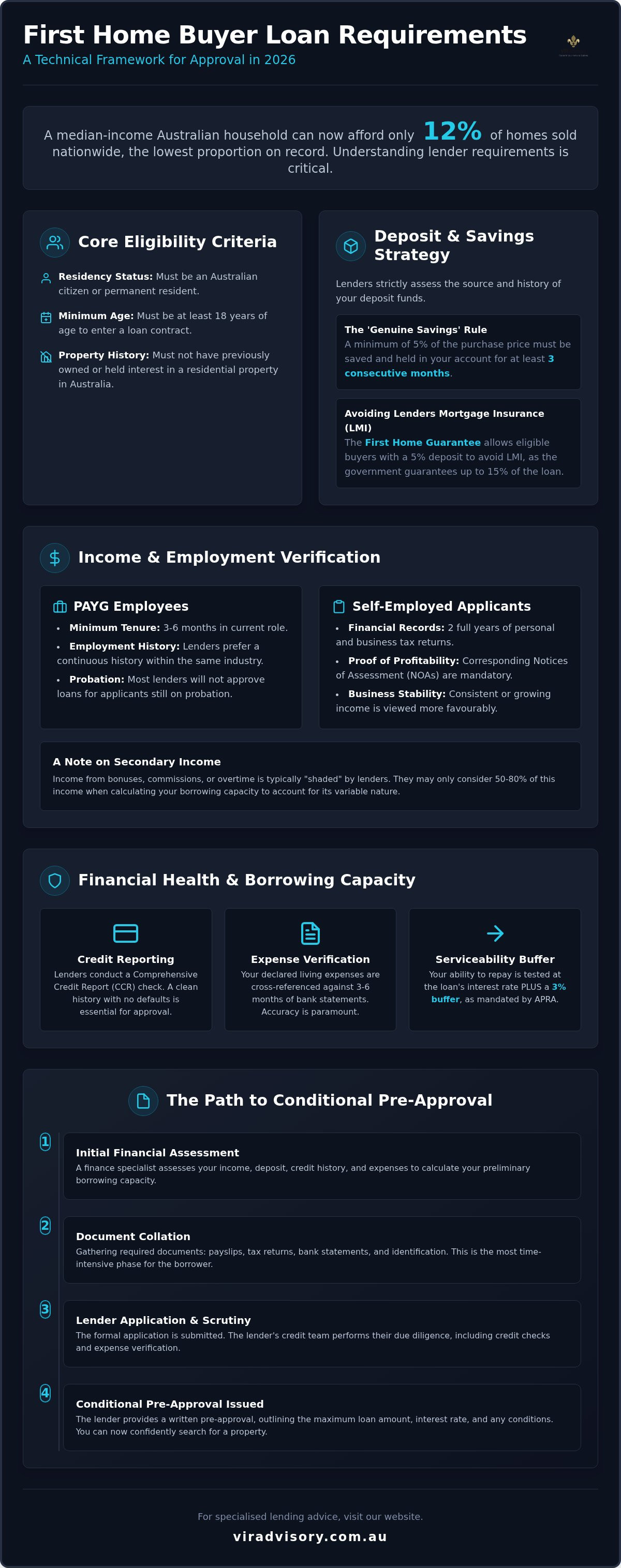
The First Home Guarantee (FHG) is a primary tool for those entering the market with a smaller deposit. Under this scheme, the government acts as a guarantor for up to 15% of the property value, which allows you to avoid the significant cost of Lenders Mortgage Insurance (LMI). It's a significant saving, but it doesn't bypass bank scrutiny. Lenders will still assess your application against the APRA-mandated 3% serviceability buffer to ensure you can manage the debt over the long term.
Other mechanisms that support your entry into the market include:
- First Home Super Saver Scheme (FHSSS): This allows you to withdraw up to $50,000 of voluntary super contributions to put toward a deposit, providing a tax-effective way to save.
- Regional First Home Buyer Guarantee: This specifically targets buyers in regional areas with similar 5% deposit provisions and no LMI.
- Stamp Duty Exemptions: Most states provide full exemptions or tiered concessions based on the purchase price, often saving buyers between $20,000 and $50,000 in upfront costs.
Scheme eligibility does not guarantee a loan approval. Banks maintain their own internal risk policies that are often more granular than the government's baseline rules, particularly regarding property types and locations.
Income Evidence and Employment Stability Standards
Lenders prioritise the reliability of your earnings over the total figure on your group certificate. For PAYG employees, standard first home buyer loan requirements usually dictate at least three to six months in your current role, or a clear history of continuous employment within the same industry. If you're a self-employed professional, the benchmark is higher. You'll generally need to provide two full years of tax returns and Notices of Assessment (NOAs) to prove your business's profitability and stability over time.
Secondary income sources, such as bonuses, commissions, or overtime, are rarely accepted at face value. Most Australian banks apply "shading," where they only count 80% of these variable earnings toward your borrowing capacity to account for potential fluctuations. This conservative approach extends to serviceability buffers. Under current APRA guidelines, lenders must assess your ability to meet repayments at a rate 3% higher than the actual interest rate on your loan. This ensures you can still manage the debt if the cash rate, currently at 4.35%, shifts upward.
Documenting Your Income
The "three-pay-slip" rule is the baseline for most applications, but lenders often require three months of bank statements to verify that your net pay actually matches your payslips. If you've recently taken maternity leave or a career break, lenders will look for a return-to-work letter confirming your salary and hours. High-risk profiles might even need to show annual leave or sick leave balances to ensure there's a buffer for unforeseen absences. While Saving for a home deposit demonstrates financial discipline, your current pay cycle is what proves you can sustain the debt.
Borrowing Capacity and Serviceability
Lenders use a Debt-to-Income (DTI) ratio to cap the amount you can borrow, often limiting total debt to six or seven times your gross annual income. Understanding How borrowing capacity is calculated in Australia is essential, as even minor liabilities like HECS/HELP debt can significantly reduce your net monthly cash flow. Banks treat HECS repayments as a fixed expense based on your total income, which can lower your borrowing limit by tens of thousands of dollars.
If you're unsure how your current salary structure or debt levels will be viewed by a credit assessor, you can book a preliminary assessment to review your figures against current bank policies.
Deposit Requirements and the 'Genuine Savings' Rule
Securing a home loan involves more than just reaching a specific dollar amount; it requires demonstrating financial discipline to a credit assessor. While the Australian Government's Home Guarantee Scheme allows eligible participants to enter the market with as little as a 5% deposit, most lenders still enforce the "genuine savings" rule. This means you must prove that at least 5% of the property's purchase price has been held or accumulated in a bank account for a minimum of three months. This requirement serves as a risk mitigation tool, showing the bank you have the cash flow management skills necessary to service a mortgage.
The 20% deposit threshold remains the gold standard in Australian lending because it eliminates the need for Lenders Mortgage Insurance (LMI). If you have less than 20%, LMI is typically required to protect the lender, not you, against the risk of default. For those receiving assistance from family, gifted deposits are acceptable provided they are accompanied by a Statutory Declaration confirming the funds are a non-repayable gift. However, even with a large gift, many banks still require a 5% genuine savings component to satisfy their first home buyer loan requirements.
The Composition of Your Deposit
Lenders distinguish between funds you've earned and funds that have appeared suddenly. Acceptable sources of genuine savings include bank deposits, shares, and managed funds held for over 90 days. Funds accessed through the First Home Super Saver Scheme (FHSSS) are also viewed favourably. Since these are voluntary contributions you've made to your superannuation, credit teams generally treat them as genuine savings. Conversely, using personal loans or credit card advances for a deposit is a major red flag that usually leads to an immediate decline, as it indicates an inability to save and adds additional debt to your serviceability profile.
Understanding Lenders Mortgage Insurance (LMI)
LMI is a one-off, non-refundable premium that can often be "capitalised" or added to your total loan amount, meaning you don't necessarily need the cash upfront. The cost is calculated on a sliding scale based on your loan-to-value ratio (LVR) and the total loan size. While it adds to your debt, paying LMI can be a strategic move to enter the market sooner if property prices are rising faster than your ability to save. Certain professionals, such as doctors, lawyers, and accountants, may qualify for LMI waivers even with a 10% deposit, provided they meet specific income thresholds and professional body membership requirements. If you're unsure if you qualify for these exemptions, you can review our frequently asked questions for more details on professional lending policies.
Credit Health and Living Expense Verification
Lenders look far beyond your deposit to evaluate your behavioural history as a borrower. A credit score of 600 or higher is generally the baseline for prime first home buyer loan requirements, but the score itself is only part of the story. Since the implementation of Comprehensive Credit Reporting (CCR), banks have visibility over your exact repayment history for utilities, phone contracts, and credit cards. Even a single missed payment in the six months prior to your application can signal a lack of financial discipline, potentially leading to a lower borrowing limit or a more stringent assessment of your file.
Banks don't simply accept your declared living expenses at face value; they use the Household Expenditure Measure (HEM) to benchmark your spending against national averages for your demographic. If your declared costs are significantly lower than the HEM, the lender will likely use the higher benchmark figure to calculate your serviceability. This is why a meticulous audit of your bank statements is essential. Frequent food delivery orders and multiple streaming subscriptions are now under a microscope, as they represent discretionary spending that could be redirected toward mortgage repayments.
A common hurdle for high-income professionals is what we call the "Credit Card Trap." Lenders assess your borrowing capacity based on the total credit limits you have available, not the balance you actually owe. For example, a $10,000 credit card limit can reduce your total borrowing capacity by approximately $40,000. This happens because the bank must factor in the risk that you could exhaust that limit at any time. Reducing these limits or closing unused accounts is a practical way to meet first home buyer loan requirements for those looking to maximise their funding.
Optimising Your Financial Profile
Transparency is the most effective strategy during a credit assessment. Undisclosed debts, including Buy Now, Pay Later (BNPL) accounts or private personal loans, are almost always discovered through bank statement descriptions or CCR. It's advisable to clear these liabilities and close the accounts at least three months before you submit an application. You should also avoid making large, uncharacteristic purchases, such as a new vehicle or expensive furniture, in the window leading up to your purchase, as these can disrupt the profile of stability the bank expects to see.
Living Expense Scrutiny
You can improve your approval prospects by categorising your spending into mandatory and discretionary buckets before the bank does. Mandatory expenses include groceries, healthcare, and transport, while discretionary spending covers entertainment and luxury items. If you can demonstrate a consistent reduction in discretionary spending over a 90-day period, you present a lower risk profile to the lender. This "Mortgage Health Check" allows you to identify spending leakage and adjust your habits to align with the bank's internal risk policies.
Approval Framework: Navigating the Application Process
The approval process is a multi-stage sequence that requires meticulous coordination between your financial preparation and the property market's demands. Meeting first home buyer loan requirements begins with a comprehensive financial assessment, where you organise tax returns, pay slips, and identification documents to establish your baseline borrowing capacity. Once these are verified, the next step is obtaining a conditional pre-approval. This provides you with a firm budget and the confidence to participate in auctions, though it's vital to remember that pre-approval is always subject to the lender's final review of the specific property you choose.
After you've signed a contract, the lender initiates a property valuation to ensure the purchase price reflects the current market value. This is a critical stage of the framework; if the valuation comes in lower than the purchase price, you may need to bridge the gap with additional capital to maintain your loan-to-value ratio. Formal, or unconditional, approval is only granted once the bank is satisfied with both your financial status and the security of the property. This transition from conditional to unconditional status is the final regulatory hurdle before the settlement process begins.
The Role of a Mortgage Broker
Professional mortgage brokers provide a significant advantage by comparing products across a broad panel of lenders, often identifying favourable terms and niche policies that exist beyond the "Big Four" banks. A broker acts as a central point of contact, managing the complex communication required between your solicitor, the real estate agent, and the lender's credit team. This oversight ensures that deadlines are met and that the application remains on track through to settlement, reducing the friction often associated with property transfers. You can learn more About VIR Advisory and our approach to lending to see how we manage these professional relationships.
Final Readiness Checklist
Before committing to a purchase, you must ensure your cash reserves cover the professional fees and statutory costs that fall outside your deposit. These expenses can impact your total liquidity and must be factored into your initial budget. A robust checklist for final readiness includes:
- Building and Pest Inspections: These are essential for identifying structural risks or maintenance issues before the contract becomes unconditional.
- Strata Reports: Required for apartments or townhouses to assess the financial health and insurance status of the body corporate.
- Conveyancing and Legal Fees: These cover the professional transfer of title and the detailed review of the contract of sale.
- 100-Point ID Check: A final verification of passports, licenses, and Medicare cards is required to meet Australian anti-money laundering regulations.
If you're ready to move from research to action, you can Submit an enquiry for a tailored assessment of your borrowing capacity against current lender policies.
Strategic Preparation for Your First Property Purchase
Successful entry into the 2026 property market depends on your ability to align your financial profile with rigorous bank internal policies. From managing the impact of HECS debt on your borrowing capacity to ensuring your deposit meets the three-month genuine savings rule, the details of first home buyer loan requirements are now more technical than ever. While government schemes provide a useful entry point, they must be balanced against the 3% serviceability buffer and the strict debt-to-income caps enforced by prime lenders.
VIR Advisory brings more than 15 years of banking and finance expertise to this process, offering national coverage across Australia. Founder Raina Doshi provides the personalised service and precise oversight required to streamline your application and address potential approval obstacles before they reach a credit assessor. This methodical approach replaces uncertainty with a structured plan for funding.
We look forward to helping you establish a strong financial foundation for your first property.
Frequently Asked Questions
Can I get a first home loan with a 5% deposit?
Yes, you can secure a home loan with a 5% deposit by utilising the First Home Guarantee (FHG) or through specific low-deposit lending products. Under the FHG, the government acts as a guarantor for the 15% shortfall, allowing you to avoid Lenders Mortgage Insurance. You'll still need to meet standard first home buyer loan requirements, including proof of stable income and a clear credit history to satisfy the bank's internal risk assessment criteria.
How much deposit do I need to avoid Lenders Mortgage Insurance (LMI)?
You typically need a deposit of at least 20% of the property's purchase price to avoid Lenders Mortgage Insurance. This ensures your loan-to-value ratio is 80% or less, which lenders view as a lower risk. Some professional waivers exist for doctors or lawyers that allow for a 10% deposit without LMI. For most buyers, reaching this 20% threshold is a strategic move that saves thousands in non-refundable insurance premiums over the loan term.
Does HECS/HELP debt reduce how much I can borrow for my first home?
Yes, HECS/HELP debt reduces your borrowing capacity because lenders treat the compulsory repayments as a fixed financial liability. Even though it isn't a traditional loan, the percentage of your salary diverted to repayments reduces your net monthly cash flow. Banks factor these repayments into their serviceability calculations, which can lower the total amount they're willing to lend by tens of thousands of dollars depending on your income bracket and total debt levels.
What is the 'genuine savings' requirement for Australian lenders?
The 'genuine savings' rule requires you to demonstrate that at least 5% of the purchase price has been accumulated or held in a bank account for a minimum of three months. This serves as evidence of your financial discipline and ability to manage cash flow. Lenders prioritise these funds over one-off windfalls or gifts to ensure you meet the first home buyer loan requirements for long-term mortgage sustainability and professional risk management.
Can I use a cash gift from my parents as a deposit?
You can use a cash gift for your deposit, provided the donor signs a Statutory Declaration confirming the funds are a non-repayable gift. While this helps reach the total required amount, most lenders still insist that you have at least 5% in genuine savings. This combination of gifted funds and personal savings is a common way to enter the market while still proving to the bank that you have established consistent saving habits.
How long do I need to be in my job before I can apply for a home loan?
PAYG employees generally need to be in their current role for three to six months, or have a continuous two-year history within the same industry. If you've recently changed jobs but remained in the same field, some lenders may consider your application sooner. Self-employed borrowers face stricter standards, usually requiring two years of tax returns and Notices of Assessment to verify the stability and longevity of their business income and cash flow.
What are the common reasons for a first home loan being declined?
Common reasons for a decline include an inadequate credit score, undisclosed liabilities like 'Buy Now, Pay Later' accounts, or a property valuation that comes in below the purchase price. Lenders also look closely at your living expenses; if your discretionary spending on subscriptions and food delivery is too high, it can impact your serviceability. Failing to meet the genuine savings threshold or having inconsistent employment history are also frequent obstacles to obtaining a formal approval.
How do I calculate my borrowing capacity as a first-time buyer?
Your borrowing capacity is calculated by subtracting your total living expenses and existing debt repayments from your gross annual income, then applying a 3% interest rate buffer. Lenders use this buffer to ensure you can still manage repayments if rates rise. The final figure is also capped by a debt-to-income ratio, which usually limits your total borrowing to six or seven times your gross earnings to prevent excessive leverage and long-term financial stress.

Article by
Raina Doshi
Raina Doshi has worked in banking and finance since 2011, including experience with major Australian lenders. She helps homeowners, property investors, business owners and professionals secure and structure lending solutions across home loans, refinancing, commercial finance and business lending.
Areas of expertise include residential lending, investment property finance, debt recycling, commercial property finance, equipment finance, construction finance and strategic debt structuring.
Drawing on extensive banking and finance experience, Raina helps clients navigate lender requirements, improve borrowing outcomes and structure effective finance solutions.
Disclaimer
The information in this article is general in nature and does not take into account your personal objectives, financial situation or needs. Before acting on any information, consider whether it is appropriate to your circumstances and seek professional advice.


