

Securing a mortgage as a first home buyer Australia often feels like hitting a moving target, especially with the RBA holding the cash rate at 4.35% as of August 2026. While saving a 20% deposit while renting is increasingly difficult, the technical landscape has shifted significantly with the removal of income caps on the federal 5% Deposit Scheme. To successfully enter the market, you must align your deposit strategy with specific lender serviceability buffers and state-based concessions, such as the NSW $800,000 stamp duty exemption or Queensland’s $30,000 First Home Owner Grant.
It's understandable to feel overwhelmed by the technicalities of lender assessment criteria and the shifting eligibility for shared equity programs. This guide provides a technical framework for maximising your borrowing capacity and utilising every applicable government incentive, such as the First Home Super Saver scheme. You'll learn how to structure your loan to manage long-term interest rate risk and avoid common approval obstacles that frequently stall applications. We'll examine current Household Expenditure Method (HEM) benchmarks and the exact documentation required to satisfy strict credit policies in the current economic climate.
Key Takeaways
- Identify how to leverage 2026 federal incentives, including the 5% Deposit Scheme with no income caps and the Help to Buy shared equity program.
- Understand how Australian lenders apply the Household Expenditure Measure (HEM) and serviceability buffers to determine your maximum borrowing capacity.
- Learn how a first home buyer Australia can strategically use offset accounts and redraw facilities to reduce interest expense and manage debt effectively.
- Compare the technical costs and benefits of paying Lenders Mortgage Insurance (LMI) against accessing government-backed deposit guarantees.
- Follow a 90-day preparation framework to organise your financial documentation and expense profile for a streamlined bank approval process.
Navigating the Australian First Home Buyer Market in 2026
Entering the market as a first home buyer Australia in 2026 requires a precise understanding of a multi-speed property environment. National dwelling values declined by 0.7% in July 2026, yet this figure hides significant regional divergence. While Sydney and Melbourne values have retracted by 2% and 2.8% respectively, markets like Perth have surged by over 20% in the last year. This volatility means that local conditions dictate the urgency of your finance strategy, while underlying lender requirements remain universally stringent across the national panel.
To better understand the financial obligations and potential hidden costs involved in this process, watch this helpful video:
Current Market Dynamics and Interest Rate Considerations
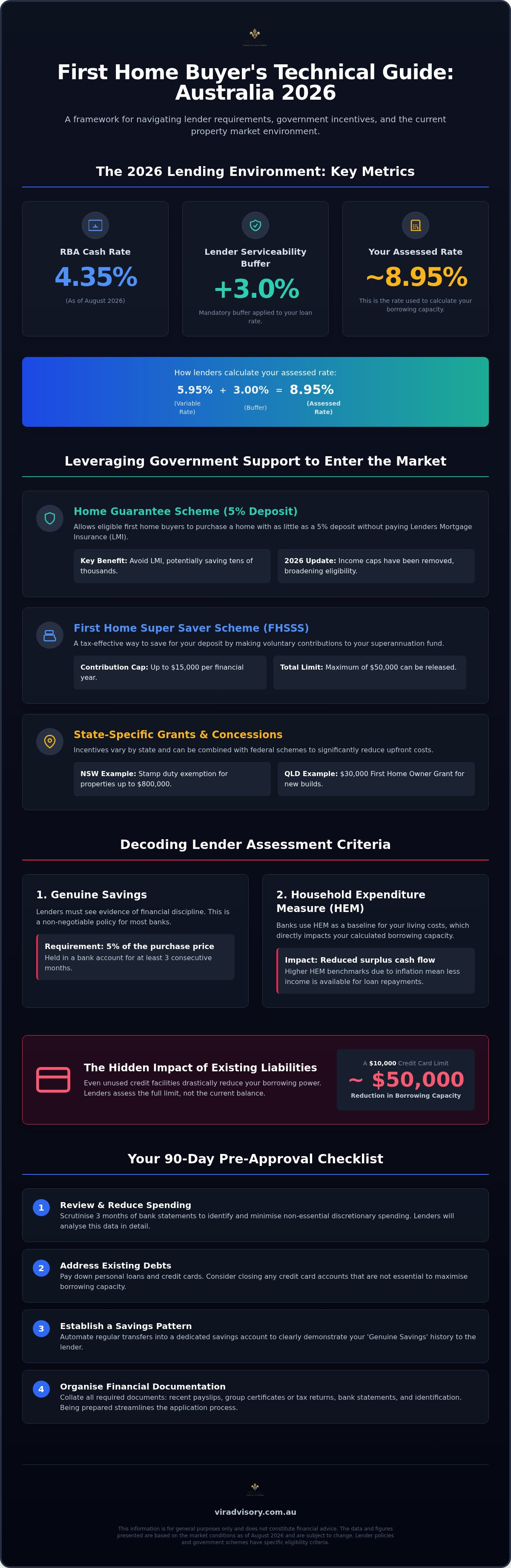
Lenders currently apply a 3% serviceability buffer to ensure borrowers can maintain repayments if interest rates rise further. With the RBA holding the official cash rate at 4.35% in August 2026, a loan with a 5.95% variable rate is actually assessed at 8.95%. This calculation significantly restricts your maximum borrowing capacity compared to the low-rate environment of previous years. Inflation also plays a critical role; banks have adjusted their Household Expenditure Measure (HEM) benchmarks upward to account for the rising cost of essential goods, which effectively reduces the surplus cash flow available for debt servicing.
Identifying Common Approval Obstacles
Credit assessors now scrutinise discretionary spending with greater precision, often distinguishing between temporary lifestyle choices and permanent essential commitments. While the First Home Owner Grant history shows a long-standing government commitment to assisting new entrants, modern lenders prioritise "genuine savings". This typically requires 5% of the purchase price to be held in a bank account for at least three months, proving financial discipline. Existing liabilities also create friction. A credit card with a $10,000 limit can reduce your borrowing power by approximately $50,000, even if the balance is zero. Addressing HECS/HELP debts and personal loans before submitting an application is often necessary to maximise your funding solutions.
Engaging with a specialist who understands the back-end of bank assessments is vital in this tight credit environment. A structured approach allows you to present your financial profile in the best possible light, ensuring that your income, especially for self-employed borrowers or company directors, is categorised correctly by the lender. This level of precision is often the difference between a standard rejection and a successful approval. For more information on how we assist with these complex requirements, view our services offered.
Federal and State Support: Grants, Schemes and Concessions
Strategic use of government incentives is the most effective way for a first home buyer Australia to bridge the deposit gap in 2026. By stacking federal deposit guarantees with state-specific stamp duty concessions and grants, you can often secure a property with as little as 2% to 5% of the purchase price. As of August 2026, the federal 5% Deposit Scheme has removed income caps, making it accessible to a broader range of professionals and self-employed borrowers who previously exceeded threshold limits. This scheme allows you to avoid Lenders Mortgage Insurance (LMI), which can otherwise cost tens of thousands of dollars.
The First Home Super Saver Scheme (FHSSS) Mechanics
The FHSSS is a tax-leveraged deposit-building tool that allows you to make voluntary superannuation contributions to save for your first home. You can contribute up to $15,000 within a single financial year, with a total cap of $50,000 across all years. Because these contributions are often made from pre-tax income, they reduce your taxable income while building a deposit at a lower tax rate. You must request a determination from the ATO before signing a contract, as withdrawing these funds can take several weeks, which frequently impacts settlement timelines.
The 5% Deposit Scheme and Single Parent Stream
The Home Guarantee Scheme remains a cornerstone of the 2026 lending landscape. While the standard stream requires a 5% deposit, the Family Home Guarantee allows eligible single parents to enter the market with just 2%. Property price caps apply and vary significantly between capital cities and regional areas. Not every bank on the national lender panel participates in these schemes. Some lenders have limited places available, so confirming a lender’s current allocation is a critical first step in your finance strategy. To ensure your application aligns with current scheme availability, you can book a technical strategy session to review your eligibility.
The Help to Buy shared equity program allows the government to contribute up to 40% of the purchase price for new homes. This significantly reduces your loan size and ongoing repayments, though it does involve the government holding an equity share in your property. When combined with state-based exemptions, such as the NSW full stamp duty waiver for properties up to $800,000 or Victoria’s $600,000 threshold, the total upfront saving can exceed $60,000 for many borrowers. Managing these moving parts requires a methodical approach to ensure no incentive is overlooked during the approval process.
Lender Assessment Criteria: How Banks View Your Application
While government grants provide a foundation, the technical approval of a first home buyer Australia rests on the bank's internal risk assessment. Lenders evaluate the "Five Cs of Credit," with "Character" often being the most scrutinised. This isn't about personality; it's about your history of meeting financial obligations. Credit assessors look for clean account conduct, meaning no overdrawn fees, missed credit card payments, or excessive reliance on Buy Now Pay Later (BNPL) services. Any irregularity in these areas signals a higher risk profile, regardless of your income level or deposit size.
Serviceability and Living Expense Benchmarks
Lenders use the Household Expenditure Measure (HEM) as a baseline for living expenses, but they'll always use your actual spending if it's higher. Credit assessors typically scrutinise three to six months of transaction history to categorise your outgoings. Discretionary spending on dining, entertainment, and luxury subscriptions is often viewed as "reducible" debt, but consistent high spending can still lower your borrowing capacity. Dependants also play a major role. Each additional child or non-earning adult in the household increases the HEM benchmark, which directly reduces the surplus cash flow available to service a mortgage. To improve your approval prospects, it's advisable to moderate discretionary spending at least 90 days before submitting an application to demonstrate financial discipline.
Requirements for Self-Employed First Home Buyers
For company directors and self-employed professionals, the documentation requirements are more extensive than for PAYG employees. Standard "Full-Doc" applications generally require two years of personal and business tax returns, alongside financial statements. Lenders typically calculate income by averaging the last two years of Net Profit Before Tax, though they may "add back" non-cash expenses like depreciation or one-off interest costs to determine your true EBITDA (Earnings Before Interest, Taxes, Depreciation, and Amortisation). This process is vital for any first home buyer Australia who is also a business owner, as it ensures your actual cash flow is accurately represented.
If your recent financials show significant growth, some lenders on our national panel may consider the most recent year's figures rather than a two-year average. Alternatively, "Alt-Doc" funding solutions exist for those who haven't yet finalised their tax returns, using Business Activity Statements (BAS) or accountant declarations to verify income. Optimising your business structure and ensuring your director's drawings align with your borrowing needs is a critical part of a successful finance strategy. For more detail on how these assessments vary between institutions, you can review our frequently asked questions regarding credit policy.
Strategic Loan Structuring for Long-Term Debt Management
Selecting a mortgage is only the initial step; the technical structure of that facility determines your long-term interest expense and future financial flexibility. For a first home buyer Australia, the standard requirement is a Principal and Interest (P&I) loan. While Interest Only (IO) terms are common in investment loan structuring, lenders generally mandate P&I for residential owner-occupiers to ensure equity is built from the first instalment. Structuring your debt correctly at the outset allows you to manage cash flow effectively while keeping the option open to convert the property into an investment in the future.
LMI vs. The 5% Deposit Scheme: A Technical Comparison
Lenders Mortgage Insurance (LMI) is often misunderstood as a protection for the borrower, but it is actually a premium paid to protect the lender in the event of default. When your Loan-to-Value Ratio (LVR) exceeds 80%, LMI is typically capitalised into the loan amount, increasing your total debt and monthly repayments. In contrast, the federal 5% Deposit Scheme allows you to bypass LMI entirely through a government guarantee. Deciding between these options requires a "break-even" analysis. If property values in your target market are rising faster than the cost of the LMI premium, paying the insurance to enter the market sooner may be a viable strategy. For a deeper breakdown of these costs, refer to our First Home Buyer Deposit Guide: How Much Do You Really Need?
Offset Accounts and Family Loan Structures
An offset account is a critical component of a sophisticated finance strategy. It functions as a standard transaction account linked to your mortgage, where every dollar held reduces the balance upon which interest is calculated. This maintains liquidity for emergencies while effectively reducing your interest bill. Many borrowers also utilise a split loan strategy, where a portion of the debt is fixed to provide repayment certainty, while the remainder is variable to allow for offset benefits and extra repayments without penalty.
Guarantor loans remain a prominent solution for a first home buyer Australia with a limited deposit. In this structure, a family member uses the equity in their own property to secure a portion of your loan, often allowing you to borrow up to 100% of the purchase price plus costs without LMI. The primary risk management consideration here is the exit strategy. We typically recommend a plan to refinance the loan and release the guarantee once the property value has increased or the loan balance has reduced to an 80% LVR. This ensures the guarantor's liability is temporary rather than indefinite.
Approval Strategy: Preparing Your Finance Application
A successful application for a first home buyer Australia isn't merely about the day of submission; it's the result of a 90-day framework designed to present your financial conduct in the best possible light. Lenders typically require three to six months of transaction history to verify your expense profile and savings discipline. During this period, it's essential to avoid new credit enquiries or large, unexplained transfers that might complicate the credit assessor's review. Navigating the 2026 lender panel requires a methodical approach, as credit policies regarding self-employed income and probation periods vary significantly between major banks and non-bank lenders.
Understanding the difference between pre-approval and full approval is vital for managing risk. A pre-approval is an indication of your borrowing capacity based on a preliminary assessment, but it remains "subject to valuation" and a final credit review. You shouldn't commit to an unconditional contract until a full approval is issued, as the lender must still verify that the specific property meets their security criteria. This is where the expertise of a finance broker becomes essential, as they identify which lenders are currently most receptive to your specific employment type or deposit structure.
The First Home Buyer Documentation Checklist
Lenders require a comprehensive set of documents to verify your capacity to service the debt. Ensuring these are organised before you begin your search prevents delays in a competitive market. Key requirements include:
- Proof of Identity: Current passport, driver's licence, and Medicare card.
- Income Verification: Your two most recent payslips, an employment contract, and a Group Certificate or PAYG summary.
- Genuine Savings: Bank statements showing 5% of the purchase price held for at least 90 days.
- Employment Stability: Evidence that you've completed any probation periods, as many lenders won't approve a loan if you're still in a trial phase.
To ensure your profile is as strong as possible, review our guide on How to Improve Your Borrowing Capacity Before Applying for a Home Loan.
Mitigating Risk and Managing Expectations
One of the most significant risks in the 2026 market is a "short valuation". This occurs when the bank's valuer assesses the property's worth at less than the agreed purchase price, leaving a funding gap that you must cover from your own cash reserves. Building a contingency fund is therefore critical. Beyond your deposit, you should set aside funds for settlement costs, legal fees, and initial council rates. This liquidity buffer ensures that your finance strategy remains stable even if unforeseen costs arise during the final stages of the transaction. A final review of your loan structure, including offset accounts and split rates, ensures that your facility is ready to support your long-term financial objectives from the day of settlement.
Securing Your Entry into the 2026 Property Market
Successful entry into the Australian property market in 2026 demands more than just a deposit; it requires the precise alignment of government policy, lender assessment criteria, and strategic loan structuring. By understanding how Household Expenditure Measure (HEM) benchmarks and serviceability buffers impact your borrowing capacity, you can position your application for a higher probability of approval. Whether you are utilising the federal 5% Deposit Scheme or state-based stamp duty concessions, the key is to ensure your financial conduct over the preceding 90 days meets the requirements of the national lender panel.
As a first home buyer Australia, navigating these complex lending requirements is more manageable when supported by technical expertise. Raina Doshi brings over 15 years of banking and finance experience to every assessment, specialising in the complex loan structures required by professionals and self-employed borrowers across the country. This professional oversight ensures that your finance strategy is robust, allowing for a thorough identification of potential obstacles before they impact your settlement.
With a clear structure and a methodical approach to your application, you can move forward with confidence in your funding solutions.
Frequently Asked Questions
How much deposit do I actually need for a first home in Australia in 2026?
You generally require a deposit between 5% and 20% of the purchase price, depending on your eligibility for government guarantees. While the traditional benchmark is 20% to avoid Lenders Mortgage Insurance, the federal 5% Deposit Scheme allows eligible borrowers to enter the market with a smaller contribution. As of August 2026, this scheme has no income caps, though property price limits still apply. Single parents may access the Family Home Guarantee with as little as a 2% deposit.
Can I use the First Home Super Saver Scheme with the 5% Deposit Scheme?
Yes, you can combine these incentives to maximise your funding solutions. The First Home Super Saver Scheme helps you build a deposit through tax-effective super contributions, while the 5% Deposit Scheme provides a government guarantee to bypass Lenders Mortgage Insurance. Using them together allows a first home buyer Australia to accumulate funds faster while simultaneously reducing the total upfront capital required to secure a property on the national lender panel.
What is the Household Expenditure Measure (HEM) and how does it affect me?
The HEM is a standard benchmark used by lenders to estimate your annual living expenses based on your location and family size. If your actual expenses, verified through bank statements, are lower than the HEM, the lender will still use the HEM as a minimum floor for their serviceability calculations. This affects your borrowing capacity because higher estimated expenses reduce the surplus income available to meet your monthly mortgage repayments, regardless of your actual spending habits.
Is it better to pay Lenders Mortgage Insurance (LMI) or wait for a government spot?
This decision depends on property market growth versus the cost of the insurance premium. If property prices are increasing by 10% annually, waiting a year to save a larger deposit or secure a government spot might cost you more in capital growth than the one-off LMI fee. Paying LMI allows you to purchase sooner with a smaller deposit, but it increases your total debt as the premium is typically capitalised into the loan balance.
How do lenders assess self-employed income for first home buyers?
Lenders typically require the two most recent years of personal and business tax returns to calculate an average income. They examine Net Profit Before Tax and may add back non-cash expenses, such as depreciation or one-off interest costs, to determine your true borrowing capacity. If your business has seen recent growth, some specialist lenders may consider your most recent year's figures or offer Alt-Doc solutions using Business Activity Statements to verify your current cash flow.
Do I still get stamp duty concessions if I buy with a partner who isn’t a first home buyer?
In most Australian states, you will only receive a partial or pro-rata stamp duty concession if your partner has previously owned property. Eligibility is usually based on the percentage of the property you are purchasing. For example, if you own 50% as a first home buyer, you may receive a 50% discount on the applicable concession. However, rules vary between jurisdictions, so it's essential to verify the specific thresholds and definitions for your state.
What happens if my property valuation comes in lower than the purchase price?
If a bank valuation is lower than the purchase price, a funding gap is created that you must cover with additional cash. The lender bases your Loan-to-Value Ratio on the lower of the two figures. For instance, if you buy for $800,000 but the valuation is $780,000, the bank will only lend a percentage of the lower amount. This is a significant risk that requires maintaining a contingency fund to ensure settlement can still proceed.
Can I use a gift from my parents as a deposit for my first home?
Yes, gifted funds are acceptable, but most lenders still require evidence of genuine savings. This usually means you must hold 5% of the purchase price in your own account for at least three months. The gift must be accompanied by a statutory declaration confirming the funds don't need to be repaid. This ensures your first home buyer Australia application satisfies credit policy regarding your ability to manage long-term debt and demonstrates your financial discipline.

Article by
Raina Doshi
Raina Doshi has worked in banking and finance since 2011, including experience with major Australian lenders. She helps homeowners, property investors, business owners and professionals secure and structure lending solutions across home loans, refinancing, commercial finance and business lending.
Areas of expertise include residential lending, investment property finance, debt recycling, commercial property finance, equipment finance, construction finance and strategic debt structuring.
Drawing on extensive banking and finance experience, Raina helps clients navigate lender requirements, improve borrowing outcomes and structure effective finance solutions.
Disclaimer
The information in this article is general in nature and does not take into account your personal objectives, financial situation or needs. Before acting on any information, consider whether it is appropriate to your circumstances and seek professional advice.


