

What if your home loan rate reflects more than a lender’s advertised offer? How to get a better home loan rate Australia starts with understanding how your loan size, equity, repayment history and loan features may affect lender pricing, then comparing offers on the same terms. A lower headline rate isn’t automatically a better deal if fees or restrictions outweigh the difference.
It’s reasonable to question whether your current rate is competitive, especially when refinancing can involve costs and a fresh assessment of your finances. The RBA cash rate is 4.60% following the September 2026 increase, but lenders don’t necessarily adjust every home loan rate by the same amount. Your borrowing capacity and approval prospects also depend on factors such as income, existing debts and lender assessment criteria.
This article explains what lenders consider when setting rates, how to compare interest, fees and loan features, and what to check before asking for a rate review or refinancing. You’ll also find a practical process for weighing potential savings against switching costs, eligibility requirements and the risk of giving up useful features.
Key Takeaways
- How to get a better home loan rate Australia depends on how your circumstances match a lender’s pricing and eligibility criteria, not just the advertised rate.
- Check how your loan-to-value ratio, income, expenses, repayment history and loan purpose may affect the options available to you.
- Compare a proposed loan with your current one on a like-for-like basis, including fees, loan term, repayment type and features.
- Use a review checklist to prepare evidence, request a reassessment and check lender requirements before applying to refinance.
- Weigh any potential rate reduction against the full cost of switching, so a lower headline rate doesn’t obscure the overall value of the loan.
How to get a better home loan rate Australia: start with your current loan
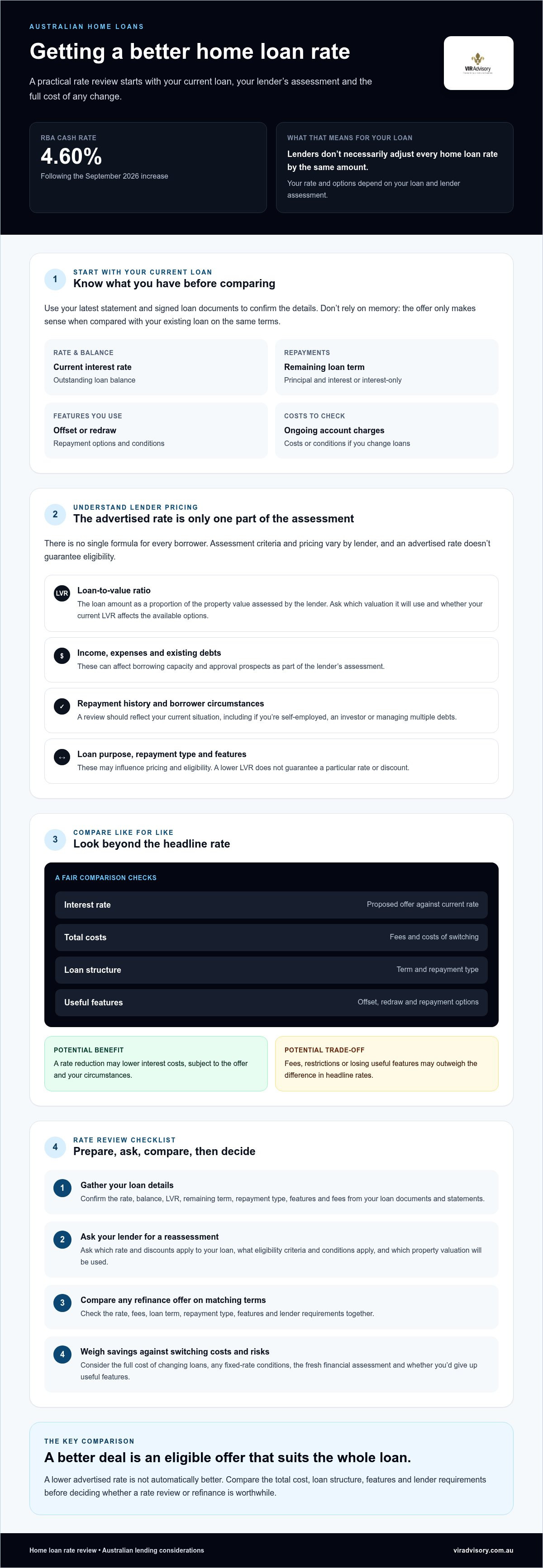
Start by reviewing your existing loan, preparing evidence for a rate review and comparing the total cost before switching. A better rate isn’t necessarily the lowest advertised figure. It’s an offer you’re eligible for that suits your repayments, loan features and overall borrowing costs.
Begin with your documents, not memory. Your latest loan statement and contract can confirm the interest rate, balance, remaining term and whether repayments are principal and interest or interest-only. Note any offset or redraw facility you use, account fees, and conditions that may apply if you have a fixed-rate loan. For a general explanation of mortgage terminology, see this overview of understanding your current loan. Your own lender documents remain the source for your specific terms.
For a practical overview of rate negotiations, you can watch this video:
Rate-review checklist
- Current rate: Record the rate on your latest statement.
- Balance: Confirm the outstanding amount.
- LVR: Compare the loan balance with your property’s current value, using a reliable valuation source where available.
- Features: List the offset, redraw and repayment options you use.
- Fees: Note ongoing charges and any costs or conditions to check before changing loans.
What details should you check on your existing home loan?
Record the loan term and repayment type alongside the rate and balance. These details matter when comparing offers. A lower rate may not suit you if the alternative has a different term, repayment structure or features you rely on. If your loan is fixed, ask your lender what conditions or costs may apply before changing it. Check recent statements and signed loan documents to confirm the details.
Why might your current rate differ from advertised rates?
Lenders may consider the loan purpose, loan-to-value ratio (LVR), repayment type and borrower circumstances when setting or reviewing pricing. An advertised rate doesn’t mean you’ll qualify for it. Eligibility criteria and conditions vary by lender and offer. Ask which rate and discounts apply to your loan, and confirm the lender’s current requirements directly.
A variable rate may change following a lender’s pricing decision. A negotiated discount or move to another product is a separate change to confirm with the lender. If you’re self-employed, an investor or managing multiple debts, make sure any review reflects the details of your application. Before agreeing to a change, compare the revised offer with your existing loan’s features and costs.
How Australian lenders assess your home loan rate and pricing options
There’s no single formula for setting every borrower’s home loan rate. Lenders may consider the property’s value and loan amount, your income and expenses, repayment history, loan purpose and requested features. Their assessment criteria and pricing can differ, so an offer from one lender isn’t a reliable guide to what another will offer.
Loan-to-value ratio (LVR) is the loan amount as a proportion of the property value assessed by the lender. Lenders may consider it when pricing a loan because it indicates how much equity supports the borrowing.
How can your loan-to-value ratio affect rate discussions?
If you’ve paid down principal, your loan balance may now be lower relative to the property’s value. A lender may assess that value differently from your own estimate, which can change the LVR it uses. This may be relevant to a rate review, but a lower LVR doesn’t guarantee a particular rate or discount. Ask the lender what valuation it will rely on and whether your current LVR affects the options available.
Which borrower and loan details can affect lender pricing?
Lenders may review whether your income is stable and supportable, how regular expenses and existing debts affect cash flow, and whether repayments have been made as required. For self-employed applicants, a lender may assess income using its own documentation and assessment requirements. Loan purpose, such as owner-occupier or investment, and requested features can also affect which products are considered.
Assessment methods vary. Lenders can apply different serviceability requirements, property valuation methods and policies to the same application, so don’t assume your current lender’s view will match another’s. For a broader explanation of income, expenses and other factors lenders may assess, see this Australian borrowing capacity guide.
Rates also depend on the offer’s type and terms. A variable rate can change over time, while a fixed rate applies under the product’s fixed-rate terms. An introductory rate may differ from the ongoing rate after the offer period, so check when it ends and what rate applies afterwards. Compare product conditions as well as the rate, particularly if you rely on features such as an offset account or redraw. There’s no universally suitable choice. The right fit depends on your repayment preferences, cash flow and loan requirements.
The Reserve Bank of Australia sets the cash rate, which can influence the broader interest-rate environment, but lenders’ home loan pricing doesn’t necessarily move in step with it. The Reserve Bank of Australia’s interest-rate information provides context. Your lender can confirm how its current pricing and eligibility criteria apply to your loan. If you’re considering how to get a better home loan rate Australia, understanding lender-specific criteria is as important as tracking broader rate movements.
Will refinancing for a lower home loan rate actually save you money?
It can, but the advertised rate alone won’t tell you whether switching is worthwhile. Compare your current loan with the proposed one using the same balance, remaining term, repayment type and features. Then factor in switching costs and any differences in how you’ll use the loan.
A lower advertised rate does not establish a lower total borrowing cost. A new loan might reduce repayments but add fees, remove an offset feature you rely on or extend the term. Compare costs over a consistent period and consider the effect of changes across the full loan term. For Australian consumer guidance on the trade-offs, see Moneysmart’s information about refinancing and switching home loans.
How should you compare the offers?
Request details from both lenders and check that the comparison uses the same loan balance, remaining term, repayment type and relevant features. Then account for the proposed interest rate, fees and any changes to repayments or loan conditions. Use this framework:
- Rate and repayments: Compare the rate type, repayment amount and when any introductory offer ends.
- Fees and conditions: Include costs to exit the current loan and establish the replacement, plus any applicable fixed-rate conditions.
- Term and features: Check whether the new term is longer and whether you’d lose or gain features such as offset or redraw.
- Overall cost: Consider whether the expected benefit still outweighs the costs over the period you expect to keep the loan.
A comparison rate can show the interest rate and most fees and charges as a single figure, but it’s calculated using standard assumptions and may not reflect your actual loan, costs or circumstances. Australian comparison-rate disclosure requirements can apply to credit advertisements. Check the current requirements and offer documents, and don’t treat the comparison rate as a personalised cost calculation.
What refinancing costs and conditions should you check?
Ask the relevant lenders to confirm any discharge, application, valuation and settlement fees, and whether fixed-rate break costs or other conditions may apply. Don’t assume a cost is waived unless the lender confirms it. Compare the new loan term with the time left on your existing one. Extending the term may reduce required repayments while increasing the time you pay interest.
When could keeping your current lender make more sense?
Ask your lender whether it can review your rate or make a retention offer. Keeping the loan may avoid switching steps, but weigh the offer against the alternative’s fees, rate, features and conditions. Refinancing also depends on meeting the new lender’s eligibility and approval requirements, so a lower advertised rate doesn’t guarantee approval. Comparing a retention offer and a refinance on equal terms is a practical way to assess the trade-off.
How to negotiate a better home loan rate: a practical review checklist
A rate review is easier to assess when you can explain what you’re asking for and support it with current loan and financial details. Use this process to approach your lender, compare any revised offer with alternatives, and decide whether to stay or explore refinancing. A review or application doesn’t guarantee a lower rate or approval.
- 1. Review your position. Confirm your current balance, rate, repayment history, loan purpose and features. Note changes to your income, expenses, debts or property circumstances since the loan was assessed.
- 2. Prepare evidence. Gather recent loan statements and relevant income documents. Summarise regular expenses, existing debts and the features you want to keep or add.
- 3. Request a reassessment. Ask your current lender to review the rate and explain which products or pricing options may fit your circumstances. If speaking with a broker, provide the same information so the comparison reflects your actual needs.
- 4. Compare the offers. Check eligibility conditions, rates, fees, repayments, loan term and features. Don’t compare headline rates alone or assume a lower rate means a lower total cost.
- 5. Decide before applying. Ask what documents the lender needs and confirm likely costs and conditions. Treat approval as subject to assessment, not assured, before committing to a refinance.
Application-readiness checklist
- Loan details: Statements, current balance, repayment type and repayment history.
- Income evidence: Documents relevant to your employment or income structure.
- Cash flow: Regular expenses, debts and any changes in circumstances.
- Questions: What rate and product could I qualify for? What fees or features change? What information is still needed? Will an application involve a credit enquiry?
What should you prepare before asking for a rate review?
Have your figures and documents ready rather than relying on estimates. List the loan features you use, the ones you’d consider changing, and any comparable offer you’ve received. Check the other offer’s eligibility conditions and costs before presenting it as a basis for negotiation. If you’re self-employed or your income has changed, ask what supporting documents the lender requires.
What questions should you ask your lender or broker?
Ask which rate and product options may be available to you, what conditions apply, and whether a change affects repayments, fees, loan term or features. Confirm what information is needed for an accurate assessment and whether a credit enquiry will occur. Before applying to refinance, check the new lender’s specific documents and requirements.
Common mistakes include focusing only on the headline rate, overlooking fees or assuming an application will be approved. Compare the complete offer and confirm eligibility before deciding. The practical approach is to prepare a clear case, check the details and make a like-for-like decision.
How VIR Advisory can help you compare Australian home loan options
Comparing home loan options involves more than finding a lower advertised rate. A mortgage broker can help assess lender options against your current loan, circumstances and priorities, then review the costs and trade-offs of refinancing. If you’re considering how to get a better home loan rate Australia, this can help you decide whether to request a review, compare alternatives or keep your existing loan.
VIR Advisory is a national mortgage and finance brokerage, not a direct lender. Founder Raina Doshi has over 15 years of banking and finance experience, including more than a decade with one of Australia’s leading banks. A broker can help organise a comparison, but each lender sets its own eligibility criteria and makes its own assessment. Neither a lower rate nor approval can be guaranteed.
What should borrowers expect from an initial home loan discussion?
Be ready to discuss what you want from your loan, along with your current rate, balance, repayment type, features and potential refinancing costs. The discussion can also cover relevant income, expenses, existing debts and changes in your circumstances, helping identify what information may be needed to assess your options.
Useful questions include: What lender options may suit my circumstances? Which eligibility conditions should I check? How could switching affect fees, repayments, loan term or features? What documents are needed for an accurate comparison? These questions help clarify potential next steps without assuming an application will be suitable or approved.
To outline your circumstances and ask about home loan options, visit the home loan enquiry page.
When may a broker review be useful?
A review may help if you’re weighing offers from several lenders, your income or financial commitments have changed, or you’re unsure whether refinancing costs outweigh a potential rate benefit. It can also help borrowers with different circumstances, such as self-employed applicants or property investors, identify which lender requirements need closer checking.
Bring recent loan information, details of your income and expenses, and questions about rates, fees, features and approval requirements. This gives the discussion a practical focus. The lender’s assessment determines which options are available and whether an application is approved.
You can book a 30-minute home loan discussion to compare your options.
Make your next home loan rate decision with confidence
How to get a better home loan rate Australia starts with knowing your current loan and what you need from it. Review your rate, balance, repayment type and features, then ask your lender to reassess the pricing that applies to your circumstances. Lender criteria differ, so an advertised offer doesn’t prove you’ll qualify.
Compare any revised offer or refinance against the full cost, including fees, loan term, repayments and features. A lower rate may not be worthwhile if switching costs outweigh the benefit or the new loan no longer suits your needs. Confirm eligibility and approval requirements before making a change.
VIR Advisory provides home loan and refinancing brokerage services across Australia. Founder Raina Doshi has over 15 years of banking and finance experience. A broker can help compare lender options and review refinancing trade-offs, but the lender determines eligibility, pricing and approval.
Frequently Asked Questions
How can I get a better home loan rate in Australia?
Review your current loan, ask your lender to reassess its rate and compare eligible alternatives on their total cost. How to get a better home loan rate Australia depends on factors such as your loan-to-value ratio, repayment history, income, loan purpose and required features. Check each lender’s eligibility criteria, fees, repayment terms and conditions before switching. A lower advertised rate doesn’t guarantee you’ll qualify or pay less overall.
Can I ask my current lender to lower my home loan rate?
Yes, you can ask your lender to review the rate on your existing loan. Have your current balance, rate, repayment history and details of comparable offers ready. Ask what pricing or product options may be available for your circumstances. Confirm whether a change affects fees, repayments, loan term or features. The lender decides what it can offer, so don’t assume a review will result in a lower rate.
Does refinancing always get you a lower home loan rate?
No. A refinance may offer a lower rate, but approval and pricing depend on the new lender’s assessment, and switching can involve costs or changed loan features. Compare the proposed loan with your current one using the same balance, repayment type and remaining term. Check any discharge, application, valuation or settlement fees, and assess whether the overall cost and conditions suit your needs before applying.
How does my loan-to-value ratio affect my home loan rate?
Your loan-to-value ratio (LVR) is the loan amount compared with the property value assessed by the lender. Lenders may consider LVR when pricing a loan because it indicates the equity supporting the borrowing. Paying down the loan or a changed valuation may affect the LVR used in a review, but lender valuation methods differ. A lower LVR doesn’t guarantee a lower rate or approval.
What should I compare besides the home loan interest rate?
Compare fees, repayment type, remaining loan term, repayment amount and features such as offset or redraw. Check whether an advertised rate is introductory and what rate applies afterwards. A comparison rate can help account for interest and most fees, but it uses standard assumptions and may not reflect your actual costs. Review the lender’s offer documents and compare loans on equivalent terms before deciding.
Can changing from a fixed to a variable rate reduce my repayments?
It may reduce repayments if the variable rate and loan terms are more favourable, but that outcome isn’t assured. Variable rates can change, so repayments may rise or fall. Before ending a fixed-rate loan, ask your lender whether break costs or other conditions apply. Compare the new rate, fees, features and repayment structure, and consider whether variable repayments suit your cash flow if rates change.
How often should I review my home loan rate?
Review your loan when your circumstances change or you’re considering a new loan arrangement, such as after a change in income, debts, property value or loan purpose. It can also be useful to check your current rate against available offers periodically rather than assuming it remains competitive. Confirm current eligibility and total costs before acting, as lender pricing and criteria can change over time.

Article by
Raina Doshi
Raina Doshi has worked in banking and finance since 2011, including experience with major Australian lenders. She helps homeowners, property investors, business owners and professionals secure and structure lending solutions across home loans, refinancing, commercial finance and business lending.
Areas of expertise include residential lending, investment property finance, debt recycling, commercial property finance, equipment finance, construction finance and strategic debt structuring.
Drawing on extensive banking and finance experience, Raina helps clients navigate lender requirements, improve borrowing outcomes and structure effective finance solutions.
Disclaimer
The information in this article is general in nature and does not take into account your personal objectives, financial situation or needs. Before acting on any information, consider whether it is appropriate to your circumstances and seek professional advice.


