

Could borrowing to cover a cash-flow gap leave your business with less room next month? A working capital loan can help fund day-to-day costs such as wages, stock, rent and supplier invoices while you wait for customer payments or manage a seasonal dip. It may suit a temporary timing mismatch, but repayments can add pressure if cash shortages are ongoing or the repayment schedule does not match incoming revenue.
It is sensible to check the fit before borrowing. Consider what the funds will cover, when cash is expected to arrive and how repayments will sit alongside existing commitments. A loan is not automatically the best option. Debtor finance or another business funding structure may better match the timing of your receivables.
This article explains how working capital finance may be structured, what lenders could assess and how to compare costs, security requirements and repayment terms. It also sets out practical preparation steps to help you present your business’s financial position and judge whether a facility fits its cash-flow cycle before applying.
Key Takeaways
- A working capital loan is intended for short-term operating needs. Asset or property purchases generally call for a different funding structure.
- Before applying, calculate the funding gap and how long it is likely to last using actual business records, not optimistic revenue estimates.
- Compare a loan with debtor finance and equipment finance by checking the purpose, repayment pattern, security and effect on cash flow.
- Lenders may assess financial information and business performance differently, so confirm what evidence each lender requires before preparing an application.
- VIR Advisory connects businesses with lenders and can help compare potential working capital finance options. It does not lend directly.
What is a working capital loan, and when might an Australian business use one?
A working capital loan provides funds for short-term business operating needs, rather than long-term investment in assets or property. A business might enquire about one when it needs to pay costs before customer payments arrive. The funds may help manage a cash-flow gap, but permitted uses and repayment terms depend on the lender and the application.
Working capital refers to the funds available to cover day-to-day business obligations. It includes current assets and current liabilities, as outlined in this Working capital overview. A loan is one possible source of additional funds, but it does not by itself resolve a persistent mismatch between income and expenses.
For a brief overview of working capital facility types, watch this video:
Which business cash-flow situations might prompt a loan enquiry?
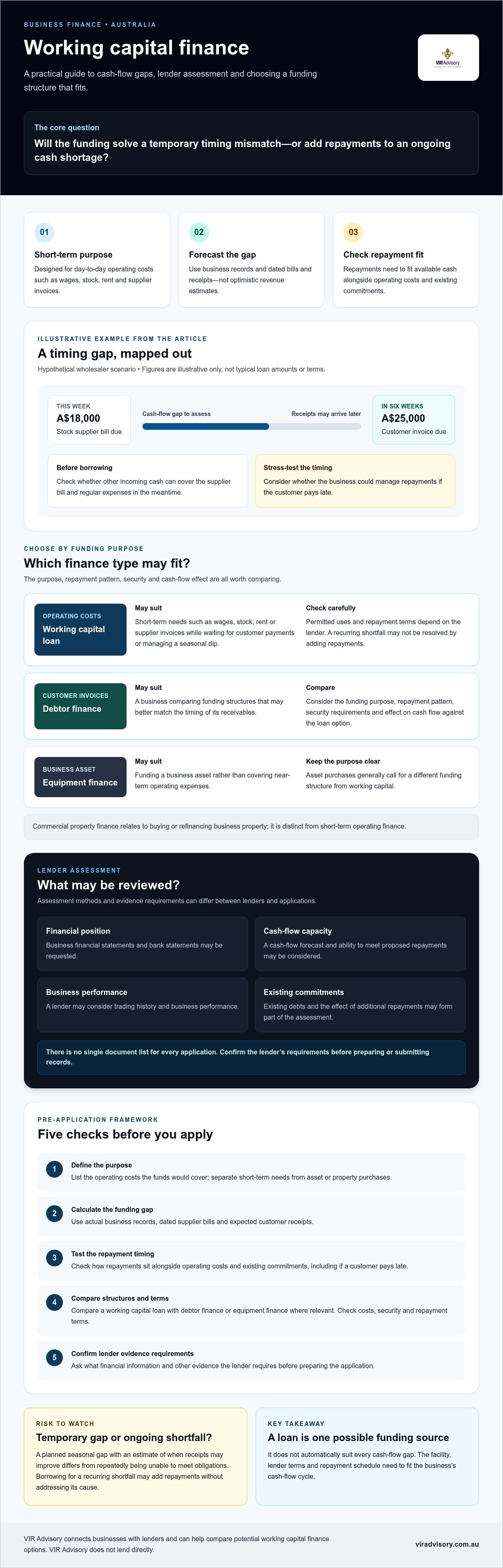
A timing gap can occur when a business pays suppliers before customers settle invoices. Hypothetical example: A wholesaler needs to pay A$18,000 for stock this week, while a customer invoice for A$25,000 is due in six weeks. If other incoming cash will not cover the supplier bill and regular expenses in the meantime, the business might enquire about short-term funding. These figures are illustrative only, not typical loan amounts or terms.
Other possible needs include paying wages during a seasonal downturn or settling supplier bills ahead of a busy trading period. A planned seasonal gap, with a reasonable estimate of when receipts should improve, is different from repeatedly being unable to meet obligations. Borrowing to cover a recurring shortfall may add repayments without addressing its cause.
How does a working capital loan differ from longer-term business finance?
Operating finance is intended to address near-term cash requirements. Equipment finance may be considered for a business asset, while commercial property finance relates to buying or refinancing business property. The asset’s expected useful life and the timing of any cash returns can help frame the funding discussion, but neither determines approval or suitability on its own.
Before applying, map the amount needed against dated supplier bills, invoices and other expected receipts. Check whether the forecast leaves enough cash to make repayments if a customer pays late. Lenders assess applications differently, and the intended use does not guarantee approval or determine the structure offered. Confirm eligible uses, acceptable evidence, security requirements and repayment terms with each lender. If you are comparing broader working capital funding solutions, focus on how each option fits your cash-flow pattern and the lender’s actual terms.
How do working capital loans work, and what might lenders assess?
The process generally starts with defining the amount, purpose and expected duration of the funding need. A lender or broker can then consider the business’s financial position, cash-flow timing and proposed facility structure. If approved, the business accepts the lender’s terms and makes repayments according to the agreed schedule. Structures, assessment methods and acceptable evidence vary between lenders.
Repayments need to fit the cash available after operating costs and existing commitments. A facility may ease a temporary cash-flow pinch, but an unsuitable schedule can increase pressure rather than relieve it. This working capital loan overview outlines some structural differences and trade-offs. When comparing local options, rely on Australian lenders’ terms and criteria.
What business information may a lender review?
Depending on the lender and application, requested evidence may include business financial statements, bank statements and a cash-flow forecast. A lender may also consider trading history, existing debts and whether the business appears able to meet proposed repayments. There is no single document list for every application, so confirm requirements before gathering or submitting records.
These are common assessment considerations, not guaranteed approval criteria. A lender’s decision depends on its own requirements and the details of the application.
Records to discuss with a broker
- Recent business financial statements and bank statements, if requested.
- A cash-flow forecast showing expected receipts, operating expenses and proposed repayments.
- A summary of existing business debts and repayment commitments.
- Information about trading history and expected changes that could affect revenue.
This is a preparation checklist, not a universal lender document list.
How can revenue timing and existing commitments affect suitability?
Turnover alone does not show whether repayments are sustainable. A business may record strong sales but still have tight cash flow if customers pay after supplier bills, wages or other debt repayments fall due. Compare expected receipts with proposed repayment dates and existing obligations, including periods when income may be less predictable.
Prepare a forecast using conservative assumptions. Show when customer payments are expected, identify uncertain receipts and test what happens if invoices are paid late or costs rise. This helps show whether the repayment schedule fits the operating cycle, rather than relying on a headline revenue figure.
Working capital loan or alternative finance: how do the options compare?
The right fit depends on what the funds need to cover, how the business receives cash and which repayment or security terms it can manage. A working capital loan may fund broader operating needs. Debtor finance is linked to eligible receivables, while equipment finance is intended for an asset purchase. An overdraft or another facility may also be available, subject to lender criteria. Availability and terms vary, so compare the actual offer rather than relying on the facility name.
| Option | Funding purpose | Repayment pattern | Security and cash-flow considerations |
|---|---|---|---|
| Working capital loan | Short-term operating needs, subject to the lender’s permitted uses. | May require scheduled repayments; check amount, timing and term in the offer. | Security requirements vary. Repayments continue even if expected customer receipts are delayed. |
| Debtor finance | Funding linked to eligible customer invoices or receivables. | How funds are advanced and repaid depends on the facility terms and receivables. | Eligibility and assessment of invoices matter. Check how fees and collections affect available cash. |
| Equipment finance | Purchase of eligible equipment rather than general operating costs. | Repayments are set under the lender’s agreement; confirm the schedule and term. | Ask what security applies and whether repayments remain manageable if the asset generates revenue later than expected. |
| Overdraft or other facility | May provide access to funds for cash-flow needs if offered and approved. | Access and repayment arrangements depend on the facility. | Check availability, limits, costs and security requirements with the lender. |
When might a loan suit better than debtor finance?
Debtor finance may be worth comparing if a business has eligible invoices and needs funding linked to the time customers take to pay. A loan may be considered for broader borrowing needs that are not tied to specific receivables. Neither structure is automatically preferable. Invoice eligibility, cash-flow timing, lender assessment and the full facility terms all matter. Compare how each option affects the cash available to operate the business.
What are the main benefits and risks of borrowing?
Borrowing may help meet a defined operating expense before expected income arrives. The trade-off is the cost of credit, which can include interest and fees, as well as the obligation to make repayments. If receipts are delayed or reduced, repayments can put further pressure on cash flow. Security exposure matters too, but only the lender’s written terms can confirm whether security is required and what it covers.
Before choosing a working capital loan or another facility, compare total repayment obligations, fees, repayment dates and security terms. Check whether the business can meet them under a less favourable cash-flow forecast, not just the expected case.
How to assess a working capital loan before applying: a practical checklist
Assess a working capital loan against a specific funding need and the business’s actual cash-flow records. Establish the size and duration of the gap, test whether repayments remain manageable under less favourable conditions, and compare the full terms of relevant facilities before applying.
- Define the need. Identify the expense, amount and payment date the funds would cover. Avoid applying for a general buffer without a clear purpose.
- Map the cash flow. Use actual bank transactions, invoices and bills to estimate when cash leaves and when customer payments arrive. Calculate the funding gap and how long it lasts rather than relying on an optimistic estimate.
- Review alternatives. Consider whether debtor finance or an overdraft may better match the timing of receivables, subject to availability and lender criteria. If the requirement relates to equipment or commercial property, discuss asset finance or commercial property finance instead of assuming an operating facility is suitable.
- Compare lender terms. Review repayment frequency, term, interest, fees and total obligations. Check security, guarantees, conditions and early repayment terms where applicable.
- Prepare evidence. Organise relevant financial records and a cash-flow forecast, then confirm each lender’s document requirements before submitting an application.
How can a business test whether repayments are manageable?
Set out expected receipts alongside operating expenses, existing debt commitments and proposed repayments for each relevant period. Then test less favourable scenarios, such as customer payments arriving late, revenue falling below forecast or costs increasing. If the business would struggle to make repayments under a plausible downside case, reconsider the amount, structure or timing before proceeding.
Use records to support forecast assumptions and clearly label uncertain income. A forecast that assumes every customer pays on time can understate risk. Where appropriate, review assumptions with an accountant or finance professional who understands the business’s records.
What should businesses compare across lender offers?
Look beyond the headline rate. Compare disclosed interest and fees alongside repayment frequency, loan term and total obligations. Check whether the business can meet the schedule through quieter trading periods, not only when cash flow is strong.
Review security requirements, guarantees, conditions and early repayment terms where they apply. These can affect the business’s overall exposure, so rely on the lender’s written offer rather than assumptions about what a facility usually includes. Requirements and terms differ between lenders.
A common mistake is focusing only on approval or the amount offered without checking whether repayments fit the operating cycle. Another is relying on a single forecast. Use actual records, test more than one cash-flow scenario and clarify uncertain terms before accepting an offer.
How VIR Advisory can help assess working capital finance options
VIR Advisory is an Australian finance brokerage that connects businesses with lenders. It does not lend directly. For a business considering a working capital loan, a broker can help clarify what the funding needs to cover, when cash is expected to arrive and what repayment pattern may fit the operating cycle. Potential lender options and terms depend on the business’s circumstances and each lender’s assessment, so no particular structure or approval can be guaranteed.
VIR Advisory can review the funding requirement and cash-flow timing, then help compare relevant options across lenders. This can help a business consider whether proposed repayments and conditions appear workable alongside existing commitments. Raina Doshi brings over 15 years of banking and finance experience, including more than a decade with one of Australia’s leading banks. That experience informs the finance discussion but does not guarantee a lender decision.
What to prepare for an initial finance discussion
Bring a concise outline of the funding need. Available records can make the discussion more specific, although document requirements vary by lender.
- The purpose of the funds, the amount required and the anticipated timing.
- Available business financial statements, bank records and cash-flow forecasts.
- Details of existing loans and other repayment commitments.
- Questions about repayment frequency, security, fees or lender conditions.
- Any uncertainties, such as customer payments that may arrive later than expected.
Distinguish confirmed income from estimates and identify assumptions in the forecast. This gives the broker a clearer basis for discussing funding structures and the additional information a lender may request.
How to take the next step with VIR Advisory
Review the business and commercial finance services available through VIR Advisory, then consider whether a discussion could help you assess potential lender options. Bring the figures and questions that matter to your business, including how repayments would fit around expected receipts and existing obligations.
A conversation can help clarify your business’s funding needs and cash-flow timing before you consider the next step.
Assess the fit before committing to finance
A working capital loan may help cover short-term operating costs when business expenses fall due before customer payments arrive. Its suitability depends on the size and duration of the funding gap, the repayment schedule and the business’s ability to manage repayments alongside existing commitments. Borrowing can ease a timing mismatch, but it may intensify pressure if the cash-flow shortfall is ongoing.
Before applying, use actual business records to map expected receipts, expenses and debt repayments. Compare the loan’s interest, fees, repayment frequency, term and any security requirements with alternatives such as debtor finance or equipment finance. Lenders assess applications differently, so confirm their document requirements and review the written terms rather than relying on a headline rate or assumed eligibility.
VIR Advisory connects Australian businesses with lenders as a finance brokerage, not a direct lender. Raina Doshi has over 15 years of banking and finance experience. A discussion can help clarify your funding requirement and compare potential options, without guaranteeing approval or specific terms.
With a clear view of the funding need and repayment fit, you can assess available options with greater confidence.
Frequently Asked Questions
What can a working capital loan be used for?
A working capital loan may fund short-term operating costs such as stock purchases, wages, supplier invoices or rent, depending on the lender’s approved uses and facility terms. For example, a business waiting for customers to pay invoices might seek funds to cover a supplier bill that falls due first. Confirm permitted uses before applying, as lenders set their own conditions and not every facility covers every expense.
How do lenders assess a working capital loan application?
Lenders may assess business cash flow, existing debts and the capacity to meet proposed repayments. They may consider financial statements, bank records, trading history and a forecast, but assessment methods and acceptable evidence differ between lenders. Turnover alone may not show whether repayments are affordable after operating costs and other commitments. Ask the lender what information it requires, then provide a clear picture of expected receipts and expenses.
Can a new business get a working capital loan in Australia?
A new business can enquire about finance, but eligibility and lender requirements vary. Trading history may inform an assessment, and a newer business may have less historical information to show how revenue and cash flow perform over time. Lenders may consider other evidence depending on their criteria and the application. Check requirements directly or through a broker before relying on a particular facility being available.
How much can a business borrow for working capital?
There is no single borrowing limit that applies to every Australian business. The amount a lender may offer depends on its assessment of the business, the funding purpose, cash flow, existing commitments and proposed facility. Work out the actual funding gap and how long it is expected to last using business records. Avoid requesting more than the requirement without checking how additional debt and repayments could affect cash flow.
Is a working capital loan better than debtor finance?
Neither option is automatically better. A loan may be structured around broader business borrowing needs, while debtor finance is linked to eligible receivables and the lender’s assessment of those invoices. Compare how each facility makes funds available, how repayments work, the costs and any security requirements. The right comparison depends on the business’s invoices, cash-flow timing and the terms offered by each lender.
What happens if a business cannot make a working capital loan repayment?
Review the facility agreement and contact the lender promptly if the business expects to miss a repayment. Explain the cash-flow issue and ask what options, if any, may be available under the lender’s process. The response and any consequences depend on the contract and lender. Do not assume a repayment can be deferred or changed without agreement. Get any variation and its terms confirmed in writing.
What documents may be needed to apply for a working capital loan?
Depending on the lender, an application may involve business financial statements, bank statements, a cash-flow forecast and details of existing loans or repayment commitments. A lender may also request information about the funding purpose and trading history. These are possible records, not a universal checklist. Requirements differ by lender and application, so confirm what is needed before submitting documents and ensure figures are consistent across the information provided.

Article by
Raina Doshi
Raina Doshi has worked in banking and finance since 2011, including experience with major Australian lenders. She helps homeowners, property investors, business owners and professionals secure and structure lending solutions across home loans, refinancing, commercial finance and business lending.
Areas of expertise include residential lending, investment property finance, debt recycling, commercial property finance, equipment finance, construction finance and strategic debt structuring.
Drawing on extensive banking and finance experience, Raina helps clients navigate lender requirements, improve borrowing outcomes and structure effective finance solutions.
Disclaimer
The information in this article is general in nature and does not take into account your personal objectives, financial situation or needs. Before acting on any information, consider whether it is appropriate to your circumstances and seek professional advice.


