

Securing a new home before selling your current residence is often viewed as a logistical hurdle, but it's actually a tactical liquidity manoeuvre that requires precise debt structuring. Many property owners hesitate because they're concerned about the mechanics of bridging finance Australia, specifically the prospect of managing peak debt while waiting for a settlement. It's common to feel pressured by the standard six to twelve month sale windows and the potential for overlapping mortgage obligations. You want to move into your next property with confidence, knowing the transition is supported by a clear, methodical financial plan.
This guide provides a technical breakdown of how bridging loans function, from initial lender assessment criteria to the final discharge of debt. You'll learn how to calculate the total cost of the bridging period and establish a robust exit strategy that protects your equity. We'll examine the specific documentation required for approval, the risks associated with varying sale timelines, and the practical steps to maintain cash flow during the transition. By understanding these lending frameworks, you can manage the property exchange process with professional oversight and minimal friction.
Key Takeaways
- Understand the distinction between Peak Debt and End Debt to accurately project your total financial commitment and cash flow requirements during the property transition.
- Evaluate the differences between closed and open bridging finance Australia to determine which loan structure aligns with your current sale status and settlement timeline.
- Learn how lenders assess borrowing capacity and LVR restrictions, which are typically capped at 80% of the combined property value, to ensure a successful approval.
- Identify common pitfalls such as overestimating sale prices and develop a rigorous exit strategy to manage interest and holding costs effectively.
- Discover how professional debt structuring provides access to a broad network of bank and non-bank lenders for customised short-term liquidity solutions.
What is Bridging Finance and How Does it Work in Australia?
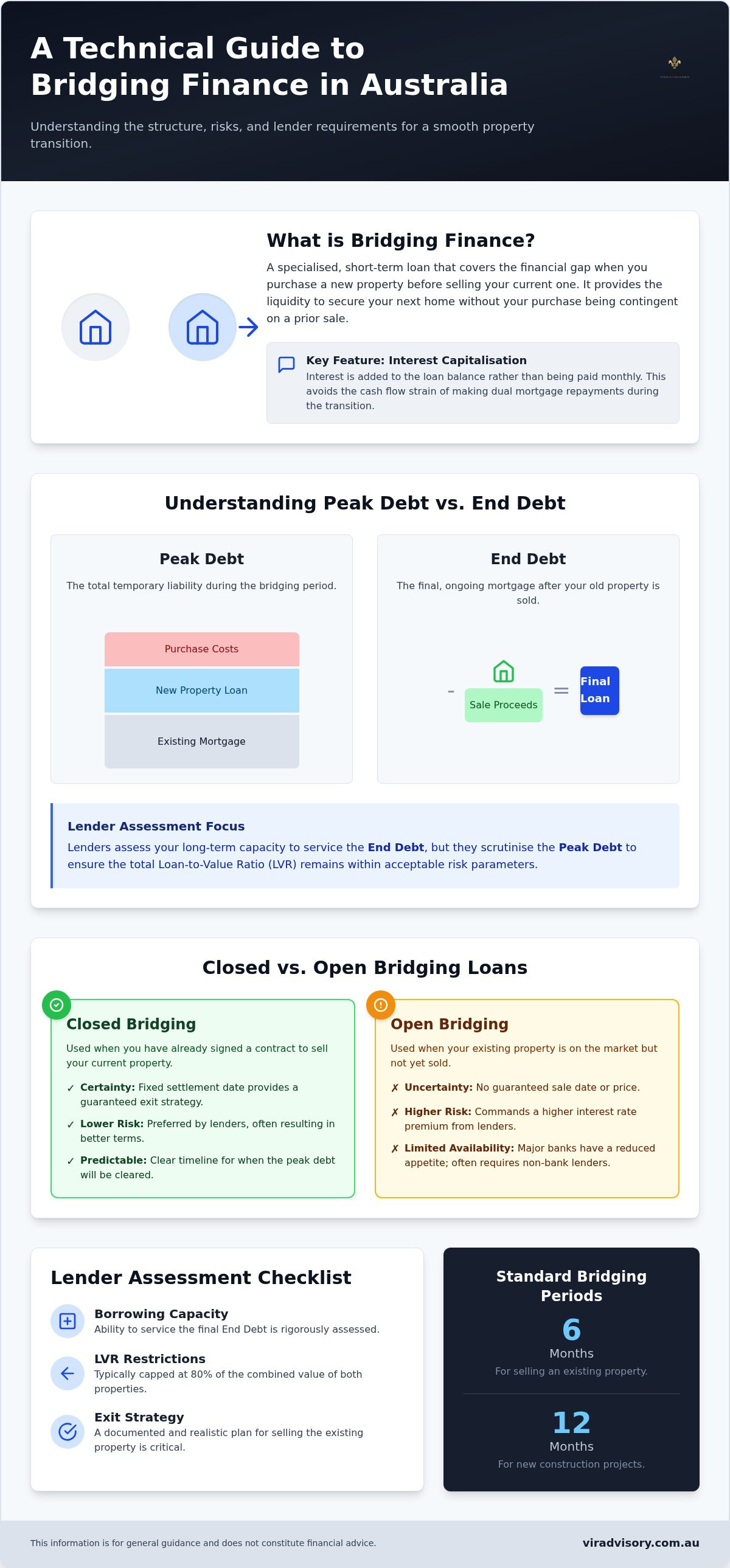
Bridging finance Australia serves as a specialised lending structure designed to cover the financial gap when you purchase a new property before your current one has settled. Effectively, it allows you to secure a new home without making your purchase contingent on a prior sale. If you're asking What is a bridge loan?, it's essentially a short-term facility that provides the liquidity needed to facilitate a smooth transition between two assets. This structure is particularly useful in competitive markets where delays in financing can lead to missed opportunities or the loss of a deposit.
To better understand this concept, watch this helpful video:
A key feature of this funding is interest capitalisation. Interest capitalisation is a mechanism where interest is added to the loan balance rather than paid monthly. This allows borrowers to avoid the cash flow strain of making dual mortgage repayments while waiting for their original property to sell. Lenders typically add the interest onto the 'Peak Debt' of the loan, which is then cleared once the sale proceeds are received. You can find more details on how these structures fit into a broader finance strategy on our FAQs page.
The Mechanics of the Bridging Period
Lenders in the Australian market generally offer bridging terms ranging from six months for existing properties to twelve months for new construction projects. This window provides a defined period to market and sell your asset. If the property doesn't sell within this timeframe, lenders may apply higher default interest rates or require an immediate restructure of the debt. Maintaining market momentum is vital; the bridge ensures you don't lose your place in the property cycle while you wait for a suitable buyer for your current home.
Peak Debt vs End Debt: The Technical Breakdown
Understanding the distinction between Peak Debt and End Debt is critical for approval. Peak Debt represents the total liability during the bridging period, including the existing mortgage, the new loan, and all associated purchase costs. End Debt is the residual mortgage that remains after the sale proceeds of your first property have been applied. Lenders assess your capacity to service the End Debt over the long term, but they also scrutinise the Peak Debt to ensure the overall loan-to-value ratio (LVR) remains within their risk parameters, which is a common point of discussion during investment loan structuring.
Closed vs Open Bridging Loans: Comparing Your Options
When exploring bridging finance Australia, you'll encounter two primary structures: closed and open. Closed bridging occurs when you've already exchanged contracts for the sale of your current property with a fixed settlement date. This provides lenders with a guaranteed exit strategy and a definitive timeline for repayment. Conversely, open bridging is used when your existing home is on the market or being prepared for sale, but no contract has been signed. Because the repayment timeline is uncertain, open bridging carries a higher risk profile and typically commands an interest rate premium to account for the lender's exposure.
By 2026, many of Australia's major banks have significantly reduced their appetite for open bridging facilities. This shift is driven by stricter credit risk management and the potential for property market volatility to extend sale periods beyond the standard six-month window. Consequently, borrowers seeking open-ended solutions often find more flexible terms through non-bank lenders who specialise in short-term liquidity. Understanding how bridging loans work in Australia across different lender tiers is essential for selecting a structure that matches your specific settlement requirements.
The Benefits and Risks of Closed Bridging
Closed bridging is the preferred route for most borrowers due to the financial certainty it provides. Since the sale price and settlement date are locked in, lenders often offer interest rates closer to standard variable products. Documentation is usually more streamlined because the contract of sale serves as the primary evidence for the exit strategy. However, risks remain. If the purchaser of your current home defaults or settlement is delayed, your bridging facility could face complications. You must ensure your legal representative includes protections in both contracts to align settlement dates where possible.
Navigating Open Bridging in a Volatile Market
If you choose to buy before listing your property, you'll face more stringent eligibility criteria. Lenders typically require a lower Loan-to-Value Ratio (LVR), often capped at 75% or 80% of the combined value, ensuring a significant equity buffer exists. A conservative, realistic valuation of your current asset is vital; overestimating your sale price can lead to a shortfall that jeopardises your long-term End Debt position. Most lenders will insist on an independent valuation rather than relying on real estate agent appraisals for this reason.
Before proceeding with an open-ended facility, consider this checklist:
- Confirm you have at least 20% to 30% equity in your current property to meet LVR caps.
- Obtain independent valuations to establish a conservative baseline for your sale proceeds.
- Review your cash flow to ensure you can manage capitalised interest for up to 12 months.
- Prepare a secondary exit strategy in case the property doesn't sell within the bridging term.
Managing these variables requires a precise approach to debt management. If you're unsure which structure fits your property portfolio, you can book a consultation to discuss your specific lending requirements and evaluate your approval prospects.
Lender Assessment Criteria and Approval Requirements
Lenders in the Australian market apply a rigorous framework to bridging applications, focusing on the viability of the eventual debt position. While the short-term facility provides liquidity, the approval process prioritises your ability to manage the long-term mortgage. A clean credit history and a consistent record of mortgage repayments are essential for a successful application. For company directors and self-employed professionals, lenders require comprehensive financial data to verify income stability and ensure the business can sustain the debt through the transition.
Understanding Loan-to-Value Ratio (LVR) Constraints
The Loan-to-Value Ratio is a primary risk metric for bridging finance Australia. Lenders typically cap the LVR at 80% of the combined value of the existing property and the new purchase. If you have a home worth $1,200,000 and are buying a new residence for $1,500,000, your total security pool is $2,700,000. Under an 80% cap, your total combined debt, including the new loan and any remaining balance on the old one, cannot exceed $2,160,000.
If your equity position falls below 20%, obtaining Lenders Mortgage Insurance (LMI) for a bridging product is exceptionally difficult. Most Australian lenders view bridging as a higher-risk category and won't approve applications where the LVR exceeds 80%. A valuation shortfall, where the bank's assessment of the property is lower than the purchase price, can also jeopardise the deal. In these cases, you must be prepared to contribute additional cash or provide other assets as security to maintain the required LVR. You can find more information on how we handle these valuations in our FAQs.
Servicing Capacity and Income Verification
Lenders take different approaches to assessing servicing capacity during the bridging term. Most major banks focus on your ability to service the End Debt, which is the mortgage remaining after you've applied the sale proceeds to the Peak Debt. However, they'll still perform a stress test on your finances to ensure you aren't over-leveraged during the transition. They want to see that your current income can support the long-term loan without relying on the sale of the asset to stay afloat.
For self-employed borrowers, income verification involves providing two years of full tax returns and financial statements. Lenders evaluate the net profit of your business to ensure it can comfortably cover the End Debt repayments. In some commercial bridging scenarios, lenders may require an Interest Coverage Ratio (ICR) to demonstrate that business cash flow can handle interest costs if the sale is delayed. If you intend to rent out your current property while waiting for a sale, lenders typically only include 70% to 80% of the estimated rental income in their servicing calculations to account for management fees and potential vacancies.
Common Mistakes and the Exit Strategy Framework
The #1 mistake borrowers make is overestimating the sale price of their existing property. Many property owners enter these agreements with optimistic valuations based on peak market results, only to find that current shifts leave them with a capital shortfall. Beyond the principal loan, you must account for holding costs. These expenses include capitalised interest on the Peak Debt, council rates for two properties, and ongoing maintenance. Without a structured framework, these costs can quickly erode the equity you intended to carry into your new home when utilizing bridging finance Australia.
The 4-Step Exit Strategy for Australian Borrowers
A methodical approach prevents the fire sale scenario when using bridging finance Australia, where you're forced to accept a low offer because the bridging term is expiring. We recommend following this structured framework to protect your equity:
- Step 1: Obtain three independent valuations from registered valuers rather than relying solely on a single real estate agent's appraisal to establish a realistic price floor.
- Step 2: Calculate a financial buffer by assuming a sale price 10% lower than the median valuation. This ensures your End Debt remains manageable even if the market softens during your sale campaign.
- Step 3: Establish a hard drop dead date for price reductions. If the property hasn't sold by month four of a six-month bridge, a pre-planned price adjustment is necessary to ensure settlement occurs before the term expires.
- Step 4: Prepare a contingency plan for converting the bridge into a long-term investment loan. This is a vital funding solution if the sale is no longer the optimal path or if you decide to retain the asset as part of a rental portfolio.
Avoiding the "Double Mortgage" Trap
The bridging period introduces a unique form of financial and psychological pressure. Carrying the responsibility for two properties requires a clear understanding of your liquidity and cash flow. A common error is committing to a new property with a settlement period that is too short, leaving insufficient time for a comprehensive marketing campaign on the existing asset. If your new purchase has a 90-day settlement but your current home hasn't sold, the clock is already ticking against your bridging window.
To maximise your sale price, time your campaign to coincide with peak buyer activity and ensure the property is presented to the highest standard. This reduces the risk of being stuck with two mortgages indefinitely, which is a primary concern for most property investors. Practical debt management involves aligning these timelines with precision to ensure a seamless transition between assets.
Securing Bridging Finance: The Role of a Professional Broker
Bridging finance Australia is a specialised credit category that requires a precise understanding of lender credit policies and risk appetites. Unlike standard mortgages, these facilities are often assessed on a case-by-case basis, making the role of an experienced broker vital for a successful outcome. A broker doesn't just find a rate; they manage the entire debt structure to ensure the transition between properties remains seamless and secure. At VIR Advisory, we focus on VIR Advisory Services that prioritise debt management and long-term financial stability over high-pressure sales tactics.
Accessing a Broad Network of Lenders
Relying on a single bank for a bridging solution often limits your options, particularly if your situation involves complex company structures or a need for open bridging. Many major banks have tightened their criteria, yet a broad network of non-bank lenders continues to offer competitive, flexible terms for short-term liquidity. These lenders often look beyond standard servicing models, focusing instead on the strength of the asset and the viability of the exit strategy. Once the bridging period concludes and your property has sold, a broker facilitates the transition back to a traditional loan structure through debt optimisation and refinancing, ensuring your End Debt is placed with a lender offering the most favourable long-term terms.
The Application Process and Next Steps
The timeline for securing a bridging loan typically spans four to six weeks from the initial enquiry to settlement, though this can vary based on the complexity of the security and the lender's requirements. Early engagement is the most effective way to avoid approval obstacles. You should consult a specialist before signing a purchase contract to ensure your borrowing capacity supports the Peak Debt requirements. This proactive approach allows for a thorough assessment of your equity position and the development of a secure exit strategy before any financial commitments are made. It ensures that every detail of the property exchange is handled with professional oversight, allowing for a frictionless experience.
If you're planning a property transition, you can Contact Raina Doshi at VIR Advisory to discuss your lending requirements and receive a detailed assessment of your funding solutions.
Strategic Debt Management for Your Next Property Acquisition
Navigating a property transition requires more than just finding a competitive interest rate; it demands a methodical approach to debt structuring and risk management. By accurately calculating your peak debt and establishing a rigorous exit strategy, you can avoid the common pitfalls of over-leveraged transitions. Bridging finance Australia remains a sophisticated tool for those who need to maintain market momentum while waiting for an asset to settle.
VIR Advisory brings over 15 years of banking and finance expertise to every application. We provide comprehensive residential and commercial lending solutions to professionals and investors nationwide, ensuring your loan structure aligns with your long-term financial objectives. Whether you're a company director or a self-employed borrower, our team focuses on precision and individual attention to secure a seamless approval.
Moving into your next property should be a period of stability rather than stress. With professional oversight and a clear funding solution, you can manage the exchange of assets with complete confidence.
Frequently Asked Questions
How much more expensive is bridging finance than a standard home loan?
Interest rates for bridging finance Australia are typically 1% to 2% higher than standard variable rates. The primary expense isn't just the rate, but the capitalised interest on the peak debt. Since you aren't making monthly repayments during the bridge, interest is added to your loan balance. This increases the total debt you'll eventually clear when your original property settles. It's a premium for the flexibility of buying before you sell.
Can I get a bridging loan if I am self-employed?
Self-employed borrowers can definitely secure bridging finance by providing two years of personal and business tax returns. Lenders assess your business's net profit to ensure you can comfortably service the end debt. While the approval requirements are more rigorous than for salaried employees, demonstrating consistent cash flow and a clean credit history helps. We specialise in structuring these applications to meet the specific documentation standards required by both bank and non-bank lenders.
What happens if I cannot sell my house within the 6 or 12-month period?
If you don't sell within the agreed window, usually six to twelve months, the lender may apply higher default interest rates. They might also pressure you to lower your sale price significantly to exit the bridge. In some cases, you'll need to restructure the debt into a standard investment loan if you can demonstrate servicing. This is why having a hard "drop dead" date for price reductions is a vital part of your exit strategy.
Is it possible to get a bridging loan for a commercial property?
Yes, commercial bridging is a common funding solution for business owners transitioning between premises. These facilities often require a lower Loan-to-Value Ratio, typically around 65% to 70% of the combined asset value. Lenders focus heavily on your business's Interest Coverage Ratio and working capital. The goal is to ensure the business can sustain the debt if the sale of the original commercial property takes longer than the expected six-month marketing period.
Do I need a deposit for a bridging loan in Australia?
You don't always need a cash deposit if your existing property has enough equity to cover the purchase. Lenders assess the combined value of both homes and generally cap the total debt at 80% LVR. If your equity covers the gap between the new purchase price and the loan, you won't need to contribute savings. However, purchase costs like stamp duty and legal fees must be factored into the peak debt calculation from the start.
Can I use an offset account with a bridging loan?
Most lenders don't allow offset accounts on the capitalised bridging portion of the loan. Since you aren't making active repayments, there's no interest to "offset" in the traditional sense. However, once your original property sells and you move to the end debt, you can usually link an offset account to that remaining mortgage. It's important to clarify these loan structures with your broker during the application process to manage your future cash flow effectively.
What are the typical fees associated with setting up bridging finance?
Setup costs usually include establishment fees, legal fees for dual-property documentation, and valuation fees for both the existing and new assets. These are often higher than standard loan fees because the lender is assessing two properties simultaneously. You might also encounter discharge fees when the bridging component is repaid. It's essential to factor these into your total borrowing capacity to ensure you have enough funds to cover the transition without unexpected out-of-pocket expenses.
How does the lender calculate the value of my current home?
Lenders use an independent, registered valuer to determine the market value of your home. This assessment is often more conservative than a real estate agent's appraisal because it accounts for the risk of a quick sale. The valuer looks at comparable sales from the last three to six months in your immediate area. Relying on an accurate bank valuation is a critical step in ensuring your finance strategy remains realistic and achievable.

Article by
Raina Doshi
Raina Doshi has worked in banking and finance since 2011, including experience with major Australian lenders. She helps homeowners, property investors, business owners and professionals secure and structure lending solutions across home loans, refinancing, commercial finance and business lending.
Areas of expertise include residential lending, investment property finance, debt recycling, commercial property finance, equipment finance, construction finance and strategic debt structuring.
Drawing on extensive banking and finance experience, Raina helps clients navigate lender requirements, improve borrowing outcomes and structure effective finance solutions.
Disclaimer
The information in this article is general in nature and does not take into account your personal objectives, financial situation or needs. Before acting on any information, consider whether it is appropriate to your circumstances and seek professional advice.


