

Understanding Construction Finance in the Australian Market
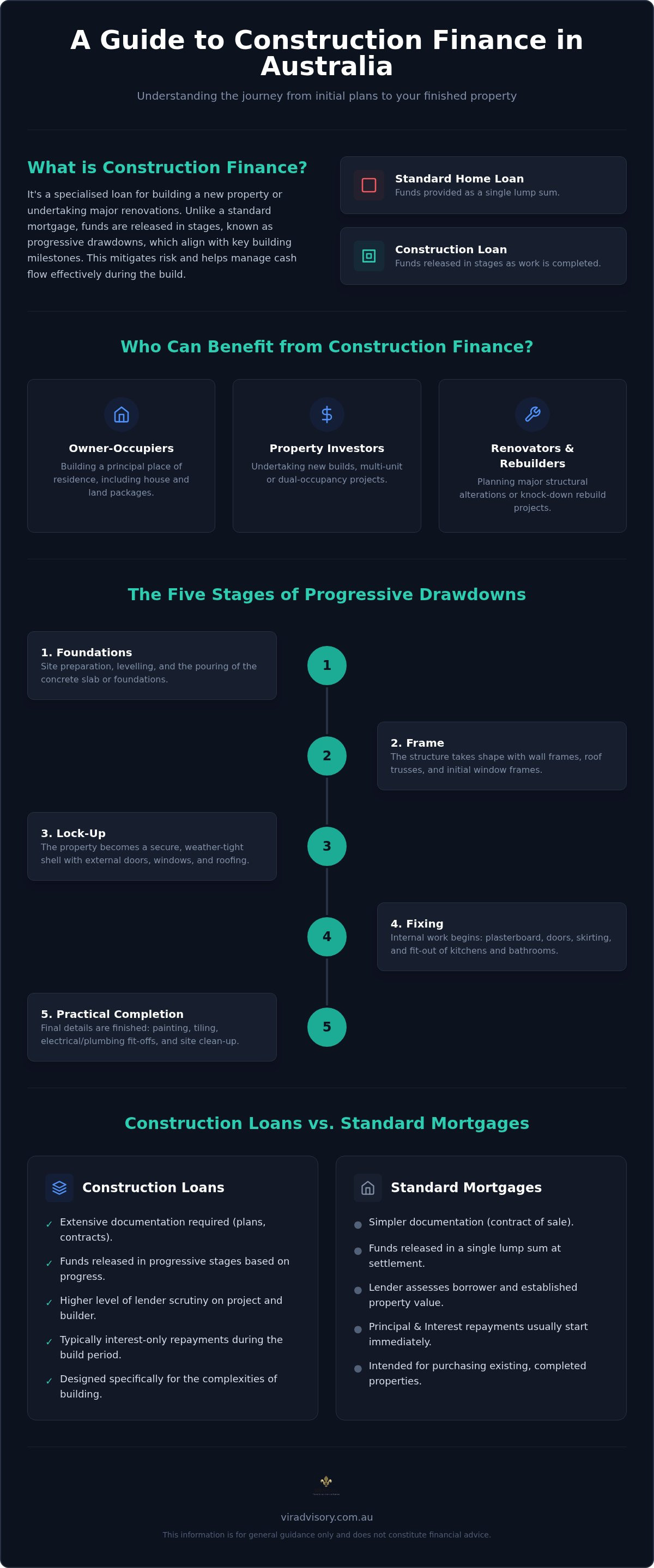
Construction finance is a specialised lending facility designed for the purpose of building a new property or undertaking major structural renovations. Unlike a standard home loan where funds are provided as a single lump sum at settlement, a construction loan releases funds in stages. These payments, known as progressive drawdowns, are aligned with key milestones in the building process, from the slab being poured to the final fit-out.
This structure is essential because it mitigates risk for both the borrower and the lender. Funds are only released for work that has been completed and verified, ensuring the project stays on track and within budget. An "on-completion" valuation, which estimates the property's value once the build is finished, is a critical component that determines the total borrowing capacity before the first sod is turned.
Who is Construction Finance For?
- Owner-occupiers: Individuals and families building a principal place of residence, either from scratch or as part of a house and land package.
- Property investors: Those undertaking new builds, multi-unit developments, or dual-occupancy projects to expand their investment portfolios.
- Renovators: Homeowners planning significant structural alterations, extensions, or complete "knock-down rebuild" projects where the existing dwelling is demolished to make way for a new one.
Construction Finance for Knockdown Rebuild Projects
A knockdown rebuild project involves demolishing an existing house to build a new one on the same block of land. This is an increasingly popular strategy in established suburbs where land is scarce. From a lending perspective, knockdown rebuild finance is treated similarly to a standard construction loan. Lenders will require a fixed-price building contract, council-approved plans, and will fund the project via progressive drawdowns. Key considerations include the costs of demolition and site clearing, which must be factored into the total project budget. The loan is secured against the land value plus the cost of construction, based on the on-completion valuation.
The Strategic Advantage of Specialised Building Loans
- Improved Cash Flow Management: Most construction loans are structured with interest-only payments during the building phase. This means you only pay interest on the funds that have been drawn down, not the total loan amount, which significantly reduces your repayment burden during construction.
- Risk Mitigation: Paying for completed work in stages protects your financial position. It ensures the builder is meeting their contractual obligations before receiving payment, a crucial safeguard in building finance.
- Alignment with Building Contracts: The loan structure is designed to mirror the payment schedule outlined in your fixed-price building contract, creating a seamless and accountable funding process.
Navigating the Mechanics of Progressive Drawdowns
The core feature of construction loans in Australia is the system of progress payments. Instead of receiving all the funds at once, the loan is drawn down in stages as your builder completes key phases of the project. A lender-appointed valuer typically inspects the property at each stage to confirm the work has been done to standard before authorising the next payment to your builder.
Once construction is complete and you have received the final Certificate of Occupancy, the loan typically converts from an interest-only facility to a standard principal and interest mortgage. This marks the transition from the construction phase to a long-term property loan.
The Five Standard Stages of a Build
While schedules can vary slightly, most residential construction projects in Australia follow five key payment stages:
- Slab Down/Foundations: This first stage covers the initial site preparation, levelling, and the pouring of the concrete slab or foundations.
- Frame Stage: The house begins to take shape as the wall frames, roof trusses, and initial window frames are erected.
- Lock-Up Stage: The property becomes a secure, weather-tight shell. This includes the installation of external doors, windows, and roofing.
- Fixing Stage: The internal work begins, including plasterboard installation, doors, skirting boards, architraves, and the fit-out of kitchens and bathrooms.
- Practical Completion: The final details are finished, such as painting, tiling, electrical and plumbing fit-offs, and final site clean-up. The builder hands over the keys upon payment of the final invoice.
Managing Interest-Only Payments During Construction
During the build, interest is calculated only on the portion of the loan that has been paid to the builder. For example, after the slab is poured and the first 15% is drawn down, you only pay interest on that 15%, not the entire loan amount. This keeps repayments manageable, which is particularly important if you are also paying rent or servicing another mortgage. Interest-only periods are standard in modern construction lending because they align repayments with the borrower's capacity while the asset is non-income-producing and often uninhabitable.
Strategic Comparison: Construction Loans vs. Established Property Mortgages
Securing a construction loan is a more complex process than financing an established home due to the higher level of documentation and risk assessment involved. Lenders need to be confident not only in your ability to service the debt but also in the viability of the project and the credibility of your builder.
- Documentation Burden: A construction loan application requires a full set of council-approved plans, specifications, a signed fixed-price building contract, and evidence of the builder's insurance. This is far more extensive than the simple contract of sale needed for an established property.
- Risk Assessment: Lenders scrutinise the project's potential for valuation shortfalls (where the on-completion value is less than the land and build cost) and the financial stability of the chosen builder.
- Flexibility: Construction loans are inherently structured to handle a staged process, whereas a standard mortgage is not equipped to fund a project through progressive payments.
- Equity Creation: Successfully completing a build can create instant equity if the market value of the finished property exceeds the total cost of the project.
The Challenge of Valuation Shortfalls
A valuation shortfall occurs when the bank's valuer determines the on-completion value of your project will be less than the total cost (land price + construction contract). If this happens, the lender will reduce the loan amount, and you will be required to contribute more of your own funds to cover the difference. This can be managed by contributing a larger deposit, demonstrating additional savings, or, in some cases, re-negotiating non-structural elements of the build to reduce costs.
Fixed-Price Contracts vs. Cost-Plus Arrangements
Australian lenders overwhelmingly prefer fixed-price building contracts for residential construction. This type of contract locks in the total price for the build as specified in the plans, providing certainty for both the borrower and the lender. Cost-plus contracts, where the builder charges for labour and materials plus a margin, are seen as high-risk for residential projects because they lack a defined ceiling and can easily lead to budget blowouts. A robust fixed-price contract should always include details of the builder's insurance and clauses for liquidated damages to protect you from costly delays.
Common Construction Finance Mistakes and How to Avoid Them
Navigating the construction funding process requires careful planning. Avoiding common pitfalls can save significant time, money, and stress, leading to a more successful project outcome.
- Signing a Building Contract Before Finance Approval: Committing to a builder before your loan is formally approved is a major risk. If finance is declined or the approved amount is less than expected, you could be left in a difficult contractual and financial position. Always secure unconditional finance approval first.
- Underestimating Site and Infrastructure Costs: A building contract often excludes variable expenses like soil removal, rock excavation, retaining walls, and connection to services. These "site costs" can add tens of thousands of dollars to your budget and must be accounted for separately.
- No Contingency Buffer: Even with a fixed-price contract, unforeseen issues or desired upgrades can arise. Lenders expect you to have a contingency fund, typically 5-10% of the build cost, to cover variations without derailing the project.
- Choosing a Builder Without Financial Due Diligence: A builder's financial instability is a leading cause of project failure. Before signing, verify their licence, check their insurance certificates, speak to past clients, and ensure they have a solid track record of completing projects on time and on budget.
- Failing to Budget for Interest During Construction: Remember that you will need to make interest payments on the drawn-down loan balance throughout the build. These payments will increase after each progress payment is made. This needs to be factored into your budget, especially if you are also paying rent.
- Underestimating Valuation Risk: Do not assume the cost to build will equal the final market value. Over-capitalising on high-end finishes in an area with a lower price ceiling can lead to a valuation shortfall. Research local property values to ensure your project makes financial sense.
Understanding Construction Loan Costs
Beyond the price of land and the building contract, it's crucial to budget for the specific costs associated with obtaining and managing construction loans in Australia. These are separate from your builder's invoices but are an integral part of the total project expense.
- Loan Establishment Fees: A one-off fee charged by the lender to set up the loan facility.
- Valuation Fees: Lenders charge for the initial on-completion valuation and may also charge for subsequent valuations required at each progress payment stage.
- Progress Inspection Fees: Fees for the physical site inspections conducted to verify the completion of each building stage before funds are released.
- Government Charges: Standard costs such as mortgage registration fees that apply to all property loans.
- Interest During Construction: As mentioned, you will pay interest on the drawn-down amount during the build. This is a significant cost to budget for.
- Other Lender Fees: Depending on the lender and loan product, there may be ongoing account-keeping fees or other administrative charges.
Essential Preparation: A Checklist for Your Construction Loan Application
A successful building loan approval depends on a well-prepared application. Lenders require a comprehensive set of documents to assess both your financial position and the viability of the construction project itself. Organising these documents methodically can significantly speed up the approval process.
Your Documentation Roadmap
In addition to standard income and identity documents, your application must include the "hard" construction-specific paperwork:
- Council-Approved Plans: Full architectural drawings that have been stamped and approved by the relevant local council.
- Specifications or Inclusions List: A detailed document outlining every fixture, fitting, and finish for the home, from tapware to flooring.
- Signed Fixed-Price Building Contract: The legally binding agreement between you and your builder, which must include a clear schedule of the progress payments.
- Builder's Insurance: Certificates for Public Liability Insurance and Home Warranty Insurance (or its state-based equivalent).
Builder Selection from a Lender’s Perspective
Your choice of builder is one of the most critical factors in your loan application. Lenders will conduct their own due diligence on the builder to ensure they are licensed, insured, and financially solvent. A builder with a poor history or unstable finances can be a red flag for lenders and may jeopardise your application. A methodical review of a builder's credentials and financial stability is an essential risk management step in current lending conditions.
How VIR Advisory Helps Clients Structure Construction Finance
Securing the right finance structure for a building project is more complex than a standard mortgage. At VIR Advisory, we specialise in navigating the specific requirements of construction finance in Australia, providing expert guidance to ensure your funding aligns with your project objectives. Our approach is built on the deep industry expertise of finance consultant Raina Doshi.
Expertise in Construction Lending
We provide strategic advice across every phase of the funding process, from initial assessment to final drawdown. Our services include:
- Funding Strategy Development: Analysing your financial position and project scope to determine the most effective lending strategy.
- Lender Selection and Negotiation: Leveraging our knowledge of different lenders' credit policies to match your project with the right financial institution and negotiate favourable terms.
- Builder Due Diligence Support: Assisting you in assessing the documentation and credentials of your chosen builder from a lender's perspective.
- Valuation Management: Proactively managing the valuation process to minimise the risk of shortfalls and ensure a smooth funding progression.
- Drawdown Guidance: Coordinating with you, your builder, and the lender to ensure progress payments are processed efficiently and on schedule.
- Post-Construction Refinancing: Assisting with the transition from your construction loan to a long-term mortgage structure that suits your ongoing financial goals.
Learn more about our strategic finance services to see how we can support your project.
Conclusion and Next Steps
Construction finance requires careful planning, strong documentation and a lending structure that aligns with the scope of the project. Understanding drawdowns, valuation requirements, builder expectations and funding costs can help reduce delays and improve the likelihood of a successful outcome.
Whether you are building a new home, completing a knockdown rebuild or financing an investment project, obtaining the right finance structure early can provide greater flexibility and confidence throughout the construction process.
Begin your building project with a strategic consultation at VIR Advisory.

Article by
Raina Doshi
Raina Doshi has worked in banking and finance since 2011, including experience with major Australian lenders. She helps homeowners, property investors, business owners and professionals secure and structure lending solutions across home loans, refinancing, commercial finance and business lending.
Areas of expertise include residential lending, investment property finance, debt recycling, commercial property finance, equipment finance, construction finance and strategic debt structuring.
Drawing on extensive banking and finance experience, Raina helps clients navigate lender requirements, improve borrowing outcomes and structure effective finance solutions.
Disclaimer
The information in this article is general in nature and does not take into account your personal objectives, financial situation or needs. Before acting on any information, consider whether it is appropriate to your circumstances and seek professional advice.


