

Waiting until you've saved a full 20% deposit might actually be the most expensive way to enter the property market. While traditional lending often penalises low-deposit borrowers with Lenders Mortgage Insurance (LMI), the current landscape of first home buyer grants Australia offers sophisticated mechanisms to bypass these costs entirely. In 2026, eligible buyers can access the Australian Government 5% Deposit Scheme to avoid LMI, or utilise the Help to Buy shared equity scheme with as little as a 2% deposit. State-based incentives, such as the $50,000 HomeGrown Territory Grant or Tasmania’s $20,000 First Home Owner Grant, provide direct capital to bolster your position. These schemes aren't merely subsidies; they're tactical lending tools that significantly increase your borrowing capacity and accelerate your time to approval.
It's understandable to feel overwhelmed by the technical overlap between federal guarantees and state-specific grants while managing rising rental costs. This guide provides a professional analysis of the 2026 eligibility criteria, income thresholds, and property price caps across all jurisdictions. We'll examine how to structure your application to meet strict lender requirements and outline a clear strategy to minimise your deposit requirements without the burden of LMI. By the end of this analysis, you'll have a precise framework for calculating your total financial support and a methodical plan to secure your first property with confidence.
Key Takeaways
- Distinguish between federal deposit guarantees that eliminate Lenders Mortgage Insurance and state-based cash grants that provide upfront capital for new builds.
- Navigate the 2026 eligibility criteria for First home buyer grants Australia to determine if you qualify for the 2% Family Home Guarantee or the Help to Buy shared equity scheme.
- Evaluate the financial impact of stamp duty concessions, which frequently offer higher total savings than one-off cash grants when purchasing established properties.
- Understand the "genuine savings" requirement and how lenders assess your serviceability to ensure your application meets strict credit policy standards.
- Implement a methodical strategy to compare scheme availability across more than 30 participating lenders to maximise your borrowing capacity.
What Are the Current First Home Buyer Grants in Australia?
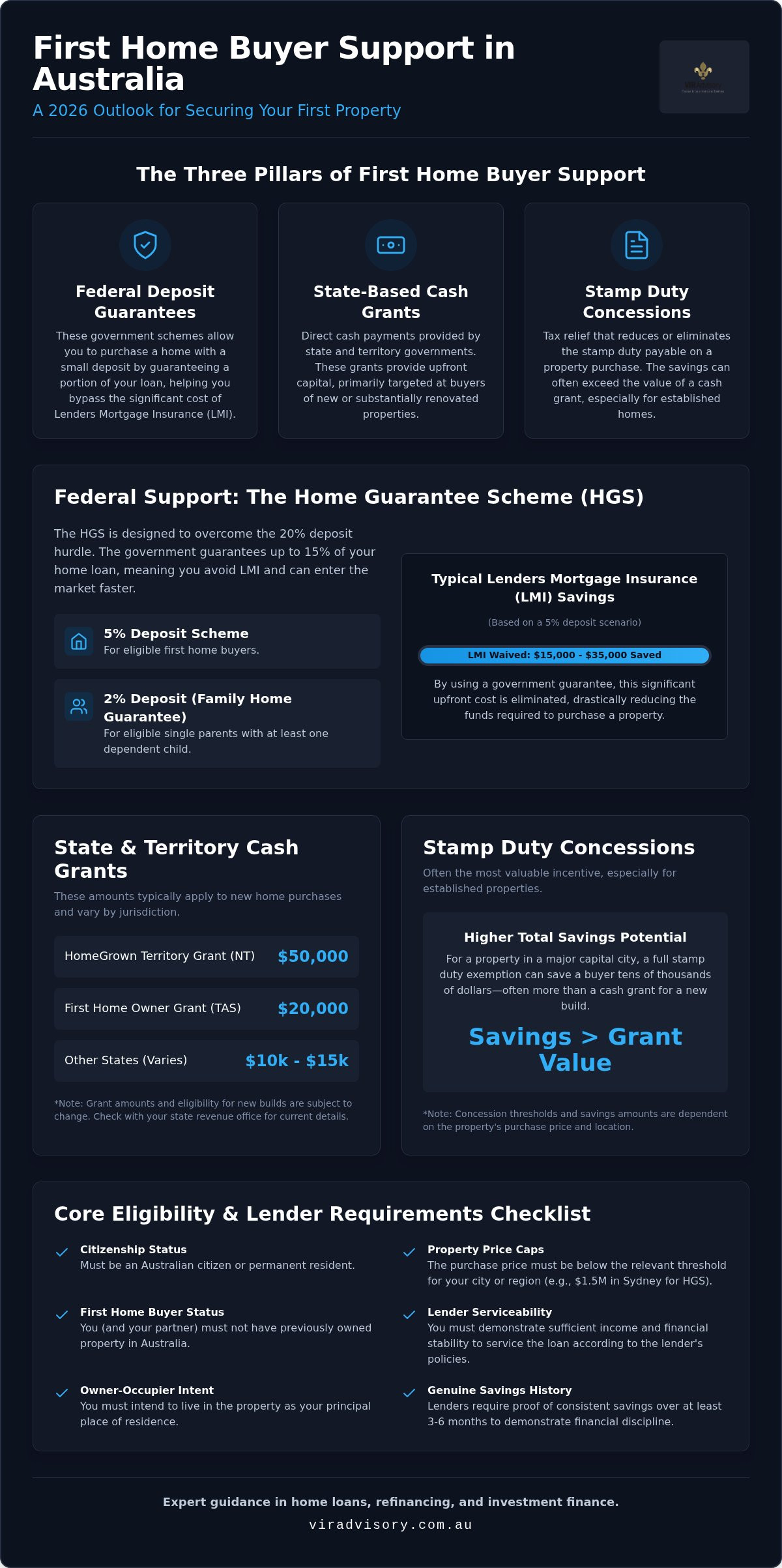
In 2026, first home buyer grants Australia are categorised into three primary tiers of financial support: federal deposit guarantees, state-based cash grants, and stamp duty concessions. These incentives function as tactical lending tools designed to lower the entry barriers for new participants in the property market. While a cash grant provides immediate capital for new builds, a federal guarantee allows you to bypass Lenders Mortgage Insurance (LMI) by having the government back a portion of your loan. Stamp duty concessions further reduce the upfront costs required at settlement. By effectively combining these schemes, eligible borrowers can often reduce their deposit-saving timeline by up to five years. Success requires matching these incentives with specific lender policies, making professional brokerage essential to navigate the 30+ participating institutions.
The Three Pillars of First Home Support
Financial assistance is structured to address different stages of the purchase process. Federal schemes, managed through Housing Australia, focus on deposit guarantees and shared equity programs that reduce the initial cash requirement. The First Home Owner Grant scheme (FHOG) remains a cornerstone of state-level support, providing direct cash payments primarily for new or substantially renovated properties. Tax relief forms the third pillar, where stamp duty exemptions or concessions can save buyers tens of thousands of dollars. These savings often exceed the value of cash grants, particularly when purchasing established homes in higher-priced capital cities.
Eligibility Fundamentals for 2026
To access these schemes, applicants must meet several core criteria. Primary applicants must be Australian citizens or permanent residents, though specific state grants may have varying residency requirements. The "first home" rule is strictly enforced; you cannot have previously owned or held an interest in residential property within Australia, and this restriction often extends to your de facto partner or spouse. Property price caps also dictate eligibility. For example, the Australian Government 5% Deposit Scheme Sydney cap is currently $1.5 million. These thresholds are regularly adjusted to reflect market movements, so verifying the current cap for your target postcode is a critical first step in your finance strategy.
Lenders also apply their own credit assessment rules alongside government criteria. Even if you qualify for a grant, you must still demonstrate serviceability and meet "genuine savings" requirements. This means showing a history of consistent savings over at least three to six months to prove financial discipline. Professional guidance ensures your application is structured to satisfy both the government's eligibility rules and the lender's internal risk management policies.
Federal Support: Guarantees and Shared Equity Schemes
Federal support for first home buyer grants Australia has shifted toward high-leverage guarantees that effectively replace the need for a 20% deposit. The primary mechanism used by Housing Australia is the Home Guarantee Scheme (HGS), which allows eligible participants to enter the market with as little as a 5% or 2% deposit. By providing a government guarantee to the lender for the remaining portion of a standard deposit, these programs eliminate the requirement for Lenders Mortgage Insurance (LMI). This can save a borrower between $15,000 and $35,000 in upfront costs depending on the property value and loan-to-value ratio (LVR). Additionally, the First Home Super Saver (FHSS) scheme allows you to withdraw up to $50,000 of voluntary superannuation contributions, plus associated earnings, to fund your initial purchase costs with significant tax advantages.
The First Home Guarantee (FHBG) Explained
The First Home Guarantee functions by having the government act as a guarantor for up to 15% of the property's value. As of 1 October 2025, the federal government removed income caps and place limits for this specific scheme, making it accessible to a broader range of professionals and self-employed borrowers. While the eligibility has widened, the property price caps remain strict and vary by region. For example, Sydney and regional NSW centres are currently capped at $1.5 million. You must still meet the specific credit and serviceability requirements of a participating lender, even with the government guarantee in place. Not all banks participate in the HGS, so matching your financial profile with a lender that has an available allocation is a critical step in the approval process.
Shared Equity vs. Deposit Guarantees
The Help to Buy scheme, launched in December 2025, introduced a shared equity model that differs significantly from a standard deposit guarantee. Under this program, the government contributes up to 40% of the purchase price for new homes and 30% for existing homes. This reduces your ongoing mortgage repayments and requires only a 2% deposit. However, this support comes with trade-offs. The government retains an equity stake in your home, meaning they'll receive a proportional share of any capital gains when the property is sold. Unlike the First Home Guarantee where you retain 100% of the equity growth, Help to Buy participants must balance lower monthly cash flow requirements against reduced long-term wealth accumulation.
Lenders assess shared equity applications with a high degree of scrutiny, focusing heavily on your ability to eventually "buy out" the government's share or refinance the debt. Because of the complexities involved in these loan structures, you should book a consultation to evaluate which federal scheme aligns with your long-term borrowing capacity and investment strategy. Each lender has different risk appetites for shared equity participants, and choosing the wrong institution can lead to unnecessary application marks on your credit file.
State-Based Incentives and Stamp Duty Concessions
State-level incentives complement federal schemes by providing either direct capital or substantial tax relief at settlement. While federal guarantees focus on reducing the deposit hurdle, state-based first home buyer grants Australia are designed to stimulate specific sectors of the property market, particularly new construction. The financial impact of stamp duty concessions often outweighs the value of the First Home Owner Grant (FHOG), as these tax exemptions can save buyers tens of thousands of dollars in upfront costs. Unlike federal programs that apply nationally, state incentives are governed by local legislation, meaning thresholds and eligibility criteria vary significantly depending on where you intend to purchase.
National Comparison of State Grants
The capital provided through the FHOG is typically reserved for those purchasing or building a new home. In 2026, the available amounts and property value thresholds reflect local market conditions across the country:
- New South Wales, Victoria, and Western Australia: Eligible buyers receive a $10,000 grant for new residential properties.
- Queensland and South Australia: Both states offer a $15,000 grant, with Queensland's amount having reverted from a higher temporary figure on 1 July 2026.
- Tasmania: A $20,000 grant is available for eligible transactions between 1 July 2026 and 30 June 2027.
- Northern Territory: The HomeGrown Territory Grant provides up to $50,000 for contracts signed by 30 September 2027.
- Australian Capital Territory: No cash grant is offered; however, the ACT has abolished stamp duty for all first home buyers as of 1 July 2026.
Most jurisdictions require you to occupy the property as your principal place of residence for a continuous period of six to twelve months, starting within a year of settlement or construction completion. Failing to meet these residency requirements can result in an order to repay the grant with associated penalties.
New Builds vs. Established Properties
The primary distinction in state support lies in the property's history. In most states, the FHOG is no longer available for established homes, as the policy focus has shifted toward increasing housing supply. However, first home buyer grants Australia still provide significant value to purchasers of established homes through stamp duty concessions. For example, NSW offers a full exemption on homes up to $800,000, while Western Australia provides similar relief up to $600,000. These concessions are applied at settlement, reducing the total amount of cash you need to bring to the table.
When opting for a new build, you must manage the timing of grant payments carefully. For a "turnkey" home, the grant is usually paid at settlement. For a construction loan, the funds are often released at the first progress payment, which is typically the slab stage. This timing can create temporary cash flow gaps that must be addressed within your finance strategy. Lenders will assess your ability to cover the initial deposit and land settlement before the grant funds become available, making it essential to have a clear understanding of your lender's specific draw-down policies.
Lender Requirements and Common Approval Obstacles
Securing approval for first home buyer grants Australia requires meeting more than just the government's eligibility criteria. Lenders maintain their own internal risk management policies that can override a government guarantee. For instance, the "Genuine Savings" rule remains a significant hurdle. Most lenders require proof that you have personally saved at least 5% of the purchase price over a three to six-month period. While a state-based cash grant or the FHSS withdrawal provides capital, it is often not classified as genuine savings. Lenders use this requirement to gauge your financial discipline and ability to manage ongoing mortgage obligations.
Serviceability assessments are another critical layer. Lenders don't calculate your borrowing capacity based on the current market interest rate. Instead, they apply a "buffer", typically 3% above the product rate, to ensure you can maintain repayments if rates rise. This assessment includes a deep dive into your debt-to-income (DTI) ratio. Even small existing liabilities can have a disproportionate impact. For example, a credit card with a $10,000 limit is assessed based on the full limit rather than the balance you actually owe. This single card can reduce your total borrowing capacity by $40,000 or more because the lender must factor in the potential for you to max out that credit line at any time.
What Lenders Look for in a First Home Application
Lenders prioritise stability in your employment history. If you are currently in a probation period at a new job, many institutions will decline the application until your position is permanent. Self-employed borrowers typically need two years of tax returns, though some specialised lenders accept one year under specific conditions. Your credit score is also non-negotiable for schemes like the First Home Guarantee. Any recent defaults or missed utility payments can result in an automatic rejection from the government-backed portion of the loan, as these schemes are reserved for borrowers with a clean credit history.
Common Mistakes to Avoid
A frequent error is selecting a property type that falls outside lender guidelines. Many banks apply lower Loan-to-Value Ratio (LVR) caps on high-density apartments or units under 40 to 50 square metres. If you are relying on a 5% deposit scheme, these restrictions can leave you with a funding gap you cannot fill. Additionally, many buyers fail to account for "completion costs". Beyond the deposit, you must have liquid funds for legal fees, building inspections, and strata adjustments. Failing to secure a formal pre-approval before an auction is a high-risk move; it leaves you legally committed to a purchase without a guaranteed funding solution. You can find more details on these requirements in our frequently asked questions.
Step-by-Step Process to Securing Your First Home Loan
A successful application for first home buyer grants Australia requires a sequential approach that aligns your financial profile with both government legislation and lender-specific credit policies. The process is not merely about finding a property; it is about ensuring your funding structure is robust enough to withstand the scrutiny of a formal credit assessment. A finance broker facilitates this by comparing over 30 lenders, identifying those with available scheme allocations and assessment criteria that suit your specific employment or income type. Documenting your eligibility involves gathering evidence of citizenship, a clean credit history, and a declaration that you have not previously held an interest in Australian residential property.
Your Application Framework
- Step 1: Conduct a mortgage health check. Before inspecting properties, you must calculate your borrowing capacity. This involves a granular review of your credit file, living expenses, and current liabilities to determine a sustainable budget.
- Step 2: Maximise your deposit. Utilise the FHSS scheme or maintain disciplined savings in a high-interest account. Lenders typically look for three to six months of consistent saving patterns to satisfy the "genuine savings" requirement.
- Step 3: Identify eligible properties. Ensure your target property falls within the 2026 price caps for your region. For example, if you are using the Australian Government 5% Deposit Scheme in Sydney, the property value must not exceed $1.5 million.
- Step 4: Secure a conditional pre-approval. Apply through a participating lender to lock in a scheme place. This provides the confidence to bid at auction or sign a private treaty contract with a confirmed funding solution.
Improving Your Approval Prospects
Managing your debt-to-income ratio before applying is one of the most effective ways to increase your borrowing capacity. Strategies such as debt consolidation or closing unused credit card accounts can immediately improve your cash flow position in the eyes of a credit assessor. A professional broker provides high-value input here, as they understand the nuances of how different lenders treat overtime, bonuses, or self-employed income. The timeline is also critical; while you apply for federal guarantees alongside your loan application, state-based grants are typically processed after the contract of sale is signed, with funds released at settlement or construction commencement.
Organise a professional lending assessment
Executing Your 2026 Home Ownership Strategy
Securing a position within the complex landscape of First home buyer grants Australia requires a methodical approach that balances government eligibility with bank-specific credit policies. Successful applicants don't just focus on eligibility; they recognise that while federal guarantees can eliminate the need for Lenders Mortgage Insurance, their borrowing capacity is ultimately dictated by debt-to-income ratios and serviceability buffers. By structuring your application to meet "genuine savings" requirements and leveraging state-based stamp duty concessions, you can significantly reduce the capital required to secure your property without compromising your cash flow.
VIR Advisory, led by Raina Doshi with over 15 years of banking expertise, provides the technical oversight needed to compare scheme availability across a broad network of lenders. We focus on methodical funding solutions that address the specific requirements of professionals and self-employed borrowers. Aligning these tactical lending tools with a disciplined financial framework ensures you enter the market with confidence and long-term stability.
Frequently Asked Questions
Can I get the First Home Owner Grant for an established home?
In most Australian states, the First Home Owner Grant is targeted at new or substantially renovated properties and is not available for established homes. However, buyers of existing properties can still access support through stamp duty concessions and federal deposit guarantees. The Northern Territory’s HomeGrown Territory Grant is a notable exception that applies to existing dwellings under specific 2026 criteria. You should focus on stamp duty exemptions as a primary saving mechanism for established houses.
Do I still need a deposit if I am eligible for a government grant?
Yes, you still require a minimum cash contribution even when utilising First home buyer grants Australia. While the government provides guarantees for up to 18% of the property value, lenders typically mandate a personal deposit of at least 2% to 5% to demonstrate financial discipline. Additionally, most credit providers require proof of "genuine savings," which means the funds must have been held in your account for at least three months rather than coming solely from a grant or gift.
What is the maximum income I can earn to qualify for the First Home Guarantee?
As of 1 October 2025, the Australian Government removed income caps for the First Home Guarantee, making the scheme accessible regardless of your annual earnings. This policy shift allows high-earning professionals and company directors to access the 5% deposit scheme without being disqualified by their salary. However, you must still meet individual lender serviceability requirements to ensure you can manage the mortgage repayments at current interest rates plus a 3% buffer. Your borrowing capacity remains the primary limiting factor.
How does the Help to Buy shared equity scheme affect my ownership?
Under the Help to Buy shared equity scheme, the federal government co-purchases the property with you, taking a legal interest of up to 40% for new homes. While this reduces your initial loan size and monthly repayments, it means you don't own the property outright. When you eventually sell the home, the government is entitled to a proportional share of the capital growth, effectively reducing your long-term equity accumulation compared to a standard mortgage structure where you retain 100% growth.
Can I use a gift from my parents as part of my deposit with these grants?
You can use a gifted deposit from family members, but it must be documented correctly with a statutory declaration. Most lenders will still require you to demonstrate that at least 5% of the purchase price consists of your own genuine savings accumulated over time. While the gift helps reach the total required for settlement, credit assessors use your personal savings history to verify your ability to manage future debt obligations and cash flow requirements without relying on external financial support.
What happens if I move out of the property within the first 12 months?
Moving out of the property within the first 12 months generally results in a breach of the residency requirements attached to most state grants and federal guarantees. Most jurisdictions require you to live in the home as your principal place of residence for a continuous period of at least six to twelve months. If you fail to meet this obligation, you may be required to repay the full grant amount and lose your Lenders Mortgage Insurance waiver status, incurring significant unexpected costs.
Are these grants available to permanent residents or only Australian citizens?
Eligibility varies between federal and state programs. The Australian Government 5% Deposit Scheme is available to both Australian citizens and permanent residents. However, specific state-based First Home Owner Grants may have different criteria, sometimes requiring at least one applicant to be an Australian citizen. It's essential to verify the specific residency rules for the jurisdiction where you intend to buy, as these requirements are strictly enforced. Professional guidance ensures your application is directed to lenders who support your specific residency status.
How long does it take for the First Home Owner Grant to be paid?
The timing of the grant payment depends on the type of property you are purchasing. For "turnkey" new homes or established properties, the funds are typically released at the time of settlement to help cover the purchase price. For construction loans, the grant is usually paid out at the first progress payment stage, such as the completion of the slab. Your mortgage broker will coordinate with your lender to ensure the funds are available when needed to meet your contractual obligations.

Article by
Raina Doshi
Raina Doshi has worked in banking and finance since 2011, including experience with major Australian lenders. She helps homeowners, property investors, business owners and professionals secure and structure lending solutions across home loans, refinancing, commercial finance and business lending.
Areas of expertise include residential lending, investment property finance, debt recycling, commercial property finance, equipment finance, construction finance and strategic debt structuring.
Drawing on extensive banking and finance experience, Raina helps clients navigate lender requirements, improve borrowing outcomes and structure effective finance solutions.
Disclaimer
The information in this article is general in nature and does not take into account your personal objectives, financial situation or needs. Before acting on any information, consider whether it is appropriate to your circumstances and seek professional advice.


