

The lowest-rate loan isn’t automatically the best fit for an investment portfolio. A sound investment loan structure keeps borrowing purposes clear while balancing repayments, security and flexibility. That can help prevent one property’s finance arrangements from unnecessarily restricting future borrowing or refinancing. Separating personal and investment borrowing is a common consideration, and the way loans are split and secured can affect how clearly you track each purpose and manage your options later.
This article explains how loan purpose, loan splits, property security and lender assessment can shape an investment loan structure. You’ll see the trade-offs between common choices, what lenders may consider when assessing income, existing debts, rental income, credit history and property, and what information to prepare before applying. It also covers practical steps to avoid common structural issues, such as combining borrowing purposes in a way that makes later changes harder to manage. The right arrangement depends on your circumstances and objectives, not just the advertised rate.
Key Takeaways
- An investment loan structure brings together the borrower, purpose of the funds, property security, loan splits and repayment type. Consider how each part may affect future borrowing and flexibility.
- Separate loan splits can make different borrowing purposes easier to identify. Cross-collateralisation may affect your options when refinancing or selling a property.
- Compare repayment type, offset access, loan splits and security for both their cash-flow benefits and their limitations, including lender eligibility.
- Prepare a clear picture of your income, debts, available equity and rental assumptions, along with supporting documents, before seeking assessment.
- Compare lender options against your objectives and financial position to assess which investment loan structure may suit your circumstances.
What does an investment loan structure include, and why does it matter?
An investment loan structure is the arrangement of who borrows, what the borrowed funds are used for, which property secures the debt, and how the loan is divided and repaid. These choices affect how clearly you can track borrowing, manage repayments and respond to future plans. Approval matters, but the structure should also reflect your cash-flow needs and objectives.
A mortgage is a loan secured against property. The mortgage loan overview explains this basic relationship between borrower, lender and security. For an investment property, the details of the loan purpose, borrower and loan settings help determine how the security supports the borrowing.
The following video provides a general overview of loan structure concepts. Its examples may not reflect Australian lender policies or your circumstances.
Which decisions make up an investment loan structure?
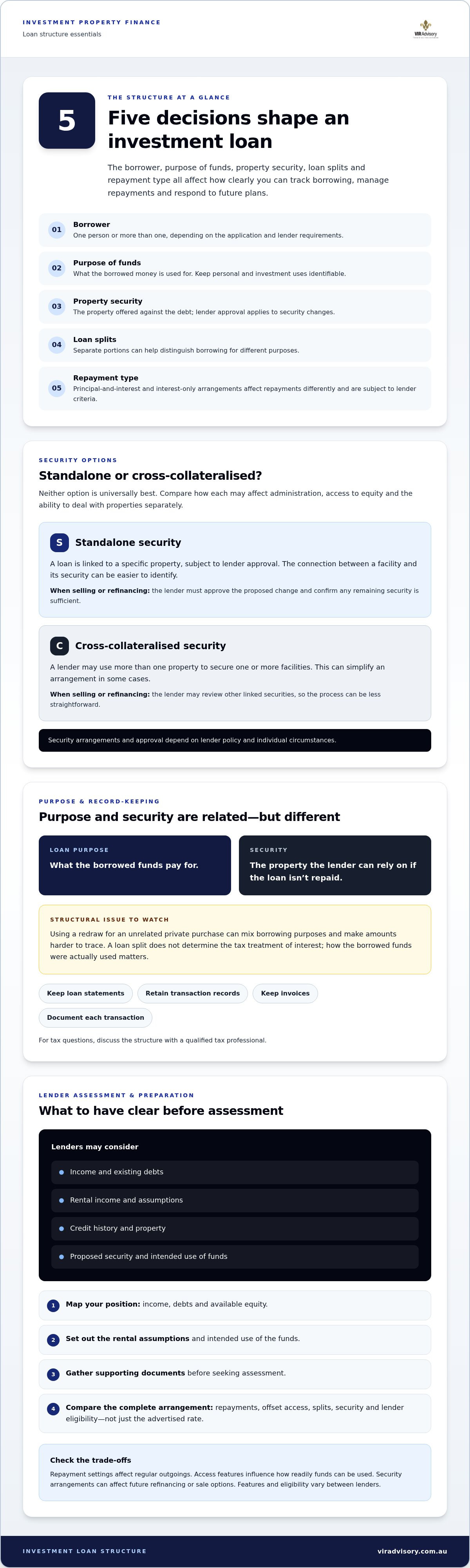
The borrower may be one person or more than one, depending on the application and lender requirements. Loan purpose records what the funds are for, while security is the property offered against the debt. Loan splits divide borrowing into separate portions, which may have different purposes or features. Repayment type also matters: principal-and-interest and interest-only arrangements affect repayments differently and are subject to lender criteria.
Hypothetical example: An investor applies to borrow for a rental property while retaining a separate home loan. The lender assesses the applicant’s income, liabilities, proposed security and intended use of the funds. The investor’s preference to keep borrowing purposes distinct is another consideration, but lender assessment and available options determine what can be approved.
Why do investors need to think beyond the interest rate?
A lower headline rate may reduce interest costs, but it doesn’t establish that the loan suits your cash flow or plans. Repayment settings affect regular outgoings, access features influence how readily funds can be used, and security arrangements can affect future refinancing or sale options. Features and eligibility vary between lenders, so compare the complete arrangement rather than the rate alone.
Clear records are practical, too. If funds for personal and investment purposes are mixed, it can be harder to identify what each portion financed. Keep records of how borrowed funds are used, and discuss the structure with a qualified tax professional if you need guidance on tax treatment. Before applying, consider how proposed repayments fit alongside existing commitments and review your borrowing capacity as part of the wider lending picture.
How do loan purpose, splits and security work for investment property?
Loan purpose describes what the borrowed funds pay for; security identifies the property the lender can rely on if the loan isn’t repaid. These are related but separate parts of an investment loan structure. A rental property can secure a loan without determining how every dollar borrowed was used.
Keeping these details clear can matter if you later refinance, sell a property or review how funds were applied. The right arrangement depends on your objectives, lender requirements and the circumstances of the application.
What is the difference between standalone and cross-collateralised loans?
With standalone security, a loan is linked to a specific property, subject to lender approval. This can make the connection between a facility and its security easier to identify. If you sell or refinance that property, the lender still needs to approve the proposed change and confirm that any remaining security is sufficient.
Cross-collateralisation means a lender may use more than one property to secure one or more facilities. This can simplify an arrangement in some cases, but selling or refinancing one property may involve reviewing the other linked securities. The process can be less straightforward, and the lender’s requirements apply to the facilities as a whole.
Neither option is universally best. Compare how each may affect administration, access to equity and your ability to deal with properties separately. Security arrangements and approval depend on lender policy and individual circumstances.
When can loan splits help keep borrowing purposes clear?
A loan split is a separate portion of borrowing within a loan arrangement. Splits can help distinguish funds used for different purposes, but the split itself doesn’t determine the tax treatment of interest. Tax analysis can depend on how the borrowed funds were actually used, so accurate records matter.
Hypothetical example: An investor borrows to pay investment property expenses, then redraws from the same facility to fund a private purchase. The facility now has mixed use, which can make it harder to trace the amounts and assess the tax position. Keeping investment and private borrowing in separate portions from the outset may make records easier to follow, but each transaction still needs to be documented.
Keep loan statements, transaction records and invoices. Avoid using a redraw facility for unrelated purposes without considering the record-keeping implications. A qualified tax adviser can assess tax questions against your specific circumstances.
Which investment loan structure options should you compare?
Compare loan features as a combination, not in isolation. Repayment type affects how quickly the balance reduces, access features influence how funds are managed, and security settings can shape later changes. Options, terms and eligibility depend on lender policy and your application. Your investment loan structure should also reflect income stability, cash-flow needs and investment plans.
| Option | Potential benefit | Limitation to consider |
|---|---|---|
| Principal and interest | Repayments reduce both interest and principal over time. | Regular repayments may be higher than an interest-only arrangement, affecting available cash flow. |
| Interest-only | During the agreed interest-only period, scheduled repayments cover interest rather than principal, which may leave more cash flow available for other commitments. | The balance generally doesn’t reduce through scheduled repayments during that period. Eligibility, terms and later repayments depend on lender policy and assessment. |
| Offset account | Where available, money held in the account can reduce the balance on which interest is calculated, while remaining accessible. | Access and account conditions vary. Consider applicable features and costs when comparing the overall loan. |
| Redraw facility | May allow access to eligible additional repayments made on the loan. | Access is subject to facility terms, and using redraw for different purposes can complicate records and purpose tracing. |
| Separate loan splits | Distinct portions can make borrowing purposes or features easier to identify and manage separately. | More portions may require additional administration, and a split doesn’t itself determine tax treatment. |
| Standalone or linked security | Standalone security can keep a facility tied to a specific property; linked security may support multiple facilities or properties. | Standalone arrangements still require lender approval. Linked security may make a sale or refinance more involved. |
Interest-only or principal-and-interest: what changes?
With principal-and-interest repayments, each scheduled payment covers interest and reduces some principal. With interest-only repayments, principal generally remains unchanged during the agreed period unless you make additional repayments. Interest-only may provide short-term cash-flow flexibility, but the balance stays higher for longer and repayments may change when the period ends. Consider the effect on your budget beyond the initial term, as well as the lender’s assessment criteria.
Offset account, redraw or separate loan split?
An offset account holds funds separately while potentially reducing the balance used to calculate interest. Redraw gives access to eligible extra repayments already made on a loan. A separate split creates another loan portion, which may help keep uses or features distinct. These options differ in access, terms and record-keeping, and none guarantees a tax outcome. If reviewing an existing facility or considering a refinance, include the features and security arrangements in your comparison, not just the rate.
Before choosing a combination, compare repayments with expected income and expenses, review the lender’s terms, and consider how a future refinance or property sale could affect the arrangement.
How can you prepare an investment loan structure for lender assessment?
Prepare your application by setting out the intended borrowing, your financial position and the evidence supporting it. Lenders assess applications under their own policies, so no document set or loan arrangement guarantees approval. Clear, consistent information helps a lender assess the proposed investment loan structure and identify gaps to resolve.
What information may lenders consider?
Assessment may cover income, regular expenses, existing loans and credit commitments, assets, available equity, the proposed loan purpose and the property offered as security. Lenders may also consider rental income, but the amount they recognise can vary by policy. Property values and acceptable valuation methods can vary between lenders, too, so don’t assume an estimated value will match the figure used in an assessment.
These inputs affect borrowing capacity, so review your full financial position before comparing options. For an overview, see the published borrowing capacity guide.
Which mistakes can delay or weaken an application?
Unreported debts, incomplete records and inconsistent figures across documents can prompt follow-up questions or affect assessment. Unclear use of funds can also make it harder to understand the purpose of a loan split. Prepare accurate information before comparing lender options or submitting an application.
Test assumptions rather than treating them as certain. Expected rent, usable equity and the possibility of refinancing later may differ from what a lender accepts or what the property supports at the time. Keep rental estimates and property details documented, and make sure your figures account for existing repayments and other liabilities.
A practical preparation process
- Clarify the objective: Record what you intend to buy or fund, the amount sought and how you’ll use the funds.
- Map your finances: List income, expenses, assets, available equity, current loans and credit commitments.
- Document property assumptions: Gather information on the proposed security and expected rental income, recognising that lender assessment may differ.
- Check the structure: Note which borrowing purposes may need separate portions and what security arrangement you want considered.
- Compare lender options: Review assessment approaches, terms and features against your objectives, then organise consistent supporting evidence.
Application preparation at a glance
OBJECTIVE → What are the funds for?
FINANCES → Income, expenses, assets, debts and equity
PROPERTY → Security details and rental evidence
STRUCTURE → Purpose, loan portions and security arrangement
SUBMISSION → Complete, consistent supporting documents
Useful documents may include income records, current loan statements, details of assets and liabilities, property information, rental evidence and records showing the intended use of funds. Self-employed applicants may need income records that reflect how their income is earned. Exact evidence requirements vary by lender and applicant.
How can VIR Advisory help assess an investment loan structure?
A broker can compare lender options against your objectives and financial position, then explain how differences in assessment criteria, security and loan features may affect the proposed arrangement. VIR Advisory provides investment loan structuring and finance brokerage, helping investors assess options without acting as a direct lender.
What can a tailored brokerage assessment cover?
An assessment brings together the key parts of an application: the purpose of the borrowing, current liabilities, available equity, expected cash flow and the property or properties involved. Lender options can then be compared against your circumstances, including relevant criteria and the trade-offs between repayment settings, loan splits and security arrangements.
This comparison is specific to your application. Lender policies differ, and approval, loan terms and conditions depend on the application and the lender’s assessment. Tax treatment also depends on your circumstances and how funds are used, so discuss tax questions separately with a qualified tax adviser.
VIR Advisory’s investment finance services draw on Raina Doshi’s more than 15 years of banking and finance experience, including over a decade with one of Australia’s leading banks. The focus is on assessing available finance options in light of your stated plans and existing commitments.
What should you bring to an initial discussion?
A concise summary helps keep the discussion practical. Include your income and assets, existing debts and regular commitments, property plans, available equity and intended use of borrowed funds. Note any preferences around repayments, loan splits or security, along with questions about cash flow or future refinancing.
Bring supporting documents where available, such as current loan statements, income records, property details and rental information. These help clarify your position, although a lender may request further evidence during its assessment.
Explore VIR Advisory’s investment finance services to discuss your circumstances and potential lender options.
Review your borrowing structure before the next purchase
A well-considered investment loan structure involves more than securing lender approval. Clear borrowing purposes, suitable loan splits and carefully assessed security can support accurate record-keeping and help preserve options for refinancing or future purchases. Repayment settings and access features also need to fit your cash flow, while lender policies and your circumstances determine what may be available.
Before applying, organise accurate information about income, liabilities, equity, rental assumptions and how you intend to use the funds. Compare lender options against those details rather than relying on the headline rate alone, and seek qualified tax advice for questions about tax treatment.
VIR Advisory provides investment loan structuring and finance brokerage across Australia. Raina Doshi brings over 15 years of banking and finance experience to discussions about your objectives and potential lender options.
Frequently Asked Questions
What is an investment loan structure?
An investment loan structure is the arrangement of the borrower, the purpose of the funds, the property offered as security, and how the loan is split and repaid. For example, an investor may have one portion for an investment purchase and another for a different purpose. The structure also includes features such as repayment type and access to funds. Lender policy and the borrower’s circumstances influence which arrangements may be available.
Is it better to keep an investment loan separate from a home loan?
Keeping investment borrowing in a separate facility can make it easier to identify which funds relate to each purpose, but it isn’t automatically the best option for everyone. Consider the security arrangements as well: separate loans may still be secured against more than one property, depending on lender approval. Consider how the proposed setup could affect record-keeping, repayments, refinancing and future property plans before deciding.
Can I use equity in my home to fund an investment property deposit?
You may be able to borrow against available equity in your home to help fund an investment property deposit, subject to lender assessment and approval. Equity isn’t automatically available cash: the lender considers factors such as the property’s value, existing debt and your ability to meet repayments. Additional borrowing increases your liabilities and may affect borrowing capacity, so assess the repayments and security implications alongside the deposit plan.
What is cross-collateralisation in an investment loan?
Cross-collateralisation is an arrangement where a lender uses multiple properties as security for one or more loan facilities. This can connect the properties within the lending arrangement, which may affect how a sale, refinance or change to one loan is handled. By contrast, standalone security links a facility to a specific property, subject to lender approval. Compare the options against lender requirements, your objectives and the effect on future flexibility.
Should an investment property loan be interest-only or principal-and-interest?
It depends on your cash-flow requirements, plans and the lender’s assessment. Principal-and-interest repayments reduce the loan balance over time, while interest-only repayments generally don’t reduce principal during the agreed period. Interest-only may provide more cash-flow flexibility initially, but leaves a higher balance to repay and repayments may change when that period ends. Compare the full repayment profile, not only the initial payment, and check the terms available for your application.
How do lenders assess an investment property loan application?
Lenders assess applications under their own policies, considering information such as income, expenses, existing debts, assets, credit history, available equity and the proposed property security. They may also consider expected rental income, though the amount accepted can vary. Prepare consistent financial records, details of current liabilities, information about the property and a clear explanation of the funds’ intended purpose. Approval depends on the lender’s assessment of the complete application.
What happens if I redraw investment loan funds for personal use?
Redrawing funds for a personal purpose can make it harder to distinguish that borrowing from amounts used for the investment, particularly if the loan also has investment-related use. Keep clear records of each redraw and what the funds paid for. The tax treatment of interest may depend on how borrowed funds were used, so don’t assume the account’s original label determines the outcome. Ask a qualified tax adviser to assess your circumstances.

Article by
Raina Doshi
Raina Doshi has worked in banking and finance since 2011, including experience with major Australian lenders. She helps homeowners, property investors, business owners and professionals secure and structure lending solutions across home loans, refinancing, commercial finance and business lending.
Areas of expertise include residential lending, investment property finance, debt recycling, commercial property finance, equipment finance, construction finance and strategic debt structuring.
Drawing on extensive banking and finance experience, Raina helps clients navigate lender requirements, improve borrowing outcomes and structure effective finance solutions.
Disclaimer
The information in this article is general in nature and does not take into account your personal objectives, financial situation or needs. Before acting on any information, consider whether it is appropriate to your circumstances and seek professional advice.


