

Expanding a business in Australia is a significant step. It’s a sign of success and a commitment to future growth, but it also comes with the challenge of securing the right funding. Finding the best way to finance your expansion without compromising long-term financial stability can feel overwhelming, especially in Australia's evolving lending landscape.
This guide provides a clear roadmap for Australian SME owners. We'll move beyond the basics of applying for a loan and focus on how to strategically structure your funding for sustainable growth. We'll explore the different types of finance available, what lenders look for, and how an expert broker can help you navigate the process with confidence.
Understanding Business Expansion Loans in the Australian Market
A business expansion loan is a form of growth capital specifically designed to fund activities that scale your operations, increase market reach, or improve profitability. Unlike standard working capital that covers daily expenses like rent and wages, expansion funding is a strategic investment in your company's future revenue-generating capacity.
This type of finance requires a different approach. Lenders are not just looking at your past performance; they are assessing the viability of your future plans. Your ambition to grow is a key part of the equation, and the right funding acts as the catalyst to turn that ambition into reality.
The Distinction Between Growth Capital and Working Capital
Understanding the difference between these two funding types is crucial for structuring your finance correctly.
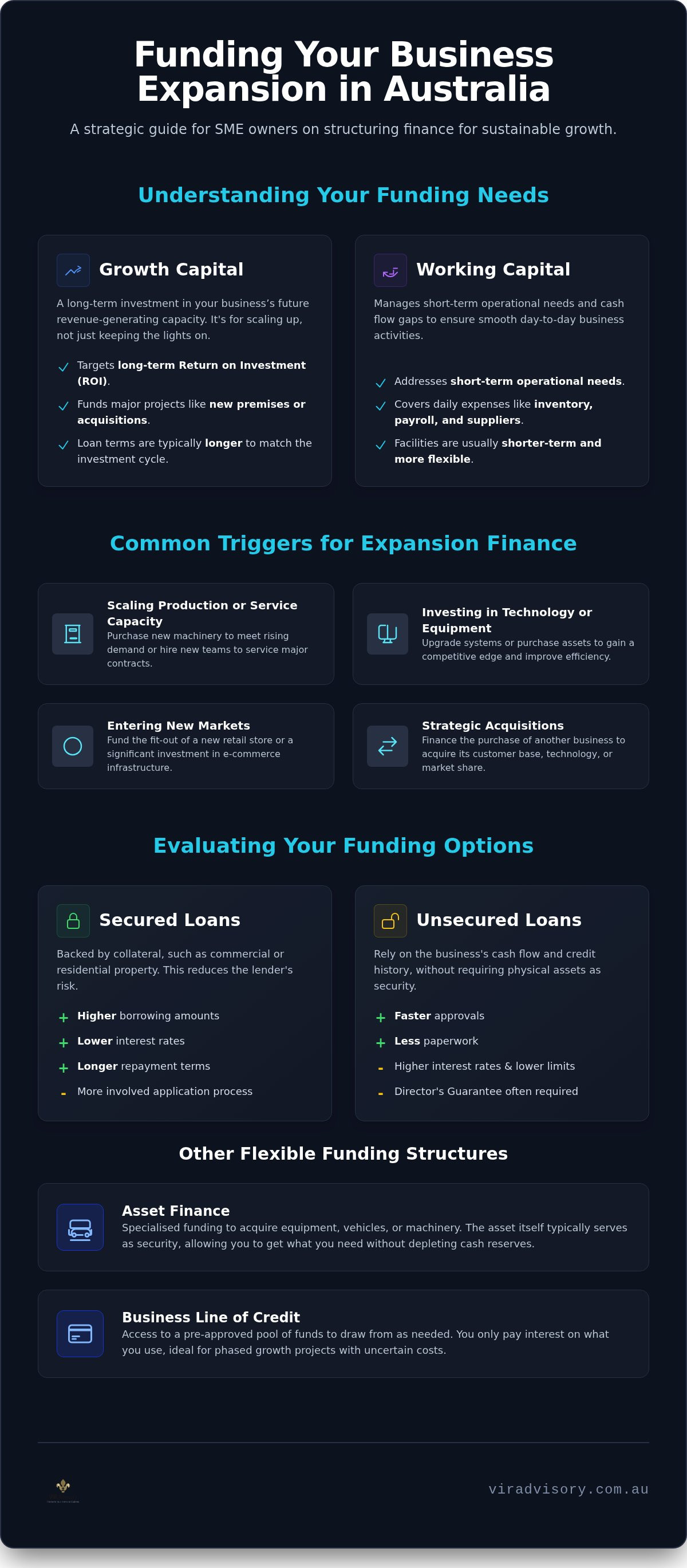
- Growth Capital is an investment in your business’s future. It targets long-term return on investment (ROI) by funding major projects like acquiring new premises, purchasing significant assets, or launching in a new market. The loan terms are typically longer to align with the time it takes for these investments to generate returns.
- Working Capital addresses short-term operational needs and cash flow gaps. It covers day-to-day expenses like inventory, payroll, and supplier payments. These facilities are usually shorter-term and more flexible.
Mismatched funding—using a short-term loan for a long-term project—can place immense pressure on your cash flow. Aligning the loan's purpose and term with your growth cycle is fundamental to long-term financial health.
Common Triggers for Seeking Expansion Finance
Businesses seek expansion funding to capitalise on specific growth opportunities. These often include:
- Scaling Production or Service Capacity: A manufacturing business might need to purchase new machinery to meet rising demand, or a consulting firm might need to hire a new team to service a major contract.
- Investing in Technology or Equipment: Upgrading technology to gain a competitive edge, such as a logistics company investing in automation or a café buying a state-of-the-art coffee roaster through asset finance.
- Entering New Markets: This could involve the physical expansion of fitting out a new retail store or office, or a digital expansion through a significant investment in e-commerce infrastructure and marketing.
- Strategic Acquisitions: Funding the purchase of another business to acquire its customer base, technology, or market share.
Evaluating Funding Structures: Beyond the Standard Business Loan
Choosing the right loan is about more than just securing the funds; it’s about selecting a structure that supports your business's cash flow and future plans. The finance product you choose today will impact your ability to refinance or secure further credit down the track. The goal is to match the right product to your specific expansion milestone.
Secured vs. Unsecured Expansion Finance
One of the first decisions is whether to use an asset as security for the loan.
- Secured Loans: These are backed by collateral, such as commercial or residential property. Because this reduces the lender's risk, secured loans typically offer higher borrowing amounts, lower interest rates, and longer repayment terms. However, the application process can be more involved.
- Unsecured Loans: These do not require physical assets as security, relying instead on the business's cash flow and credit history. They offer faster approvals and less paperwork, making them suitable for urgent opportunities. The trade-off is often a higher interest rate and lower borrowing limit. Many unsecured business loans still require a director's guarantee, which is a personal commitment to repay the debt if the business cannot.
Asset Finance and Business Lines of Credit
Beyond a simple lump-sum loan, other products offer more flexibility for specific expansion goals.
- Asset Finance: This is a specialised type of funding used to acquire equipment, vehicles, or machinery. The asset itself typically serves as security for the loan. This allows you to acquire essential equipment without depleting your cash reserves, with repayments structured to match the asset's useful life.
- Business Line of Credit: This provides access to a pre-approved pool of funds that you can draw from as needed. You only pay interest on the amount you use. A line of credit is ideal for the phased stages of a growth project with uncertain costs, such as a renovation or a prolonged marketing campaign, allowing for the flexible execution of your business plan.
The Strategic Advantage of a Finance Broker for Growth Capital
Navigating the complex lending market alone can be time-consuming and frustrating. A commercial finance broker acts as your advocate and guide, helping you access a broader market and secure more suitable terms. Instead of approaching lenders one by one, you gain an expert partner dedicated to finding the right solution for your specific circumstances.
The key benefits include:
- Access to a Wider Range of Lenders: A broker has established relationships with dozens of lenders, including major banks and non-bank specialists, many of whom do not deal directly with the public.
- Expert Guidance and Strategy: A good broker does more than just find a loan. They help you structure your application, present your business case effectively, and negotiate terms on your behalf.
- Saving Time and Effort: The broker manages the entire application process, from paperwork to settlement, freeing you up to focus on running your business.
Major Banks vs. Non-Bank Lenders: A Comparison
Australia has a diverse lending environment. A broker helps you navigate the two distinct worlds of traditional banks and specialist non-bank lenders.
Major Banks
- Best for: Established businesses with a long trading history, strong financials, and property to offer as security.
- Strengths: Often offer lower interest rates, larger loan amounts, and a wide range of products. They provide a sense of stability and familiarity.
- Considerations: Can have rigid lending criteria, slower approval times, and may be less flexible for businesses in niche industries or with unique circumstances.
Non-Bank Lenders
- Best for: Newer businesses, those with fluctuating cash flow, or owners who need fast and flexible funding solutions without using property as security.
- Strengths: More flexible credit policies, faster decision-making, and innovative products tailored to specific industries or scenarios (e.g., low-doc loans).
- Considerations: Interest rates can be higher to reflect the increased risk. It's important to work with a reputable broker to navigate this diverse market.
Securing Favourable Terms Through a Structured Approach
The best loan isn't always the one with the lowest interest rate. A broker helps you evaluate the entire loan structure, including establishment fees, ongoing charges, and key terms and conditions (covenants). Their expertise is in structuring the debt to support your cash flow and long-term goals, ensuring the finance solution is a genuine asset to your business, not a burden.
For an overview of how tailored strategies can be applied, see our range of commercial finance services.
Preparing Your Enterprise for a Successful Loan Application
A well-prepared application presents a compelling case to lenders and significantly improves your chances of approval. Lenders need to be confident in both your business's current stability and its future potential. Professional oversight during this stage can reduce stress and prevent common mistakes.
Essential Documentation and Financial Reporting
Meticulous documentation is the foundation of lender trust. Lenders use your financial records to verify your ability to service the debt. Before applying, you should have:
- Up-to-Date Financial Statements: Typically two years of Profit & Loss statements and Balance Sheets.
- Recent Business Activity Statements (BAS): To show current revenue and tax compliance.
- Tax Returns and ATO Portal Statements: For both the business and its directors to confirm there are no outstanding tax debts.
- A Clear Business Plan: For expansion funding, this is critical. It should detail how the funds will be used, projected revenues, and the expected return on investment.
- Cash Flow Projections: A forecast showing how your business will comfortably manage the new loan repayments alongside its existing obligations.
Understanding Key Lender Assessment Criteria
Lenders assess what is often called the "Five Cs of Credit" to determine your eligibility:
- Character: Your business and personal credit history, industry experience, and reputation.
- Capacity: Your ability to repay the loan. Lenders calculate your Debt Service Cover Ratio (DSCR) to ensure your business generates enough surplus cash flow to cover the proposed repayments.
- Capital: The amount of money you have personally invested in the business. It shows you have skin in the game.
- Collateral: Assets available to secure the loan, which reduces the lender's risk.
- Conditions: The purpose of the loan, the amount requested, and the prevailing economic conditions for your industry.
Common reasons for a loan being declined include a poor credit history, insufficient or inconsistent cash flow, a weak business plan, or outstanding tax debts. Addressing these issues before you apply is a crucial step. To get a preliminary understanding of your position, it can be helpful to speak with an expert. You can contact us for a complimentary eligibility assessment.
How VIR Advisory Can Help You Secure Growth Funding
At VIR Advisory, we provide a clear, logical pathway to business expansion finance. We understand that taking on debt for growth is a major decision, and our role is to provide the expert guidance and support you need to move forward with confidence. We act as your strategic partner, ensuring the funding solution you choose aligns perfectly with your business goals.
A Personalised Experience for Australian Business Owners
Our process is built on a foundation of thorough consultation. We take the time to understand your business, your industry, and your specific objectives. This allows us to:
- Navigate the Market for You: We leverage our national network of banks and non-bank lenders to identify the most suitable options for your circumstances, saving you time and uncertainty.
- Structure Your Funding Correctly: We focus on how today’s loan structure will impact your business’s stability and flexibility tomorrow, optimising for healthy cash flow and future growth.
- Manage the Application Process: We handle the details with professional oversight, from preparing the documentation to liaising with lenders, ensuring a smooth and efficient experience.
Next Steps: Organise Your Strategic Consultation
Move from uncertainty to clarity. A conversation with one of our finance experts is the first step toward securing the right funding to fuel your business's growth. We can help you understand your options, assess your eligibility, and build a clear plan of action.
Book a Strategic Finance Consultation to discuss your expansion plans with an expert.
Frequently Asked Questions (FAQs)
What is the typical interest rate for business expansion loans in Australia?
Interest rates for business loans vary widely depending on the lender, the loan type (secured vs. unsecured), your business's financial health, credit history, and the loan amount. Secured loans generally have lower rates than unsecured options. A finance broker can help you compare current rates from a range of lenders.
Can I get a business expansion loan without using my home as collateral?
Yes. Many businesses secure funding without using residential property as security. Options include unsecured business loans, which rely on your business cash flow, or asset finance, where the equipment being purchased serves as security. Non-bank lenders, in particular, offer a range of flexible solutions.
How long does the application process for a business growth loan usually take?
The timeline depends on the lender and the complexity of the application. Unsecured loans can sometimes be approved and funded within a few business days. Larger, more complex secured loans can take several weeks. Having all your documentation prepared in advance will help speed up the process significantly.
Is a business expansion loan different from a standard commercial loan?
A business expansion loan is a type of commercial loan, but it is specifically for the purpose of growth. The application often requires more detail about future plans, such as a business plan and cash flow projections, as lenders are assessing your strategy for generating a return on the borrowed funds.
What documents do I need to provide for a business loan in Australia?
Typically, you will need two years of financial statements (P&L and Balance Sheet), recent BAS, business and personal tax returns, and bank statements. For expansion funding, a detailed business plan explaining how the funds will be used is also essential.
Can a finance broker help me if I have been rejected by a major bank?
Absolutely. A rejection from one bank does not mean you cannot get finance elsewhere. Finance brokers have access to dozens of non-bank lenders who have different credit policies and may be more willing to fund your proposal. A broker can help identify the reasons for the decline and present your application to a more suitable lender.
How much can my business borrow for expansion purposes?
Your borrowing capacity is determined by your business's ability to service the debt. Lenders will analyse your revenue, profitability, and existing financial commitments to calculate how much you can comfortably repay. The amount of available security can also influence the maximum loan size.
What happens if I need to refinance my expansion loan later?
Refinancing is a common strategy used to secure better terms, reduce repayments, or access additional equity as your business grows. It's important to choose a loan with minimal or no early exit fees to maintain this flexibility. A broker can help you review your loan structure periodically to ensure it still meets your needs.

Article by
Raina Doshi
Raina Doshi has worked in banking and finance since 2011, including experience with major Australian lenders. She helps homeowners, property investors, business owners and professionals secure and structure lending solutions across home loans, refinancing, commercial finance and business lending.
Areas of expertise include residential lending, investment property finance, debt recycling, commercial property finance, equipment finance, construction finance and strategic debt structuring.
Drawing on extensive banking and finance experience, Raina helps clients navigate lender requirements, improve borrowing outcomes and structure effective finance solutions.
Disclaimer
The information in this article is general in nature and does not take into account your personal objectives, financial situation or needs. Before acting on any information, consider whether it is appropriate to your circumstances and seek professional advice.


