

For Australian business owners, securing the right finance is the critical difference between stagnation and seizing a market opportunity. Yet, the traditional path through the Big Four banks is often a slow, rigid process, leaving agile businesses without the capital they need, when they need it. This guide explores the sophisticated and increasingly vital world of non-bank business loans in Australia, a landscape that has evolved far beyond a simple ‘Plan B’.
Discover how non-bank lenders provide the flexibility and speed traditional banks often lack, and learn to select the right pathway for your business growth. It’s not just about getting a loan; it’s about architecting a debt structure that fuels your vision.
Understanding the Australian Non-Bank Lending Landscape
The term ‘non-bank lender’ can feel ambiguous, but the reality is a diverse and highly regulated ecosystem of financial specialists. These institutions are a cornerstone of the Australian economy, providing essential capital to the small and medium-sized enterprises (SMEs) that drive our national growth.
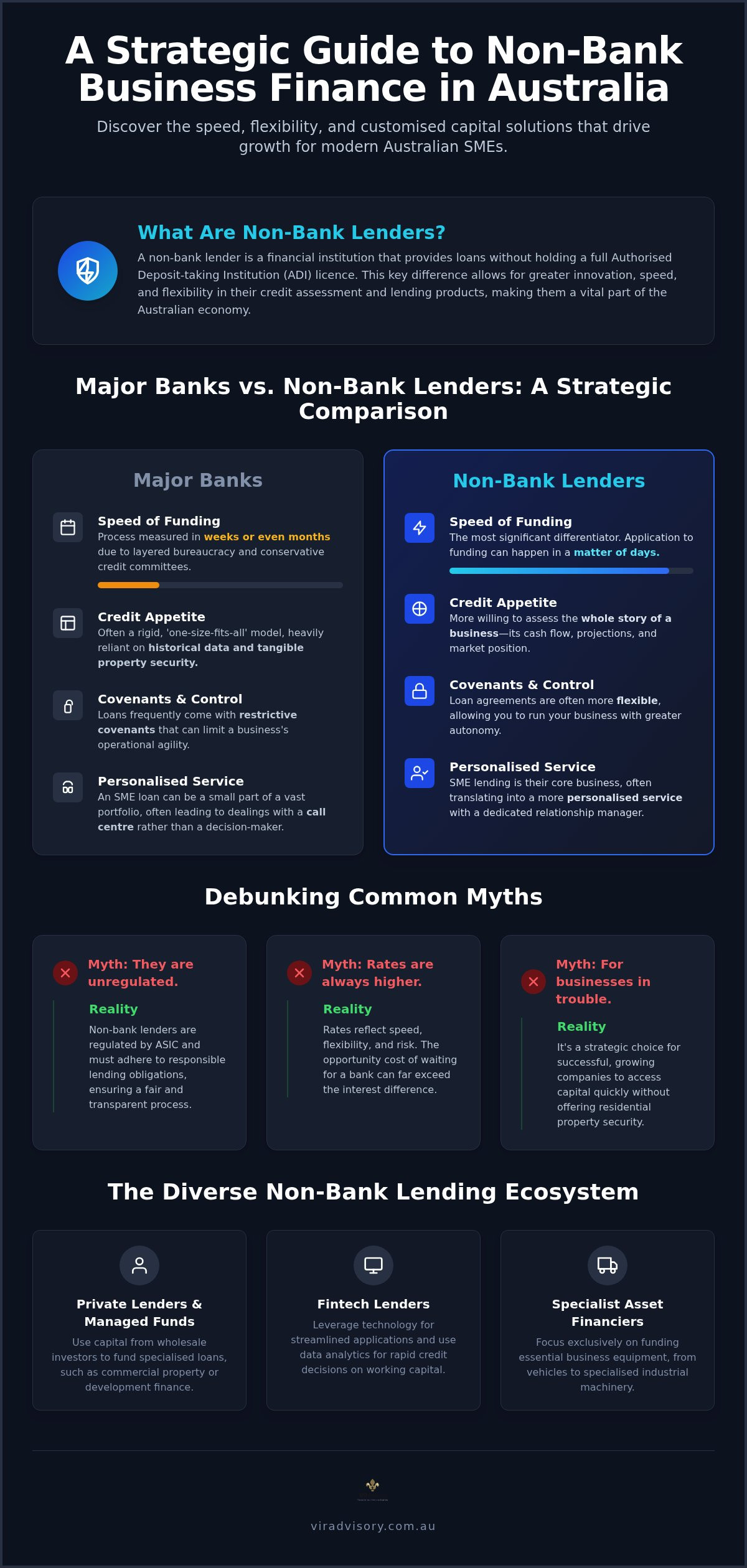
So, what exactly are they? A non-bank lender is a financial institution that provides credit and loans without holding a full Authorised Deposit-taking Institution (ADI) licence from APRA. This distinction is key. Because they don’t take customer deposits like traditional banks, they operate under a different capital and regulatory structure, allowing for greater innovation and flexibility in their credit assessment and lending products.
This sector includes a wide range of providers:
- Private Lenders and Managed Funds: These institutions use capital from wholesale and sophisticated investors to fund specialised business loans, often in commercial property or development finance.
- Fintech Lenders: Leveraging technology, these online platforms offer streamlined application processes and use advanced data analytics for rapid credit decisions, ideal for working capital or unsecured loans.
- Specialist Asset Financiers: These lenders focus exclusively on funding essential business equipment, from vehicles and trucks to specialised industrial machinery.
The Evolution of Alternative Finance in Australia
Historically, non-bank lenders were often viewed as a ‘lender of last resort’. Today, that perception is outdated. The Australian SME market is deliberately shifting away from an exclusive reliance on the Big Four, driven by a need for speed, customisation, and a more nuanced understanding of modern business models.
Technology has been a major catalyst, enabling non-bank lenders to automate document analysis and integrate directly with accounting software like Xero and MYOB. This allows them to assess the real-time health of a business, rather than relying solely on historical tax returns. The result is a credit process that is not only faster but often more relevant to a company’s current trajectory. This evolution has positioned non-bank lenders as primary strategic partners for thousands of successful Australian businesses.
Common Myths About Non-Bank Lenders
Misconceptions can create hesitation, so it’s important to address them directly. The most common myths often revolve around regulation, cost, and risk.
- Myth: They are unregulated. This is incorrect. Non-bank lenders operating in Australia are regulated by the Australian Securities and Investments Commission (ASIC) and must adhere to responsible lending obligations under legislation like the National Consumer Credit Protection Act (NCCP) where applicable. This ensures a fair and transparent process for borrowers.
- Myth: Their interest rates are always higher. While some non-bank products may have a higher headline interest rate than a major bank, this reflects a different assessment of risk, speed of funding, and flexibility. It’s crucial to evaluate the value, not just the cost. The opportunity cost of waiting months for a bank approval can far exceed the difference in interest.
- Myth: They are only for businesses in trouble. This is perhaps the most damaging myth. Today, some of Australia’s most successful and rapidly growing companies choose non-bank finance. They do so for strategic reasons: to secure growth capital without offering up the family home, to fund a major equipment purchase quickly, or to access bespoke cash flow solutions that align with their specific industry cycle.
Major Banks vs. Non-Bank Lenders: A Strategic Comparison
Choosing between a major bank and a non-bank lender isn’t about which is ‘better’ in a general sense; it’s about which is the right strategic fit for your specific circumstances. Understanding their fundamental differences is the first step in making an informed decision.
Here’s a breakdown of the key comparison points for the Australian market:
- Speed of Funding: This is the most significant differentiator. Non-bank lenders, particularly fintechs, can often move from application to funding in a matter of days. Traditional banks, with their layered bureaucracy and conservative credit committees, typically measure this process in weeks or even months.
- Credit Appetite: The Big Four often apply a rigid, ‘one-size-fits-all’ credit scoring model heavily reliant on historical financial data and tangible security (like residential property). Non-bank lenders are more willing to assess the whole story of a business—its forward-looking projections, the strength of its cash flow, the experience of its directors, and its position in the market.
- Covenants and Control: Bank loans frequently come with restrictive covenants that can limit a business’s operational agility. These might include rules around director changes, dividend payments, or maintaining specific financial ratios. Non-bank loan agreements are often more flexible, allowing you to run your business with greater autonomy.
- Personalised Service: For a major bank, an SME loan can be a small part of a vast portfolio. For a non-bank lender, it's their core business. This often translates into a more personalised service, where you are dealing with a decision-maker or a dedicated relationship manager rather than a call centre.
When a Traditional Bank Makes Sense
Despite their limitations, the Big Four remain the right choice in certain scenarios:
- Blue-chip enterprises with extensive trading histories and significant ‘bricks and mortar’ security to offer.
- For long-term, low-risk finance where speed is not a primary concern.
- Businesses with simple, predictable cash flow profiles that fit neatly into a bank’s credit assessment template.
When to Pivot to a Non-Bank Solution
A strategic pivot to a non-bank lender is often the superior choice for businesses that are:
- In rapid growth phases requiring quick injections of working capital to fund new contracts or inventory.
- Operating in specialised industries (e.g., construction, transport, professional services) that banks may deem too complex or volatile.
- Seeking unsecured finance or wishing to avoid using personal property, such as the family home, as collateral.
- Borrowers with non-traditional financial documentation or those who require ‘low-doc’ loan options due to the nature of their income.
The Strategic Advantages of Non-Bank Finance for SMEs
Beyond simply providing capital, non-bank finance offers strategic tools that can fundamentally improve a company’s financial health and operational efficiency. It’s about structuring debt in a way that empowers, rather than constrains, your business.
The key advantages lie in customisation and optimisation:
- Bespoke Debt Structuring: Non-bank lenders excel at tailoring a loan to a specific purpose. Whether it’s a short-term facility to cover a GST payment or a multi-year asset finance agreement, the structure can be matched to your business cycle, ensuring repayments align with revenue.
- Cash Flow Optimisation: Products like invoice finance (funding against your accounts receivable) or trade finance (funding for inventory purchases) allow you to unlock capital tied up in your operations, preserving precious working capital for growth activities.
- Security Flexibility: Many non-bank business loans are unsecured, meaning they don’t require real estate as collateral. For those that are secured, they can often be secured against business assets (like equipment or invoices) rather than personal property, creating a clear separation between your business and personal finances.
Asset and Equipment Finance: Driving Productivity
For many Australian businesses, the right equipment is the engine of productivity and profit. Non-bank lenders are market leaders in this space, providing agile finance for everything from company vehicles and IT upgrades to heavy industrial machinery. Strategic asset finance can protect a company’s working capital by allowing for essential equipment upgrades without a large upfront cash outlay.
These specialists understand the assets they are funding, which allows for faster approvals and more flexible terms. They also offer various structures, such as chattel mortgages or finance leases, each with different tax and GST implications. A knowledgeable advisor can help you select the structure that delivers the best outcome for your balance sheet. To learn more, you can explore our asset finance solutions.
Working Capital and Cash Flow Solutions
Cash flow is the lifeblood of any SME. Even highly profitable businesses can face a squeeze when there’s a gap between delivering a service and getting paid. Non-bank lenders offer powerful solutions to manage this.
A flexible line of credit can provide a crucial buffer for seasonal businesses or cover unexpected expenses. Furthermore, by integrating with your accounting software, many lenders can assess your real-time cash flow and make credit decisions based on current trading performance. This is a world away from the bank’s reliance on last year’s tax return and provides a far more accurate picture of your business’s ability to service a loan.
Navigating the Application: Eligibility and Preparation
Securing a non-bank business loan is often faster and more flexible, but it still requires careful preparation. A well-prepared application not only increases your chances of approval but also ensures you secure the most favourable terms. It’s not about ticking boxes; it’s about presenting a compelling and coherent case for investment in your business.
Follow this strategic four-step process:
- Clarify the "Why": Be crystal clear about the purpose of the capital. Is it for expansion, equipment, cash flow, or something else? A lender needs to see a clear, logical use of funds that will generate a return and enable repayment.
- Get Your House in Order: Ensure your core business information is organised and up-to-date. This includes your ABN and GST registration details, recent financial statements (Profit & Loss, Balance Sheet), and bank statements.
- The "Story": This is where non-bank applications differ most from the banks. Beyond the numbers, you need to articulate your business pathway. Explain your vision, your market opportunity, your team’s experience, and your growth potential. This narrative provides the context that credit managers need to lend with confidence.
- Professional Review: Before submitting, have an expert review your application and proposed debt structure. A finance advisor can identify potential weaknesses, ensure the loan product is the right fit for your long-term goals, and frame your story in the language lenders understand.
What Australian Non-Bank Lenders Really Look For
While every lender has its own criteria, most non-bank credit assessors prioritise a common set of factors:
- Forward-Looking Projections: They are keenly interested in your future potential. Well-researched cash flow forecasts, new contracts, and a clear growth strategy can be just as important as historical performance.
- Director's Credit History: A clean personal credit history for the business directors is vital. It demonstrates financial responsibility and is a key indicator of reliability.
- A Clear Repayment Pathway: Lenders need to see how they will be repaid. This could be through demonstrated consistent cash flow, the sale of an asset, or refinancing at the end of the loan term. A clear "exit strategy" is non-negotiable.
Avoiding Common Pitfalls in Business Lending
The path to securing finance has potential traps that can damage your credit score and waste valuable time. Be mindful of these common mistakes:
- "Scattergun" Applications: Applying to multiple lenders online in a short period can generate numerous credit enquiries, which can negatively impact your credit score and make you look like a distressed borrower. A targeted approach guided by an expert is far more effective.
- Focusing Only on the Headline Rate: The interest rate is just one part of the total cost. You must understand all establishment fees, ongoing fees, and any potential early repayment penalties to calculate the true cost of the credit.
- Signing Without a Strategic Review: A loan is a significant long-term commitment. Before signing any offer, a strategic assessment is essential to ensure the terms, covenants, and repayment structure align with your business’s financial future.
Securing Your Business Future with Expert Debt Advisory
In a complex and crowded market, navigating the world of non-bank business loans alone can be overwhelming. A generic comparison website might show you rates, but it can’t provide the strategic guidance needed to build a sustainable financial future. This is where the role of a specialist finance broker or debt advisor becomes invaluable.
An expert advisor acts as your navigator, negotiator, and advocate. They take the time to understand your business, your story, and your goals. With this deep understanding, they can identify the right lenders—not just any lender—and structure a compelling application that speaks directly to their credit appetite. With over 15 years of experience in elite Australian banking, VIR Advisory’s founder, Raina Doshi, provides this level of insight, using her deep industry knowledge as your secret weapon.
We believe in moving beyond a single transaction to build a long-term partnership. Our commitment is to "walk beside" you, ensuring your story is heard and that the financial structure we build today supports the business you want to lead tomorrow.
A Personalised Approach to Commercial Finance
Every business is unique, and your finance solution should be too. We focus on tailoring solutions that align with your specific professional and personal goals. The lending process can be stressful, which is why we prioritise clarity and compassion at every step, demystifying complex concepts and providing the honest advice you need to make confident decisions. If you have initial questions, you might find answers in our FAQs on business lending.
Your Next Steps: Building a Stronger Financial Future
The right debt structure can be a powerful catalyst for growth. The journey begins with a clear strategy. A 30-minute discovery session can help map your financial pathway, whether you’re looking to seize a new opportunity or transition from high-interest "emergency" debt to a more sustainable, strategic capital solution.
Don’t leave your financial future to chance. Take the first step towards clarity and control.
Book a strategic finance consultation with Raina Doshi
Frequently Asked Questions
What exactly is a non-bank business loan in the Australian market? A non-bank business loan is a form of finance provided by a company that is not an Authorised Deposit-taking Institution (ADI), meaning it doesn't hold a traditional banking licence or take customer deposits. These lenders are specialists in business finance and include fintechs, private funds, and asset financiers, offering products like term loans, lines of credit, and equipment finance.
Are non-bank lenders in Australia safe and regulated? Yes. Reputable non-bank lenders in Australia are regulated by ASIC (Australian Securities and Investments Commission) and must comply with national credit laws. They are a legitimate and established part of the Australian financial services industry, providing a safe and viable alternative to the major banks.
How do interest rates for non-bank business loans compare to the Big Four? Interest rates can vary widely based on the loan type, security offered, and the lender's assessment of risk. While some non-bank rates may be higher than a bank's best-advertised rate, they often reflect the value of speed, flexibility, and a more inclusive credit appetite. A strategic advisor can help you assess the total value proposition, not just the headline rate.
Can I get a business loan from a non-bank lender if I have been rejected by my bank? Yes, this is a common scenario. Non-bank lenders use different credit assessment criteria than traditional banks. They may place more weight on recent cash flow, forward-looking contracts, or the story behind your business, making them an excellent option for viable businesses that don't fit the rigid mould of the Big Four.
What documents do I need to prepare for a non-bank business loan application? Typically, you will need your ABN, GST registration details, at least 6-12 months of business bank statements, and recent financial statements (Profit & Loss, Balance Sheet). Some fintech lenders have streamlined processes that require minimal documentation by linking directly to your accounting software.
How quickly can a non-bank lender fund a business loan in Australia? Speed is a major advantage of non-bank lenders. Depending on the loan type and complexity, funding can be arranged in as little as 24-48 hours for simple, unsecured loans. More complex secured loans or asset finance may take a few days to a week, which is still significantly faster than the weeks or months typical of major banks.
Do I need to provide my family home as security for a non-bank business loan? Not necessarily. Many non-bank lenders offer unsecured business loans up to a certain threshold. For larger amounts or secured loans, they can often take security over business assets, such as equipment, vehicles, or invoices, allowing you to keep your personal property separate from your business financing.
What are the most common types of non-bank finance used by Australian SMEs? The most common types include unsecured business loans for general purposes, working capital solutions like lines of credit and invoice finance, and asset finance for purchasing vehicles, machinery, and equipment. Each is designed to solve a specific business challenge, from managing cash flow to investing in growth.

Article by
Raina Doshi
Raina Doshi has worked in banking and finance since 2011, including experience with major Australian lenders. She helps homeowners, property investors, business owners and professionals secure and structure lending solutions across home loans, refinancing, commercial finance and business lending.
Areas of expertise include residential lending, investment property finance, debt recycling, commercial property finance, equipment finance, construction finance and strategic debt structuring.
Drawing on extensive banking and finance experience, Raina helps clients navigate lender requirements, improve borrowing outcomes and structure effective finance solutions.
Disclaimer
The information in this article is general in nature and does not take into account your personal objectives, financial situation or needs. Before acting on any information, consider whether it is appropriate to your circumstances and seek professional advice.


