

Navigating the Australian Business Loan Landscape in 2026
For Australian business owners, securing the right finance is one of the most critical steps towards growth. Yet the lending market in 2026 can feel overwhelming. With the rise of digital-first lenders and non-bank institutions alongside the traditional big four banks, the number of options has exploded. This choice is a double-edged sword: more opportunities, but also more complexity and potential pitfalls.
The core challenge isn’t just finding a loan; it’s finding a financial solution that genuinely supports your strategic goals. A poorly structured loan can strain cash flow and hinder the very growth it was meant to fund. This guide is designed to cut through the noise, providing practical insights for business owners and directors looking to make informed decisions about their commercial finance.
Why Businesses Seek Growth Capital
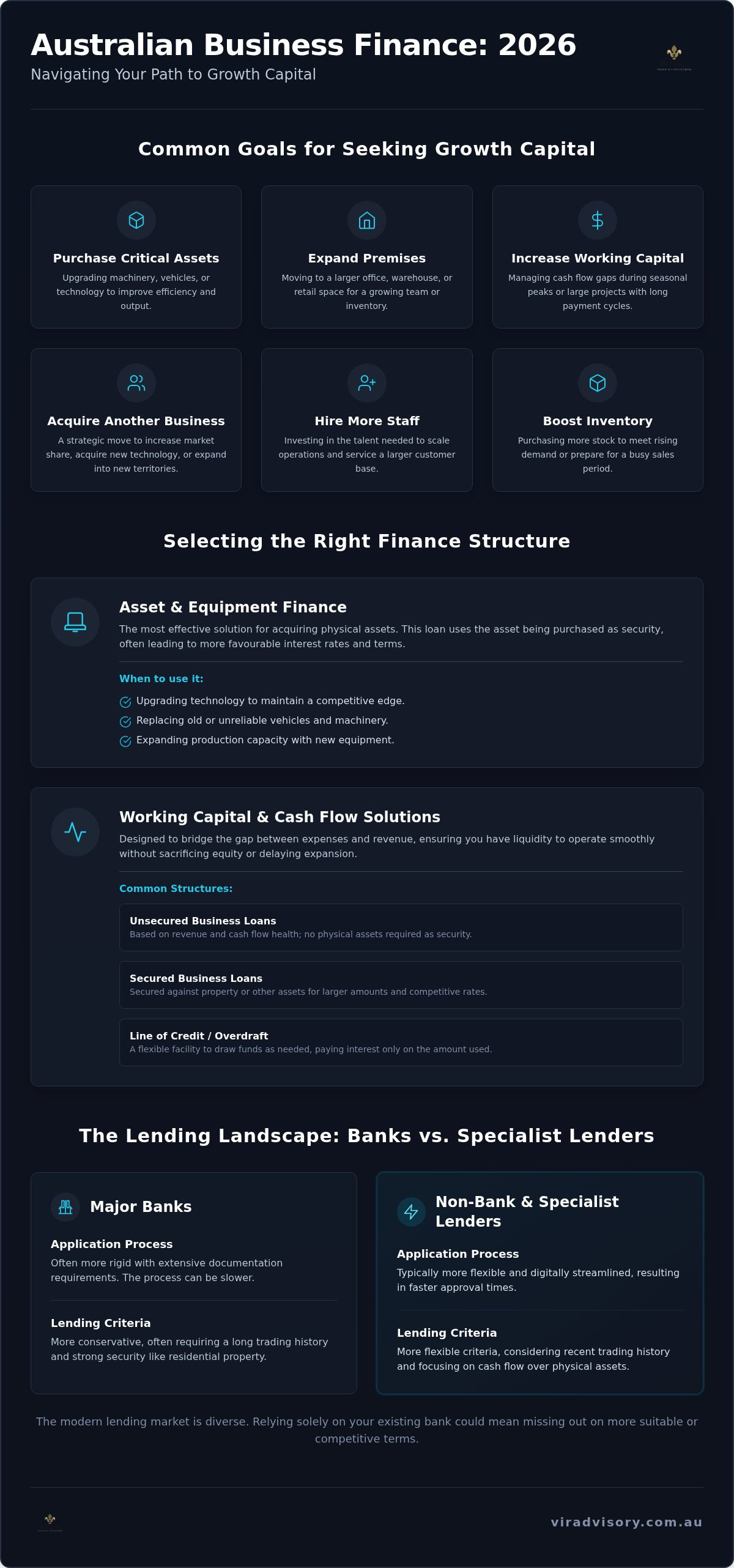
Business finance isn't just about covering short-term costs. It's a strategic tool used to achieve specific commercial objectives. Businesses across Australia typically seek expansion funding to:
- Purchase critical assets or equipment: Upgrading machinery, vehicles, or technology to improve efficiency and output.
- Expand premises: Moving to a larger office, warehouse, or retail space to accommodate a growing team or inventory.
- Increase working capital: Managing cash flow gaps, especially during seasonal peaks or when taking on large projects with long payment cycles.
- Acquire another business: A strategic move to increase market share, acquire new technology, or expand into new territories.
- Hire more staff: Investing in the talent needed to scale operations and service a larger customer base.
- Boost inventory: Purchasing more stock to meet rising demand or prepare for a busy sales period.
The Shift from a Bank-Dominated Market
For decades, Australian businesses turned almost exclusively to their primary bank for funding. Today, the landscape is far more diverse. Non-bank lenders, fintech companies, and private funders have entered the market, often offering more flexible criteria, faster approval times, and specialised products that major banks may not provide.
This shift means that relying solely on your existing bank could mean missing out on more suitable or competitive terms. A national perspective is essential. A lender with a strong presence in one state might have different offerings or risk appetites compared to another. Understanding this broad ecosystem is the first step to securing finance that aligns with your business, not just the lender's standard product list.
Selecting the Right Finance Structure for Your Commercial Goals
Choosing the right type of business loan is as important as the loan itself. The ideal structure depends entirely on what you want to achieve. A loan to purchase a new vehicle requires a different approach than one designed to manage a temporary cash flow shortage. Aligning the finance product with its purpose protects your working capital and ensures the debt is productive.
Here’s a practical look at common business finance solutions and how they match specific commercial goals.
Asset and Equipment Finance
When your business needs to acquire physical assets—from a new truck or IT hardware to specialised manufacturing equipment—asset finance is often the most effective solution. This type of loan uses the asset being purchased as security, which can lead to more favourable interest rates and terms compared to unsecured lending.
When to use it:
- Upgrading technology to maintain a competitive edge.
- Replacing old or unreliable vehicles and machinery.
- Expanding production capacity with new equipment.
The key benefit is that it preserves your working capital. Instead of paying a large lump sum upfront, you can use the business's cash for day-to-day operations, marketing, and wages. Different structures, such as a chattel mortgage or finance lease, also offer various tax and depreciation advantages that should be discussed with your accountant.
Working Capital and Cash Flow Solutions
Even highly profitable businesses can experience cash flow challenges. A large order might require a significant upfront investment in materials long before the client pays their invoice. Seasonal businesses often face revenue dips during the off-season. Working capital loans are designed to bridge these gaps.
These can be structured as:
- Unsecured Business Loans: Based on the business's revenue and cash flow health, these loans don't require physical assets as security. They are typically faster to approve but may come with higher interest rates.
- Secured Business Loans: Secured against property or other assets, these offer larger borrowing amounts and more competitive rates.
- Line of Credit or Overdraft: A flexible facility that allows you to draw down funds as needed up to a pre-approved limit, paying interest only on the amount you use.
These solutions are ideal for managing the "growth gap" between expenses and revenue, ensuring you have the liquidity to operate smoothly without sacrificing equity or delaying expansion plans. For businesses juggling multiple high-interest debts, a single, well-structured loan can also be used for debt consolidation, simplifying repayments and often reducing the total interest paid.
Bank vs. Non-Bank Lenders: A Quick Comparison
Understanding the key differences between traditional banks and non-bank lenders can help you decide where to look for your business finance.
| Feature | Major Banks | Non-Bank & Specialist Lenders |
|---|---|---|
| Application Process | Often more rigid, with extensive documentation requirements. Can be slower. | Typically more flexible and digitally streamlined. Often faster approval times. |
| Lending Criteria | More conservative. Often require a long trading history and strong security (like residential property). | More flexible criteria. May consider recent trading history and focus more on cash flow than physical assets. |
| Loan Products | Standardised, "off-the-shelf" products. | Often offer niche or specialised products tailored to specific industries or situations (e.g., low-doc loans). |
| Interest Rates | Can be very competitive, especially for well-established businesses with strong security. | Rates can vary widely. May be higher for unsecured or higher-risk loans but can be competitive for strong applicants. |
| Relationship | Often transactional, dealing with different departments for different needs. | Can be more relationship-focused, especially with smaller lenders or through a broker. |
Note: Lending criteria and product features vary significantly between individual lenders.
The Strategic Advantage: Why Expert Brokerage Outperforms Direct Lending
With so many lenders and products available, how do you find the right one? While many business owners default to their existing bank, this approach can be limiting. Your bank can only offer its own products, which may not be the most competitive or suitable for your specific needs.
This is where a finance broker provides a distinct advantage. A broker works for you, not the lender. Their role is to understand your business goals, assess your financial position, and navigate the entire market to find a solution that fits.
How a Broker Helps You Secure Better Outcomes
Engaging a professional broker is about more than just finding a low interest rate. It’s a strategic decision that can save you time, reduce stress, and result in a superior financial structure.
- Access to a Wider Market: Brokers have relationships with dozens of lenders, including major banks, non-bank institutions, and specialist funders you may not have access to directly. This broadens your options significantly.
- Expert Negotiation: An experienced broker understands lender policies and knows how to negotiate on your behalf. They can often secure more favourable terms, fees, and conditions than you could achieve on your own.
- Strategic Structuring: The cheapest interest rate isn't always the best. A broker helps you evaluate the entire loan structure—including repayment flexibility, fees, and loan covenants—to ensure it supports your long-term cash flow and growth objectives.
- Time and Effort Savings: The loan application process is time-consuming. A broker manages the entire process for you, from preparing the application and gathering documentation to liaising with lenders, freeing you up to focus on running your business.
Refinancing as a Growth Strategy
Securing finance is not a "set and forget" activity. The market is constantly changing, and so is your business. Refinancing your existing business debts can be a powerful strategy to unlock growth. A regular review of your commercial loans can reveal opportunities to:
- Lower your interest rate: If rates have dropped or your business's financial position has improved, you may qualify for a more competitive rate.
- Improve cash flow: Restructuring debt can lower your monthly repayments, freeing up cash for other business priorities.
- Consolidate multiple debts: Combining several loans into one can simplify your finances and reduce your overall interest burden.
- Access equity: If you have commercial property, refinancing can unlock equity that can be used as capital for expansion.
A broker can help you assess whether the benefits of refinancing outweigh the costs, ensuring it’s a strategic move for your business. To understand what options might be available, you can explore a full range of commercial and residential finance services.
Preparing Your Enterprise for a Successful Loan Application
A successful loan application depends on preparation. Lenders need to see a well-managed business with a clear plan for how the funds will be used to generate a return. By organising your documentation and understanding what lenders are looking for, you can significantly improve your chances of approval.
What Australian Lenders Scrutinise in 2026
When you apply for business finance, lenders will conduct a thorough assessment of your application. While criteria vary, they generally focus on these key areas:
- Cash Flow and Serviceability: This is the most critical factor. Lenders need to be confident that your business generates enough consistent cash flow to comfortably meet its existing obligations plus the new loan repayments. They will analyse your bank statements, profit and loss statements, and tax returns to verify this.
- Credit History: Both your business's credit file and the personal credit files of the directors will be checked. A history of on-time payments is crucial. Past issues don't always mean an automatic decline, but they will need to be explained.
- Trading History: Most lenders prefer to see a business that has been operating for at least 1-2 years, with a proven track record of revenue. Start-ups or businesses with shorter histories may need to seek out specialist lenders.
- Security: For secured loans, the value and type of asset being offered as collateral is a key consideration. This is often residential or commercial property, but can also be the business assets themselves.
- The "Lending Narrative": Lenders want to understand the purpose of the loan. A clear, logical explanation of how the capital will be used to grow the business, increase revenue, or improve efficiency strengthens your application.
Your Funding Preparation Checklist
Before you approach a lender, ensure you have the following organised. A "clean" and complete application is the fastest way to a "yes".
- Business Details: ABN/ACN, GST registration details, and business address.
- Financial Statements: Typically the last 1-2 years of profit and loss statements and balance sheets, prepared by an accountant.
- Tax Returns: The last 1-2 years of complete business and personal tax returns for all directors.
- Business Bank Statements: Usually the last 6-12 months of statements to demonstrate cash flow.
- ATO Portal Statement: A printout from the Australian Taxation Office portal showing that your BAS and tax obligations are up to date.
- Director Information: Personal identification, plus a statement of personal assets and liabilities for all company directors.
- Loan Purpose Statement: A brief document explaining what the funds are for and how they will benefit the business (e.g., a quote for new equipment, a business acquisition plan).
Common Reasons Business Loan Applications Are Declined
Understanding why applications are rejected can help you avoid common mistakes:
- Poor or Inconsistent Cash Flow: The business does not demonstrate sufficient regular income to service the debt.
- Incomplete or Inaccurate Financials: Messy books or conflicting information in your application documents raise red flags for lenders.
- Adverse Credit History: Recent defaults or a poor credit score for the business or its directors can be a major obstacle.
- Outstanding Tax Debt: Lenders see unpaid BAS or income tax as a sign of poor financial management.
- Lack of a Clear Plan: The lender is not convinced that the loan will be used productively to generate a return.
Many of these issues can be addressed with careful planning and expert guidance before you submit an application.
Partnering for Prosperity: Your Pathway to Optimised Business Finance
Securing business finance in Australia's competitive market requires a clear strategy and a methodical approach. It’s about more than just filling out forms; it’s about presenting your business in the best possible light to the right lenders.
The VIR Advisory approach is built on providing clear, expert guidance in a complex market. We believe that a long-term partnership delivers far better results than a simple one-off transaction. By taking the time to understand your unique business and personal financial goals, we can help you navigate the lending landscape with confidence.
A Personalised Financial Journey
Led by finance expert Raina Doshi, our team tailors every strategy to your specific circumstances. We focus on creating a clear pathway to funding that minimises stress and disruption to your business. We act as your advocate, handling the complexities of the application process so you can remain focused on what you do best.
Our expertise across both commercial and residential finance allows us to take a holistic view of your financial position, ensuring your business and personal goals are aligned.
Secure Your Strategic Consultation
Taking the first step is often the hardest. A no-obligation consultation can provide the clarity you need to move forward. In an initial discovery session, we will discuss your objectives, assess your current situation, and map out a potential pathway to securing the growth capital your business needs.
Ready to explore your options? Contact our team for a strategy session and move from uncertainty to confidence.
Frequently Asked Questions
What are the current business loan interest rates in Australia for 2026?
Interest rates for business loans vary widely depending on the lender, the type of loan (secured vs. unsecured), the strength of the application, and the overall economic environment set by the Reserve Bank of Australia. As of 2026, rates can range from highly competitive for strongly secured loans to higher rates for unsecured, cash-flow-based lending. A broker can provide an accurate assessment based on your specific circumstances.
Can I get a business loan in Australia without a residential property as security?
Yes. Many lenders now offer unsecured business loans based on the strength of your business's turnover and cash flow. Asset finance, where the loan is secured by the equipment being purchased, is another popular option that doesn't require property as security.
How much can my business borrow based on its annual turnover?
This is a common question, but there's no single formula. Lenders assess serviceability based on net profit and cash flow, not just revenue. Generally, a profitable business might be able to borrow a multiple of its monthly or annual earnings, but the final amount depends on a full assessment of its financial health and ability to make repayments.
What is the difference between a bank and a non-bank business lender?
Banks are Authorised Deposit-taking Institutions (ADIs) regulated by APRA, and they fund loans using customer deposits. Non-bank lenders are not ADIs and fund their loans through other means, such as wholesale investors. Non-banks often have more flexible lending criteria and can be faster to approve applications, providing a valuable alternative to traditional banking.
How long does the business loan application and approval process take?
The timeline can range from 24-48 hours for a simple, unsecured loan from a fintech lender to several weeks for a complex commercial property loan from a major bank. A well-prepared application with all necessary documentation will always result in a faster process.
Is interest on a business loan tax-deductible in Australia?
In most cases, yes. If the loan is used for business purposes to generate income, the interest paid is generally considered a tax-deductible expense. However, it's essential to seek advice from your accountant to understand the specific tax implications for your business.

Article by
Raina Doshi
Raina Doshi has worked in banking and finance since 2011, including experience with major Australian lenders. She helps homeowners, property investors, business owners and professionals secure and structure lending solutions across home loans, refinancing, commercial finance and business lending.
Areas of expertise include residential lending, investment property finance, debt recycling, commercial property finance, equipment finance, construction finance and strategic debt structuring.
Drawing on extensive banking and finance experience, Raina helps clients navigate lender requirements, improve borrowing outcomes and structure effective finance solutions.
Disclaimer
The information in this article is general in nature and does not take into account your personal objectives, financial situation or needs. Before acting on any information, consider whether it is appropriate to your circumstances and seek professional advice.


