

Why does one major Australian bank decline a loan application that another lender approves within forty-eight hours using the exact same financial data? It's a common source of frustration for business owners and professionals who find their borrowing capacity fluctuating wildly between institutions despite having a stable income and a solid deposit. This variation exists because lender assessment criteria are not uniform; they are internal frameworks designed to manage specific risk appetites and regulatory obligations. Understanding these nuances is essential for anyone seeking to secure finance without damaging their credit file through unsuccessful attempts.
You'll gain a clear understanding of how banks calculate serviceability in a high-interest environment and learn actionable strategies to improve your approval prospects. We'll examine the technical impact of the current 4.35% cash rate alongside the APRA-mandated 3% serviceability buffer, providing a methodical approach to navigating the complexities of modern credit policy and avoiding the trap of a mortgage prison. By identifying common approval obstacles and refining your finance strategy, you can move toward a successful funding outcome with total confidence.
Key Takeaways
- Learn why lender assessment criteria vary across the Australian market and how individual bank risk appetites directly influence your borrowing capacity.
- Understand the technical "5 Cs" of credit, specifically how lenders evaluate your character and capacity to service debt under current APRA-mandated buffers.
- Identify why major bank "scorecard" lending often leads to automatic declines and how to target institutions whose policies align with your specific financial profile.
- Recognise the critical importance of full documentation and liability disclosure to prevent processing delays or damage to your credit file.
- Discover how to transition from a simple loan application to a structured finance strategy that addresses complex cash flow and risk management requirements.
The Mechanics of Australian Lender Assessment Criteria
Lending is often viewed by borrowers as a simple mathematical calculation where income minus expenses equals a loan amount. However, for an Australian bank, it's primarily a risk-mitigation exercise. Lenders apply their specific lender assessment criteria based on the fundamental principles of credit risk, seeking to ensure that a loan remains performing even if economic conditions deteriorate. This is why two institutions can look at the same tax return and reach different conclusions. Their risk appetites are influenced by their current portfolio balance; if a bank already has heavy exposure to commercial property in a specific sector, they might tighten their requirements to diversify their risk.
The Australian Prudential Regulation Authority (APRA) sets the baseline for the industry, but individual lenders often layer their own "Standard Policy" on top of these benchmarks. While most applications must fit within these rigid boxes, experienced specialists can sometimes negotiate "Exceptions to Policy" when a borrower's overall profile remains strong despite a minor technical breach. Understanding these internal nuances is a core part of a robust finance strategy.
The Impact of the Serviceability Buffer
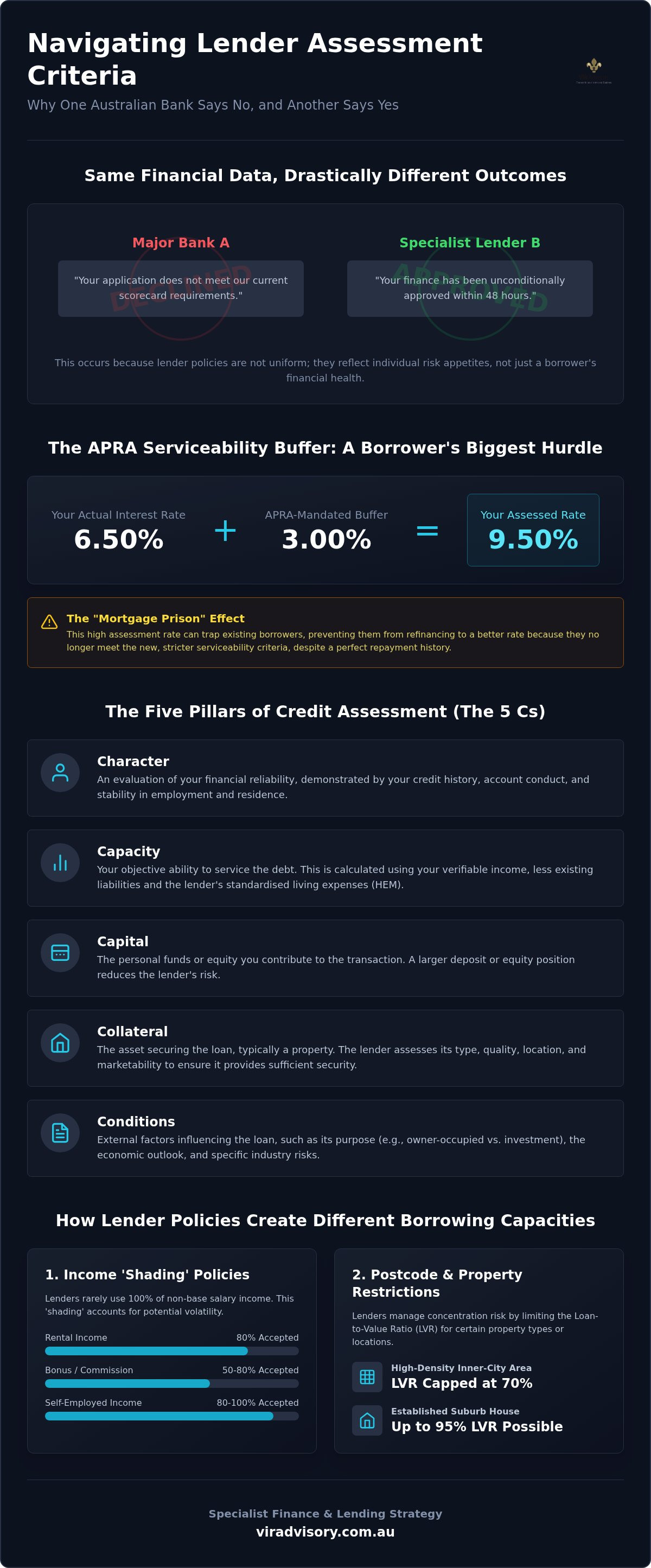
APRA currently mandates a 3% serviceability buffer. This means that if your actual interest rate is 6.5%, the bank must assess your ability to repay the debt at 9.5%. Under current market conditions, this stress test significantly reduces borrowing capacity. It has also created "mortgage prisons," where existing borrowers are unable to refinance to a better rate because they don't meet the 3% buffer requirement under new assessment rules, even though they have a perfect repayment history. Some lenders have introduced reduced buffer options for "like-for-like" refinances to address this issue, provided specific equity and conduct criteria are met.
Why One Bank Says No and Another Says Yes
Variance in lender assessment criteria often stems from how different banks treat income. A major bank might shade self-employed income by 20% or require two years of full tax returns, while a non-bank lender might accept one year of accountants' letters or BAS statements. Postcode restrictions also play a role. A lender may limit the Loan-to-Value Ratio (LVR) to 70% in high-density inner-city areas while offering 95% in established suburbs. These internal "exposure limits" allow banks to manage their concentration risk, meaning a "no" from one bank is often a reflection of their current balance sheet rather than your creditworthiness.
The Five Pillars of Credit Assessment (The 5 Cs)
Every Australian bank operates under a framework known as the "5 Cs of Credit" to determine the viability of a loan. While the specific lender assessment criteria may differ between a major bank and a non-bank lender, these five pillars form the foundation of their decision-making process. This framework ensures compliance with Australian banking regulations regarding responsible lending. The five pillars include:
- Character: An evaluation of your financial reliability, evidenced by your credit history and account conduct.
- Capacity: Your objective ability to repay the debt based on income, expenses, and existing liabilities.
- Capital: The personal contribution you make toward the purchase, such as a cash deposit or existing property equity.
- Collateral: The type, condition, and location of the security property being offered to the bank.
- Conditions: External factors including the loan's purpose, current interest rates, and specific industry risks.
A weakness in one pillar can often be offset by strength in another. For example, a lower deposit (Capital) might be acceptable if the borrower has a high surplus income (Capacity) and an impeccable repayment history (Character).
Capacity Assessment: Income Shading and HEM
Capacity is the most common point of failure in modern applications. Lenders rarely use your gross income at face value; instead, they apply "shading" to non-standard income streams. Most banks only recognise 80% of projected rental income to account for vacancies and management fees. Similarly, bonuses, commissions, or overtime are often shaded to 50% or 80% of their historical average. This conservative approach ensures the loan remains serviceable even if these variable amounts fluctuate.
Lenders also compare your declared living expenses against the Household Expenditure Measure (HEM). If your actual spending, verified through three to six months of bank statements, is higher than the HEM benchmark, the bank will use your actual figures. This often catches borrowers off guard, particularly those with high discretionary spending on lifestyle or subscriptions. If you're concerned about how your spending habits might impact your borrowing capacity, it's worth reviewing your serviceability profile before submitting an application.
Character and Credit Reputation
The introduction of Comprehensive Credit Reporting (CCR) has changed how lenders view "Character". Banks now see a detailed history of your repayment conduct across all accounts, not just defaults. Even small liabilities like "buy now, pay later" accounts or unused credit cards with high limits are viewed as potential debt. A $10,000 credit card limit can reduce your borrowing capacity by approximately $40,000, even if the balance is zero, because the bank must assume you could max out that card at any time. Your internal credit grade at a bank is a proprietary calculation that considers these factors alongside your stability of employment and residence.
Major Banks vs. Finance Brokers: Navigating Credit Policy
Major Australian banks rely heavily on "scorecard" lending, an automated system that delivers a binary yes or no outcome based on rigid data points. If an application falls even slightly outside their preferred lender assessment criteria, it's frequently met with an immediate decline. This rigidness is often tied to their massive volume requirements and strict internal risk-weighting models. In contrast, finance brokers operate as technical intermediaries, identifying lenders whose policy "sweet spots" align with a borrower's specific profile, ensuring the application is presented to the institution most likely to provide a favourable response.
The Australian market is divided into Tier 1 (major banks), Tier 2 (regional and smaller banks), and non-bank lenders. While Tier 1 banks offer competitive rates for "standard" PAYG borrowers, they often lack the flexibility required for complex structures. For example, APRA's focus on debt-to-income loan limits has seen many major institutions implement hard caps that disadvantage high-leverage investors. Non-bank lenders often use manual underwriting, allowing them to look beyond automated scores to understand the underlying strength of a professional's cash flow or an investor's equity position.
Accessing Niche Lending Policies
Niche policies are where the technical expertise of a specialist becomes evident. Some lenders specialise in self-employed borrowers, accepting only one year of tax returns rather than the standard two-year requirement. Others recognise the stability of medical and legal professionals, offering Loan-to-Value Ratios (LVR) of up to 90% without requiring Lenders Mortgage Insurance (LMI). Identifying these specific lender assessment criteria across 30 or more institutions requires a depth of market knowledge that a single bank's staff cannot provide. This level of customisation is essential for borrowers with trust income or those who receive significant portions of their remuneration via shares or bonuses.
The Risk of Multiple Direct Applications
A significant risk for borrowers is "shopping around" by submitting multiple direct applications. Each formal submission triggers a hard enquiry on your credit file, which can lower your score and signal credit-seeking behaviour to future lenders. A professional brokerage performs a "soft" preliminary assessment, verifying your position against multiple credit policies before a single enquiry is made. This methodical approach protects your credit reputation and ensures that when an application is submitted, it has the highest probability of approval. For those requiring a professional review of their current position, exploring VIR Advisory Services provides a clear starting point for a structured finance strategy.
Common Approval Obstacles and Risk Management
Even when a borrower's income appears sufficient, an application can still fail due to specific risk-weighting factors within a bank's lender assessment criteria. Inadequate documentation remains the primary cause of processing delays and formal declines. Lenders require a clear, chronological audit of your financial position; missing pages of bank statements or outdated tax portals can lead a credit officer to assume there's a lack of transparency. Similarly, undisclosed liabilities are almost always identified through Comprehensive Credit Reporting. Hidden credit card limits or car loans don't just reduce your borrowing capacity; they raise questions about your character and integrity as a borrower.
Employment probation is another frequent hurdle for professionals. While major banks often require a minimum of six months in a current role, some lenders will accept a new position if you're in the same industry and have no gap in employment. Property valuation shortfalls also present a significant risk, especially in volatile markets. If the bank's independent valuer assesses the property lower than the purchase price, you must cover the shortfall with additional cash or risk the loan being declined due to an unacceptable Loan-to-Value Ratio (LVR).
Strategies to Improve Approval Prospects
Proactive management of your financial profile before submission is essential. You can immediately boost your borrowing capacity by closing unused credit card limits; as established in previous sections, banks assess the limit rather than the balance. Maintaining twelve months of clean repayment history on all existing debts, including personal loans and utilities, demonstrates a low-risk profile. For those with multiple high-interest liabilities, a structured debt consolidation strategy can improve monthly cash flow and satisfy serviceability requirements. Providing a comprehensive finance strategy that addresses these points upfront ensures a smoother approval process.
Identifying Collateral Red Flags
Lenders also evaluate the security property against strict collateral guidelines. Postcode restrictions are common in high-density areas where banks fear oversupply; this may limit your LVR or lead to an outright decline. Studio apartments often face minimum square metre requirements, typically 40 to 50 square metres excluding balconies and car spaces. Unusual property types, such as company title or rural-residential land, often require specialist lenders who understand these specific risks and have the appropriate lender assessment criteria to accommodate them.
Strategic Application Structuring for Optimal Approval
Successful funding outcomes are rarely the result of luck. They require a deliberate finance strategy rather than a simple loan application. While an application is merely a request for funds, a strategy considers your long-term objectives, tax structures, and future borrowing capacity. By aligning your profile with the specific lender assessment criteria of the right institution, you avoid the frustration of a generic decline and ensure your debt is structured to support your growth. This methodical approach is particularly vital for professionals and investors who require flexibility as their portfolios expand.
For company directors and self-employed borrowers, the presentation of financial data is critical. Lenders don't just look at past tax returns; they evaluate the viability of your future cash flow. Providing clear, professional cash flow projections allows a credit officer to understand the business's resilience and its ability to service debt under stress. This level of detail is essential for working capital or commercial property finance, where the risk management requirements are more stringent than standard residential lending.
Investors with multiple properties must be wary of cross-collateralisation. This occurs when a lender uses multiple properties as security for a single loan or group of loans. While banks prefer this because it increases their security, it significantly limits your control. If you sell one property, the bank may insist on using all proceeds to pay down debt across the entire portfolio rather than allowing you to reinvest the capital. A structured approach ensures properties remain stand-alone, preserving your equity and maximising future flexibility.
The VIR Advisory Approach: Precision and Clarity
With over 15 years of banking experience, we understand the internal credit logic used by Australian institutions. This background allows us to pre-empt the questions a credit assessor will ask and address them before the application is formally submitted. Our process involves a thorough audit of your financial position, identifying potential red flags in your lender assessment criteria profile and resolving them early. We focus on debt optimisation and precision, ensuring every application is presented with the clarity required for a prompt approval.
Next Steps for Your Finance Strategy
Securing a successful approval starts with meticulous preparation. You should begin by organising your documentation, including the last two years of tax returns, recent payslips, and six months of bank statements for all accounts. Conducting a regular Mortgage Health Check is also vital to identify refinancing opportunities that could lower your interest costs or release equity for further investment. If you require a professional review of your current loan structures or borrowing capacity, you can Submit an Enquiry for a confidential assessment.
Securing Your Funding with Precision and Strategy
Navigating the Australian lending market requires more than just a strong income; it demands a technical understanding of how different institutions apply their specific lender assessment criteria. A rejection from one major bank is often a reflection of their current risk appetite rather than your creditworthiness. By focusing on the 5 Cs of credit and maintaining meticulous documentation, you can position your application to meet the stringent requirements of both Tier 1 and non-bank lenders.
VIR Advisory, led by Raina Doshi with over 15 years of banking experience, provides the specialist expertise needed for complex residential, commercial, and SMSF lending. We offer national service with a commitment to professional, honest financial guidance, ensuring your debt is structured for long-term stability and growth. Our methodical approach helps you move from uncertainty toward a feeling of complete confidence in your financial arrangements.
Taking a proactive approach to your finance strategy allows you to avoid common approval obstacles and secure the funding solutions you require. We look forward to helping you achieve a successful outcome.
Frequently Asked Questions
How much does a lender stress-test my interest rate in 2026?
Lenders currently apply a 3% serviceability buffer as mandated by APRA. With the official cash rate held at 4.35% as of August 2026, most borrowers are being assessed at interest rates exceeding 7% or 8%. This stress test ensures you can maintain repayments if rates rise further. It's a core component of lender assessment criteria designed to protect the stability of the Australian financial system while managing individual default risks.
Can I get a home loan if I am self-employed with only one year of financials?
Yes, it's possible to secure a home loan with one year of financials, though options at major banks are limited. While Tier 1 lenders typically require two years of tax returns, several Tier 2 and non-bank lenders specialise in "alt-doc" or low-doc solutions for self-employed professionals. These products often require an accountant's letter or BAS statements to verify income, provided you've held an active ABN for at least twelve to twenty-four months.
What is the maximum LVR I can borrow without paying LMI?
The standard threshold to avoid Lenders Mortgage Insurance (LMI) is a Loan-to-Value Ratio (LVR) of 80%. However, certain professionals in the medical, legal, and accounting sectors can often access LMI waivers for an LVR of up to 90%. Additionally, the Australian Government 5% Deposit Scheme allows eligible first-home buyers to purchase with a 5% deposit without paying LMI, as the government effectively guarantees the remaining 15% of the loan.
How do lenders treat overtime and bonus income in their assessments?
Lenders generally "shade" or discount variable income to account for potential fluctuations. Most banks will only include 50% to 80% of your overtime, bonuses, or commissions in their serviceability calculations. They also require evidence that this income is consistent, typically requesting two years of payment history. This conservative approach is a standard part of lender assessment criteria to ensure the loan remains affordable during periods where extra income might not be available.
Why did my bank decline my loan even though I have a high salary?
A high salary is only one component of a credit assessment. Your application might be declined due to high discretionary spending, large existing credit card limits, or a low credit score from multiple recent enquiries. Banks also evaluate the "collateral" pillar; if the property you're buying is in a restricted postcode or is smaller than forty square metres, the bank may deem the security risk too high regardless of your personal income levels.
Does having a HECS/HELP debt affect my borrowing capacity?
Yes, HECS/HELP debt significantly impacts your borrowing capacity because it reduces your net disposable income. Lenders don't look at the total balance of the debt, but rather the monthly repayment amount deducted from your salary. For a high-income professional, these repayments can be substantial, often reducing the total amount you can borrow by tens of thousands of dollars. It's often more effective to clear small remaining balances before applying for a loan.
How long does a credit enquiry stay on my file in Australia?
A credit enquiry remains on your credit file for five years in Australia. This includes both successful and unsuccessful applications for credit cards, personal loans, and mortgages. While a single enquiry has a minimal impact, multiple enquiries within a short window can lower your credit score and signal credit-seeking behaviour to potential lenders. This is why it's essential to perform a preliminary assessment before submitting a formal application to any institution.
What is the difference between a conditional approval and a full approval?
Conditional approval, often called pre-approval, is an indication that a lender will likely lend you a specific amount subject to certain conditions. These conditions usually include a satisfactory property valuation and verification of your final documents. Full approval, or formal approval, occurs once all conditions are met and the bank issues a binding offer. Don't sign a contract without a "subject to finance" clause unless you've reached the formal approval stage.

Article by
Raina Doshi
Raina Doshi has worked in banking and finance since 2011, including experience with major Australian lenders. She helps homeowners, property investors, business owners and professionals secure and structure lending solutions across home loans, refinancing, commercial finance and business lending.
Areas of expertise include residential lending, investment property finance, debt recycling, commercial property finance, equipment finance, construction finance and strategic debt structuring.
Drawing on extensive banking and finance experience, Raina helps clients navigate lender requirements, improve borrowing outcomes and structure effective finance solutions.
Disclaimer
The information in this article is general in nature and does not take into account your personal objectives, financial situation or needs. Before acting on any information, consider whether it is appropriate to your circumstances and seek professional advice.


