

Could an outstanding ATO debt automatically rule out business finance? No. Business finance ATO debt applications may still be considered, but an unpaid tax liability can affect borrowing capacity or contribute to a decline, depending on the lender and the business’s overall position. The debt matters, but it is only one part of the assessment.
If you’re managing tax obligations alongside wages, suppliers and other repayments, it’s reasonable to consider whether borrowing could add pressure rather than solve a cash flow problem. Lenders may examine the amount and status of the debt, the business’s engagement with the ATO, recent financial performance, cash flow, existing commitments, available security and the proposed use of funds. Accurate records and a clear explanation of any repayment arrangement help show the full picture, but they don’t guarantee approval.
This article explains how ATO debt may affect a business finance assessment, how funding options differ in purpose and risk, and what information can make an application easier to assess. It also sets out a practical way to map cash flow and planned repayments, so you can judge whether borrowing is a workable response to the pressure.
Key Takeaways
- Outstanding ATO debt doesn’t automatically decide a business finance application, but its status and the business’s ability to meet repayments can affect the lender’s assessment.
- For business finance ATO debt, match the funding type to the actual need, such as working capital, unpaid invoices, equipment or commercial property.
- Compare the facility’s purpose and repayments with realistic cash flow before deciding whether borrowing is suitable.
- Prepare a clear account of the ATO debt, the funding purpose and the records that support your cash flow explanation.
- Present the figures accurately. An ATO payment arrangement or a particular finance option does not guarantee approval.
Business finance with ATO debt: what the debt does and does not mean
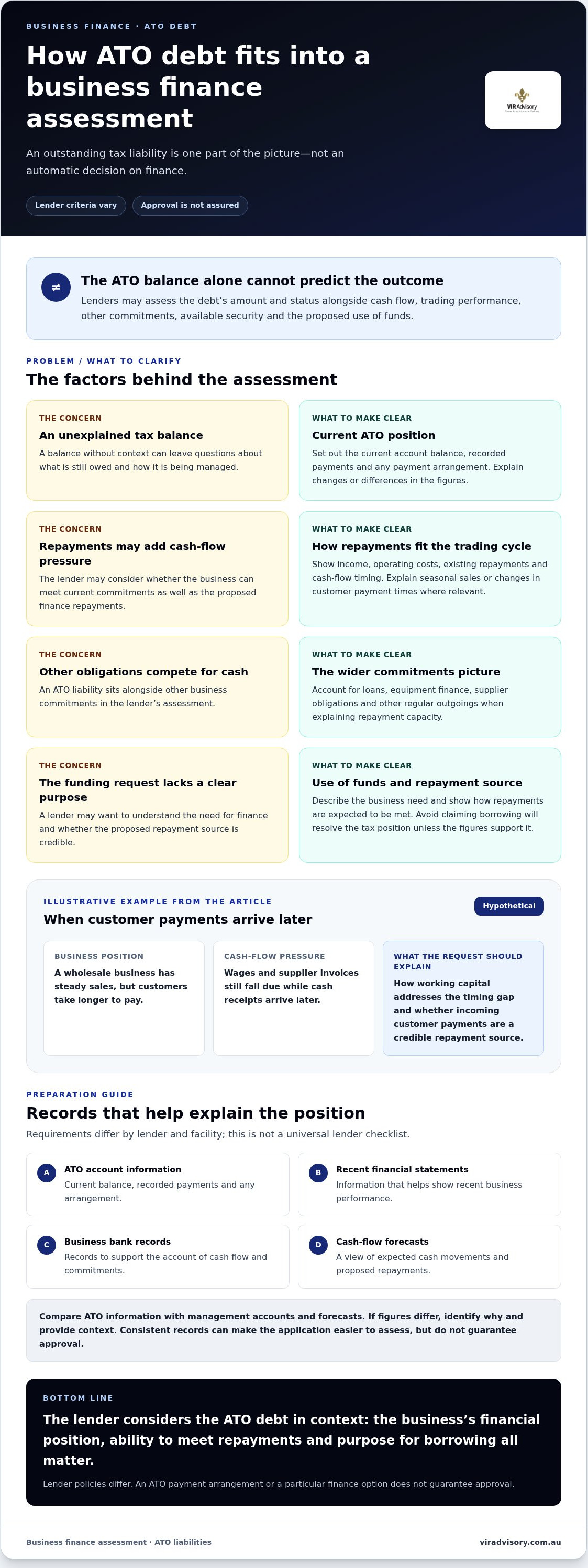
ATO debt does not determine a finance outcome by itself. A business can apply for finance with an outstanding tax liability, but each lender assesses the application against its own criteria. The balance is relevant, but it is not conclusive. Lenders may also consider other liabilities, the business’s capacity to meet repayments and the reason it needs funding. Business finance ATO debt applications therefore can’t be judged by the tax debt figure alone.
ATO debt is an unpaid tax liability owed to the Australian Taxation Office. It may relate to a business activity statement (BAS), GST, PAYG withholding or income tax. This differs from a business loan, equipment finance or another borrowing: tax debt is an amount payable to the ATO, while a loan is a separate finance obligation with its own terms and repayments. Both can affect cash flow and the total liabilities a lender considers. For general context, debt can include obligations used to fund business operations, though a tax liability has a different source from a commercial loan.
Definition: An ATO debt is an unpaid tax liability. Its balance alone cannot predict finance approval because the lender assesses it alongside the business’s wider financial position and proposed funding purpose.
What lenders may want to understand about an ATO debt
The amount matters, but so do the debt’s status and the circumstances behind it. A lender may want to know whether the balance is still outstanding, whether payments or an arrangement have changed the amount due, and how the business plans to manage the liability. These details put the balance in context rather than leaving it as an unexplained figure.
Use current ATO account information to describe the position accurately. Compare the account balance and any recorded payments or arrangements with the figures in management accounts and cash flow forecasts. If the liability is recorded consistently, a lender can more readily compare it with the business’s other commitments. If figures differ, identify why and provide context. Unexplained discrepancies can prompt follow-up questions and make the application harder to assess.
Does having ATO debt automatically prevent business finance?
No single rule applies across all lenders. Some may take a more cautious view of outstanding tax liabilities, while others assess the wider circumstances and proposed use of funds. The business’s trading position, other commitments, cash flow and ability to service the requested finance all contribute to the assessment. The lender’s policy also matters, so one lender’s decision does not establish what another will decide.
For example, a business seeking funding for equipment should explain how the purchase relates to its operations and show how repayments fit the cash flow forecast. That context does not remove the ATO liability, but it helps a lender assess the request. Approval is never assured. Present the debt accurately, explain changes in its status and avoid saying that borrowing will resolve the issue unless the figures support that conclusion.
How lenders assess a business finance application when ATO debt is outstanding
Lenders consider the ATO position as part of the wider application, not in isolation. For business finance ATO debt, they may assess trading performance, cash flow, existing liabilities, the amount requested and how the funds will be used. The assessment depends on the facility, lender criteria and the business’s circumstances, so document requirements and outcomes can vary.
The central question is whether the business can meet its current commitments and the proposed repayments. A lender may consider the ATO balance alongside loans, equipment finance, supplier obligations and other regular outgoings. It will also want to understand whether the facility addresses a defined business need and whether the expected repayment source is credible. A request supported by clear, consistent figures is easier to assess than one based on general assurances.
Cash flow, trading performance and repayment capacity
Revenue patterns matter as well as total revenue. A business with seasonal sales, slow-paying customers or a recent change in trading may need to explain how these factors affect available cash. Lenders may compare income with operating costs and existing repayments to assess whether the facility appears serviceable across the business’s trading cycle.
Hypothetical example: A wholesale business requests working capital after several customers extend their payment times. Sales remain steady, but cash receipts arrive later while wages and supplier invoices still fall due. The application should show how the funding addresses that timing gap and identify the expected repayment source, such as incoming customer payments. If those receipts are uncertain or already committed to other expenses, the lender may assess the repayment case differently.
Business records and ATO account information to organise
Before applying, assemble records that explain both current performance and the ATO position. Depending on the lender and facility, useful material may include recent financial statements, business bank records, cash flow forecasts and relevant ATO account information. This is a preparation guide, not a universal lender checklist. The information requested can differ between applications.
Check that dates, balances and figures align across the documents. If the ATO balance has changed, or the accounts show an unusual movement in revenue or costs, explain the reason and provide supporting context. Don’t leave an inconsistency unexplained or present a forecast as a guaranteed result. Accurate records help distinguish confirmed information from estimates and allow the lender to assess existing commitments alongside the proposed repayments.
Infographic brief: evidence to lender question
- Business evidence: financial statements, bank records and forecasts. What does trading performance show, and how much cash remains after operating costs?
- ATO position: current account information and a clear explanation of the balance. What is outstanding, and how is the business managing the liability?
- Proposed repayments: requested facility, funding purpose and repayment source. How will the funds be used, and what cash flow is expected to meet repayments?
Compare business finance options for ATO debt: purpose, fit and risk
The right facility depends on why the business needs funds, not simply on the existence of an ATO liability. Working capital, debtor finance, equipment finance and commercial property finance serve different purposes, and a lender may limit how funds can be used. Check that the proposed purpose fits the facility’s terms, then weigh any cash flow benefit against repayments, fees and potential security exposure.
These options are not interchangeable. A facility intended to bridge a gap between business expenses and customer payments may not suit a property purchase. Borrowing over a longer term for a short-term tax obligation can also leave the business repaying well after the immediate pressure has passed. Reviewing available business and commercial finance options can help frame the comparison, but suitability still depends on the business’s position and lender requirements.
Match the funding structure to the business need
Working capital finance may suit operating expenses or a cash flow need, subject to the facility’s permitted purpose. Debtor finance may release funds against eligible outstanding invoices, but its suitability depends on the business’s receivables and the lender’s assessment. Neither should be assumed to be available for paying ATO debt.
Equipment finance is generally used to acquire business equipment, while commercial property finance relates to a commercial property purchase or another eligible property purpose. If the underlying need is an overdue tax liability, state that clearly and establish whether the proposed facility permits that use. Lender rules differ, and the application needs evidence for both the intended use and repayment plan.
Weigh potential cash flow relief against borrowing risk
New funding may ease an immediate cash shortfall, but it also creates repayments and may involve fees or security. If regular trading cash flow remains weak, another commitment can intensify pressure rather than resolve it. Consider whether the repayment source is reliable and whether the loan term matches the need. Long-term borrowing for a short-term obligation can extend the period of indebtedness and keep assets exposed for longer than intended.
| Finance type | Intended purpose and possible fit | Assessment considerations | Key risks |
|---|---|---|---|
| Working capital | Business operating needs or a timing gap in cash flow. | Trading activity, forecast cash flow, requested use and repayment source. | Repayments may add pressure if the cash shortfall is ongoing; fees and security depend on the facility. |
| Debtor finance | Potential cash flow support linked to outstanding invoices. | Receivables, customer payment patterns and lender eligibility criteria. | Availability and costs vary; it may not address weak underlying trading or suit every debtor book. |
| Equipment finance | Acquiring equipment for business use. | Equipment, business cash flow and repayment capacity. | Repayments continue even if the equipment doesn’t generate expected income; security terms vary. |
| Commercial property finance | An eligible commercial property purchase or related purpose. | Property, business position, available security and proposed repayments. | A longer commitment and security exposure may be unsuitable for a short-term liability. |
Before choosing, compare the facility’s permitted use, total obligations and repayment timing against a realistic cash flow forecast. No option guarantees approval. The lender’s policy and the evidence provided will shape the assessment.
Prepare a stronger finance application: a practical ATO debt checklist
A clear application links the amount requested to a defined business need, shows how repayments fit the cash flow and explains the ATO liability accurately. This does not guarantee approval, but it gives a lender a more complete basis for assessing the request. Work through these steps before submitting an application.
- Define the funding purpose. Record the amount sought, what it will pay for and why the funds are needed now. Separate a one-off expense from an ongoing cash flow shortfall. If the proposed facility is intended to address an ATO liability, state that plainly. Don’t assume every lender or facility permits this use.
- Map cash flow and commitments. Forecast income and operating expenses using realistic assumptions, then include existing loan repayments, supplier obligations and relevant tax commitments. Test the proposed repayments against periods when receipts may be lower or delayed. A forecast that only works if every customer pays on time may not show a dependable repayment source.
- Assemble supporting records. Gather current financial statements, business bank records, cash flow forecasts and relevant ATO account information. The exact documents requested vary by lender and facility, so treat this as a preparation list rather than a fixed requirement. Reconcile key balances and dates across records before providing them.
- Explain the ATO position. State the outstanding amount shown in current account information, describe any relevant changes and outline any current arrangement accurately. If the liability arose alongside a specific change in trading or cash flow, explain that with supporting evidence where available. Don’t minimise the balance or suggest it has been resolved if it hasn’t.
- Check the repayment case. Set out the expected source of repayments and compare it with existing commitments. If the funding is intended to improve cash flow, explain how it addresses the timing or operating issue rather than relying on an unsupported promise that trading will improve.
Application errors that can undermine a clear assessment
Leaving out an ATO liability, submitting figures that don’t match across records or describing the funding purpose vaguely can lead to follow-up questions and weaken the application’s credibility. Correct errors before lodging, and explain material changes rather than hoping they go unnoticed.
Another common mistake is focusing on the amount borrowed without calculating the total repayment commitments it creates. A new facility may relieve immediate pressure yet increase regular outgoings. Review the forecast with existing debts included, and distinguish confirmed income from projections. A balanced, evidence-led explanation is more useful to an assessment than optimistic assumptions.
For broader context, consider how the proposed business loan’s purpose, financial records and repayment capacity may affect eligibility. Requirements differ between lenders, so don’t treat one lender’s document list as universal.
Use this checklist to make the request specific, internally consistent and supported by current records. Before lodging, compare the information in the application with the underlying records and check that the proposed repayments remain realistic under less favourable trading conditions.
Explore business finance options with VIR Advisory
For a business managing an ATO liability, the funding request needs to make sense alongside trading performance, cash flow and existing commitments. VIR Advisory brokers business and commercial finance, reviewing the proposed purpose and business position against potential lender criteria. VIR Advisory is an intermediary, not a direct lender. Any assessment or approval depends on the lender’s requirements and the business’s circumstances.
Raina Doshi has more than 15 years of banking and finance experience, including more than a decade with one of Australia’s leading banks. Her experience informs a practical review of how a requested facility may fit the business’s needs, what evidence could support the application and which lender requirements may apply. A brokerage discussion can help clarify the questions to address before submitting a request, but it can’t guarantee a particular lender decision.
What a finance discussion can cover
The discussion can consider the requested amount and use of funds alongside the business’s cash flow, current debts and ATO position. A joined-up view matters: a facility might ease a short-term timing issue but create repayments the business must manage over time. The funding purpose should be specific, and the expected repayment source should be consistent with the business’s financial information.
Depending on the circumstances, relevant funding categories may include working capital finance, debtor finance or equipment finance. These facilities address different business needs, and lender policies may govern both eligibility and permitted use. For example, debtor finance may be assessed against a business’s receivables, while equipment finance relates to acquiring equipment. Neither is automatically suitable for an ATO liability. Potential options depend on the business evidence, lender assessment and ability to meet repayments.
A review can also help identify gaps to resolve before applying, such as figures that don’t reconcile or a funding purpose that isn’t clearly explained. The aim is to present the position accurately, not to minimise tax debt or assume that a particular structure will be approved. This can make it easier to compare possible finance with the business need and the obligations it would add.
What to have ready for an initial discussion
A brief, factual outline is a useful starting point. Be ready to explain:
- What the business does and how its trading is currently performing.
- How much funding is being considered, what it would be used for and when it is needed.
- Current cash flow, major commitments and existing finance repayments.
- The amount and status of the ATO liability, with current account information or details of any arrangement.
- How the business expects to meet repayments, using realistic figures rather than untested growth assumptions.
These details help frame a business finance ATO debt request around the funding purpose, business position and repayment capacity. VIR Advisory can review the information and discuss potential lender fit, without promising approval.
Set a clear next step for your funding decision
Before progressing a business finance ATO debt request, identify what the funding is intended to support: paying the tax liability, protecting day-to-day operations or meeting a separate business need. Then compare the proposed repayments with existing commitments and realistic cash flow. This distinction keeps the application focused and helps you judge whether borrowing could ease pressure or add a commitment the business can’t comfortably carry.
VIR Advisory provides business and commercial finance brokerage across Australia, helping business owners consider funding purpose, financial position and potential lender fit. Lender criteria and the business’s circumstances determine which options may be suitable, and approval isn’t assured. A focused discussion can help identify the information to organise and questions to resolve before taking the next step.
A considered application starts with a clear view of the figures and the purpose behind the request. With those details in hand, you can assess the options more confidently.
Frequently Asked Questions
Can a business get finance with an outstanding ATO debt?
Yes, a business can apply for finance while an ATO debt is outstanding, although the lender’s assessment determines the outcome. For example, an established business with consistent customer receipts may present a different application from one experiencing falling sales and overdue supplier accounts. Explain how the liability arose, what the business is doing about it and how the requested facility would fit its cash flow. Approval isn’t assured.
Does ATO debt automatically prevent a business loan approval?
No, ATO debt doesn’t automatically prevent approval across all lenders. Policies and assessment approaches differ, and a lender may consider the business’s trading history, other commitments and reason for borrowing. The impact may also depend on whether the debt is current, being managed or part of broader financial pressure. Don’t assume one lender’s response predicts another’s, and avoid making multiple applications without first understanding their potential effect.
Can a business loan be used to pay an ATO debt?
Possibly, but the intended use must be permitted under the lender’s policy and the specific facility terms. State clearly that the funds would be used to pay an ATO liability rather than describing the request only as general working capital. Compare the proposed loan repayments with the existing tax obligation and cash flow. Replacing one liability with another changes the repayment structure, but doesn’t remove the need to manage the business’s finances.
How much business finance can a business with ATO debt borrow?
There isn’t a universal borrowing amount for a business with tax debt. A lender may assess revenue, expenses, existing repayments, the ATO liability, requested purpose and any security offered. For instance, a business seeking equipment funding may be assessed differently from one requesting general cash flow support. Prepare a request that reflects the actual cost or need, then test repayments against conservative cash flow rather than borrowing the maximum amount offered.
Will an ATO payment arrangement improve a business loan application?
A current payment arrangement may help explain how the business is managing its tax liability, but it doesn’t guarantee approval or a stronger result. The lender may consider whether payments are being maintained and whether the business can meet them alongside proposed loan repayments and other commitments. Include accurate details of the arrangement and remaining liability. If circumstances have changed, explain this clearly rather than implying payments are up to date.
What documents might a lender request when a business has ATO debt?
Depending on the lender, facility and business, requested records may include financial statements, business bank statements, cash flow forecasts and current information about the ATO account. A lender may also ask for details supporting the funding purpose or explaining changes in trading. Keep dates and balances consistent across the material you provide. If figures differ between records, explain the reason and provide context instead of leaving the discrepancy unresolved.
Is taking out more finance always the right response to ATO debt?
No. Borrowing may help address a specific cash flow timing issue, but it adds repayments and may involve costs or security obligations. If the business’s income can’t support both current commitments and new repayments, finance could increase pressure. Before applying, compare the proposed facility with the business’s cash flow and consider whether the underlying issue is temporary or ongoing. A clear forecast helps show whether borrowing is workable rather than simply delaying the shortfall.

Article by
Raina Doshi
Raina Doshi has worked in banking and finance since 2011, including experience with major Australian lenders. She helps homeowners, property investors, business owners and professionals secure and structure lending solutions across home loans, refinancing, commercial finance and business lending.
Areas of expertise include residential lending, investment property finance, debt recycling, commercial property finance, equipment finance, construction finance and strategic debt structuring.
Drawing on extensive banking and finance experience, Raina helps clients navigate lender requirements, improve borrowing outcomes and structure effective finance solutions.
Disclaimer
The information in this article is general in nature and does not take into account your personal objectives, financial situation or needs. Before acting on any information, consider whether it is appropriate to your circumstances and seek professional advice.


