

While traditional bank lending often feels like the default option, over 30% of Australian business owners now secure funding through non-bank specialists to bypass rigid serviceability hurdles. You likely understand that maintaining liquidity is vital, yet the prospect of navigating complex lender jargon and strict bank criteria often leads to stalled growth or depleted cash reserves. Accessing asset finance for businesses shouldn't be a source of frustration, but rather a calculated strategy to scale your operations without compromising your working capital.
This guide provides the technical clarity you need to master lender assessment criteria and optimise your tax position through structures like the $20,000 instant asset write-off. We'll examine the specific requirements for various loan types, helping you distinguish between chattel mortgages and leases while addressing the 2026-27 car depreciation limits. By understanding how lenders evaluate your debt management and cash flow, you can secure the equipment and vehicles required for your business with total confidence in your financial structure. We will cover everything from borrowing capacity and loan structures to the specific risks and approval requirements inherent in the current Australian lending market.
Key Takeaways
- Understand the technical distinctions between chattel mortgages and finance leases to choose the most efficient structure for your tax and ownership requirements.
- Identify the core lender assessment criteria, such as ABN longevity and GST status, that influence your borrowing capacity and approval speed.
- Learn how to implement asset finance for businesses to acquire critical equipment and vehicles without depleting your primary cash reserves.
- Optimise your cash flow by matching loan terms to the expected operational life of your assets, avoiding debt that outlasts your equipment's productivity.
- Explore strategies for navigating a diverse panel of Australian lenders to secure terms that align with your specific commercial objectives.
Asset Finance for Australian Businesses: Technical Definitions and Core Functions
Asset finance is a specialised funding solution designed to help enterprises acquire physical assets without the immediate burden of significant capital expenditure. By spreading the cost of an acquisition over its useful life, companies can maintain operational momentum while keeping their cash reserves intact for other strategic priorities. In the Australian market, asset finance for businesses typically involves the lender taking a mortgage or security interest over the specific item being funded, which often removes the requirement for additional real estate or personal collateral.
The Role of Asset Finance in Working Capital Management
Preserving cash is critical in a high-interest environment. With the Reserve Bank of Australia holding the official cash rate at 4.35% as of August 2026, the cost of liquidity has increased, making efficient debt management essential. Using asset-backed lending allows you to fund growth without depleting the funds needed for daily operational expenses or unexpected opportunities. This approach keeps your balance sheet lean and maintains a healthy debt-to-equity ratio, as the liability is directly offset by the value of the equipment. Maintaining this liquidity provides a vital buffer against the economic headwinds currently impacting the national economy.
Hard Assets vs Soft Assets: Lender Risk Profiles
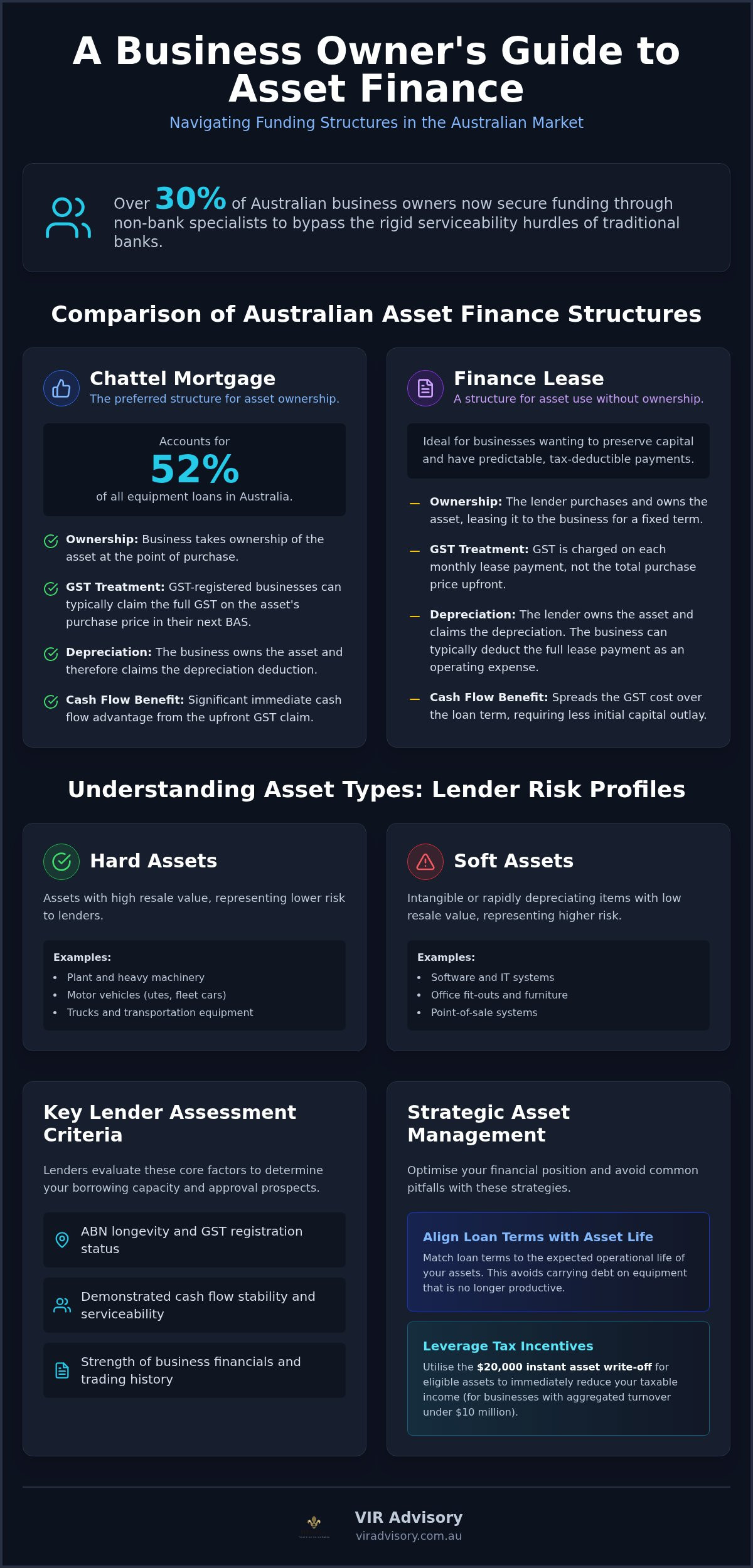
Lenders distinguish between asset classes based on their resale value and durability. Hard assets include plant, heavy machinery, and motor vehicles such as utes or fleet cars. These are highly favoured because they retain significant value in the secondary market, providing the lender with a clear recovery path if the loan defaults. Conversely, soft assets consist of intangible or rapidly depreciating items like software, office fit-outs, and furniture. These items are harder to finance because their resale value is negligible once installed or used.
To secure funding for soft assets, lenders usually require more robust business financials and longer trading histories to mitigate the increased security risk. For Australian SMEs, soft asset finance risk is primarily driven by the lack of a secondary market for the collateral, necessitating a deeper focus on the borrower's overall serviceability and cash flow stability. Understanding these distinctions is the first step in building a sustainable commercial finance strategy that aligns with your long-term operational needs.
Comparison of Australian Asset Finance Structures: Chattel Mortgage vs Lease
Selecting the right debt structure is as important as the asset itself. The most common form of asset finance for businesses in Australia is the chattel mortgage, which currently accounts for 52% of all equipment loans. Under this arrangement, the business takes ownership of the asset at the point of purchase, while the lender secures the loan with a mortgage over the "chattel" (the equipment or vehicle). Alternatively, a finance lease involves the lender purchasing the asset and leasing it back to the business for a fixed term. Commercial Hire Purchase (CHP) provides a middle ground where the business hires the asset and gains ownership only after the final instalment, whereas a novated lease is a specific three-way agreement between an employer, employee, and lender, typically used to provide motor vehicles as part of a salary package.
Technical Breakdown of GST and Depreciation
The primary distinction between these structures lies in their tax treatment. With a chattel mortgage, GST-registered businesses can typically claim the full GST amount paid on the purchase price in their next Business Activity Statement (BAS). This provides a significant immediate cash flow benefit. Under a finance lease, GST is instead charged on the monthly lease payments rather than the total purchase price. Regarding depreciation, the business claims the deduction for a chattel mortgage, whereas the lender claims it for a lease, though the business can usually deduct the full lease payment as an operating expense. For the 2026-27 financial year, businesses with an aggregated turnover under $10 million can still utilise the $20,000 instant asset write-off for eligible assets, making the chattel mortgage a particularly attractive option for immediate tax relief.
Ownership and Residual Value (Balloon Payments)
Most asset finance agreements incorporate a residual value, commonly known as a balloon payment. This is a lump sum due at the end of the loan term, which serves to lower the monthly repayments during the life of the contract. The Australian Taxation Office (ATO) provides specific guidelines on minimum residual values based on the asset class and the length of the finance term. A common risk occurs if the market value of the asset falls below the pre-set residual value at the end of the term, potentially leaving the business with a shortfall. It's essential to discuss your asset lifecycle with a specialist to ensure your balloon payment aligns with realistic resale expectations. Careful planning prevents liquidity issues when the final payment falls due, ensuring your debt strategy remains sustainable and matched to the asset's productivity.
Lender Assessment Criteria: How Banks Evaluate Business Applications
Lenders evaluate applications for asset finance for businesses by focusing primarily on stability and repayment capacity. They typically require a minimum of 12 to 24 months of active ABN registration to establish a baseline of trading history. GST registration is often a prerequisite for accessing the most competitive interest rates. Beyond these basics, banks scrutinise your Profit and Loss statements, Balance Sheets, and recent Business Activity Statements (BAS) to verify consistent revenue. They also review both the business credit file and the personal credit scores of all directors to ensure a clean history of debt management.
The asset itself undergoes rigorous scrutiny. Lenders assess the age and condition of the equipment, often preferring newer items purchased from licensed dealers. Private sales are acceptable to many financiers, though they usually involve more detailed valuation checks to ensure the security value matches the loan amount. This ensures the lender's risk is appropriately mitigated if the asset needs to be liquidated.
The Five-Step Approval Framework
- 1. Initial Eligibility: Verifying ABN longevity, GST status, and checking the business against industry risk profiles.
- 2. Capacity Assessment: Calculating the Debt Service Cover Ratio (DSCR) to confirm that net cash flow covers repayments by a specific margin, typically 1.2x to 1.5x.
- 3. Asset Valuation: Benchmarking the purchase price or invoice value against independent market data.
- 4. Structure Review: Ensuring the loan term and any residual balloon payments align with the asset's effective working life.
- 5. Final Credit Approval: Issuing the Letter of Offer and organising security registration on the Personal Property Securities Register (PPSR).
Common Approval Obstacles and Mitigation Strategies
Newer businesses often face hurdles due to short trading histories. "Low Doc" or "Lite Doc" finance options provide a solution here, allowing for approval based on bank statements or director property equity rather than two years of full tax returns. Existing tax debt is another common barrier that can stall an application. While an ATO payment plan doesn't automatically disqualify a borrower, it requires transparent disclosure and evidence of consistent compliance. Seeking strategic financial guidance before submitting an application helps you present a clean profile. This preparation allows you to address potential serviceability gaps before the lender identifies them, significantly increasing your prospects for a smooth approval.
Strategic Asset Management: Optimising Cash Flow and Risk
Matching the loan term to an asset’s effective working life is a fundamental principle of sound debt management. If you finance a delivery vehicle over seven years when its operational productivity peaks at five, you risk entering a state of negative equity. This occurs when the outstanding loan balance exceeds the asset's market value, creating a financial hurdle when the time arrives to upgrade. Effective asset finance for businesses requires a proactive approach to replacement cycles, ensuring that new acquisitions are planned before maintenance costs on ageing machinery begin to erode your profit margins.
In the current 2026 economic environment, managing interest rate risk is equally vital. With the RBA cash rate sitting at 4.35%, many borrowers opt for fixed-rate contracts to provide certainty in their cash flow forecasting. However, variable rates may offer more flexibility for those planning early repayments or expecting a shift in the lending market. You must also remain cautious of over-leveraging against assets with high obsolescence risk. IT hardware and rapidly evolving technology often require shorter finance terms to reflect their limited functional lifespan, preventing you from paying for equipment long after it's been decommissioned.
Infographic: The Asset Finance Decision Framework
A structured approach to acquisition helps maintain operational efficiency. This framework provides a visual guide to the following decision points:
- Structure Comparison: Evaluating the cash flow impact of a Chattel Mortgage versus a Finance Lease based on your specific ownership goals.
- Cash Flow Checklist: Assessing whether your current revenue cycles support standard monthly repayments or require seasonal "skip" payment structures.
- Finance vs Cash Flowchart: A logic-based tool to determine if an asset should be financed to preserve growth capital or purchased outright to reduce interest costs.
The Cost of Capital: Comparing Asset Finance to Other Debt
Asset finance typically carries lower interest rates than unsecured business loans because the equipment serves as primary security. These rates are generally higher than residential mortgage rates, reflecting the depreciating nature of the collateral. It's essential to consider the "opportunity cost" of using cash reserves. While buying an asset outright avoids interest, it may prevent you from investing that same capital into high-growth areas of your enterprise. For a broader look at debt management, you can review our refinance home loan guide to see how different debt facilities can be optimised across your entire portfolio.
Navigating the Australian Lending Market with VIR Advisory
Accessing asset finance for businesses requires more than a simple comparison of interest rates. In an environment where lender appetite fluctuates, having access to a panel of over 40 institutions—including major banks, non-bank specialists, and boutique equipment financiers—is a distinct advantage. Raina Doshi’s 15 years of institutional banking experience allows us to apply a methodical approach to every application, ensuring that complex loan structures are designed to support your long-term liquidity. We provide a high level of technical precision when arranging business loans and commercial finance, helping you maintain a balanced debt-to-equity ratio while scaling your operations.
The Broker Advantage: Beyond the Interest Rate
The value of professional representation lies in the ability to negotiate terms that a standard retail application might overlook. This includes advocating for reduced facility fees, the waiver of certain restrictive covenants, and the implementation of flexible repayment structures that mirror your seasonal revenue. We manage the entire settlement process, from coordinating directly with equipment dealers to ensuring accurate Personal Property Securities Register (PPSR) filings. Our commitment to providing honest financial advice ensures you remain informed about the specific risks and benefits of each facility, allowing you to make decisions based on technical data rather than marketing claims.
Next Steps for Your Business Finance
To begin the funding process, you should gather your most recent financial statements and any specific invoices for the assets you intend to acquire. It's also beneficial to review your business’s projected cash flow for the next 3 to 5 years, as this helps determine whether a balloon payment or a fully amortising loan is more appropriate for your specific circumstances. Preparing these documents in advance allows for a more efficient capacity assessment and faster approval times.
If you are ready for a technical assessment of your funding requirements, you can submit your enquiry to engage our specialised advisory service. We will review your current debt management strategy and identify the most efficient funding solutions for your commercial needs, providing the clarity required to secure the equipment and vehicles your business needs to grow.
Securing Your Operational Infrastructure
Mastering the technical requirements of asset finance for businesses ensures you can acquire essential equipment while maintaining a robust cash flow position. By selecting between a chattel mortgage or a finance lease based on your specific tax obligations, you align your debt with the actual productivity of your assets. It's vital to remember that lender approval depends on a methodical preparation of your financial statements and a clear understanding of your serviceability ratios. This precision prevents the risk of negative equity and ensures your capital remains available for growth.
Navigating these complex requirements is more efficient when you have access to a network of 40+ Australian lenders and specialist expertise in commercial structures. Raina Doshi brings over 15 years of banking experience to help you negotiate favourable terms and manage the administrative burden of PPSR registrations. With a well-structured finance strategy, your business can scale with confidence and professional oversight.
We look forward to helping you optimise your commercial lending and strengthen your enterprise's fiscal health for the years ahead.
Frequently Asked Questions
What is the difference between a chattel mortgage and a finance lease in Australia?
A chattel mortgage grants immediate ownership to the business, while a finance lease keeps ownership with the lender until the term ends. The primary distinction involves GST treatment; chattel mortgages allow for a full upfront GST claim in your next BAS, whereas leases apply GST to each monthly rental. This choice significantly impacts your initial cash flow and balance sheet structure, so it's essential to align the facility with your specific tax strategy.
Can a new business with a fresh ABN obtain asset finance?
New enterprises can secure asset finance for businesses through specialised "Low Doc" or "Lite Doc" facilities even without a two-year trading history. While major banks often require 12 to 24 months of ABN registration, non-bank lenders may approve applications based on director property equity or three months of clean bank statements. These pathways allow startups to acquire critical equipment while their full financial statements are still being established by their accountants.
How does the instant asset write-off work for business vehicles in 2026?
For the 2026-27 financial year, the instant asset write-off threshold remains at $20,000 for businesses with an aggregated turnover of less than $10 million. This allows for an immediate deduction of the full cost of eligible assets. However, if you're financing a vehicle, you must also consider the 2026-27 car depreciation limit of $69,883, which caps the maximum value used for calculating depreciation claims on passenger motor vehicles even if the purchase price is higher.
What is a balloon payment and is it a high-risk strategy?
A balloon payment is a pre-determined lump sum due at the end of the loan term, used to reduce regular monthly repayments. While it's a common strategy for maintaining liquidity, it carries the risk of negative equity if the asset's market value depreciates faster than expected. To mitigate this, lenders follow ATO guidelines to ensure the residual value reflects a realistic market price at the conclusion of the finance contract, preventing a shortfall at settlement.
Do Australian lenders require a personal guarantee for asset finance?
Most Australian lenders require a personal guarantee from company directors when providing asset-backed facilities to a corporate entity. This legal commitment ensures that directors are personally liable for the debt if the business fails to meet its repayment obligations. For many small to medium enterprises, providing this guarantee is a standard requirement to secure competitive interest rates and higher borrowing capacities, as it significantly reduces the lender's overall credit risk profile.
Can I finance used equipment or only brand-new assets?
You can finance both used equipment and brand-new assets, though lenders apply different criteria to each category. New assets typically attract lower interest rates and longer terms, while used equipment is subject to age restrictions, often requiring the asset to be no older than 10 to 12 years at the end of the loan. Private sales for used equipment usually necessitate an independent valuation or inspection to verify the security value before the lender releases funds.
What documents do I need to provide for a business asset finance application?
Standard applications require your ABN details, identification for all directors, and a formal invoice or quote for the asset. Full-doc applications also necessitate the last two years of financial statements, including Profit and Loss and Balance Sheets. If you're applying for asset finance for businesses under a "Low Doc" policy, the lender might only require recent bank statements and an asset description to verify your current serviceability and repayment history.
How long does the approval and settlement process typically take?
The approval process typically takes between 24 and 72 hours once a complete application is submitted to the lender's credit team. Once approved, the settlement and funding of the asset usually occur within one to two business days. Delays are often caused by incomplete documentation or issues with PPSR registrations, so ensuring all invoices and business financials are accurate before submission is critical for a smooth and frictionless transaction.

Article by
Raina Doshi
Raina Doshi works with homeowners, property investors, business owners and professionals to secure and structure lending solutions across home loans, refinancing, commercial finance and business lending. Areas of expertise include investment property finance, debt recycling, commercial property finance, equipment finance and strategic debt structuring.
Disclaimer
The information in this article is general in nature and does not take into account your personal objectives, financial situation or needs. Before acting on any information, consider whether it is appropriate to your circumstances and seek professional advice.


