

Profit on paper won’t pay wages when they’re due. If customer payments arrive after payroll, supplier bills or tax obligations, business cash flow finance may help bridge a temporary, forecastable gap. It is less likely to solve a structural shortfall, and repayments can add pressure if cash inflows remain weak. The key is to match funding to the cause and timing of the gap, rather than borrowing simply because cash is tight.
Choosing an option starts with understanding the shortfall: when it occurs, what it will pay for and how the business expects to repay the funds. This article compares six common funding solutions Australian businesses use, explains potential benefits and risks, and outlines what lenders may assess, including cash flow, trading history, funding purpose and a director’s credit profile. It also sets out how to distinguish a timing issue from an ongoing deficit, prepare a realistic cash flow forecast and organise supporting information before applying.
Key Takeaways
- Use a cash flow forecast to pinpoint when the shortfall occurs and whether it is temporary or ongoing.
- Compare working capital finance with debtor finance, including how each facility is repaid and what risks it carries.
- Check whether business cash flow finance could bridge a timing gap without creating repayments the business cannot sustain.
- Define the funding purpose, organise relevant records and test repayments against realistic cash inflows before applying.
- Lender criteria vary by facility. VIR Advisory can help compare business finance options against your forecast and repayment capacity.
Business cash flow finance: what it is and when a business may need it
Business cash flow finance is borrowing used to cover a forecast funding gap: cash is expected to leave the business before enough money is due to arrive. It may help with a defined shortfall, such as supplier payments falling due while customer invoices remain unpaid. It does not automatically make the business more profitable. First, identify whether the pressure is about timing or whether the business is repeatedly spending more than it receives.
Accounting profit and available cash measure different things. A business may record revenue when it issues an invoice but still have to wait for the customer to pay. Meanwhile, wages, rent, supplier invoices or tax obligations may fall due. Seasonal sales can also make receipts uneven, while several large operating expenses may cluster in one period. Cash flow tracks money moving into and out of a business, helping show whether funds will be available when obligations need to be met.
A useful forecast includes dates, not just totals. Record the opening cash balance, expected customer receipts and planned payments. If a customer may pay late or a forecast receipt is uncertain, reflect that risk rather than treating the money as already available. This helps show the size and duration of the gap, and whether expected inflows could support another repayment.
How a timing gap can arise in a profitable business
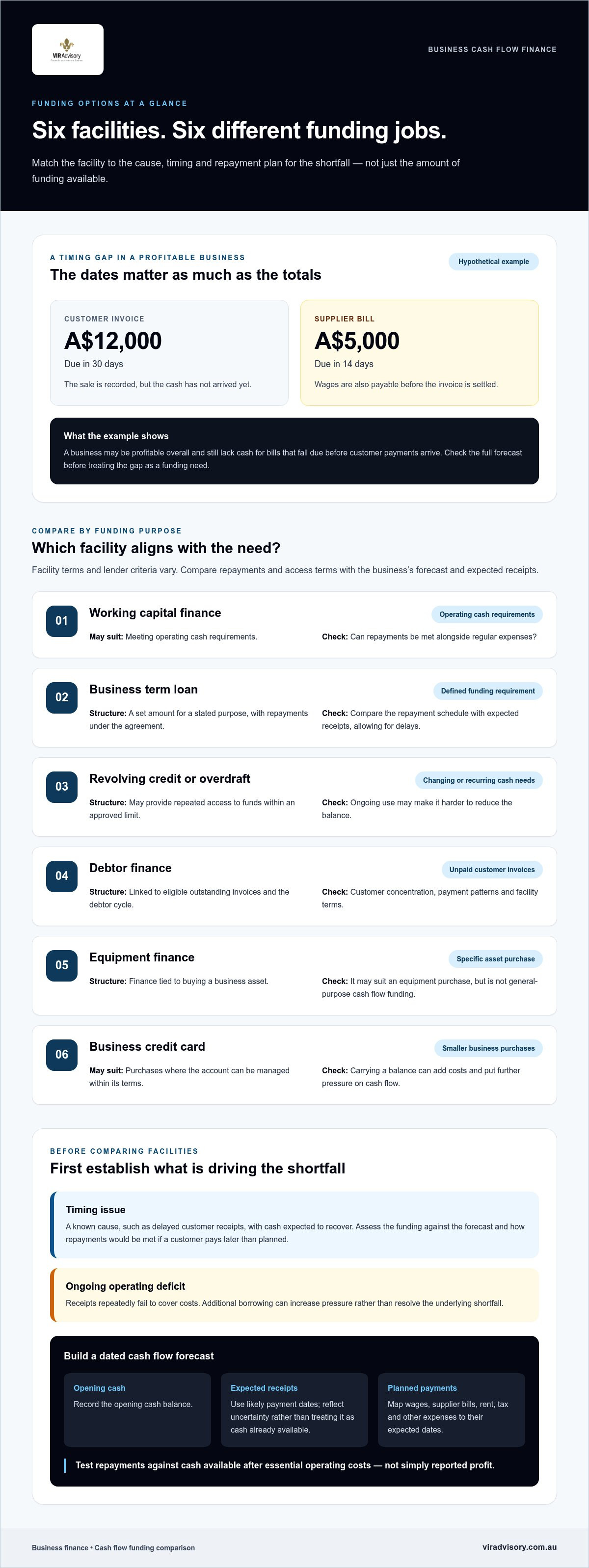
Hypothetical example: A business issues an invoice for A$12,000, due in 30 days, and records the sale. Its A$5,000 supplier bill is due in 14 days, with wages also payable before the invoice is settled. The business may be profitable overall yet have too little cash in its account to cover those earlier payments. That mismatch alone does not establish that the business is insolvent. It identifies a timing issue to assess against the full forecast.
Map each expected receipt and payment to its likely date. A forecast showing A$12,000 of expected receipts for the month may conceal a shortfall if most of the money arrives after key bills are due. The weekly or daily sequence can matter as much as the monthly total.
When borrowing may help, and when it may not
Borrowing may be worth assessing when a shortfall is temporary, identifiable and linked to a defined expense or delayed receipt. The forecast should indicate when cash is expected to recover and how repayments could be met, including if a customer pays later than planned. Compare repayments with cash available after essential operating costs, not simply with reported profit.
A timing gap has a known cause and expected end; a recurring operating deficit means receipts repeatedly fail to cover costs. If that deficit persists, additional borrowing can increase pressure rather than resolve it. Review the pattern across forecast periods to determine whether the problem is a one-off mismatch or a continuing gap between income and outgoings.
Business cash flow finance options and what each may be suited to
The suitable facility depends on what the funds are for, how long they are needed and how the business expects to repay them. Working capital finance addresses operating cash requirements, while debtor finance is linked to eligible unpaid invoices. These options are not interchangeable: one can support broader operating needs, while the other is tied to customer invoices. The comparison below highlights points to examine. Facility terms and lender criteria vary.
The Australian Government’s cash flow guidance covers cash flow statements and planning for payments. Use your forecast to compare repayment obligations with expected receipts, rather than choosing an option only by the amount of funding it could provide.
Funding need → facility to compare → key consideration
Operating expenses
Working capital finance: Intended for operating cash requirements. Repayments depend on the facility and lender. Check whether the business can meet them alongside regular expenses.
A defined funding requirement
Business term loan: Provides a set amount for a stated purpose, with repayments structured under the agreement. Compare the schedule with expected receipts, allowing for possible delays.
Changing or recurring cash needs
Revolving credit or overdraft: May provide access to funds within an approved limit. Review access and repayment terms, and consider whether ongoing use could make it harder to reduce the balance.
Unpaid customer invoices
Debtor finance: Linked to eligible outstanding invoices and the business’s debtor cycle. Customer concentration, payment patterns and facility terms may affect its suitability.
A specific asset purchase
Equipment finance: Tied to buying a business asset, with obligations set out in the finance agreement. It may suit an equipment purchase, but is not general-purpose cash flow funding.
Smaller business purchases
Business credit card: May be used for purchases where the account can be managed within its terms. Carrying a balance can add costs and put further pressure on cash flow.
Working capital finance, business loans and revolving credit
Working capital finance is considered for operating requirements; it is not simply another name for every business loan. A term loan provides a defined amount, while revolving credit or an overdraft may allow repeated access up to an approved limit. Their access and repayment structures differ. Compare the obligations with forecast receipts and existing commitments, not just the available limit. When considering working capital finance, check that the proposed use matches the business’s funding need.
Debtor finance and equipment finance
Debtor finance is connected to eligible invoices, so the timing and reliability of customer payments matter alongside the facility terms. If a small number of customers account for a large share of invoices, that concentration may affect how well the structure fits. Equipment finance has a different purpose: it relates to an identified asset purchase, rather than covering general operating costs. Match the facility to the need before comparing repayment arrangements.
Is business cash flow finance the right fix? Weigh benefits against risks
Business cash flow finance may help manage a temporary mismatch between incoming receipts and payments due, but it is still debt that must be repaid. The decision is not simply whether funds are available. Consider whether the funding purpose is clear, expected cash inflows are credible and the business can meet repayments under realistic trading conditions.
Finance suitability depends on both the purpose of the borrowing and the business’s capacity to repay it from forecast cash flow. Borrowing is not a substitute for a viable operating model. If income persistently falls short of operating costs, finance may defer the problem while increasing the amount the business owes.
Weigh potential benefits against the obligations:
- Potential benefit: A suitable facility may help cover a defined payment while expected customer receipts are pending, reducing pressure on day-to-day operations.
- Potential benefit: Funding may offer timing flexibility for a seasonal business if expected sales and collection periods are supported by trading records.
- Risk: Repayments, interest and any applicable fees create additional commitments, which may coincide with other major business expenses.
- Risk: If receipts arrive late, fall short or fail to materialise, the business may need to meet repayments from already limited cash.
Repeatedly drawing on a facility to meet ordinary costs deserves closer examination. It may indicate that costs consistently exceed receipts, margins are too narrow or customer collection practices extend the time between completing work and receiving payment. Compare funding use across periods. If a balance does not reduce as forecast, the cause may be a recurring operating issue rather than a one-off timing mismatch.
Signs a funding gap may be temporary
A short-term gap is easier to assess when there is a specific cause, a reasonable estimate of its duration and an identifiable source of repayment. For example, a seasonal business may have quieter trading before its established sales period. Expected receipts should still be grounded in available trading history and realistic payment dates. Separate one-off costs, such as an unexpected repair, from expenses that recur each trading period.
Check whether the forecast shows the facility being repaid after the relevant receipts arrive, while still allowing for ordinary bills. If the proposed repayment depends on optimistic sales or every customer paying on time, test a more conservative scenario before proceeding.
Risks to assess before taking on finance
Review the full repayment obligation against conservative cash flow assumptions, not just the expected balance in a good trading month. Include existing loan repayments and essential operating costs. Check the facility’s total cost, fees, repayment frequency and whether security is required. The agreement may also set out consequences if a repayment is missed; these depend on the specific terms.
Lender terms and assessment criteria vary by facility. Before applying, make sure the forecast explains the funding amount, how it will be used and how repayments are expected to be met. If the forecast instead shows an ongoing deficit, borrowing alone is unlikely to correct the underlying gap between costs and receipts.
How to prepare for a business cash flow finance application
A clear application connects the funding request to the business’s cash flow: what the money is for, when it is needed and how repayments could be met. Lenders may assess cash flow, trading history, the purpose of the funds and a director’s personal credit profile. Criteria vary by lender and facility, so there is no single checklist that guarantees approval. Consistent records and a realistic forecast can help explain the request and reveal potential gaps.
Build a cash flow forecast lenders can understand
For each forecast period, record opening cash, expected receipts, operating outgoings and closing cash. Include the timing of receipts and payments, not just totals. Label assumptions clearly and distinguish forecasts from actual figures. If receipts are irregular, show the basis for your estimates rather than treating uncertain income as guaranteed. Keep GST treatment consistent throughout the forecast, stating whether figures include or exclude GST.
Use this sequence to prepare:
- Forecast the gap. Map cash in and out over relevant periods, identify when the balance is expected to tighten and note the assumptions behind key receipts.
- Define the purpose. State the amount requested, what it will fund and when the business needs access to it. Link the request to a specific operating need or other defined expense.
- Assemble relevant records. Gather financial statements, business bank information, existing debt details and supporting records that explain the forecast and proposed use.
- Test repayments. Include proposed repayments alongside existing commitments and operating outgoings. Consider a more conservative scenario, such as delayed customer payments or lower receipts.
- Compare suitable options. Match the funding structure to the need and forecast. For a defined operating cash requirement, compare relevant working capital finance options with other facilities, taking account of access and repayment obligations.
Quick forecast checklist
- Opening and projected closing cash for each period
- Expected receipts, dates and assumptions
- Operating outgoings and payment due dates
- Existing debts and repayment commitments
- Proposed funding amount, purpose and timing
Prepare for lender assessment and common obstacles
Before applying, check that the figures and explanation align across your forecast, records and funding request. A clear link between the documents and the stated purpose can make the application easier to assess. Requirements differ, and a lender may request additional material depending on the facility, the business and its circumstances.
Explain irregular receipts, incomplete records or existing commitments with accurate supporting context. For instance, identify a seasonal pattern in the forecast and show the records that support your expected receipts. Inconsistent figures, unexplained gaps or an unclear use of funds can make it harder to understand the business’s position. State the expected repayment source plainly, and do not rely on an optimistic forecast to make the proposed commitment appear affordable.
How VIR Advisory can help assess business cash flow finance options
VIR Advisory is an Australian finance brokerage arranging business and commercial finance, rather than lending directly. Assessing business cash flow finance involves matching the proposed facility to the funding purpose, forecast gap and business’s capacity to manage repayments. Lender requirements differ, so the facility and supporting information need to be considered in the context of the business’s circumstances.
Led by Raina Doshi, VIR Advisory brings more than 15 years of banking and finance experience to business finance discussions, including over a decade with one of Australia’s leading banks. The review can help clarify the funding requirement, relevant finance structures and the information needed to explain the business’s position.
What to bring to an initial finance discussion
A concise, supported summary keeps the discussion grounded in the business’s actual cash position. Bring the information available and mark any figures that are estimates rather than confirmed amounts.
- The gap: When cash is expected to fall short, the cause and the expected duration.
- The purpose: What the funds would pay for, the amount sought and when it is needed.
- The forecast: Expected receipts, operating outgoings, opening and closing cash balances, and the assumptions behind the figures.
- Current commitments: Existing debts and repayments, alongside available records showing cash received and paid.
- Questions: Points to clarify about repayment structure, security, costs and lender requirements.
These details help frame the funding request, but they do not replace a lender’s assessment or create a universal application checklist. If the forecast depends on irregular customer receipts, explain the pattern and provide supporting records where available. Flag existing commitments so they can be considered alongside proposed repayments, rather than leaving them unexplained.
Discuss a finance approach suited to the business
A broker can review the stated funding need and compare lender options against the business’s forecast and repayment capacity. Look beyond access to funds: the structure, repayment obligations and relevant lender requirements all need to fit the circumstances. VIR Advisory arranges business finance services, including working capital and equipment finance, as well as business and commercial finance.
Use the discussion to clarify which funding structures may align with the purpose and which could add repayment pressure. A finance option should be considered in light of the forecast, not treated as a substitute for addressing a continuing operating shortfall. Review the funding purpose, available records and forecast, then compare the requirements attached to potential options.
Make your next funding decision with a clear view of cash flow
Before committing to business cash flow finance, check that the funding request still fits if receipts arrive later or costs rise. A forecast is a decision tool, not a guarantee. Use it to test whether the proposed repayment remains manageable under less favourable conditions and whether the facility addresses a specific need rather than extending a recurring shortfall.
A finance discussion can help clarify which structure fits the timing of the cash requirement, what obligations come with it and what information a lender may need to assess the request. VIR Advisory provides business loan and finance brokerage services across Australia. Bring your funding purpose, available records and forecast to discuss the options with Raina Doshi.
A considered decision starts with a realistic view of what the business can repay. Take that view into your next finance discussion.
Frequently Asked Questions
Can business cash flow finance be used to pay tax or GST bills?
It may be considered for a business tax or GST expense, subject to lender criteria, facility terms and the business’s repayment capacity. Using business cash flow finance does not change the amount due or the payment deadline. Include expected tax-related payments in cash planning, and obtain tax guidance from a qualified adviser. A finance broker can discuss funding structures, but that discussion is not tax advice.
Can a seasonal business apply for cash flow finance?
A seasonal business can apply, but seasonal trading does not guarantee approval or make borrowing the preferred option. Alongside trading records, consider whether expenses can be staggered or payment timing adjusted to reduce the funding need. A lender will assess the request under its own criteria and consider the business’s circumstances. Compare any proposed repayments with quieter trading periods as well as peak-season income.
What should a business do if its cash flow forecast shows repeated shortfalls?
Use the forecast to locate the recurring pressure, then examine management accounts for patterns in gross margin, fixed and variable costs, overdue customer accounts and existing repayments. For example, steady sales may still leave a deficit if costs rise or invoices take longer to collect. Before taking on further debt, discuss accounting or tax questions with a qualified professional and assess whether proposed repayments remain manageable.
How quickly can business cash flow finance be approved?
Approval and funding timeframes vary with the lender, facility, application completeness and business circumstances. Timing can also depend on whether the lender needs clarification or further documents. Before applying, identify the date the funds are required and organise supporting information so the request is ready for assessment. VIR Advisory can discuss options, while the lender controls its own assessment and processing.
Can a sole trader apply for business cash flow finance?
A sole trader can apply, but eligibility depends on the lender’s criteria and proposed facility, not business structure alone. To make the request clear, prepare records that distinguish business income and expenses from personal transactions, where possible, and document existing commitments. Explain how the funds would be used and what cash inflows are expected to support repayments. Lenders may request different information, so eligibility cannot be assumed.
Should a cash flow forecast include GST?
Either approach can be used, provided the forecast clearly states whether figures include or exclude GST and applies that treatment consistently. The Australian Government’s cash flow guidance recommends making this distinction. Consider how GST-related payments affect the cash balance when they are due, rather than treating collected amounts as unrestricted funds. For reporting or tax treatment questions, consult a qualified tax professional.
Does applying for cash flow finance guarantee that a lender will approve the application?
No. A lender makes its own decision after reviewing the request against its criteria, the information supplied and the business’s capacity to meet repayments. A broker can help compare available options and present the application clearly, but cannot determine the lender’s outcome. Before proceeding, clarify what information the selected lender requires and check that the facility’s repayment terms and any security conditions are understood.

Article by
Raina Doshi
Raina Doshi has worked in banking and finance since 2011, including experience with major Australian lenders. She helps homeowners, property investors, business owners and professionals secure and structure lending solutions across home loans, refinancing, commercial finance and business lending.
Areas of expertise include residential lending, investment property finance, debt recycling, commercial property finance, equipment finance, construction finance and strategic debt structuring.
Drawing on extensive banking and finance experience, Raina helps clients navigate lender requirements, improve borrowing outcomes and structure effective finance solutions.
Disclaimer
The information in this article is general in nature and does not take into account your personal objectives, financial situation or needs. Before acting on any information, consider whether it is appropriate to your circumstances and seek professional advice.


