

Could your accounting qualification reduce the deposit needed for a home loan? A home loan for accountants may come with lender-specific benefits, such as an LMI waiver, but eligibility depends on the lender’s current policy and your professional status, income, deposit and overall application. Your occupation is one part of the assessment, not a substitute for meeting the lender’s requirements.
It’s worth understanding the conditions before relying on an advertised waiver or rate discount, particularly if you run a practice, work in a partnership or earn variable income. Lenders still assess your income, expenses, debts and ability to meet repayments. If you’re self-employed, the lender may also need more detailed information about how your income is earned and received.
This article explains how your professional and financial profile may affect a home loan assessment, what to compare beyond a headline offer, and how to organise your information before applying. Use the practical steps and checklist to assess any potential benefit against the loan’s full costs and conditions.
Key Takeaways
- A home loan for accountants may include profession-specific benefits, but eligibility depends on the lender’s criteria and your application.
- Compare rates alongside LMI treatment, fees, repayment flexibility and the conditions attached to each offer.
- If you earn business or variable income, organise records that show how your income is structured and received.
- Use a step-by-step checklist to clarify your purchase plans, review existing commitments and prepare supporting information.
- Assess any potential benefit against the full loan costs and your borrowing needs before choosing a loan structure.
Home loans for accountants: what your profession may, and may not, change
A home loan for accountants is a residential mortgage assessed under a lender’s application process. Some lender policies may recognise an applicant’s accounting profession and offer selected benefits, such as considering an LMI waiver. That recognition doesn’t create an automatic entitlement, guarantee approval or replace an assessment of your finances.
Occupation-based criteria are one policy consideration. Borrowing capacity is the amount a lender assesses you can repay after reviewing your income, expenses, debts and deposit. Meeting a profession-specific rule may make a loan feature available, while the lender’s broader credit assessment still determines whether it can approve the application and the amount it may lend.
Which accounting roles might lenders distinguish?
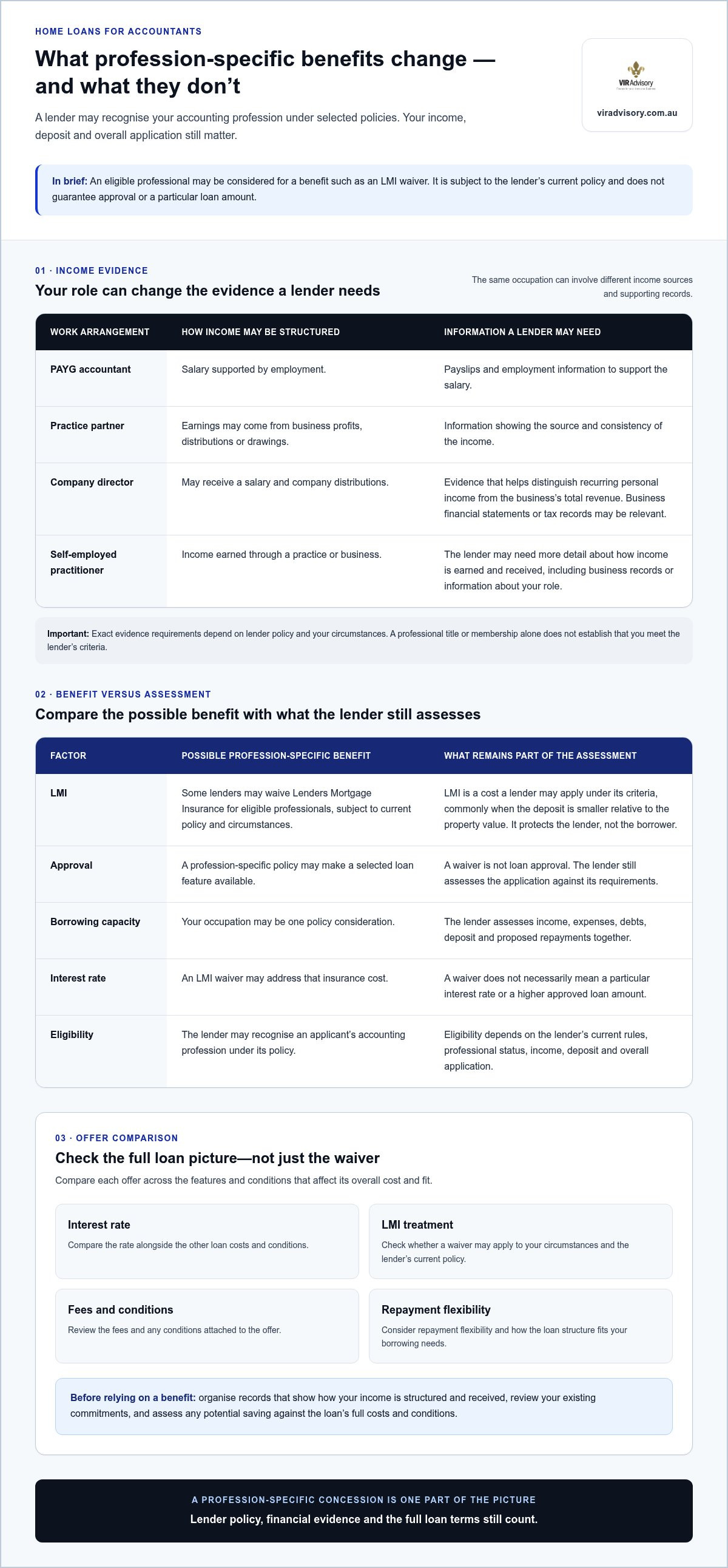
Lenders may assess a PAYG accountant differently from a partner in an accounting practice, a company director or a self-employed practitioner. For a PAYG applicant, salary may be supported by payslips and employment information. For an owner or partner, earnings may come from business profits, distributions or drawings, so the lender may need to understand the source and consistency of the income.
These differences relate to income structure and evidence, not automatic exclusions. A professional title or membership alone doesn’t establish that you meet a lender’s criteria. For example, a salaried accountant and an accountant paid through a company may have the same occupation but need to provide different financial information for assessment.
What does an accountant-specific lending benefit mean?
Lenders Mortgage Insurance (LMI) is an insurance cost a lender may apply under its criteria, commonly when the deposit is smaller relative to the property value. It protects the lender, not the borrower. Some lenders may waive this cost for eligible professionals, subject to their current policy and the applicant’s circumstances.
A waiver is a policy concession, not loan approval. It doesn’t necessarily mean the lender will offer a particular interest rate or approve a higher loan amount. Those decisions are assessed separately against the application and the lender’s requirements. Compare any potential LMI saving with the loan’s rate, fees, conditions and repayments rather than treating the waiver as proof that the offer is the best fit.
The underlying product remains a mortgage secured against property. The general Mortgage loan overview explains this structure. An accountant-specific policy may change selected eligibility settings, but not the basic nature of the loan.
Before relying on a promoted benefit, identify which policy condition it addresses and whether your role, income structure and application fit the lender’s current rules. This helps distinguish a possible feature from a guaranteed outcome and keeps the focus on the full assessment.
How Australian lenders assess accountants applying for a home loan
An accountant’s job title doesn’t determine how much a lender will approve. For a home loan for accountants, the lender assesses the evidence behind the application: income, regular expenses, existing liabilities, deposit and proposed repayments. How you earn and document income can affect the assessment, particularly if earnings come through a practice or partnership.
Lenders commonly assess verified income, living expenses, existing debts and other liabilities, deposit, and proposed loan repayments. These factors are considered together, rather than relying on a headline salary or professional occupation. The selected lender’s policy determines which evidence it needs and how it treats different income sources.
How income structure affects application evidence
A PAYG accountant may be asked for payslips and employment details to support their salary. A partner, director or self-employed practitioner may need to show how business earnings flow to them. Relevant evidence could include business financial statements, tax records or information about the applicant’s role in the business. Exact requirements depend on lender policy and individual circumstances.
For example, a director’s salary may not show the full picture if they also receive company distributions. A lender may need to distinguish recurring personal income available for repayments from the business’s total revenue. Professional membership, such as membership of CPA Australia, may establish credentials where relevant, but it doesn’t replace financial evidence or determine the assessment outcome.
Why borrowing capacity is not an occupation-based benefit
Borrowing capacity depends on the lender’s assessment of your income alongside household spending, credit commitments and proposed repayments. Existing personal loans, credit card limits or other ongoing liabilities can affect the assessment, even if you have a strong salary. If you own a business, you may also need to explain business commitments and how they interact with your personal cash flow.
Lenders can assess the same financial profile differently because their policies and treatment of income, expenses and liabilities vary. A profession-specific concession, where available, doesn’t automatically increase the amount a lender considers affordable. Comparing the assumptions behind assessments can help explain why indicative borrowing figures differ. The article How Borrowing Capacity Is Actually Calculated in Australia discusses these assessment factors in more detail.
Before applying, organise income evidence by source and record regular expenses, debts and available deposit funds. This can reduce avoidable follow-up requests and give the lender a clearer view of your finances. Requirements differ, so match your documents to the selected lender’s current policy rather than relying on a fixed checklist.
Compare accountant home loan benefits against the full loan trade-offs
An advertised accountant benefit is only one part of a loan comparison. A lower rate or possible LMI waiver may be valuable, but fees, repayment options and eligibility conditions also affect how well a loan fits. Assess each feature against your deposit, cash flow and property plans instead of assuming a promoted concession makes one loan the strongest option.
A promoted concession does not establish the best overall loan for every applicant. Use the comparison below to identify the terms that need closer attention.
| Feature | Compare | Check |
|---|---|---|
| Advertised rate | The rate and whether it is fixed or variable | How it applies to your loan and circumstances |
| LMI treatment | Whether LMI may apply or a waiver may be available | Eligibility, deposit requirements and related conditions |
| Fees | Relevant upfront and ongoing fees | How charges affect the cost of holding the loan |
| Repayment flexibility | Available repayment options and features | Whether the terms suit your cash flow and intended use |
| Eligibility conditions | Professional, income and loan criteria | Whether your application fits current lender policy |
Loan comparison at a glance
Rate: Check fixed or variable terms → LMI: Check eligibility and deposit conditions → Costs: Account for fees → Features: Review repayment flexibility → Fit: Match terms to your circumstances
LMI waiver or lower deposit: what to weigh up
If a lender’s policy allows an eligible borrower to avoid LMI, this may reduce an upfront cost associated with the loan. However, a waiver is conditional, not a standard entitlement for every accountant. Deposit requirements and waiver conditions vary between lenders, and a smaller deposit can mean a larger loan balance and higher repayments.
Compare the funds needed to complete the purchase with the resulting loan amount and repayments. Don’t assume a particular deposit will qualify for a waiver, or that avoiding LMI alone makes the loan suitable. The lender’s current eligibility rules and your application determine whether the concession applies.
Compare rates, fees and loan features together
A lower advertised rate may not mean a lower overall cost once fees and product conditions are considered. Review the repayment structure too. A fixed rate can provide more certainty about repayments during its fixed period, while a variable rate may offer different repayment flexibility. Neither guarantees a better outcome, and future rate movements can’t be predicted.
Offset and redraw features can differ between products. Check how funds are accessed, how each feature operates and whether conditions apply, rather than relying on the feature name alone. If you already have a loan, compare its current structure with the alternative, including relevant costs and features. A home loan for accountants should be assessed on its full terms and suitability, not just a headline benefit.
Prepare an accountant home loan application with this practical checklist
A well-organised application helps a lender understand your purchase plans, income structure and financial commitments. For an accountant, preparation also means ensuring the evidence reflects how income is earned, whether through PAYG employment, a partnership, a company or self-employment. Work through these steps before comparing suitable loan options.
- Define the purchase. Note the property type, intended use, approximate budget and deposit available. Include other purchase costs you expect to fund, so you can distinguish the deposit from the cash needed for the rest of the transaction.
- Review your finances. Record household income, regular expenses and existing credit commitments. Check statements and records for obligations that can be easy to overlook, such as credit facilities or repayments that continue even when you don’t use them.
- Gather income evidence. Organise records that reflect whether you’re PAYG, a partner, a company director or self-employed. Check that the figures in your application are consistent with the supporting documents.
- Compare suitable options. Consider lender eligibility, repayments, fees and loan features together. Note any conditions attached to a potential benefit, and compare those terms with your deposit, cash flow and property plans.
Documents and financial details to organise
Prepare information by category rather than waiting until a lender requests it. This is a starting point for organising your records, not a fixed list of documents every lender will require.
- Identity: Identification and personal details needed to support the application.
- PAYG income: Payslips and employment information where required by the lender.
- Business income: Relevant financial records showing how income is earned and distributed. Documents depend on lender policy and whether you operate as a sole trader, partner or company director.
- Expenses and liabilities: Details of regular household spending, loan repayments and other credit commitments.
- Deposit: Evidence of available funds and information about where the money is held.
Check names, dates and income figures across your application and supporting records. If earnings vary, provide information that represents the pattern accurately instead of relying on a single figure that doesn’t align with the evidence. The lender’s requirements depend on its current policy and your circumstances.
Application decisions that can create avoidable friction
Taking on new credit during an application can change how a lender views your existing commitments. Before making a significant credit commitment, consider how it may affect the information being assessed. Disclose debts fully, including facilities you rarely use, and explain variable income rather than presenting it as a fixed amount.
Incomplete or inconsistent details can lead to follow-up questions and slow assessment. For more detail on the factors lenders may weigh, see How Borrowing Capacity Is Actually Calculated in Australia. If your income comes through a business, make sure the application figures can be reconciled with records showing how that income is earned and received.
Discuss your home loan options with VIR Advisory
Choosing a home loan as an accountant involves more than checking whether a profession-specific policy exists. Consider three points: whether you meet the lender’s current eligibility criteria, how your full financial position will be assessed, and whether the loan’s features and costs suit your needs. These considerations apply whether you’re buying a home or reviewing an existing loan.
VIR Advisory is a national mortgage and finance brokerage providing support with residential home loans and refinancing. Led by Raina Doshi, the brokerage draws on her more than 15 years of banking and finance experience to compare lender criteria and loan structures. For a home loan for accountants, the assessment should reflect your circumstances rather than assume an occupation-based benefit will apply automatically.
What to cover in an initial home loan discussion
Bring together the details that shape an application: whether you’re PAYG, a business owner, partner or company director; how your income is earned; the deposit available; and the type of property you’re considering. If you’re refinancing, include your current loan structure and what you want to review, such as repayments, features or overall costs.
These details help frame a practical discussion about lender criteria, potential loan structures and relevant next steps. If income varies or is tied to a business, explaining how it is earned and documented can clarify what the assessment may require. An indicative option is not the same as approval.
Get support comparing lender requirements
Lender policies can differ, so an accountant’s occupation or professional membership shouldn’t be treated as a complete answer. A brokerage can compare lender options against your stated needs and financial circumstances, including how each lender approaches income evidence, deposit, loan features and relevant professional criteria. The comparison can also consider whether a purchase loan or refinancing is the more relevant application.
Keep your questions specific: Does the lender’s policy fit your role and income structure? What does the full assessment require? How do the rate, fees, repayment flexibility and conditions compare? Consider a potential LMI waiver or other concession alongside these factors, not in isolation. The aim is to understand the terms that may be available and their conditions, without assuming a particular borrowing amount, rate or approval outcome.
VIR Advisory’s residential finance and refinancing support is tailored to the information you provide and the lending requirements relevant to your circumstances.
Set your next home loan decision in motion
Turn general loan information into questions specific to your circumstances. Consider which loan features matter, how much repayment flexibility you need and what evidence best represents your income. This gives a lender discussion a practical focus, particularly if your earnings come from a practice, partnership or company.
For a home loan for accountants, understanding how a policy applies to your role and finances can help you assess possible options without relying on assumptions about professional benefits. Raina Doshi’s experience includes more than a decade with one of Australia’s leading banks, informing VIR Advisory’s work comparing lender criteria and residential finance options.
Bring your property plans, deposit position and income structure to the discussion. You can then consider relevant lending requirements and next steps in light of your circumstances.
To discuss your home loan options with VIR Advisory, book a conversation using the link below.
Frequently Asked Questions
Can accountants get a home loan with a lower deposit?
Some accountants may be eligible for a loan with a lower deposit, subject to the lender’s policy and assessment. A smaller deposit can mean borrowing a larger share of the property’s value, affecting repayments and the cash left for other purchase costs. Compare the funds needed to complete the purchase with the funds you expect to retain after settlement.
Do accountants qualify for an LMI waiver in Australia?
Some lenders may offer an LMI concession if an applicant meets occupation and loan criteria. A professional title by itself doesn’t secure a waiver, and policies can change. Check whether the lender’s current policy applies to your professional status, deposit and proposed loan. Treat a waiver as a possible feature of an eligible application, not as a guaranteed saving or approval outcome.
Can self-employed accountants apply for a home loan?
Yes. Self-employed accountants can apply, although lenders assess business income under their own verification and serviceability policies. Your business structure can affect which records help explain your personal income, so organise documents showing how income is earned and received. Keep personal earnings distinct from business turnover, and make sure the application figures align with the supporting financial information.
Will working as an accountant increase my borrowing capacity?
Not automatically. A lender may have occupation-related criteria, but borrowing capacity still depends on its assessment of the full application. An existing car loan or other credit commitment, for example, may affect the amount available for proposed repayments. The same finances can also produce different assessments between lenders. Compare a home loan for accountants on assessed capacity and loan terms, not occupation alone.
Is a home loan for an accountant always cheaper than a standard home loan?
No. A profession-specific offer may include a concession, but that doesn’t establish the lowest overall cost. Compare the rate and applicable fees with the repayment features and conditions, then consider how long you expect to keep the loan. A lower upfront cost may not outweigh higher ongoing costs over time. The value of an offer depends on the lender’s current terms and how they fit your circumstances.
What documents might an accountant need for a home loan application?
Prepare information supporting your identity, income, expenses, debts and deposit. PAYG applicants may need employment and salary evidence, while a practitioner or company director may need records reflecting business income and structure. Requirements vary, so organise documents by income source and keep the figures used in the application consistent. Be ready to explain material differences between records, such as income that fluctuates across periods.

Article by
Raina Doshi
Raina Doshi has worked in banking and finance since 2011, including experience with major Australian lenders. She helps homeowners, property investors, business owners and professionals secure and structure lending solutions across home loans, refinancing, commercial finance and business lending.
Areas of expertise include residential lending, investment property finance, debt recycling, commercial property finance, equipment finance, construction finance and strategic debt structuring.
Drawing on extensive banking and finance experience, Raina helps clients navigate lender requirements, improve borrowing outcomes and structure effective finance solutions.
Disclaimer
The information in this article is general in nature and does not take into account your personal objectives, financial situation or needs. Before acting on any information, consider whether it is appropriate to your circumstances and seek professional advice.


