

A lower repayment can come at the cost of a longer mortgage. Refinancing to reduce your loan term in Australia can bring your mortgage-free date forward, but a shorter term usually means higher minimum repayments. Whether it makes sense depends on how the new rate, repayment amount and refinancing costs compare with your current loan.
It’s reasonable to want to pay less interest without putting unnecessary pressure on your cash flow. A lower rate may increase your savings, while extending the loan term can stretch out repayments and increase total interest, even if the monthly payment falls.
This article explains how refinancing can shorten your loan term, which costs may affect the outcome and how to weigh potential interest savings against higher repayments. It also covers lender assessments and why you should specify the term you want, helping you judge whether refinancing supports your payoff timeline and fits your budget.
- Set the new loan term deliberately to avoid extending your repayment timeline by default.
- Understand how equity, LVR, credit history and lender criteria can affect refinance options.
- Compare interest rates and loan features alongside switching costs to assess potential value.
- Factor higher minimum repayments into your cash-flow planning before shortening the term.
- Weigh the interest savings against the repayment commitment and your intended payoff date.
What Does Refinancing a Mortgage Mean?
In Australia, refinancing means replacing an existing mortgage with a new loan. The new lender arranges to pay out your current loan, and you then make repayments under revised terms. Refinancing doesn’t always mean changing lenders. Your current lender may also offer a different rate, loan structure or term.
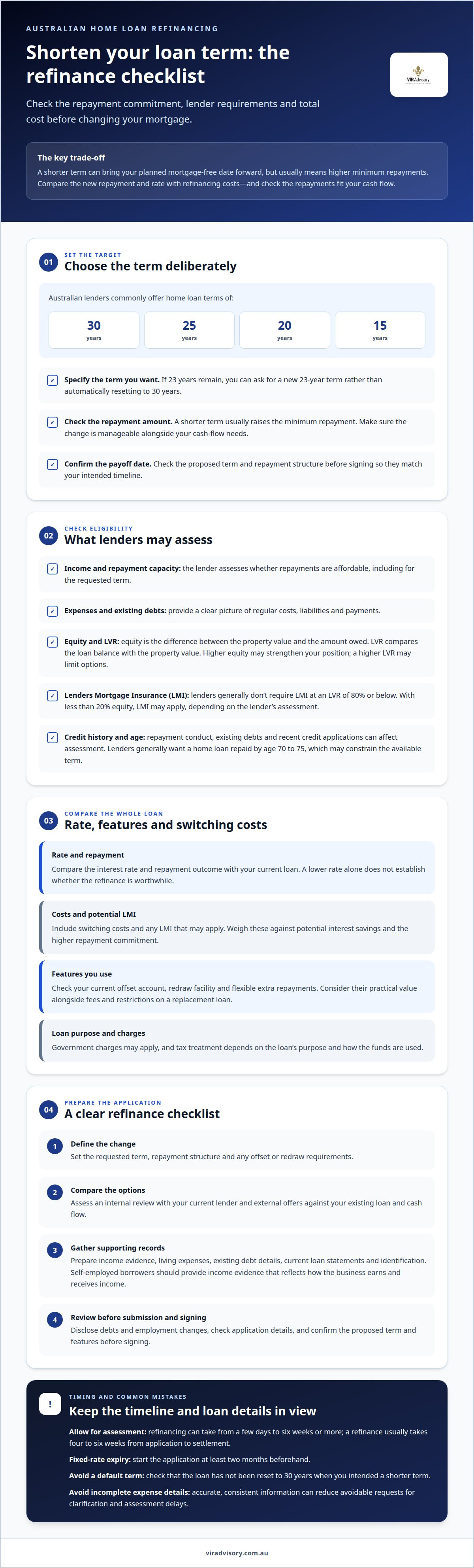
Refinancing to reduce your loan term in Australia means setting repayments and a loan duration that bring your planned payoff date forward. Australian lenders commonly offer terms of 30, 25, 20 or 15 years. If you have 23 years remaining, you can ask for a new 23-year term rather than automatically resetting to 30 years.
Equity is the difference between your property’s value and the amount you owe. Lenders use the loan-to-value ratio, or LVR, to compare your loan balance with the property value. Higher equity can strengthen your position in negotiations, while a higher LVR may limit your loan options.
Equity also affects Lenders Mortgage Insurance (LMI). Australian lenders generally don’t require LMI when the LVR is 80% or below. With less than 20% equity, a borrower refinancing may have to pay LMI, depending on the lender’s assessment. Include this potential cost when comparing a new rate with your existing loan.
Your credit history influences how lenders assess an application and the terms they may offer. Repayment conduct, existing debts and recent credit applications can all affect the assessment. A mortgage specialist can clearly present your loan purpose, repayment history and equity position when seeking revised terms from your current lender.
Review loan features as well as rates. Check whether your current loan includes an offset account, redraw facility or flexible extra repayments, then weigh their practical value against fees and restrictions on a replacement loan. A lower variable rate may look attractive, but losing a useful feature could affect how you manage cash flow.
You can start negotiations with your current lender. A specialist can compare your existing loan with suitable alternatives, identify your preferred term and repayment structure, then present a case for revised pricing or features. An internal switch may avoid changing lenders, while a new lender assesses the refinance as a new loan.
For borrowers seeking to refinance to reduce a loan term in Australia, age and retirement income can affect the term available. Australian lenders generally want a home loan repaid by age 70 to 75, which may constrain the term when refinancing. The lender’s assessment of income and repayment capacity can therefore matter as much as equity or the requested term.
How Does Refinancing Work?
Refinancing moves your home loan to a new structure or lender, subject to assessment. The process involves an application, lender approval, loan documents and settlement.
Refinance application steps and options managed by a specialist
A refinancing specialist assesses your current loan, priorities and circumstances, then coordinates an application suited to your repayment goals. You can request an internal review with your current lender or apply to a new lender. The specialist compares suitable structures, submits the application for assessment and coordinates valuation and settlement arrangements. This keeps your requested term, principal and features clear throughout the process.
- Define the change: Set the requested term, repayment structure and any offset or redraw requirements.
- Compare options: Assess internal and external offers against your current loan and cash flow.
- Submit the application: Provide documents so the lender can assess income, expenses and existing debt.
- Complete settlement: After approval and signing, the new loan pays out the old mortgage.
Assessments and required documents
A lender treats an external refinance as a new loan application and assesses whether the repayments remain affordable. It may review your income, living expenses, existing debts, repayment history, requested term and property value. The lender may also arrange a valuation. Accurate, consistent documents help the lender assess your circumstances without avoidable requests for clarification.
A refinancing specialist will typically need documents showing your finances and current loan position. Prepare the relevant records for each borrower:
- Proof of income, such as recent payslips or income records.
- Details of living expenses, existing debts and regular payments.
- Recent statements for the current loan, showing the balance and payments.
- Identification and supporting records requested for the application.
Application checklist: Confirm the requested term and features; gather income, expense and loan records; disclose debts and employment changes; then review the application details before submission. If you’re self-employed, provide income evidence that reflects how your business earns and receives income.
Refinancing can take from a few days to six weeks or more; a refinance usually takes four to six weeks from application to settlement. For a fixed-rate expiry, start the application at least two months beforehand. A common mistake is leaving the term at the lender’s default, which may reset it to 30 years. Another is applying with incomplete expense details, which can delay assessment. Check the proposed term and disclosures before signing.
Comparing Home Loan Options and Potential Savings
A useful comparison measures the total cost of each suitable home loan, not just its advertised interest rate. Australian tax treatment and government charges can also affect the result: charges may apply, while tax treatment depends on the loan’s purpose and how the funds are used.
Comparing loan features and rates with a refinancing specialist
A mortgage broker compares rates, fees, features and repayment outcomes with your current loan. That matters because a lower rate may not offer better value if it removes a feature you use or adds costs that outweigh the interest savings.
Australian home loan offers must display a comparison rate alongside the advertised interest rate. Consider both figures, but remember that the comparison rate is based on a standard loan amount and term. Compare the same loan amount and remaining term across options, then consider whether an offset account, redraw facility or extra repayments suit your cash-flow needs.
A specialist can model the current loan against alternatives using the same balance and repayment frequency. The comparison should include switching costs and the proposed term, not just the first repayment. A variable-rate option may offer flexibility, but repayments can change when rates move. Variable home loan interest rates can differ by more than 2 percentage points across the market, making lender and product comparisons material.
Rates across different loan terms
There isn’t one current Australian refinance rate for each loan term. Lenders set rates according to the borrower’s circumstances, loan structure, LVR and chosen features, so a shorter term doesn’t automatically mean a lower interest rate.
Compare available offers using the same loan balance and a term that matches your intended payoff date. A longer term can reduce minimum repayments, but it increases the time interest accrues. A 0.05% p.a. reduction in the interest rate can save thousands over the life of a home loan, while a term extension can offset some rate savings.
- Rate: Compare advertised and comparison rates for each suitable product.
- Term: Keep the remaining term consistent when testing options.
- Features: Value offset, redraw and repayment flexibility against their costs.
- Total cost: Include fees and interest across the proposed repayment period.
Ask the specialist to show how each option affects your repayments and total interest. This clarifies the trade-off: refinancing may reduce interest, but extending the term can increase the total cost of borrowing.
Shortening Your Loan Term to Pay Off Your Mortgage Faster
Refinancing to reduce your loan term in Australia can bring your mortgage payoff date forward and reduce total interest. The trade-off is higher minimum repayments, so compare the new commitment with your household cash flow.
Choosing a shorter loan term
A shorter term means repaying the principal over fewer years, which generally reduces the time interest accrues. For example, reducing a remaining term from 25 years to 20 years can lower total interest, even if the interest rate stays roughly the same.
When refinancing, request a term that matches your intended payoff date. A borrower who has repaid five years of a 30-year loan can choose 25 years to retain the original timeline. Resetting to 30 years instead adds five years of repayments and may increase total interest.
Compare the options using the same balance and rate assumptions. Refinancing to reduce a loan term in Australia could mean larger repayments, but a 28-year remaining term changed to 20 years may save tens of thousands of dollars in interest, depending on the balance and rate. Income stability and other commitments also matter.
Repayment changes
Refinancing to reduce your mortgage term spreads the outstanding principal across fewer repayments, increasing the minimum amount due. Before approving the new loan, the lender assesses whether your income and expenses can support that commitment. Repayment estimates should reflect the proposed term and interest rate, not just the balance at settlement.
Australian borrowers can also make extra repayments or use an offset account instead of formally shortening the term. Variable loans, or loans with offset or redraw facilities, generally allow unlimited extra repayments whenever the borrower can make them. This can preserve flexibility, although access and loan conditions vary.
After settlement, changing the contracted term usually requires a formal variation or another refinance. Decide on the term before accepting the new loan documents, rather than assuming extra payments will automatically change the contractual payoff date.
Interest and repayment risks
Paying your loan off sooner usually reduces total interest because the balance is repaid faster. Shortening a home loan by two or three years can reduce interest by thousands, though the actual saving depends on the balance and rate.
The main risk is cash-flow pressure from higher required repayments. A change in income, an increase in variable interest rates or unexpected household costs can make the shorter schedule harder to maintain. Leave room for regular expenses, and don’t choose a term solely to achieve the lowest projected interest total.
Compare the required repayment with your budget under a less favourable rate scenario. If the shorter term leaves little room for essential costs or a change in your circumstances, keeping the remaining term and making additional repayments may offer a more manageable balance.
Refinancing Costs and Break-Even Considerations
Refinancing costs reduce the net benefit of a lower rate or shorter term. Weigh upfront fees against expected interest savings and the time it may take to recover those costs.
Refinance costs and fees
Refinancing costs can include fees from your existing lender, the new lender and government charges. Each cost increases the borrowing expense or reduces the cash benefit available at settlement.
Borrowers leaving a fixed-rate loan may also face a break cost, calculated using the balance, rate difference and remaining fixed term. For example, an estimated break cost is A$4,000 on a A$400,000 balance, with a 0.50% p.a. rate difference and two years remaining.
Break-even and cashback comparisons
The break-even point is when accumulated loan savings equal the total cost of switching. This matters because a refinance that saves interest over time may still cost more if you sell or refinance again before recovering the fees.
Compare upfront costs with the expected monthly benefit from the new rate and term. Divide total switching costs by estimated monthly savings to see how long recovery may take. Include any fixed-rate break cost, discharge fee and new lender charges, then compare the result with your expected time in the loan.
Cashback offers reduce upfront costs, but they don’t necessarily deliver the strongest long-term result. Compare the incentive with interest savings, fees and repayments over the proposed term. A shorter term may reduce total interest while increasing each repayment; cashback doesn’t remove that cash-flow commitment or offset a less competitive variable rate.
Your equity, income and financial circumstances can affect your borrowing options and repayment capacity. Compare the net cost and payoff timeline rather than treating cashback or a headline rate as the whole refinancing decision.
VIR Advisory: Refinancing Solutions
VIR Advisory provides refinancing solutions for borrowers reviewing their mortgage structure, repayment schedule or lender. The team assesses how a proposed change fits your objectives, cash flow and lending circumstances, then helps identify suitable options. This can be useful if you want a shorter term but need to understand how higher repayments affect your household or business commitments.
A refinance should meet a clear lending need, rather than simply replace one loan with another. The assessment considers your current balance, remaining term, income, equity and the features you use. It also weighs potential interest savings against switching costs and the repayments required under the proposed structure. If changing lenders won’t improve your overall position, keeping your current loan may be worth considering.
For a home loan, the key comparison is how the proposed rate, term and features affect your repayments and expected payoff date. VIR Advisory can consider whether the requested term supports your intended timeline, whether the new repayments fit your budget and how an offset or redraw feature meets your cash-flow needs. The assessment should distinguish a lower minimum repayment from a genuine reduction in total borrowing costs.
The refinancing review can be organised around these practical decisions:
- Clarify the objective: Identify whether the priority is shortening the term, reducing interest, improving loan features or managing repayments.
- Assess affordability: Consider income, expenses and existing borrowing alongside the proposed repayment amount.
- Compare structures: Review suitable loan terms, rates and features against the current arrangement.
- Weigh costs and timing: Include applicable switching costs and any fixed-rate considerations in the comparison.
Business owners and company directors may also have business borrowing alongside a personal mortgage. VIR Advisory offers Business Loans as well as Home Loans, with financial strategy guidance when household and business commitments affect borrowing capacity. Keeping the purpose and repayment obligations of each facility clear supports a more coherent assessment and avoids treating business cash flow as interchangeable with personal income.
Refinancing may not suit every financial situation. A new loan can add costs or repayments that pressure cash flow, while a lower rate may not make up for extending the term. Focus the assessment on the complete loan structure and your intended repayment outcome, not just an advertised rate or incentive.
To discuss your refinancing requirements, contact VIR Advisory.
Frequently Asked Questions
Is refinancing a good idea?
Refinancing can make sense if the new loan better matches your plans for the property and how long you expect to keep it. Consider whether you may sell, change work arrangements or take on other borrowing before paying off the mortgage. Refinancing also requires a new application, so an existing loan that already suits your needs may be preferable to changing it without a clear purpose.
Does refinancing hurt my credit score?
A refinance application may affect your credit file, and lenders can consider your credit history during assessment. Avoid submitting several applications at once, as each lender may make its own enquiry. Before proceeding, make sure the application is accurate and consistent, especially details of existing debts and repayment commitments. Lenders may assess your credit file differently.
How long does the refinance process take?
The timing depends on the application and the steps required before settlement. Delays can arise if income or expense information is incomplete, a valuation takes longer to arrange, or the lender needs clarification about an existing commitment. A specialist coordinates these stages and keeps the application moving as documents and decisions are needed. If your circumstances change during assessment, tell the specialist promptly so the application remains accurate.
What are the interest rates?
There isn’t one rate that applies to every Australian refinance. The rate offered depends on your application and the loan you select, including whether the rate is fixed or variable. A lender’s offer is specific to the assessed circumstances and product conditions, so an advertised rate may differ from the one offered to you. Review the formal loan offer before deciding.
What can refinancing offer you?
Refinancing can help you restructure a mortgage around a specific lending goal, such as bringing the planned payoff date forward or changing how loan features support day-to-day cash management. It may also give you access to another lender’s loan range. The new arrangement isn’t automatically an improvement: a new application and changed loan conditions can affect what’s available and how the debt fits your broader commitments.
How much can borrowers save in interest by shortening a home loan term in Australia?
There’s no single saving that applies to every borrower. A useful projection needs the outstanding balance, proposed repayment schedule and rate assumptions for the comparison. Ask for the estimated interest over the remaining life of both options, not just the first repayment. This shows how the selected term affects the overall projection and distinguishes a faster payoff from a lower short-term payment.
What fees and costs apply when refinancing a home loan in Australia?
Charges depend on your existing contract, the new loan and the property arrangements. Before accepting an offer, review the written fee details and identify which costs are payable at application or settlement. A fixed-rate loan can have a break cost, so the timing of refinancing may affect the amount due. Include these charges in your cash-flow planning rather than treating them as incidental to the loan decision.
What Australian eligibility criteria do lenders use for refinancing?
Lenders assess your application using current financial information, rather than relying only on the fact that you’ve maintained an existing mortgage. They need to understand the proposed loan, the property security and whether the repayments fit your circumstances. If you’re self-employed, clear records of business income can help explain how your earnings support repayments. The lender’s age-related limits may also affect the term you request.

Article by
Raina Doshi
Raina Doshi has worked in banking and finance since 2011, including experience with major Australian lenders. She helps homeowners, property investors, business owners and professionals secure and structure lending solutions across home loans, refinancing, commercial finance and business lending.
Areas of expertise include residential lending, investment property finance, debt recycling, commercial property finance, equipment finance, construction finance and strategic debt structuring.
Drawing on extensive banking and finance experience, Raina helps clients navigate lender requirements, improve borrowing outcomes and structure effective finance solutions.
Disclaimer
The information in this article is general in nature and does not take into account your personal objectives, financial situation or needs. Before acting on any information, consider whether it is appropriate to your circumstances and seek professional advice.


