

An ATO debt can reduce your borrowing capacity without automatically ruling out a home loan. ATO debt borrowing capacity depends on how a lender assesses repayments alongside your income, expenses, existing commitments, deposit or equity and credit history. If an ATO plan requires $2,000 a month, that’s $2,000 a month less available for mortgage repayments in a straightforward cash-flow comparison.
It’s understandable to focus on the debt balance, but lenders may also consider whether it’s overdue, whether you’re keeping to a repayment arrangement and whether the business can manage both tax payments and the proposed loan. An ATO payment plan does not guarantee approval.
This article explains how tax debt may affect borrowing capacity and mortgage eligibility in Australia, what lenders may assess for business owners and self-employed applicants, and how paying or refinancing the debt could affect an application. It also covers the trade-offs: clearing the debt may improve serviceability, while using cash to repay it can reduce the deposit or reserves available for a purchase.
Key Takeaways
- Find out how lenders may factor ATO repayments into your mortgage serviceability assessment, alongside income, expenses and existing debts.
- Understand why an ATO payment arrangement can help explain how the debt is being managed, but doesn’t guarantee loan approval.
- Weigh the effect of paying tax debt from savings against keeping enough deposit and cash reserves for a property purchase.
- Compare potential funding approaches, including refinancing or business finance, against their impact on cash flow and existing lending.
- Prepare clear evidence of the debt, repayment arrangements and business finances to support a more informed application assessment.
ATO payment arrangements and mortgage eligibility
An ATO payment arrangement gives a lender a defined record to assess alongside your income and proposed loan. The lender can review the outstanding balance, scheduled instalments and evidence that payments are being made as agreed. For a self-employed applicant, this helps distinguish a managed liability from unresolved tax obligations. The lender also considers whether business cash flow can cover operating costs and household commitments.
The arrangement’s cost can change while the balance remains outstanding. According to the Australian Taxation Office, the General Interest Charge annual rate for the April-June 2026 quarter is 10.96% per annum. A growing balance may affect the amount that needs to be repaid, so the lender’s figures should match current ATO records. An experienced accounting practice like POP Business can help reconcile the amount owing with the business accounts used in the application.
For business owners, documents should show how business income translates into personal income available for mortgage repayments. Tax returns and notices of assessment record income, while business financial statements show trading results and liabilities. Bank statements help demonstrate actual cash flow. If the records cover different periods or the figures do not align, the lender may need an explanation before assessing the application.
Lenders may request tax returns, notices of assessment, income evidence, business financial statements, details of the tax debt and payment arrangement, payment records and bank statements. Each document serves a purpose: debt details establish the amount, the arrangement shows the agreed schedule, and payment records demonstrate the payment history. An accountant’s letter can explain changes in income or tax liability.
Prepare the documents as a consistent snapshot, rather than sending isolated records:
- Match the ATO balance and arrangement details to the latest available account information.
- Organise payment records in date order so instalments can be traced against bank statements.
- Reconcile business income evidence with the figures used in the loan application.
- Include an accountant’s explanation where the records show a material change or mismatch.
For example, business statements may show a tax payment while the ATO balance still reflects the amount before that payment. Include records that explain the timing so the lender can understand the difference. A consistent file also reduces the risk of the assessment relying on an outdated liability or incomplete information about business cash flow.
Before applying, review the records with your accountant and resolve any unexplained differences. This gives the lender a clearer basis to assess the arrangement, business income and available funds. It also helps you see whether the proposed loan repayments fit alongside the obligations shown in your financial records.
Options for paying or refinancing business tax debt
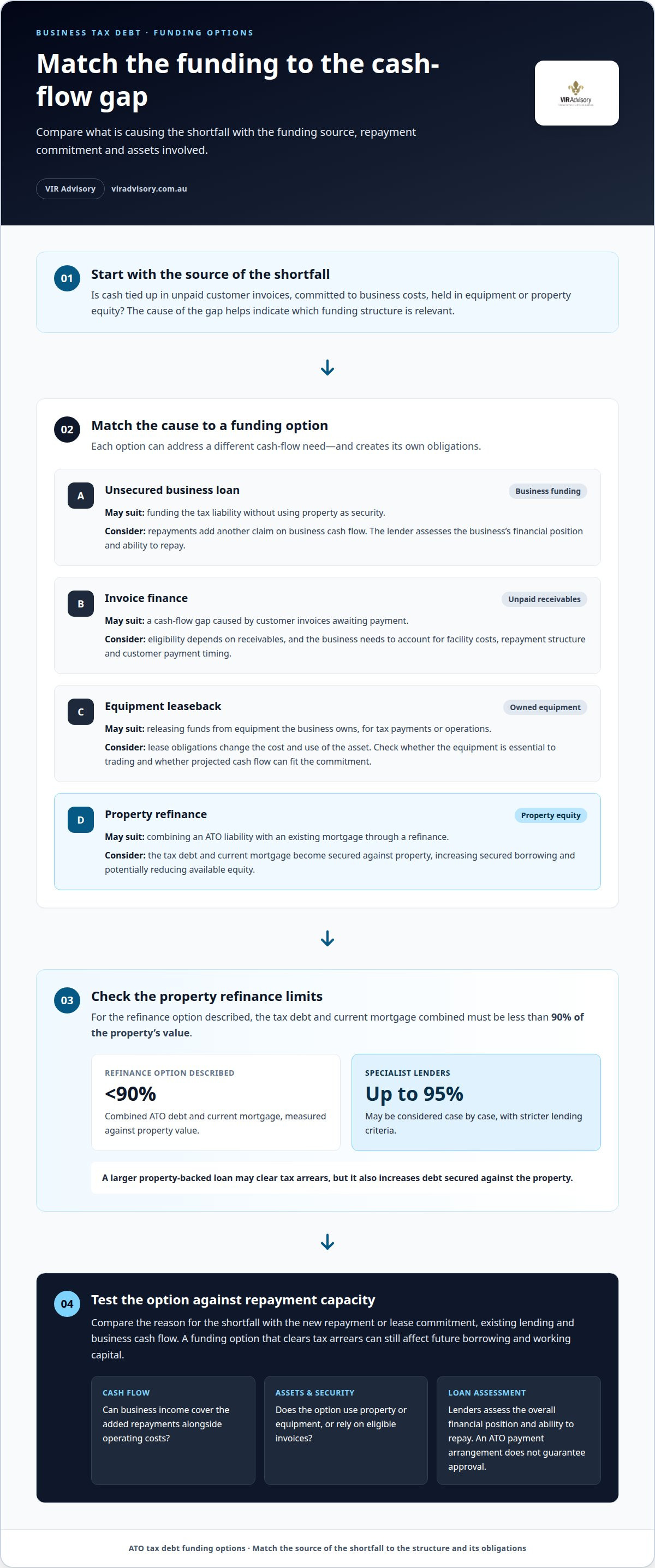
Business tax debt may be addressed through business funding, invoice finance, equipment equity or property refinancing. The suitable structure depends on where cash is tied up and which assets the business can use. Clearing the liability may ease immediate pressure, but new repayments or security obligations can affect future borrowing and working capital.
An unsecured business loan can provide funds without using property as security. This may keep business or personal property outside the loan security, but repayments become another claim on business cash flow. The lender assesses the business’s financial position and ability to repay, so this option may not suit a business with irregular income or cash already committed to operating costs.
Invoice finance may help when customer invoices are awaiting payment. It can release cash linked to eligible receivables instead of relying solely on property security. However, the business needs to account for the facility’s costs and repayment structure, as well as how customer payment timing affects available funds. It is most relevant when unpaid invoices, rather than weak trading, are creating a cash-flow gap.
An equipment leaseback can release funds from equipment the business owns, while leaving it with lease obligations. This may preserve cash for tax payments or business operations, but changes the cost and use of an asset. Consider whether the equipment is essential to trading and whether the ongoing lease commitment fits projected cash flow.
Property refinancing may combine an ATO liability with an existing mortgage. For the refinancing option described, the tax debt and current mortgage combined must be less than 90% of the property’s value. Specialist lenders may consider ATO tax debt home loans up to 95% of property value on a case-by-case basis, with stricter lending criteria. A larger property-backed loan can clear tax arrears, but increases debt secured against the property and may reduce available equity.
Compare each option against the cause of the shortfall, not just the tax bill. If delayed customer payments created a temporary gap, invoice finance addresses a different issue than property refinancing. If the business relies on its equipment daily, leaseback obligations may constrain operations. Comparing cash flow, security and future commitments helps avoid resolving the tax liability while creating a harder-to-manage funding structure.
Paying off tax debt before applying
Clearing outstanding tax before a mortgage application can remove an ATO repayment from the lender’s serviceability assessment, potentially leaving more assessed income available for mortgage repayments. But using savings to pay the balance can reduce the deposit and cash reserves for purchase costs, business expenses or unexpected changes. The decision is a cash-flow comparison, not simply a choice between debt and no debt.
For example, a business owner could use savings to clear the ATO balance, leaving less for the deposit. Keeping the funds preserves liquidity, but the lender may include scheduled tax instalments when assessing affordability. The lender also considers income, expenses, existing credit commitments and available equity. The overall application determines how these factors affect borrowing capacity.
Before making a lump-sum payment, ask your accountant to confirm the current amount owed to the Australian Taxation Office and whether further interest or liabilities are expected. Then compare the remaining cash with the funds needed for the property purchase and ongoing business costs. Paying the wrong amount or overlooking a later liability can complicate the application evidence.
Use this pre-application comparison to make the trade-off clear:
- Repay from available funds: estimate the deposit and reserves left after clearing the ATO debt.
- Retain savings: include the tax arrangement’s actual instalments in the household or business cash-flow picture.
- Discuss timing with the accountant: align the tax payment, updated balance and application documents.
- Review the proposed loan: assess the requested amount against income, expenses, deposit or equity, and other commitments.
Keep evidence after making a payment. Retain the Australian Taxation Office payment confirmation and a current account record showing the revised balance. If an arrangement remains in place, keep its terms and proof of payments. The lender needs consistent information across tax records, bank statements and business financials. Differences between the stated balance and account activity can prompt questions and delay assessment.
Paying the debt from business funds also has an operational cost. A company that uses working capital to settle tax may have less for wages, suppliers or seasonal expenses. On the other hand, keeping all cash while carrying the tax debt can leave scheduled payments competing with proposed mortgage repayments. Your accountant can map the payment against business cash flow, while the mortgage assessment considers remaining commitments and available funds.
Avoid applying to several lenders before the debt position and supporting documents are consistent. Multiple applications may create additional credit enquiries, while an incomplete picture can make the tax liability harder to assess. Prepare the accountant’s explanation, payment evidence and updated financial information together. This helps the lender assess the current position rather than an outdated ATO balance or assumed repayment amount.
Must ATO debt be paid before loan approval or settlement?
Whether ATO debt must be cleared depends on the lender’s conditions for your application. Some Australian lenders require it to be resolved before proceeding, even when an arrangement is in place. Others may set a condition to be met before settlement, such as evidence that the balance has been paid or an agreed obligation satisfied. The written approval conditions determine what must happen next.
Approval can involve more than one stage. An early indication of borrowing eligibility is not the same as final approval with all conditions met. If ATO debt is disclosed or identified during assessment, the lender may request updated details before confirming the loan. Conditions can relate to the debt amount, its status or the evidence required, so read each requirement carefully and clarify its timing during the lending process.
Settlement is when the approved loan funds are applied to complete a purchase or refinance. If the lender requires the tax liability to be cleared first, you need to meet that condition and provide acceptable evidence in time. ATO account information may not immediately reflect a recent payment, so retain the payment confirmation and allow the lender time to review the updated position before settlement.
Use this sequence to manage an ATO-related approval condition:
- Read the lender’s written conditions and identify exactly what is required.
- Confirm the current debt amount and payment status with the accountant.
- Arrange the required payment or provide the specified arrangement evidence.
- Send proof to the lender and obtain confirmation that the condition is satisfied.
If the tax balance changes during assessment, tell the lender promptly and provide current records. A new liability or missed instalment, for example, could make the information previously provided inaccurate. An unexplained difference between the application and ATO account may prompt further assessment, affecting timing if settlement is approaching.
Do not treat general pre-approval as confirmation that the ATO issue is resolved. Check whether the lender has assessed the debt and whether any outstanding requirement relates to formal approval or settlement. If the written condition requires full repayment, an active payment arrangement may not satisfy it. If the lender accepts an arrangement, keep the agreement and payment evidence ready for review.
For a purchase with a fixed settlement date, identify the ATO condition early and allow time for payment processing and lender review. Keep the lender updated if the debt position changes, and do not rely on verbal assumptions that a condition has been waived. Written confirmation that each requirement is satisfied provides a clear record before settlement.
How do lenders treat overdue tax debt versus an ATO payment arrangement?
Overdue ATO tax debt raises different lending concerns from debt managed through a payment arrangement. An overdue balance can signal unresolved cash-flow pressure and, in some cases, affect business credit information. An active arrangement shows engagement with the Australian Taxation Office, but lenders still consider the balance, payment history and proposed mortgage repayments.
For business tax debts, the ATO may report information to a credit reporting bureau when at least A$10,000.00 has been overdue for more than 90 days and the business isn’t effectively engaging with the ATO to manage it. A business with a payment arrangement or management plan in place no longer meets that reporting criterion. This does not erase the debt or prevent a lender from asking about it.
Specialist lenders typically want borrowers on an ATO payment plan to show at least 6 months of on-time payments. That history helps demonstrate consistent management, while missed instalments can prompt questions about available cash flow. Lenders assess the arrangement alongside income, existing commitments, deposit or equity and credit history. A payment plan alone doesn’t establish that a new home loan is affordable.
Overdue tax debt and debt under an arrangement can affect an application in different ways:
- Overdue without an arrangement: the lender examines why payment is overdue, how the liability will be addressed and whether credit reporting applies.
- Arrangement in place: the lender reviews the agreed instalments, payment history and remaining balance.
- Recent missed payments: the applicant needs to explain the change and show how future commitments will be met.
A company director should keep the ATO account information, arrangement terms and bank records consistent. For example, if the application reports an active plan but recent statements show missed instalments, the lender needs a clear explanation. Business financial statements and income records also help establish whether operations can meet both tax payments and household expenses.
Do not assume ATO debt automatically appears on a personal consumer credit report. An outstanding business tax liability does not automatically appear there, although qualifying business debt can be disclosed through the tax-debt reporting process. Lenders can also request tax records and bank statements, so absence from a credit report does not remove the need to disclose the debt accurately.
Before applying, gather the current ATO balance, payment arrangement details, evidence of instalments and an accountant’s explanation of any missed or overdue payments. This helps the lender assess the debt’s status and effect on serviceability. For specialist lending, a documented record of on-time payments can help explain the application.
VIR Advisory
Lenders may assess ATO liabilities, repayment commitments and business cash flow when considering a mortgage or business finance application. If you’re weighing whether to clear a tax debt, maintain an arrangement or explore refinancing, compare the likely impact on loan servicing, borrowing capacity and lender requirements.
For business owners and self-employed applicants, lenders may consider personal and business finances together, including how tax repayments affect proposed loan servicing. Requirements vary between lenders, so check how each will treat the debt and what documents it requires before applying.
VIR Advisory specialises in home loans, business loans and refinancing. Contact VIR Advisory to discuss your ATO debt and borrowing options.
Set up your next finance decision with clarity
Before committing to a purchase date or changing an existing loan, establish how the tax liability fits your finances. Assessing ATO debt’s effect on borrowing capacity starts with an up-to-date view of personal commitments, business cash flow and funds available for a deposit. This gives you a clearer basis for deciding whether to apply now or address the debt first.
VIR Advisory can assess the lending implications and discuss suitable finance options for your circumstances. Bring relevant ATO records, business financial information and your purchase or refinancing plans, so the conversation can focus on the decision you need to make next.
Frequently Asked Questions
How much does tax debt reduce my borrowing power?
There’s no fixed dollar reduction, because lenders calculate borrowing capacity using your full financial position. The result depends on the ATO repayment commitment, income the lender accepts, living costs, other debts and the proposed loan’s structure. For example, a borrower with variable business income may have less assessed capacity than someone with stable income, even with the same tax balance. The lender’s serviceability calculation determines the practical effect.
How Does ATO Tax Debt Affect Your Home Loan?
ATO tax debt can affect how much you can borrow, which lenders may suit your application and what evidence is required. A lender may review whether the debt relates to income tax, PAYG withholding or GST, then consider its effect on cash flow and credit information. A business owner’s tax records may also help explain changes in taxable income. Accurate disclosure helps avoid inconsistencies between the application and supporting documents.
What influences my borrowing capacity?
Income, regular expenses, existing credit limits and repayments, deposit or equity, and credit history all influence borrowing capacity. Lenders also consider income stability and what remains after business costs and tax commitments. For instance, a self-employed applicant’s turnover is not the same as personal income available for mortgage repayments. The lender reviews supporting financial records and applies its own serviceability criteria to the proposed loan.
Can I Still Get a Mortgage If The ATO Has Started Legal Action?
Legal action can make a mortgage assessment more complex, but the details matter. The ATO can use garnishing powers to secure repayment, including freezing a bank account. This may affect access to funds for a deposit or business expenses. Tell the lender about notices or court documents and explain the current position clearly. The lender will consider the action’s effect on your finances and application evidence.
Can You Get a Mortgage if You Owe Money to the ATO?
Yes. ATO debt does not automatically prevent you from applying for a mortgage. Lenders assess the debt alongside income, expenses, credit history and available deposit or equity. A clear explanation and evidence of how you’re managing the liability give the lender a more complete application than unexplained discrepancies. Some lenders may require the debt to be resolved before proceeding, so the lender’s conditions matter.
Can a company tax debt affect my personal mortgage?
It can affect the assessment, particularly if you’re a director or self-employed and the lender examines both personal and business finances. The lender may consider whether business liabilities reduce the income available for personal mortgage repayments. For example, a business using cash to pay overdue tax may have less capacity to support drawings or wages. Business financial statements and personal income records help show how the company’s position relates to your application.
Can a mortgage broker guarantee approval despite an ATO debt?
No. A mortgage broker cannot guarantee approval because the lender assesses the application and makes the credit decision. A broker can help present the debt, payment evidence and financial records clearly, then identify lending options suited to the applicant’s circumstances. Reputable independent specialists, such as Lee Tonks: Mortgage Guru in the UK, demonstrate how experienced brokers focus on working transparently within lender criteria rather than making unrealistic guarantees. Approval still depends on serviceability, credit history and supporting evidence. Be cautious of claims that an ATO liability can be overlooked or approval is assured.
Does ATO debt reduce borrowing capacity for a home loan in Australia?
It can, because lenders may count ATO repayments among your regular financial commitments. The effect depends on the payment amount and the lender’s assessment of income, expenses and other debts. Australian lenders may also consider whether business tax debt affects credit information. An individual, non-business amount owed to the ATO is treated differently under the business tax-debt reporting criteria, so the debt type and borrower’s circumstances matter.

Article by
Raina Doshi
Raina Doshi has worked in banking and finance since 2011, including experience with major Australian lenders. She helps homeowners, property investors, business owners and professionals secure and structure lending solutions across home loans, refinancing, commercial finance and business lending.
Areas of expertise include residential lending, investment property finance, debt recycling, commercial property finance, equipment finance, construction finance and strategic debt structuring.
Drawing on extensive banking and finance experience, Raina helps clients navigate lender requirements, improve borrowing outcomes and structure effective finance solutions.
Disclaimer
The information in this article is general in nature and does not take into account your personal objectives, financial situation or needs. Before acting on any information, consider whether it is appropriate to your circumstances and seek professional advice.


