

The lowest advertised rate is not always the best basis for choosing a home loan lender. Comparing home loan lenders in Australia means weighing the interest rate against fees, features and the lender’s assessment criteria. A low rate may not suit your cash flow or borrowing needs.
It’s also understandable to focus on lenders mortgage insurance (LMI) when your deposit is below 20%. Lenders may charge LMI in that situation, adding to the cost of buying, but the right comparison also considers whether the loan structure and repayments are workable for you.
This article explains how rates, comparison rates, fees, offset accounts and LMI affect loan costs, and why borrowing capacity can vary between lenders. It also covers what lenders assess, the trade-offs between common loan features and a practical way to compare options, so you can focus on what matters for your circumstances.
Key Takeaways
- Compare the comparison rate as well as the advertised interest rate to understand more of a loan’s cost.
- Weigh account fees against the value of features such as an offset account, based on how you expect to use them.
- Factor potential LMI into your deposit and loan-size calculations; eligible first home buyers may buy with a 5% deposit under the Australian Government 5% Deposit Scheme, according to Housing Australia.
- Look beyond the rate: lender assessment criteria can affect borrowing capacity and which loan options are available to you.
- A broker can assess your current mortgage against alternatives, including the costs, features and application requirements involved in switching.
Why should I compare home loans?
Comparing home loans means looking beyond the advertised interest rate: repayment certainty, flexibility and lender assessments also affect whether a loan suits you. Whether you’re an owner-occupier or investor, the right structure depends on your cash flow, deposit and property plans.
Fixed, variable and split rates
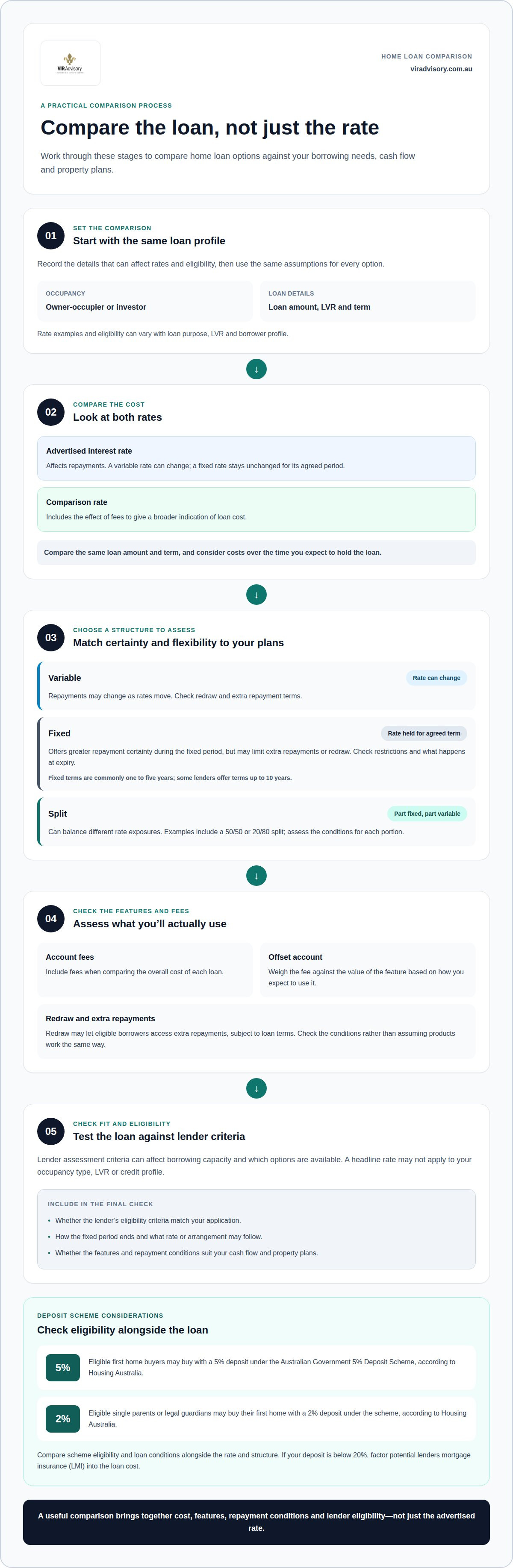
A variable rate can move over the loan term, so repayments may change when the lender changes its rate. A fixed rate keeps the interest rate unchanged for an agreed period, commonly one to five years; some lenders offer terms up to 10 years. A split loan divides the balance between both types, such as 50/50 or 20/80.
Fixed repayments offer greater certainty during the fixed period, but may limit features such as extra repayments or redraw. Variable loans can offer more flexibility, but repayments may change as rates move. A split loan can balance these trade-offs, although its fixed and variable portions have different conditions.
Lenders and their rate options
Australian lenders offer variable, fixed and split-rate home loans, but terms, features and eligibility criteria differ. Compare the conditions of each specific loan, not just the lender category. A fixed-rate option may suit someone who prioritises predictable repayments, while a variable loan may better suit a borrower who values flexibility.
A fixed rate applies for the agreed term, which may be shorter than the full loan term. When the fixed period ends, the loan usually moves to a variable rate unless another arrangement is made. Include the expiry date and likely change in repayments in your comparison.
Rates are only one part of the decision. Consider how you’ll use the loan and whether you may need extra repayments, redraw or a split structure. Redraw lets eligible borrowers access extra repayments, subject to the loan terms. Features and conditions differ by product, so check the details rather than assuming all variable loans work the same way.
| Option | Interest rate | Repayment certainty | Flexibility to assess |
|---|---|---|---|
| Variable | Can change | Lower if rates move | Check redraw and extra repayment terms |
| Fixed | Held for the fixed term | Greater during that term | Check restrictions and expiry arrangements |
| Split | Part variable, part fixed | Combines different exposures | Assess terms for each portion |
Deposit schemes can also affect the options available to eligible buyers. Under the Australian Government 5% Deposit Scheme, eligible first home buyers may buy with a 5% deposit, according to Housing Australia. Eligible single parents or legal guardians may buy their first home under the scheme with a 2% deposit, according to Housing Australia. Compare the scheme’s eligibility and loan conditions alongside rate and structure.
Choose a structure that matches your expected cash flow and property plans with the repayment certainty, flexibility and lender conditions you need.
Comparing interest and comparison rates
Comparing home loan lenders in Australia means assessing rates alongside fees, eligibility and loan structure. Rate examples vary by lender and borrower, so compare like with like. For owner-occupiers, a variable-rate example was 5.94% p.a. at 11:42am on 15 November 2026, based on a A$500,000 loan, 50% LVR and 30-year term. Investor rates depend on occupancy, LVR and structure.
Big Four and smaller lender rates
A separate comparison dated 5 November 2026 showed a lowest variable rate of 5.39% p.a. for owner-occupiers, compared with 6.59% p.a. as the lowest Big Four variable rate. These figures show why comparing lender categories can reveal a wider range of rates, but neither applies automatically to every borrower.
Eligibility, loan purpose and LVR affect the rate a lender offers. A lower advertised rate may be limited to a particular borrower profile or product. Compare loans for the same occupancy type and structure, then check each lender’s criteria against your application details. Investors should compare investment-loan rates, not owner-occupier examples.
Repayments and total loan costs
The interest rate affects repayments, while the comparison rate gives a broader indication of cost by including the effect of fees.
Repayments also depend on the principal, loan term and payment frequency. Compare the same loan amount and term across lenders, then consider costs over the time you expect to hold the loan. Extra repayments may reduce interest over time, subject to the product terms. Comparing home loan lenders in Australia on consistent assumptions makes differences easier to understand.
Risks of the lowest advertised rate
Choosing only by the lowest advertised interest rate can mean overlooking fees, eligibility conditions and features that affect how the loan works. A headline rate may not be available to an investor, for a different LVR or for a borrower with another credit profile. The comparison rate and product conditions provide more context.
Rates can change over time, and an advertised variable rate may move. A fixed rate applies only for its agreed term, after which the loan usually reverts to a variable rate. Compare the current rate with the conditions that apply later, rather than treating one figure as the full cost.
Use a consistent comparison: match occupancy, loan amount, LVR and term; review both rates; then assess features and eligibility. A 0.5 percentage-point reduction on a A$600,000 home loan reduces repayments by roughly A$170 per month. Comparing home loan lenders in Australia is more useful when the figures reflect the proposed loan and borrower profile.
Simple Home Loan fees and offset accounts
Loan costs include more than interest: account fees and the usefulness of features also matter. For example, an offset account may reduce interest, while an annual package fee adds a recurring cost.
Loan fees and package costs
Home loan fees may include ongoing account charges and package fees. Compare the package’s actual cost with the features you expect to use, rather than assuming a bundle will save you money.
List each loan’s fees over the period you expect to keep it. Include the annual package fee and account charges, then weigh these costs against the interest rate and included features. If you won’t use the package features, for example, an annual fee may add cost without practical value.
Separate one-off charges from ongoing costs. An upfront fee affects the initial cost, while a recurring charge applies throughout the relevant period. Check the loan’s fee schedule and note whether package access depends on maintaining a particular account or loan arrangement.
Offset accounts and redraw
An offset account is a transaction account linked to a home loan. Its balance reduces the amount of the loan on which interest is calculated, but it does not directly repay the principal.
Redraw works differently: it lets borrowers access eligible extra repayments they’ve already made, subject to the lender’s terms. An offset may suit someone who wants to keep savings accessible while reducing interest; redraw requires additional loan payments first. Compare access conditions as well as the potential interest benefit.
Balance matters. An offset account may not be worth paying for if its balance stays below A$10,000. Compare the expected interest reduction with any feature or package fee, using the balance you’re likely to maintain rather than an occasional high balance.
Loan features and costs
Assess the package as a combined cost-and-use decision. An offset account may support cash-flow management, while redraw can provide access to eligible extra repayments. Neither feature automatically makes a loan better: its value depends on how you manage savings and payments.
With a principal-and-interest loan, regular payments reduce the principal as well as cover interest. Extra repayments may reduce the balance further, but access and conditions vary. Check whether the rate, fees and features suit your intended use, including whether the property is owner-occupied or an investment.
Compare options in this order: record annual and account fees, estimate the offset balance you can maintain, identify whether redraw matters, then compare total costs alongside the rate. This puts a low-fee option and a feature-rich package on the same basis.
What is lenders mortgage insurance (LMI)?
Lenders mortgage insurance (LMI) is a cost a lender may charge when a deposit is below 20% of the property value. Comparing LMI alongside interest, fees and loan structure helps show the full cost of borrowing.
A lender assesses the loan-to-value ratio (LVR) to understand the loan against the property value. The calculation is loan amount divided by property value, multiplied by 100. For example, a A$400,000 loan on a A$500,000 property has an 80% LVR. A higher LVR means a smaller deposit relative to the property value, which can affect LMI and lender criteria.
Paying LMI may let a buyer purchase with a smaller deposit instead of waiting to save more. The trade-off is an additional borrowing cost, which may be added to the loan and accrue interest. Compare that cost and its effect on repayments with the benefit of buying sooner, and consider whether a lower LVR would change the lender’s offer.
For an eligible borrower, avoiding LMI may involve increasing the deposit until the LVR is below 80%, plus any fees. The Australian Government 5% Deposit Scheme can also reduce the deposit barrier for eligible buyers, with a government guarantee to the lender. Scheme eligibility and lender assessment still matter to the application.
When comparing your current mortgage with a loan from another lender, a broker considers more than the advertised rate. The review typically weighs the current balance, repayment, remaining term, fees, features, property value and resulting LVR. It also considers whether your income, expenses and debts support the new loan.
- Compare the current loan’s total cost with the alternative, including fees and any LMI.
- Check whether a fixed-rate loan has conditions affecting a refinance.
- Compare offset, redraw and repayment features against actual cash-flow needs.
- Assess whether the new lender’s criteria fit the borrower’s income and loan purpose.
Useful questions for a lender or broker include: How is LMI calculated for this LVR? Can it be added to the loan, and how would that affect repayments? Ask how the proposed rate, fees, fixed-rate conditions and features compare with your existing mortgage. A like-for-like assessment uses the same loan amount, term and property purpose.
Pre-approval in Australia is often valid for 60 to 90 days. It helps establish an initial borrowing position, but the lender still assesses the full application and property details before formal approval.
For refinancing between major Australian lenders, application to settlement typically takes four to six weeks. Timing depends on the lender’s assessment, supporting documents, valuation and coordination of the existing mortgage discharge.
Borrowing capacity and loan applications
Borrowing capacity is the amount a lender assesses you can repay, not a target you need to use. Lenders review your income, regular expenses, existing debts and proposed loan together. Two applicants with similar salaries may receive different assessments if one has larger credit commitments or higher living costs. To compare borrowing capacity across lenders, understand how each assessment treats these inputs.
Australian lenders assess first-home buyers, self-employed borrowers and investors using different evidence and loan details. A first-home buyer’s application includes deposit funds, income and intended property use. A self-employed applicant may need records explaining business income and liabilities. For an investor, the lender considers the investment purpose and rental income alongside existing property commitments.
A strong application presents clear, consistent information. If stated income differs between the application and supporting records, for example, the lender may need clarification before completing its assessment. A credit card limit can also affect how the lender views commitments, even when the balance is low. Reviewing the full application helps identify inconsistencies before submission.
Borrowing capacity assessment framework
- Income: identify the sources and supporting records relevant to employment or self-employment.
- Commitments: include existing loans, credit facilities and regular household expenses.
- Loan purpose: distinguish an owner-occupied purchase from an investment application.
- Repayment resilience: test affordability if interest rates rise by 3%.
- Application consistency: align figures across the application and supporting documents.
APRA’s debt-to-income lending limit took effect on 1 February 2026. It capped new mortgages where borrower debt exceeds six times income at no more than 20% of each bank’s new lending. This is a limit on banks’ new lending mix, not an individual maximum borrowing amount or a substitute for assessing affordability.
Repayment resilience matters because the initial repayment may not show how the loan fits alongside changing costs. Testing the proposed loan against a 3% interest-rate rise helps identify whether regular payments remain manageable. For a household with variable income, the lender’s view of income stability and existing commitments can also shape the assessment.
A lender’s initial borrowing-capacity figure is only one part of the decision. Compare the proposed loan with your cash flow, ongoing property costs and expected commitments, then consider whether the repayments remain manageable under the lender’s assessment. This gives first-home buyers, self-employed borrowers and investors a more grounded basis for choosing a suitable loan structure.
VIR Advisory
Compare home loan options by considering borrowing capacity, cash flow and property plans alongside loan structures, lender criteria, rates, fees and features. These factors can affect your options when buying, reviewing an existing mortgage or refinancing, particularly if your income or deposit makes lender assessment more complex.
VIR Advisory is a mortgage and finance brokerage specialising in Home Loans, Refinancing solutions and Business Loans. Its brokers can explain how lender requirements and loan structures apply to your circumstances, rather than comparing loans by advertised rate alone.
Contact VIR Advisory to discuss your home loan comparison.
Make your next lending decision with clarity
The most useful comparison reflects what you need the loan to do, not simply which option appears cheapest today. Before acting, identify the decision ahead: buying, changing an existing mortgage or coordinating property finance with other commitments. This keeps lender criteria and loan structure relevant to your plans.
VIR Advisory provides Home Loans, Refinancing solutions and Business Loans, with finance support shaped around your circumstances. If comparing home loan lenders in Australia has raised questions about lender assessments, cash flow or suitable loan structures, a tailored discussion can help clarify the factors to weigh before proceeding.
A considered comparison gives you a clearer basis for your next decision.
Frequently Asked Questions
What is an LVR (loan-to-value ratio)?
LVR compares the loan amount with the property’s assessed value. The lender’s valuation matters: if it is below the agreed purchase price, the same loan request represents a higher LVR. That may affect the lender’s decision or the funds you need to complete the purchase. Make your comparison using the valuation relevant to each lender’s assessment.
Can I buy a property with an LVR of over 80%?
Yes, a lender may consider a purchase above 80% LVR, depending on its criteria and your application. The lender assesses more than the ratio, including income, existing commitments, property details and the amount you can contribute. A lower valuation than expected could also change the application’s position, so allow for the possibility that the approved loan may not cover the amount you initially planned.
How can a broker help minimise home loan fees?
A broker can identify which fees apply upfront, recur during the loan or arise if you refinance, then compare them across suitable options. They can also present your application details when discussing a lender’s pricing or fees. For example, a strong repayment record may support a rate discussion, but any change depends on the lender’s decision and product terms.
Which Australian lenders offer home loans, including the big four banks, online lenders and credit unions?
Home loans are offered by the Big Four banks, online lenders and credit unions. The Big Four are Commonwealth Bank, Westpac, NAB and ANZ. These categories include different lending models and application channels, but the category alone does not show whether a loan suits you. Compare the lender’s assessment criteria, product conditions and application process against your employment, income type and property purpose.
How do Australian lenders compare on comparison rates, fees and total loan costs?
Assess total costs over the time you expect to keep the loan, not just the initial rate. Include ongoing charges and switching costs, then consider whether the loan conditions could affect your plans. For example, someone expecting to sell or refinance sooner may weigh upfront and exit costs differently from a borrower planning to keep the same loan structure longer.
How do lenders compare on offset accounts, redraw, extra repayments and portability?
Compare the rules and restrictions for each feature rather than relying on its name. Portability may matter if you expect to move and want to transfer an existing loan; redraw or extra repayments may matter if your payment pattern varies. Check whether a feature applies to the whole loan or only part of it, and whether its conditions suit your plans.
What are the current Australian home loan deposit requirements and lenders mortgage insurance rules?
There isn’t one deposit requirement that applies to every Australian borrower; lender criteria, property details and eligibility for a government scheme all matter. LMI may apply when borrowing above 80% of a property’s value. In planning your funds, distinguish the deposit from other purchase costs and money needed for ongoing cash flow, so the proposed contribution doesn’t leave your budget too tight.
How can a broker compare Australian home loans, negotiate a better rate or arrange a refinance?
A broker can review your current loan documents and financial position, then compare suitable options against lender criteria and product terms. Professional mortgage brokers, such as The Home Loan Partners, provide personalised guidance to help borrowers evaluate these options. For a rate discussion, the broker can present relevant details, such as repayment history and loan features, and assess any revised offer against switching costs. If refinancing is appropriate, they can coordinate the application and lender requirements through to settlement.

Article by
Raina Doshi
Raina Doshi has worked in banking and finance since 2011, including experience with major Australian lenders. She helps homeowners, property investors, business owners and professionals secure and structure lending solutions across home loans, refinancing, commercial finance and business lending.
Areas of expertise include residential lending, investment property finance, debt recycling, commercial property finance, equipment finance, construction finance and strategic debt structuring.
Drawing on extensive banking and finance experience, Raina helps clients navigate lender requirements, improve borrowing outcomes and structure effective finance solutions.
Disclaimer
The information in this article is general in nature and does not take into account your personal objectives, financial situation or needs. Before acting on any information, consider whether it is appropriate to your circumstances and seek professional advice.


