

A lower monthly repayment can mean paying more interest overall if you extend the loan term. Refinancing for lower monthly payments in Australia may reduce repayments through a lower interest rate, a longer term or by consolidating higher-rate personal debts into a mortgage. The right option depends on the savings after fees and the effect on your debt over time.
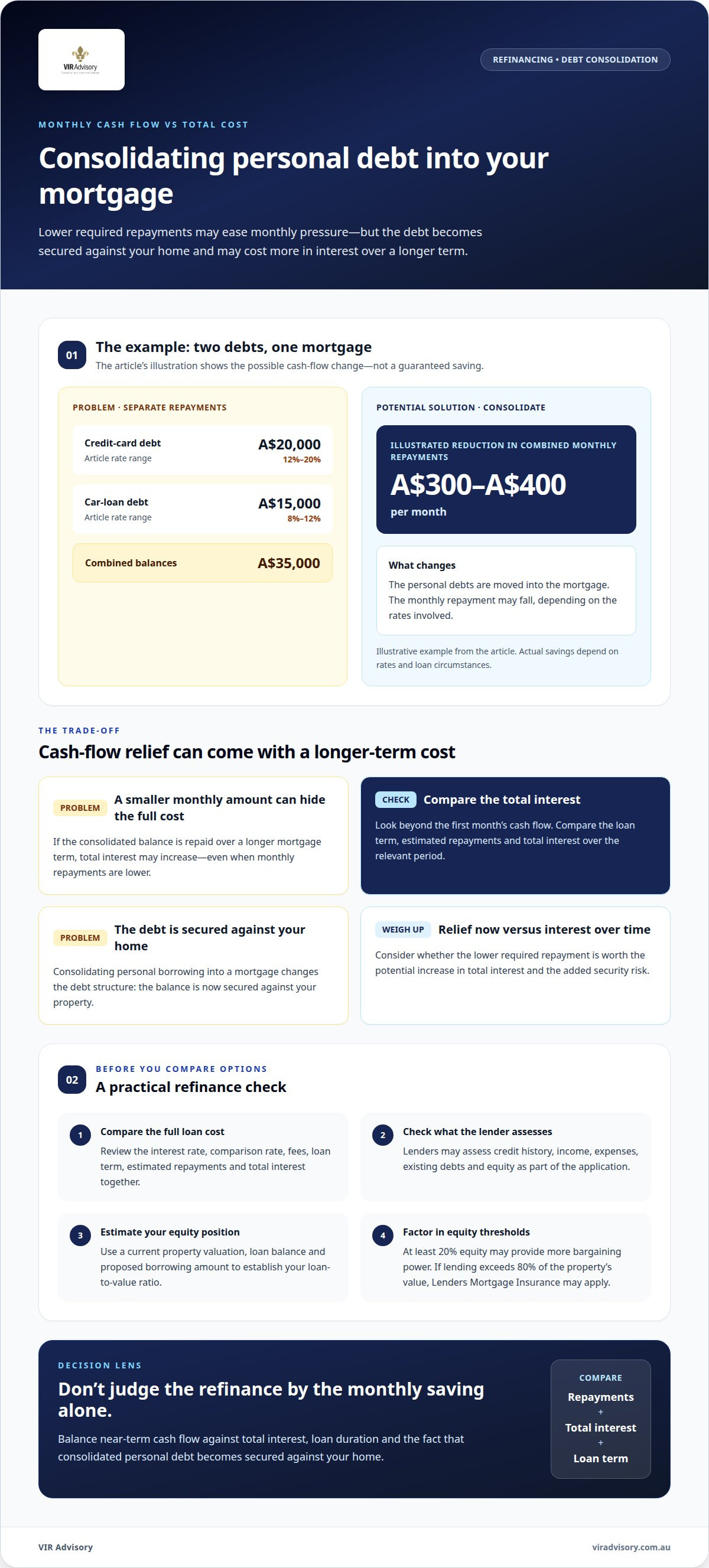
It’s understandable to focus on the amount leaving your account each month, particularly when credit-card and car-loan repayments are adding pressure. As an example, consolidating A$20,000 in credit-card debt and A$15,000 in car-loan debt into a mortgage could reduce combined monthly repayments by A$300 to A$400, depending on the rates involved. But those debts would then be secured against your home, and repaying them over a longer period could increase total interest.
This article explains how refinancing can lower repayments, what lenders assess and how fees, equity and loan terms affect the outcome. It also covers the trade-offs of debt consolidation, helping you compare short-term cash-flow relief with the longer-term cost before deciding.
Key Takeaways
- Before refinancing during a fixed-rate period, compare any break costs and switching fees with the repayments you could save, then calculate how long it may take to break even.
- Lenders assess your credit history, income, expenses, existing debts and equity; timing your application and understanding your borrowing position can affect your options.
- Compare the interest rate and comparison rate, fees, loan term and estimated repayments together to assess both monthly cash flow and total interest.
- Estimate your loan-to-value ratio before applying, as lower equity can affect lender choice and may mean Lenders Mortgage Insurance applies.
- Consolidating personal debts into a mortgage may ease monthly repayments, but can secure those debts against your home and increase interest over a longer repayment period.
Can I refinance if my fixed rate period hasn't ended yet?
Yes, you can apply to refinance before a fixed-rate period ends, but leaving early may trigger break costs. Compare these costs and other fees with the expected repayment savings before deciding whether to switch now or wait.
Refinancing costs can include a discharge fee from your current lender, an application fee, and valuation, documentation and settlement fees. Costs vary by lender and loan circumstances, so use the fees that apply to your proposed application rather than relying on a headline estimate.
- Settlement fee: typically A$100 to A$400.
Fixed-rate break costs
A break cost may apply when you repay or switch a fixed-rate loan before the fixed period ends. The lender calculates the amount using factors such as the loan balance, remaining fixed period and interest-rate movements. For an Australian example, a A$400,000 balance, a 0.50% p.a. rate difference and two years remaining produces an estimated A$4,000 break cost. Request the payout figure for your loan before comparing offers.
Costs versus potential savings
First, calculate the full switching cost, including any break cost, discharge charges and new-loan fees. Then compare that amount with the expected repayment reduction over the time you plan to keep the loan. Divide the total cost by the monthly saving to estimate the break-even point.
This calculation is useful only when you compare similar loan terms. A longer term can lower each repayment while increasing total interest and delaying the point when refinancing delivers a net benefit. Compare repayments and total interest over the remaining term, not just the first month’s cash flow.
- Obtain the current lender’s break-cost and discharge figures.
- List the new loan’s application, valuation and settlement fees.
- Compare monthly repayments, loan term and total cost, then identify the break-even month.
If a fixed period ends in a few months, starting the application process early can help assess options before the loan moves to its next rate. The Reserve Bank of Australia Monetary Policy Board meets eight times a year to decide whether to increase, decrease or maintain the cash rate, but a cash-rate change does not by itself establish that refinancing will save money.
Does refinancing hurt my credit score?
Refinancing can affect your credit file because lenders review your credit history and may record an application enquiry. Australian refinancing is subject to lenders’ credit and serviceability assessments; refinancing itself does not automatically determine tax treatment. Tax treatment depends on how borrowed funds are used, so keep private and income-producing loan purposes clearly separated.
Lenders assess more than a credit score. They may consider repayment history, defaults, existing debts, credit limits, income, expenses and the proposed loan amount. Several applications made close together can create multiple enquiries, so organise your documents and assess eligibility before applying. Paying bills on time and reducing unnecessary debt can strengthen your overall position, though neither guarantees approval.
Equity also affects lender assessment and negotiation. Borrowers with at least 20% equity may have more bargaining power with a lender. If equity is lower, the lender may have fewer suitable options, and Lenders Mortgage Insurance may apply when lending exceeds 80% of the property’s value. A current valuation, loan balance and proposed borrowing amount help establish the loan-to-value ratio.
A low credit score doesn’t automatically rule out refinancing, but it can limit your lender options. First, identify what is affecting your credit file, such as missed repayments or high card balances. Avoid lodging several applications at once, and consider whether improving repayment conduct or reducing debts before switching could strengthen eligibility. Your current lender may also discuss changes without a full lender switch.
Timing matters. If your financial position has changed, for example after a recent default or income reduction, applying immediately may weaken the assessment. Review your credit file, home-loan repayment history and available equity before choosing when to apply. Keep any redraw or offset arrangements in mind, too, as switching may change how these features work under a new loan.
Consolidating personal debt can reduce required monthly repayments, but it changes the debt structure. Australian credit-card debt may carry interest of 12% to 20%, while car-loan debt may carry interest of 8% to 12%. Moving either balance into a mortgage can extend repayment over a longer loan term and secure the debt against your home. Compare the total interest, not just the reduced monthly amount.
A review of your credit position, equity and loan purpose can clarify which issues to address before applying. Discuss your refinancing position before lodging multiple applications.
How does home loan refinancing work?
Refinancing for lower monthly payments in Australia means replacing an existing mortgage with a new loan that better suits your needs. The new interest rate, loan amount, term and features determine the repayment, while fees and loan structure affect the overall value of switching.
Australian refinance rates and comparison rates vary by lender, loan type and borrower circumstances, so there is no single rate for every applicant. Home loan offers must display a comparison rate alongside the advertised interest rate, helping borrowers assess certain fees and charges alongside the headline rate.
Interest rates and comparison rates
Compare the advertised interest rate, comparison rate and relevant fees together. The advertised rate affects the interest charged, while the comparison rate combines certain fees and charges into a single figure. It may not include every cost or suit every borrower, so account for applicable fees and offset-account costs in your assessment.
The comparison uses a A$600,000 loan amount and an 80% loan-to-value ratio. Its repayment difference between award-winner and market-average loans is A$300 monthly, also dated 21/09/2026. These are comparison figures, not a personalised refinance offer.
Estimated monthly repayments
A lower interest rate can reduce repayments if the loan amount, repayment frequency and remaining term stay the same. Use an estimate based on your balance and proposed loan term.
Check the estimate’s assumptions. A longer term may lower the monthly repayment, but paying down the balance more slowly can increase total interest. With a variable rate, repayments can also change when the rate changes.
Repayment and interest savings
Assess repayment changes and total interest separately. An Australian mortgage refinance could reduce repayments from about A$3,200 to A$2,850, freeing up over A$4,000 per year. The lower monthly amount improves cash flow, but doesn’t show by itself whether the borrower pays less interest overall.
Borrowers pursuing refinancing for lower monthly payments in Australia should compare the existing and proposed loans using the same balance and a comparable term. Include applicable fees and consider offset savings. An offset balance of A$40,000 against a A$600,000 loan means interest is charged on A$560,000.
- Compare advertised and comparison rates, plus relevant fees.
- Estimate repayments using the proposed loan amount and term.
- Review total interest and offset-account savings before switching.
Equity requirements and loan-to-value ratios
Equity affects how much you can borrow and which refinance options a lender may consider. Estimate your loan-to-value ratio (LVR) using the lender-assessed property value and proposed loan amount.
Equity and lenders mortgage insurance
Equity is the property’s value minus the amount owing on its loan. LVR compares the proposed loan with the lender-assessed property value. To estimate it, divide the loan amount by that value and express the result as a percentage. This shows how much of the property’s value would secure the debt.
In Australia, Lenders Mortgage Insurance is generally payable when a lender agrees to lend more than 80% of a property’s value. Borrowers with less than 20% equity may have to pay LMI when switching loans. A lower LVR may be viewed more favourably, although lenders also assess income, expenses and repayment capacity.
A valuation can change the result. If the lender assesses the property below your estimate, the same loan balance produces a higher LVR. Include any additional borrowing in the proposed loan amount, as it changes the calculation too.
Equity and LVR assessment
- Property value: use the value assessed by the lender.
- Proposed loan: include the current payout amount and any extra borrowing.
- LVR: divide the proposed loan by the assessed value.
- 80% threshold: lending above this level may involve Lenders Mortgage Insurance.
Using home equity
Refinancing may let you access some equity by increasing the loan, subject to lender assessment. The additional funds increase the mortgage balance and the amount on which interest is charged. With a variable-rate loan, repayments may also change when the interest rate changes.
Assess your current home-loan balance separately from the additional amount requested. Then consider the new LVR, repayment commitment and intended use of the funds. The lender assesses the complete application, including income, expenses and ability to meet repayments.
Equity isn’t the same as available cash. A lender’s valuation, criteria and serviceability assessment determine whether equity can be released. Borrowing against your home also puts the property up as security for a larger debt, so weigh the intended use against the added repayment commitment.
Use this sequence to assess a proposed refinance:
- Estimate equity using the current balance and lender-assessed value.
- Add proposed borrowing to calculate the new loan amount and LVR.
- Assess the repayments and purpose of the additional funds.
Consolidating personal debt into a mortgage
Consolidation combines personal debts with a home loan, increasing the mortgage amount. At settlement, the lender pays out the nominated debts, and the remaining balance becomes part of the home loan. This can reduce required monthly repayments, but it also changes how long you may pay interest on those debts.
Adding that balance to a mortgage could lower the required monthly repayment if the mortgage rate and term result in a smaller scheduled amount. However, spreading car debt over a longer mortgage term can mean paying interest for longer.
The key comparison is not simply the old repayment against the new one. Calculate the total amount added to the mortgage, the interest charged over the proposed term and any refinancing costs. Also compare the outcome with keeping the car loan separate and paying it off on its existing schedule.
Settlement needs to account for each debt being consolidated. The lender assesses the requested loan amount, your income, expenses, existing credit commitments and property security. The payout figures for each personal debt determine the funds needed at settlement; any change to those figures can affect the amount required.
Before proceeding, organise the decision around these checks:
- List each debt, its payout amount and current repayment.
- Calculate the proposed mortgage balance after adding those payouts.
- Compare monthly repayments and total interest across the repayment periods.
- Confirm that the settlement funds are allocated to the intended debts.
One risk is clearing credit-card balances through the mortgage and then building those balances up again. You could be left with a larger home loan and new unsecured debt. Before settlement, review card limits and spending plans, then consider directing the monthly cash-flow difference towards reducing the mortgage balance.
Consolidation may suit a borrower who needs lower required repayments and can manage the longer-term cost. It may be less suitable if the main goal is to clear debt quickly, or if adding the balance makes the home loan harder to service. Compare the mortgage option with personal loan and debt consolidation options before deciding.
VIR Advisory: Refinancing solutions
VIR Advisory offers refinancing solutions for borrowers seeking lower repayments, a different loan structure or closer alignment between lending and cash flow. The review compares your current home loan with available lending options and explains how each proposed change affects monthly commitments and overall borrowing.
A refinance review starts with why you want to change loans. You may want to reduce required repayments, replace a fixed-rate loan nearing expiry, consolidate personal debt or adjust lending for an investment property. Each objective raises different considerations, so distinguish short-term cash-flow relief from the effects on loan term, total interest and home equity.
VIR Advisory can compare your current loan structure with alternatives, including the proposed interest rate, comparison rate, repayment estimate, fees and loan features. If a lower repayment depends on extending the term, the trade-off should be clear. If you are considering debt consolidation, include the additional borrowing and its impact on the mortgage.
Lender eligibility is part of the assessment. Income, expenses, existing debts, credit history, property value and loan-to-value ratio can affect which options are available. For a self-employed borrower or company director, income assessment may need careful consideration alongside business commitments. A suitable refinance structure must account for your circumstances, not just the advertised rate.
The work can be organised around a practical sequence:
- Clarify the purpose of refinancing and the repayment outcome sought.
- Review the current home loan, balance, term and relevant features.
- Assess equity, income, debts and lender eligibility against possible options.
- Compare estimated repayments and longer-term costs before deciding whether to proceed.
When refinancing is connected to a broader borrowing need, such as reviewing personal and business commitments together, assess those obligations alongside the proposed home loan. Refinancing is not automatically the right fit if switching costs, eligibility constraints or a longer repayment period outweigh the intended benefit. A clear comparison helps establish whether changing the loan structure supports your objective.
For a review of your current loan and refinancing options, contact VIR Advisory.
Make your next refinancing decision with clarity
Before making a change, define what a better loan needs to achieve: lower required repayments, improved cash flow or a repayment structure that fits your plans. Refinancing for lower monthly payments in Australia should be assessed against both your immediate budget and the longer-term effect on your finances. A smaller repayment helps only if the loan remains manageable and the overall structure suits your priorities.
Prepare a clear picture of your current loan, income, regular expenses and planned borrowing. This gives a refinance assessment practical context, particularly if you are self-employed, own an investment property or have business commitments. You can then weigh available options against what matters most, rather than focusing on one rate or repayment figure alone.
A considered comparison can give you a clearer view of the trade-offs and help you move forward with a loan structure aligned with your needs.
VIR Advisory can discuss your refinancing objectives and the lending considerations that apply to your situation. When you’re ready, book a consultation to review your options.
Frequently Asked Questions
Why do people refinance?
People refinance when their existing loan no longer fits their circumstances or borrowing plans. A borrower might seek different loan features, review an interest-only arrangement or replace a loan nearing the end of its fixed period. An investor may also want lending structured to keep property-related borrowing distinct. Identifying the specific change needed helps focus the assessment on loan features and eligibility, not just the advertised rate.
How much debt can be consolidated into a home loan?
There is no standard consolidation limit for every borrower. The lender assesses the proposed total loan against the property value, the borrower’s income and commitments, and its lending criteria. The exact payout figures for each debt matter too, because balances can change before settlement. Start by identifying which debts are being repaid and include only those amounts in the requested loan structure.
Is it worth refinancing if I extend my loan term?
It may be worth considering consolidation if the revised repayment schedule addresses a specific cash-flow need. Before accepting a longer term, check the new loan’s rules for additional repayments and whether restrictions or charges apply. This helps you assess whether you could reduce the balance faster when your budget allows. Compare the loan’s flexibility and conditions alongside the required repayment, rather than judging it on term alone.
What are the interest rates?
Australian home loan rates vary between lenders and products, so a headline rate isn’t a personal offer. Pricing and eligibility can reflect the loan purpose, structure, loan-to-value ratio and selected features. Fixed-rate and variable-rate offers may also work differently after the initial period. Compare the rate available for your application and check any conditions attached to discounts or features.
What difference could a lower home loan rate make?
The dollar effect depends on your outstanding balance and how long the new rate applies. A rate reduction won’t change an existing loan unless the lender reprices it or a new loan settles. For a variable loan, later rate changes can also affect the benefit. Request an estimate using your proposed loan settings, then check the first statement after the change takes effect.
What documents do I need to provide?
Common application documents include identification, income evidence, current home-loan statements and details of other financial commitments. The records required depend on how you earn income. An employee may provide payslips, while a self-employed applicant may need business and income records. Property details can support the security assessment. Organising current documents together helps present a consistent picture of income, expenses and liabilities.
How can refinancing a home loan lower monthly repayments in Australia?
The process usually involves an application and lender assessment, followed by approval and settlement if the proposed loan meets the lender’s requirements. At settlement, the new loan funds the payout of your existing home loan. The new repayment schedule then applies under the agreed terms. Check the first repayment date and direct-debit arrangements so your household budget reflects the change at the right time.
How much can Australians save on monthly repayments by refinancing?
There is no single monthly saving that applies to all Australian borrowers. An estimate shows a change to scheduled repayments, not necessarily money retained in the household budget. For example, a borrower might choose to keep paying above the new minimum to reduce the principal sooner. The practical cash-flow benefit depends on both the lender’s repayment schedule and how the borrower manages the difference.

Article by
Raina Doshi
Raina Doshi has worked in banking and finance since 2011, including experience with major Australian lenders. She helps homeowners, property investors, business owners and professionals secure and structure lending solutions across home loans, refinancing, commercial finance and business lending.
Areas of expertise include residential lending, investment property finance, debt recycling, commercial property finance, equipment finance, construction finance and strategic debt structuring.
Drawing on extensive banking and finance experience, Raina helps clients navigate lender requirements, improve borrowing outcomes and structure effective finance solutions.
Disclaimer
The information in this article is general in nature and does not take into account your personal objectives, financial situation or needs. Before acting on any information, consider whether it is appropriate to your circumstances and seek professional advice.


