

A business loan can become a director’s personal debt. A director guarantee for a business loan may make the director personally liable if the company defaults, and the guarantee’s wording determines whether liability is capped or can cover more than the original borrowing. If several directors sign a joint and several guarantee, one may be pursued for the full debt.
It’s understandable to focus on the company’s repayments when it takes out finance. But a director guarantee for a business loan can expose your personal assets if the business can’t meet its obligations, so read the terms carefully before signing.
This article explains how director guarantees work, how liability can be shared, and which types of business finance may involve one. It also covers practical points to review, including liability limits, “all monies” wording, and what happens if you leave the business. Understanding these details helps you weigh personal risk alongside the finance terms.
Key Takeaways
- A personal guarantee can make you personally liable if the business defaults, so understand its scope and any cap before signing.
- With a joint and several guarantee, one director may be pursued for the full debt, even if other directors also signed.
- Review the guarantee alongside the credit application, including all monies wording, liability limits and any claims over personal assets.
- Working capital, lines of credit, invoice finance and some equipment finance may require a director’s guarantee; requirements depend on the facility and lender assessment.
- Before committing, assess the company’s debts and cash flow, and consider independent legal advice on the guarantee’s terms.
What is a Personal Guarantee?
A personal guarantee makes a director personally responsible for a company debt if the business defaults. The wording determines which debts and costs are covered, and which personal assets may be at risk.
Personal Assets at Risk
A personal guarantee can expose a director’s assets if the company can’t repay its finance. The lender may seek repayment from the guarantor personally, rather than relying only on company assets.
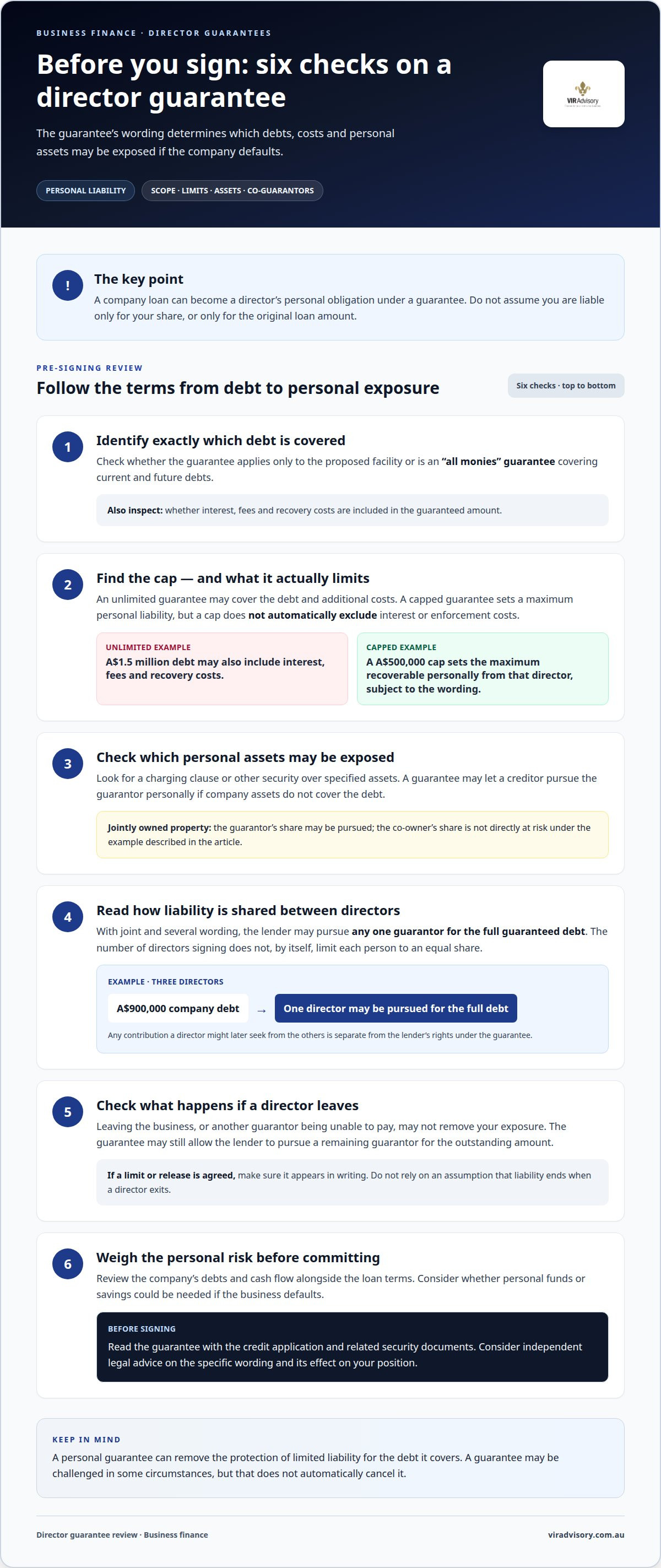
For example, a lender financing equipment may sell a repossessed asset after default. If the sale doesn’t cover the debt, the guarantee may allow the lender to seek the balance from the director. A charging clause may also let a creditor claim an interest in specified assets, including property. If property is jointly owned, the guarantor’s share may be pursued, but the co-owner’s share isn’t directly at risk.
Effects on Credit and Liability
A guarantee can make a director liable for the amount covered by its terms, potentially including interest, fees, and recovery costs. If the company defaults, the director may need to use personal funds or savings to meet that obligation.
Does a director guarantee make you liable for the full loan, interest and legal costs? It can, if the guarantee is unlimited and its terms cover those amounts. For example, an unlimited guarantee could cover a company debt of A$1.5 million, plus interest, fees and recovery costs. A default can also damage personal credit, making future credit harder to obtain.
Limiting a Guarantee
A director may negotiate a personal guarantee capped at a stated amount or limited to certain assets. A cap sets the maximum personal liability, while an asset limitation defines what the creditor can pursue under the guarantee.
For example, a limited guarantee capped at A$500,000 would set that figure as the maximum recoverable from that director personally. A cap doesn’t automatically exclude interest or enforcement costs, so the wording matters. Check whether the guarantee covers only the proposed loan or is an all monies guarantee covering current and future debts. Any agreed limit or release should appear in writing.
Unfair Guarantees and Legal Limits
Australian law provides limited liability through a corporate structure, but a personal guarantee can remove that protection for the debt it covers. There is no blanket rule that makes every guarantee considered unfair unenforceable.
Can Australian laws or court cases limit an unfair director guarantee? A guarantee may be challenged in some circumstances, including undue pressure or inadequate disclosure, but those circumstances don’t automatically cancel the agreement. Before signing, identify the amount covered, the assets exposed, and any terms that extend liability beyond the original finance. Independent legal advice can help explain how the specific wording affects your position.
Joint and several liability among directors
A guarantee can name one director or several, and its wording determines how liability is divided. Under a joint and several guarantee, each guarantor may be pursued for the full debt.
Joint and Several Guarantees
A joint and several guarantee combines shared responsibility with individual exposure to the full guaranteed amount. If the company defaults, the lender may seek repayment from any one guarantor, rather than collecting an equal share from each director.
For example, if three directors guarantee a company debt of A$900,000, the lender may pursue one director personally for the full debt. That director’s practical ability to recover contributions from the other guarantors is a separate matter. Their agreement between themselves doesn’t necessarily limit the lender’s rights under the guarantee.
Liability Between Directors
Joint and several liability means each signing director can be liable for the whole debt, even if another director stops paying. A director who contributes nothing may still leave the other guarantors exposed to the lender’s claim.
Consider three directors who sign, then one leaves the business or becomes unable to pay. The guarantee may still allow the lender to pursue either of the other directors for the outstanding amount. Each director should understand the full exposure, not assume they are responsible for only a third. Independent legal advice can clarify how the guarantee allocates liability and what rights signatories may have between themselves.
Individual and Shared Guarantees
An individual guarantee is given by one person; a shared guarantee involves multiple signatories. A guarantee described as several makes each guarantor separately responsible, while joint liability concerns an obligation shared by signatories. Joint and several wording combines both approaches.
These labels matter because the number of directors who sign doesn’t determine each person’s maximum liability. Read the operative clauses and signing schedule to identify who guarantees the debt and whether each person can be pursued for the entire amount. A director expecting to be responsible only for their share should not assume that applies unless the written terms say so.
Secured and Unsecured Guarantees
A secured guarantee is linked to specified assets, while an unsecured guarantee relies on the guarantor’s personal promise to repay. These are distinct from joint and several liability: a guarantee can be secured, unsecured, or shared among several directors.
For instance, one director might provide a guarantee linked to property, while two others give unsecured guarantees. If all three are also jointly and severally liable, the lender’s rights may extend beyond the asset offered by one guarantor. Review the security documents alongside the guarantee, including which assets are named and whether the liability applies to each signer.
Before signing, map each director against the guarantee: who signs, whether liability is individual or shared, and what security is attached. Discussing the finance structure can help clarify the lending implications; a lawyer can provide independent legal advice on the guarantee’s legal effect.
Steps to take before signing
Before signing a guarantee, review it alongside the credit application. Check the personal liability, company debts, and interest rates, then obtain independent legal advice.
Assessing the Risks
Assessing the risks means identifying what you could owe and which personal assets may be exposed if the business defaults. The amount sought can depend on the guarantee’s scope, not just the company’s original borrowing.
Use this sequence before signing:
- Read the whole document. Match the guarantee to the credit application and facility terms. Look for an amount cap, an all monies clause, interest, fees, recovery costs and any charging clause over assets.
- Map the company’s debts. Review existing borrowing and proposed finance together. A guarantee covering current and future liabilities could reach beyond the facility discussed at signing.
- Test repayment capacity. Consider the company’s cash flow, interest obligations and ability to meet repayments if revenue falls. Also assess whether personal income and savings could absorb a claim without disrupting essential commitments.
- Identify changes that could matter. If a facility is refinanced, amended or re-signed, compare the new documents with the guarantee already signed. Don’t assume a new loan automatically releases an earlier guarantee.
Record each director’s exposure, especially if the wording is joint and several. This helps distinguish the company’s debt from the personal obligation each director accepts.
Questions to Ask
Before signing, ask questions about the guarantee’s scope, duration, and release conditions. Clear answers matter because your role may change while the company’s debt remains outstanding.
- Does the guarantee cover this facility only, or other existing and future company debts?
- Is my liability capped, and does the cap include interest, fees and recovery costs?
- Does a charging clause apply to personal assets, such as property, or other specified security?
- Is liability individual, joint, or joint and several if other directors also sign?
- What written steps are required for a release if I leave the company or the facility is repaid?
Ask a lawyer to explain any clauses you don’t understand and how they apply to your circumstances. Independent legal advice is especially useful when the documents combine a guarantee with security over personal assets, or when several directors sign different obligations.
Keep the signed guarantee, credit application, and any written amendments together. If the lender agrees to a cap, change, or release, make sure the relevant document records it; an informal discussion may not change the signed terms. Retain the paperwork when a facility is refinanced or signed again, so you can compare the obligations.
What is a director’s guarantee?
A director guarantee is a personal commitment to meet specified business debts if the company defaults. It differs from company security, which uses company-owned assets to support borrowing. “Personal guarantee” is the broader term for an individual’s promise to repay.
Why Guarantees Are Required
Lenders, landlords, and suppliers may require a director guarantee when a company has limited assets or trading history. The agreement gives them recourse to an individual if the company cannot meet its obligations.
For example, a supplier extending credit may seek a director guarantee for unpaid invoices, interest, and recovery costs. A landlord may also request one as part of a commercial lease. For a small company without substantial assets, the guarantee can provide additional assurance to the creditor. It also gives the director personal exposure alongside the company’s obligation.
Before agreeing, identify which debt the guarantee covers. A guarantee linked to a supplier account may differ in wording and scope from one attached to a lender’s facility.
Reducing Lender Risk
A lender uses a guarantee as another recovery option if the company defaults. It can reduce reliance on company assets, particularly when the facility is unsecured or the business has limited assets.
This may matter when assessing a new company with little trading history to demonstrate its ability to repay. A director’s commitment adds personal accountability to the credit agreement, but it doesn’t remove the company’s obligation to repay. The lender still assesses the business and proposed finance; the guarantee is one part of its risk assessment.
A broker can explain how a guarantee fits the proposed finance structure, while a lawyer can advise on the agreement’s legal effect. These roles are distinct: finance structuring and legal interpretation answer different questions. Likewise, reviewing financial statements with an accounting practice such as fvaccounts.com can help directors evaluate company cash flow and debt capacity before committing to personal liability.
When Lenders Request Guarantees
Lenders may ask for a guarantee when a business has operated for less than two years, has no assets, or seeks a large loan. They may also require one for unsecured facilities or when the company has limited credit history.
For instance, a startup seeking working capital may have strong sales prospects but little trading history. A lender may request a director guarantee because the company has limited assets to offer. A guarantee may also be requested for secured finance if the business’s available assets provide insufficient support for the proposed borrowing.
Requirements vary by facility and lender assessment. Consider the guarantee alongside the loan amount, repayment structure, company cash flow, and security offered, rather than treating it as a standard formality.
Guarantees and Company Security
A director guarantee makes the signer personally liable; company security gives a creditor rights over specified company assets. A personal guarantee is the broader category, and a director guarantee is one given by a company director.
For example, equipment owned by the company could secure a facility, while a director separately guarantees repayment. If the asset sale doesn’t clear the debt, the guarantee may provide another route to recovery, according to its terms. Read both documents together, note who signs as borrower or guarantor, and seek legal advice if the agreement’s scope is unclear.
Business loans and finance facilities that may require a guarantee
In Australia, guarantee requirements vary by facility and lender, so the type of finance is a useful starting point. Working capital, lines of credit, invoice finance, and some equipment or vehicle facilities may involve a director guarantee, particularly when the application includes limited financial information about the business.
Facility snapshot
Working capital or cash-flow finance: May support operating costs, with the lender assessing cash flow and available business assets.
Business line of credit: May be assessed against the company’s changing use of funds and repayment capacity.
Invoice finance: Invoices support the facility, while lender requirements may also include a director guarantee.
Equipment or vehicle finance: The financed asset may provide security, while the lender may separately request a guarantee.
This comparison is a starting point, not a rule that every facility in a category has the same requirements. For example, two businesses seeking working capital may have different trading records, cash flow, and security. Those differences can affect the lender’s assessment and whether it asks for a guarantor. Review the offer against the business’s actual facility and supporting documents.
Low-documentation applications may also involve a guarantee because the lender has less financial information about the business. The assessment may include bank statements, surplus cash flow, borrowing capacity, and a Personal Property Securities Register (PPSR) check. A guarantor may need to provide identification and a statement of personal assets and debts.
With equipment and vehicle finance, distinguish between the asset being financed and any separate personal commitment. The lender may rely on the asset as security, but if it is sold after default, the proceeds may not cover the outstanding balance. The facility documents and guarantee clause establish how those obligations relate. Assess them together rather than treating asset security as the only consideration.
For a new business with limited financial history, the lender may consider company cash flow and the director’s financial position when assessing a facility. A larger borrowing request or limited company assets may also affect the assessment. A guarantee may support access to finance, while increasing the director’s personal exposure.
Before accepting an offer, identify the facility, business assets offered as security, information used in the lender’s assessment, and any requested personal guarantee. This helps clarify how the proposed finance is structured and which obligations rest with the company or guarantor.
VIR Advisory: Business Loans
VIR Advisory can help assess Business Loans against lender requirements, repayment structures, and any director guarantee attached to a facility. This is useful when arranging new finance or reviewing whether the proposed borrowing and personal exposure fit the business’s cash flow.
As a mortgage and finance brokerage, VIR Advisory can discuss business lending and financial strategy guidance in the context of your wider commitments. For example, the assessment can consider how a facility’s repayments interact with existing business debts and personal borrowing. Legal advice remains important for interpreting the guarantee itself, while finance guidance can help clarify the lending structure and application requirements.
If you’re weighing up business finance or a guarantee, contact VIR Advisory to discuss your lending requirements.
Make the guarantee part of your finance decision
Before accepting a facility, consider how its repayments and guarantee fit the business’s cash flow and your wider borrowing commitments. A director guarantee for a business loan is more than a signing requirement; it can affect your personal finances if the company can’t meet its obligations. Treat the guarantee and proposed loan structure as connected decisions.
VIR Advisory can help you assess Business Loans against lender requirements and your business’s funding needs. If company borrowing sits alongside plans for a home purchase or an existing mortgage, Home Loans and Refinancing solutions may also be relevant to your wider finance picture. Legal advice remains the right support for interpreting the guarantee’s terms.
Discuss your lending options with VIR Advisory to identify a practical next step for your finance needs.
Frequently Asked Questions
Can someone else guarantee your business loan?
Yes, someone who isn’t a director may act as guarantor, including a spouse, parent, or business partner. A lender may assess their identification, assets, and debts, and may request a property valuation or mortgage if they offer property as security. For example, a family member’s property could form part of the proposed security arrangement. The guarantor should consider how the commitment affects their borrowing and household finances before agreeing.
How do you get released as a guarantor?
Start by identifying every lender and supplier holding a guarantee you signed, as releasing one may not deal with separate obligations. A director leaving the business should notify those creditors and request a release. For a loan, discuss the release alongside any proposed refinance or replacement security, since the lender’s written agreement is needed to release you. Keep each response with the relevant facility documents, and treat every guarantee separately rather than assuming one change resolves them all.
Is there anything else I should look out for when considering a guarantee?
Consider how a guarantee could affect future borrowing, not just the immediate business facility. A lender assessing a later personal loan or home finance application may consider your existing liabilities and overall borrowing capacity. For example, an ongoing guarantee may remain relevant even when the company has kept up repayments. Include the commitment in your review of personal finances, and track changes to the company’s facilities that could affect your exposure.
What clauses should brokers and clients watch for?
Pay close attention to clauses that link documents, such as a guarantee incorporating terms from a credit application or another facility document. The incorporated wording may affect obligations beyond what the clause heading suggests. Map each document to the relevant borrower, facility, and guarantor, then identify cross-references or amendments. If a clause’s legal effect remains unclear, a lawyer can interpret the wording before you sign.
What if my company has several directors?
Several directors should establish whether every director is being asked to sign and whether anyone else, such as a shareholder, is also named. The company’s director list alone doesn’t show who has accepted a personal obligation; the signed documents do. A director who hasn’t signed may have a different position from a co-director who has. Keep a record of each person’s signed documents and any later changes to the company’s officers.
Why do so many lenders want a guarantee?
A guarantee can help a lender consider an application when the company’s assets or trading history provide limited support. The lender may also assess business bank statements, cash flow, and borrowing capacity, alongside the proposed security. For a newer business, the director’s financial position may form part of the overall assessment. This additional support may help the lender assess the request, but it also creates a personal commitment that needs separate consideration.
What is a director’s guarantee on a business loan in Australia?
A director guarantee is a document a director signs to accept personal responsibility for obligations specified in a business loan agreement. The practical distinction is whose finances are involved: the company borrows, while the director may take on a separate commitment under the guarantee. The director may need to provide personal financial information during the assessment. The signed wording, rather than the job title alone, sets out the commitment accepted by that individual.
Are directors legally required to give a personal guarantee for an Australian business loan?
No general rule requires every Australian company director to guarantee business borrowing. A lender may make a guarantee a condition of a particular loan offer, based on its assessment of the business, security, and facility. That is a lending condition, not a universal obligation attached to holding office as a director. If the proposed agreement includes a guarantee, consider its effect before accepting the offer.

Article by
Raina Doshi
Raina Doshi has worked in banking and finance since 2011, including experience with major Australian lenders. She helps homeowners, property investors, business owners and professionals secure and structure lending solutions across home loans, refinancing, commercial finance and business lending.
Areas of expertise include residential lending, investment property finance, debt recycling, commercial property finance, equipment finance, construction finance and strategic debt structuring.
Drawing on extensive banking and finance experience, Raina helps clients navigate lender requirements, improve borrowing outcomes and structure effective finance solutions.
Disclaimer
The information in this article is general in nature and does not take into account your personal objectives, financial situation or needs. Before acting on any information, consider whether it is appropriate to your circumstances and seek professional advice.


