

A lower home-loan rate doesn’t automatically make refinancing for cash out in Australia the cheaper option. This type of refinance replaces your existing mortgage with a larger one, and you receive the difference in cash. Whether it suits you depends on your available equity, borrowing capacity and the total cost of the new loan.
It can provide funds for renovations, investment or consolidating higher-cost debt, but it also increases the debt secured against your home.
A personal loan may be worth comparing when you need a smaller amount: unsecured personal loan rates typically range from 8-15% p.a., while home loans often have lower rates. This article explains how cash-out refinancing works, what lenders assess, the costs and loan structures to weigh up, and when a personal loan may be a better fit.
Key Takeaways
- Cash-out refinancing replaces your current mortgage with a larger loan, releasing some of your property equity as cash.
- Estimate usable equity against the lender’s acceptable loan-to-value ratio, then factor in borrowing capacity and any lenders mortgage insurance.
- Compare the total refinancing costs and repayment schedule, not just the interest rate; extending the loan term can increase the interest paid over time.
- Match the loan structure to the purpose of the funds, and weigh the benefit of a mortgage rate against the shorter term and unsecured structure of a personal loan.
- Prepare for lender assessment of your income, expenses, debts, property and intended use of funds before deciding how much to release.
How is it different from a home equity loan?
A cash-out refinance replaces your existing mortgage with a larger home loan, releasing the difference as cash. Australian lenders assess the intended use of the funds and may limit the amount available or how it can be used. Explain whether you need the funds for renovations, investment, debt consolidation or another large expense.
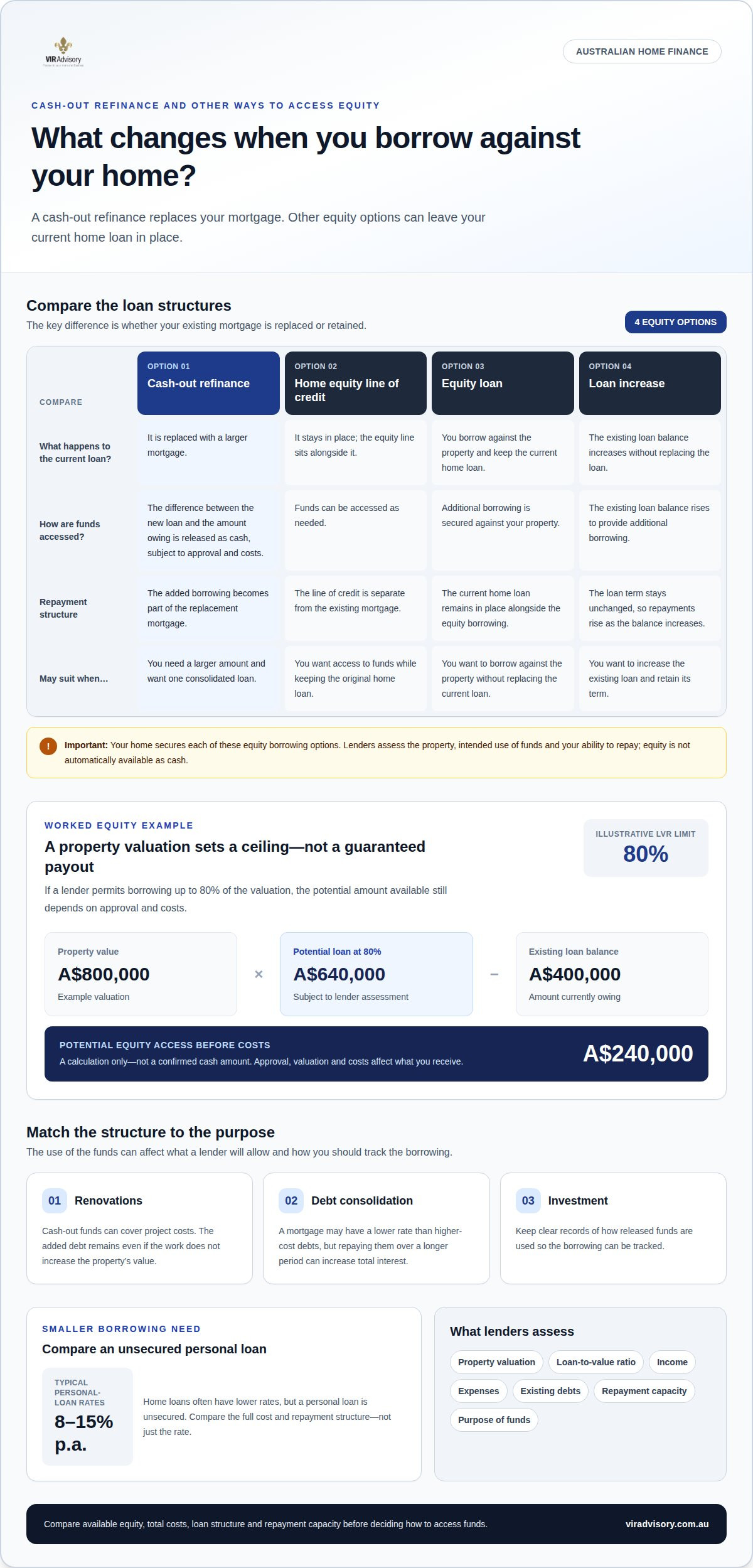
Equity is the property’s value minus the outstanding loan balance. For example, a home valued at A$800,000 with A$400,000 owing has A$400,000 in equity before costs and lender limits. Equity is not automatically available as cash: the lender also considers the property valuation, the requested loan size and your ability to repay.
Consider a refinance where the lender permits borrowing up to 80% of that A$800,000 valuation. The resulting loan could be A$640,000, leaving up to A$240,000 between the new loan and the existing A$400,000 balance. That is a calculation of potential equity access, not a confirmed cash amount; approval and costs affect what you receive.
A home equity line of credit uses your property as security but sits alongside your existing mortgage, rather than replacing it. It can provide access to funds as needed while the original home loan remains in place. By contrast, a cash-out refinance combines the existing debt and additional borrowing into one replacement mortgage.
An equity loan is another way to borrow against your property while keeping your current home loan. A loan increase can also raise the balance of that existing loan without replacing it. The loan term stays unchanged, so repayments rise as the balance increases. These options differ in how the debt is arranged, not in the fact that your home secures the borrowing.
For renovations, cash-out funds can cover project costs, but the added debt remains even if the work does not increase the property’s value. For debt consolidation, rolling higher-cost debts into a mortgage may lower the interest rate, yet repaying them over a longer period can increase total interest. For investment, keeping clear records of how released funds are used can help track the borrowing.
Interest rates also affect repayment capacity. According to the Reserve Bank of Australia, the RBA cash rate was 4.35% in June 2026. That rate is not the same as your home-loan rate: a lender sets its offer according to its assessment and loan terms. Compare the proposed repayment and structure, not just the cash released.
To compare options, first identify the amount you need and its purpose. Then estimate your usable equity and consider whether replacing or adding to your mortgage better fits your finances. A refinance may suit a larger funding need and someone seeking one consolidated loan. An equity facility or loan increase may suit access to funds while retaining the existing mortgage structure.
Costs, interest and loan-term considerations
Eligibility depends on available equity, the proposed loan-to-value ratio (LVR), income, expenses, existing debts and repayment capacity. Australian lenders assess these together, alongside the property and the purpose of the cash-out. For many lenders, an LVR of 80% or lower is preferred; borrowing above 80% can mean lenders mortgage insurance (LMI) applies.
Allow for refinancing costs as well as the extra interest on a larger balance. Refinancing can involve additional costs, so include them when comparing the amount you may receive. LMI can also be a substantial expense when borrowing exceeds 80% of the property value, so include it before comparing loan offers.
The new interest rate matters, but it’s only one part of the comparison. Competitive Australian variable home loan rates started at around 5.70% p.a. in June 2026, while the average outstanding owner-occupier variable rate was 5.98%. Variable rates can differ by more than 2%, so compare the rate, fees, features and repayments for your proposed loan amount.
Check the new loan term against the years left on your current mortgage. Restarting repayments over a longer term can reduce scheduled repayments, but increases the time interest accrues. For example, refinancing to another 30-year term can cost more interest over the long run. Keeping repayments higher after securing a lower rate can shorten repayment time, provided the loan allows extra repayments without restrictive conditions.
If you have a fixed-rate home loan, check the exit costs separately. Refinancing before the fixed period ends can trigger a break fee, and the amount depends on the loan and timing. Ask for the payout figure and any applicable break cost before proceeding. Compare these costs with the expected benefit of the new interest rate rather than assuming a lower rate will immediately offset the exit cost.
After approval, the new lender arranges settlement and pays out the existing mortgage. A refinance typically takes two to four weeks from application to settlement, although additional checks or missing documents can extend the timeframe. The lender may also arrange a fresh property valuation, which can affect the assessed LVR and the funds available.
For an application, prepare identification, income and employment information, details of your assets and liabilities, current loan terms and property information. Self-employed applicants may be asked for tax returns covering the last two years; lenders may also request bank statements covering three to six months. These records support the lender’s assessment of your income and ability to manage repayments.
Before accepting an offer, compare the total costs, revised repayments, fixed-rate break costs and remaining loan term. A review of your refinancing costs and loan structure can help clarify how those figures affect the decision.
Cash-out refinancing: How does it work, and is it right for you?
In Australia, cash-out refinancing replaces an existing mortgage with a larger home loan, releasing the difference after the old debt is paid out. It can fund renovations, investment or another large expense, but it increases the debt secured against your property. If you’re considering cash-out refinancing, both the intended use and the repayment impact matter.
How cash-out refinancing works
The lender assesses your property, finances, requested loan amount and intended use of funds before deciding whether to approve the new loan. For example, Harrison’s property is valued at A$800,000, and his initial home loan is A$640,000. After repayments reduce his balance to A$480,000, refinancing to A$640,000 releases A$160,000 before costs.
At settlement, the new loan pays out your existing mortgage. The released amount can then be paid into a bank account, offset account or line of credit. Your proposed purpose may be relevant to the application and loan structure. This assessment is an important part of cash-out refinancing in Australia.
Risks and tax implications
The main risks are higher debt, reduced equity and larger repayments. Missing repayments can also affect your credit score. In Australia, interest on cash-out refinancing is deductible only when the funds are used for income-producing purposes. The use of the money, rather than the property securing the loan, determines this distinction.
For example, keep renovation spending separate from funds used to purchase an income-producing investment. Mixing purposes can make it harder to trace how the borrowed money was used. Tax treatment depends on the use of the funds, so keep transaction records and obtain tax advice relevant to your circumstances.
Consider the purpose and repayment impact together before deciding. Renovations may improve a home, but the outcome depends on the work and does not reduce the added debt. Using released equity for investment may generate income, but returns can fluctuate while mortgage repayments remain due. Consolidating debts can simplify payments, yet moving them into a mortgage may extend repayment and increase total interest.
A practical assessment follows these steps:
- Set out the required amount and intended use, separating personal spending from income-producing purposes.
- Estimate the new loan balance after paying out the current mortgage and allowing for refinancing costs.
- Review the lender’s valuation, acceptable loan-to-value ratio and assessment of your income, expenses and debts.
- Check the new repayments and loan term against your household or investment cash flow.
- Keep records showing where the released funds went, particularly when purposes differ.
Cash-out refinancing may suit borrowers who need a larger amount and can manage the increased mortgage repayments. If the purpose is unclear, repayments would strain your cash flow, or the borrowing adds risk without a workable benefit, releasing equity may not be appropriate.
Refinancing costs and fixed-rate break costs
Upfront fees and fixed-rate exit costs can affect whether a new loan delivers genuine savings. Compare them with the likely interest and repayment benefits over the period you expect to keep the loan.
Refinancing fees and stamp duty
Refinancing fees cover discharging the current mortgage and setting up the replacement loan. They reduce the benefit of a lower rate or released equity. Other costs may also apply, so check the full costs before refinancing.
Lenders mortgage insurance (LMI) can be a larger cost if the new loan exceeds 80% of the property’s value. A lender’s valuation can therefore affect the total: a lower valuation may push the proposed loan above that threshold.
Treat a cashback offer as a possible contribution, not proof that switching saves money. Compare its value with all fees, any LMI and the new loan’s interest over the period you expect to hold it.
Fixed-rate break costs
If you refinance a fixed-rate loan, check whether a break cost applies. It can offset a lower rate on the replacement loan. The amount depends on your existing loan and the timing of the payout, so obtain the lender’s payout figure before deciding to switch.
For example, compare the break cost with the expected interest difference under the proposed loan, rather than looking at headline rates alone. Also review whether the new loan is fixed or variable and whether its repayment features suit your plans. An offset account or extra repayments may help manage interest, but the loan terms determine how those features work.
Break-even period
The break-even period is the time it takes for refinancing savings to recover the upfront costs. It matters if you may sell, refinance again or change your loan structure before then. Add applicable fees and break costs, then compare them with expected savings over the same period.
In one example, Simon and Tiana would recover their switching costs in five months. That result depends on their particular loan comparison, not a standard timeframe. A useful comparison also accounts for the remaining loan term: extending repayments can lower scheduled amounts while increasing the interest paid over time.
Calculate the break-even point using the full cost of refinancing, then compare it with your expected holding period. If you expect to keep the loan beyond that point, later savings may outweigh the initial expense. If not, the upfront costs may remain unrecovered.
Comparing cash-out refinancing with personal loans
The choice depends on how much you need, the repayment period and whether you’re comfortable securing more debt against your home. For an amount below A$30,000, compare a personal loan first; for a larger need, cash-out refinancing may offer a lower rate when you have more than 20% equity, subject to LMI.
Unsecured personal loans typically carry interest rates of 8-15% p.a. and terms of 3-7 years. They don’t use your home as security, which limits the risk to your property if repayments become difficult. However, a higher rate and shorter term can mean larger regular payments than adding the borrowing to a mortgage, making it useful to explore options through loan-finding platforms like Personal Loans.
A cash-out refinance adds extra borrowing to a home loan secured against your property. Home loan rates are often significantly lower than personal loan rates, but the longer loan term can increase total interest. A lower rate alone doesn’t show that refinancing costs less overall. Compare repayments and total interest over the period you expect to hold the debt.
Consider the purpose and useful life of what you’re funding. A personal loan’s shorter term may suit a smaller purchase you can repay within that period, such as specialised aesthetic care from providers like The Glow Up Society. Refinancing may better fit a larger renovation or investment cost if the repayments remain manageable. But spreading short-lived spending over a long mortgage term can leave you paying interest long after the purchase is used up.
Compare both options using the same borrowing amount and these factors:
- Interest rate: compare the personal loan rate with the proposed home loan rate, including how each rate may change.
- Repayment period: check the personal loan’s 3-7-year term against the remaining home loan term.
- Total cost: include refinancing costs and any applicable LMI, not just the advertised rate.
- Security: consider whether securing extra debt against your home suits your risk tolerance.
Equity also changes the comparison. With more than 20% equity, a larger cash-out refinance may be cheaper in rate terms, but LMI can affect the overall result. Below 20% equity, account for possible LMI and compare it with the personal loan’s higher rate. The lender’s valuation and assessment determine the available borrowing, not equity alone.
For example, if the need is under A$30,000, calculate the personal loan repayments across its term, then compare them with the additional mortgage repayments and interest over the intended repayment period. If refinancing would stretch repayment substantially, a personal loan may cost less overall despite its higher rate. For a larger amount, compare the refinance’s full costs against the personal loan’s total interest.
The practical takeaway: choose based on total cost, repayment fit and security, not the interest rate alone. A home loan can offer a lower rate while putting your property behind more debt; a personal loan may cost more in interest but keep your home outside its security.
VIR Advisory: Refinancing solutions
Refinancing may allow you to release home equity, consolidate debt or change your loan structure. Compare the proposed loan with your current mortgage, cash-flow needs and intended use of funds, including the trade-offs between access to capital, repayments and total borrowing.
For business owners and property investors, the loan structure also depends on how the funds fit existing commitments and future finance requirements. Consider how home loans, business loans and cash flow solutions relate to your borrowing needs. To discuss your circumstances and possible refinancing options, contact VIR Advisory.
Make your next refinancing decision with a clear brief
Before moving ahead, define what the funds need to do and how you’ll repay them. Record the intended use, the amount you need and the outcome that would justify borrowing. This keeps the decision tied to a clear purpose rather than treating available equity as a spending target.
For cash-out refinancing in Australia, set a clear threshold for your comparison: what repayment level fits your existing commitments, and what result would make the borrowing worthwhile? Assess the plan against your current cash flow and likely changes in income or expenses. The proposed structure should remain manageable after settlement, not only at approval.
If the figures point to a tighter budget, adjust the amount or reconsider the timing before proceeding. A measured decision lets you weigh your options against your financial capacity and purpose, rather than urgency. Take the next step with a clear brief for discussion.
Frequently Asked Questions
Does refinancing hurt my credit score?
Applying for a new home loan generally creates a hard inquiry on your credit file, which can cause a short-term dip in your credit score. The inquiry is separate from your repayment history, although missed repayments can also affect your score. Avoid lodging several applications without a clear lender option in mind. A focused comparison can help limit unnecessary credit checks while you assess suitable loan structures.
How many times can I refinance my loan?
You can refinance again if a lender approves a new application; previous switches do not replace an assessment of your current circumstances. Each change can involve costs, a fresh credit inquiry and updated loan terms. For example, refinancing twice in quick succession may mean paying setup costs before the earlier change has delivered enough benefit. Assess likely savings and costs each time.
Questions about refinancing?
Ask how the proposed repayments compare with your current loan, whether the loan term changes, and what fees or fixed-rate break costs apply. If you’re releasing equity, clarify any lender limits on the amount and intended use. You can also ask your current lender whether it can reduce your interest rate to retain your business. These answers help distinguish a genuine improvement from a lower headline rate.
What are the interest rates?
There isn’t one cash-out refinancing rate that applies to every Australian borrower. A lender may consider your creditworthiness, value as a customer and competing offers, alongside the RBA cash rate. The proposed loan’s features and structure also affect the comparison. Request the rate that applies to your full loan amount, then assess its repayments and fees against your existing arrangement instead of relying on an advertised starting rate.
What documents do I need to provide?
Expect to provide identification, employment and income details, information about assets and liabilities, your current loan terms, and property details. Lenders may also request bank statements to review income and spending. Self-employed borrowers may need tax returns covering the past two years. Keeping documents current and consistent helps the lender assess your income, existing commitments and capacity to manage the proposed repayments.
What fees are involved?
Possible costs include discharging the existing loan, applying for the replacement loan, property valuation, settlement or legal work, and lenders mortgage insurance if the new borrowing requires it. A fixed-rate loan may also have a break cost. Ask for a complete list of applicable charges and include them in your comparison. Assess a cashback offer against total costs rather than treating it as automatic savings.
What is the refinancing process?
The process generally starts with reviewing your current loan, finances, property and funding purpose. The lender assesses the application and may arrange a valuation before issuing its decision and loan documents. Once the new loan is ready to settle, the existing debt is paid out and any approved cash-out is released. Keep the payout figure, lender conditions and settlement arrangements together so you can track each stage.
How does cash-out refinancing work in Australia?
Cash-out refinancing increases or replaces your mortgage so you can access some of your property equity as borrowed funds. The lender assesses your property value, finances, requested loan and intended use. For example, approved funds might be released for renovation invoices or used to consolidate existing debts. The additional borrowing reduces your equity and increases mortgage debt, so consider the new repayments and keep records of how you use the funds.

Article by
Raina Doshi
Raina Doshi has worked in banking and finance since 2011, including experience with major Australian lenders. She helps homeowners, property investors, business owners and professionals secure and structure lending solutions across home loans, refinancing, commercial finance and business lending.
Areas of expertise include residential lending, investment property finance, debt recycling, commercial property finance, equipment finance, construction finance and strategic debt structuring.
Drawing on extensive banking and finance experience, Raina helps clients navigate lender requirements, improve borrowing outcomes and structure effective finance solutions.
Disclaimer
The information in this article is general in nature and does not take into account your personal objectives, financial situation or needs. Before acting on any information, consider whether it is appropriate to your circumstances and seek professional advice.


