

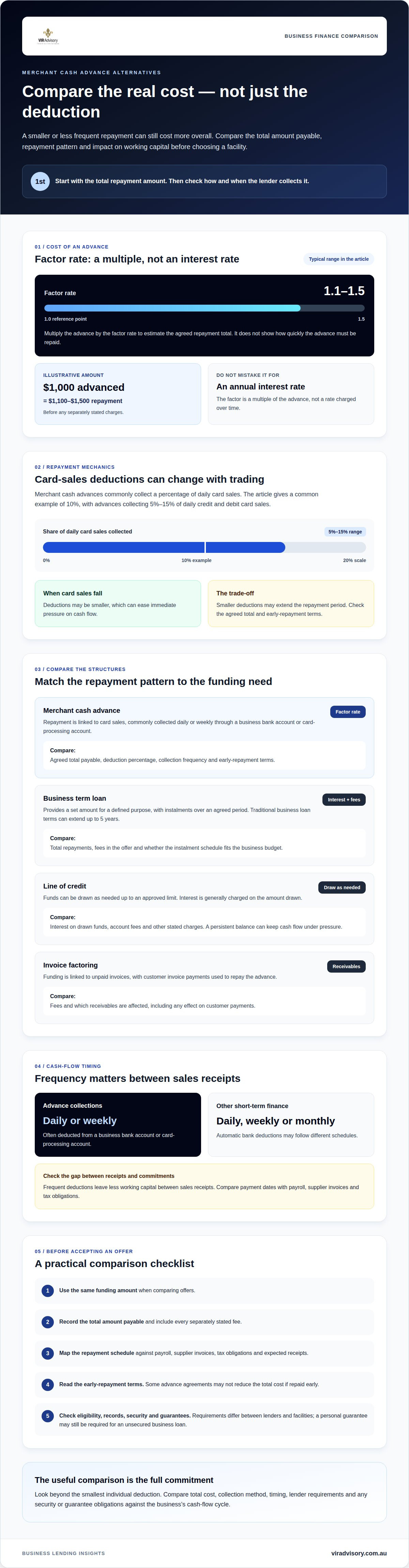
A lower-looking repayment can still leave your business paying more overall. Merchant cash advance alternatives include business loans, lines of credit and invoice finance; compare the total amount repayable, not just the size or frequency of each deduction. Merchant cash advances typically use factor rates between 1.1 and 1.5, so the agreed repayment amount can be assessed as a multiple of the advance.
It’s reasonable to ask whether a cash advance could affect your credit score. The answer depends on how the lender assesses and reports the facility, so weigh credit checks and repayment obligations alongside the cost.
This comparison shows how to assess merchant cash advance alternatives by total cost, repayment structure and security, and explains the practical differences between common funding options. You’ll also learn how lender requirements can affect eligibility and what to weigh before choosing finance, giving you a clearer basis for deciding whether another facility could better suit your cash flow.
Key Takeaways
- Compare the total amount repayable, not just the repayment size or frequency; a factor rate shows how the advance amount translates into a fixed repayment total.
- Weigh a merchant cash advance’s sales-linked deductions against a business loan’s instalments, term and lender assessment requirements.
- Before applying, consider how the lender assesses eligibility, what financial records it requires and whether a personal guarantee or security may be involved.
- Credit checks, repayment history and personal guarantees can affect the risk of borrowing, so understand the facility’s terms and reporting approach before proceeding.
- Invoice factoring may suit a business with unpaid invoices, as funding is linked to receivables rather than projected card sales; compare its fees and effect on customer payments.
Factor rates and total repayment costs
A factor rate converts an advance into a fixed repayment total rather than an interest rate charged over time. Rates typically range from 1.1 to 1.5. Multiply the amount borrowed by the factor rate to estimate the total repayment, before including any separately stated charges. This calculation gives business owners a starting point for comparing merchant cash advance alternatives by total cost.
The factor is a multiple, not an annual interest rate, so it doesn’t show how quickly the funds need to be repaid.
Repayment may come from a percentage of daily card sales. A common example uses 10% of each card transaction, while advances may collect 5% to 15% of daily credit and debit card sales. Lower sales may mean smaller deductions, but can extend the repayment period.
Collection methods affect daily cash flow. Merchant cash advance payments are commonly collected daily or weekly through deductions from a business bank account or card-processing account. Other short-term business finance may use automatic bank deductions daily, weekly or monthly. Compare the schedule with payroll, supplier invoices and tax obligations: frequent deductions leave less working capital between sales receipts.
Early repayment terms matter too. Some merchant advance agreements are rigid and may not reduce the total cost if repaid early. Before accepting an offer, record the amount received, total payable, deduction percentage, collection frequency and early-repayment terms. This makes it harder for a small individual deduction to obscure a higher overall cost when comparing merchant cash advance alternatives.
| Option | Cost basis | Repayment pattern | Key comparison |
|---|---|---|---|
| Merchant cash advance | Factor rate and agreed total | Percentage of card sales, often daily or weekly | Check total payable and early-payment terms |
| Business loan | Interest and applicable fees in the offer | Instalments over a set period | Compare total repayments and schedule |
| Invoice factoring | Fees linked to invoices funded | Customer invoice payments repay the advance | Compare fees and receivables affected |
For a fair comparison, use the same funding amount and include every stated fee, payment date and final amount payable. Choose a structure whose total cost and collection method fit the business’s cash-flow cycle, rather than focusing only on the smallest individual deduction.
Merchant cash advances compared with traditional business loans
Compare funding options by purpose, repayment pattern and impact on working capital, not approval speed alone. For an Australian business facility, read the written offer and contract carefully for costs, repayment obligations, security and guarantees before accepting.
Business Term Loans and Lines of Credit
A business term loan provides a set amount for a defined purpose, such as paying for a fit-out, with repayments following an agreed schedule. A merchant cash advance instead collects against card sales. A line of credit lets a business draw funds as needed, with interest generally charged on the amount drawn. When considering refinancing, assess whether the new repayment pattern fits the underlying cash flow.
Traditional business loan terms can extend up to 5 years, compared with merchant cash advance repayment periods of 3-18 months. Longer terms may spread repayments but keep the debt in place for longer. A business loan may suit a planned expense with a clear budget; a line of credit may better match recurring gaps between expenses and receipts.
Business Lines of Credit and Overdrafts
A business line of credit makes funds available up to an approved limit, while an overdraft permits transactions beyond the account balance. Interest rates and fees depend on the lender and facility terms, so there is no single rate or fee that applies across Australian products. Compare interest on drawn funds, account fees and any other stated charges.
These facilities can provide access to working capital without requiring the business to draw the full limit upfront. However, an available limit is still a borrowing commitment, and a persistent balance can keep cash flow under pressure. For a seasonal business, consider whether expected receipts can reduce the balance after the peak period.
Equipment finance and asset-backed business loans fund a purchase using the asset as security. The lender assesses the asset and the borrower’s ability to make repayments. If equipment finance repayments aren’t made, the financed equipment may be repossessed. This can link funding to a specific purchase, but the asset is at risk if the business cannot meet its obligations.
Australian small businesses can also explore grants and low-interest loan programs. Grants may provide funding without repayment, but eligibility criteria and application requirements can be demanding. A grant is therefore less suited to an urgent cash-flow gap than a facility designed for working capital.
For an unsecured business loan, lenders assess the application and repayment capacity without taking a specific asset as security. Approval criteria differ between banks and online lenders, and a personal guarantee may still be required. To strengthen an application, present consistent financial records, explain existing debts and connect the requested amount to a defined business purpose.
Lender eligibility criteria and funding caps
Approval depends on the facility, trading evidence and repayment capacity; funding limits vary by lender. For a merchant cash advance, card turnover is a central assessment measure. Unsecured business loans require a broader review of the business’s financial position.
Eligibility Requirements
For unsecured business loans from Australian banks and online lenders, eligibility commonly depends on business revenue, financial records, credit history and capacity to meet repayments. Each lender applies its own assessment, so a business that doesn’t meet one lender’s criteria may fit another’s. An offer may also require a personal guarantee, which adds personal risk if the business can’t repay.
To improve approval prospects, present consistent financial information, explain existing debts and request funding for a clear business purpose. Complete application records help the lender assess revenue and cash flow without having to resolve avoidable gaps. Compare eligibility criteria, repayment structure and total cost before accepting an offer.
Funding Amounts and Turnaround Time
Merchant cash advance funding is often linked to card turnover: many lenders offer an amount equal to 1-2 times monthly card turnover. Lenders may request 3-12 months of bank statements to assess trading and card sales.
Some lenders can make an offer within 24 hours of application, while funding may arrive within 1-2 business days. These timings depend on completing the application and assessment; an offer time isn’t the same as funds received. A faster process may suit an urgent purchase, but speed alone doesn’t establish affordability.
Assessment varies by facility. A merchant cash advance focuses on card revenue and sales patterns, while an unsecured business loan considers the wider financial position and repayment capacity. A lender may assess whether monthly revenue can support scheduled repayments, alongside outstanding debts and the requested amount. The business’s credit profile can also affect eligibility and terms.
Prepare an application in a clear sequence:
- Define the funding purpose and the amount needed, rather than applying for the largest available limit.
- Organise business bank statements, financial reports and details of existing repayments.
- Match the evidence to the lender’s stated criteria, including card-sales records for an advance.
- Compare the written offer’s total repayment, schedule, security and any personal guarantee.
This process can show whether an unsecured facility or sales-linked advance better fits the business. Don’t treat an indicative limit as a suitable borrowing target: a larger facility can increase repayments and strain working capital. Likewise, a short turnaround or lower stated fees don’t replace a review of the full repayment terms.
For a sound comparison, weigh the amount offered against monthly revenue, existing obligations and the timing of incoming cash. A lender’s funding cap is a maximum, not a recommended borrowing target.
Do cash advances hurt my credit score?
A merchant cash advance doesn’t automatically lower a business owner’s credit score. The effect depends on whether the lender makes a credit enquiry, how the facility is reported and whether repayments are made as agreed. Before applying, ask how the lender assesses credit and review the agreement’s default terms.
A credit check and a missed payment are different events. An application may involve an enquiry on a business or personal credit file, while overdue payments or a default can create a separate credit concern. For example, a director applying for funding should consider whether the lender will assess personal credit as well as the business’s financial records.
Approval can depend on the lender’s broader assessment, not just a credit score. Revenue, existing borrowing and repayment capacity can affect the decision. A business with seasonal sales should map expected payments against quieter trading periods, then assess whether deductions will leave enough cash flow for wages, suppliers and other commitments.
Personal guarantees need separate attention. Subject to the agreement’s terms, a guarantee can make a director personally responsible for a business debt if the business fails to repay. Signing doesn’t automatically lower the guarantor’s credit score, but unpaid obligations or a default can create further risk. Read the guarantee alongside the facility agreement, including when the lender can demand payment.
A revolving credit facility works differently from a one-off advance. The business can draw funds as needed and generally pays interest on the amount drawn. This flexibility can help manage uneven cash flow, but a continuing balance adds a repayment commitment. When assessing another application, lenders may consider the available limit and outstanding balance as existing liabilities.
Before accepting credit, work through these checks:
- Confirm whether the application includes a personal or business credit enquiry.
- Read how the lender treats missed payments, defaults and early repayment.
- List existing facilities, including credit card balances and revolving limits.
- Forecast repayments against seasonal revenue and essential business costs.
- Review any personal guarantee and identify the obligations it creates.
These checks help distinguish a credit enquiry from repayment conduct and personal liability. If a business already has an advance, avoid taking another facility solely to meet current deductions without assessing the combined repayments. A seasonal dip can make overlapping commitments harder to manage, even when each facility seemed affordable on its own.
Invoice factoring
Invoice factoring turns unpaid customer invoices into working capital before their due dates. Unlike a merchant cash advance, the funding is tied to issued receivables rather than projected card sales.
Invoice Factoring Compared with Cash Advances
A factoring company advances part of an invoice’s value, then collects payment from the customer. Businesses typically receive 70% to 90% of unpaid invoice value, with fees commonly ranging from 1% to 5% of the invoice value. This isn’t an interest rate applied to a cash advance; compare the quoted fee and amount released against the receivable funded.
With a merchant cash advance, repayment is linked to future card sales. Factoring instead uses actual invoices, so it may suit a business that sells to customers on payment terms. It won’t help a business without eligible invoices, and customers pay the factoring company for factored invoices.
Switching to Invoice Factoring
Switching can change both the repayment source and the customer payment process. Before replacing an advance, map its remaining obligations against the invoices available for factoring. The proceeds need to cover existing repayments and the business’s near-term cash needs.
Factoring doesn’t automatically cancel an existing advance. Review the advance agreement’s remaining balance and repayment terms, then assess whether customer invoice receipts can support the change. A factoring advance may be available within 24 hours of submitting an invoice, but that timing doesn’t remove the need to coordinate repayments and cash flow.
Scalable Funding Through Factoring
Funding can grow as eligible receivables increase, making factoring potentially useful when sales are made on invoice terms. A business can factor selected invoices when cash is needed, rather than fund every sale. This differs from a fixed advance amount, which is based on projections of future sales.
That flexibility has limits: each advance depends on invoices that meet the facility’s criteria, and fees reduce the cash received. Factoring relationships typically last 12 months or more, so owners should consider the continuing costs and how customer collections will operate across that period.
Compare each option using the same practical checks:
- Funding base: identify whether repayment comes from actual invoices or future card sales.
- Cost: compare factoring fees with the advance’s total repayment, rather than treating either as an interest rate.
- Cash received: account for the portion of each invoice not advanced and any fees deducted.
- Collections: confirm how customers pay and who follows up overdue invoices.
For example, a business with reliable invoice-paying customers may prefer receivables-based funding, while a retailer with little invoice revenue may rely more on card-sales finance. Neither structure is automatically cheaper: practical cost depends on invoice quality, advance amount, fees and collection arrangements.
Owners should also distinguish factoring from invoice discounting. In factoring arrangements, the factoring company may collect payments from customers. With discounting, customers pay the lender, while the business may continue to manage its own credit control. This distinction helps owners assess operational impact as well as funding cost.
Assessing Cash Flow Solutions
Cash-flow funding options may be relevant when current repayments or uneven receipts put pressure on business liquidity. Assess options against the funding purpose, existing commitments and capacity to repay.
Funding decision framework
- Purpose: identify what the funds need to cover.
- Cost: compare the full repayment obligation.
- Fit: match repayments to business cash flow.
- Risk: consider security and any personal guarantee.
If an existing facility no longer fits, refinancing may also be worth assessing. Contact VIR Advisory to discuss your options.
Make your next funding decision with cash flow in view
Start by defining what the funding needs to achieve: cover a timing gap, replace an existing obligation or support planned business spending. Use that purpose to assess a suitable structure and repayment capacity, including how the commitment fits alongside other business and household costs. This keeps a comparison of merchant cash advance alternatives focused on the actual funding need, not just approval or access to capital.
VIR Advisory can help assess Business Loans and Refinancing solutions for business funding needs, and Home Loans when household lending commitments also matter. Reviewing these obligations together can clarify how repayments interact with cash flow and borrowing capacity. The right option depends on the business’s financial position, lender criteria and facility terms.
A sound funding decision starts with a clear purpose and a repayment structure the business can manage. When you’re ready, book a consultation with VIR Advisory to discuss the available options.
Frequently Asked Questions
What are the downsides?
The main downsides are potentially high total costs and repayments that can reduce cash available for operating expenses. A business with slim margins may feel each deduction more sharply than one with stronger margins, even at similar card-sales levels. Relying on future sales also ties funding to a particular revenue channel. Before borrowing, check whether the business can still meet supplier, wage and tax commitments during a quieter trading period.
Can I get one as a sole trader?
A sole trader can apply for business finance, but approval depends on the lender’s criteria and assessment. Be ready to explain how the business trades, where its revenue comes from and how repayments fit alongside existing commitments. Consider how business borrowing interacts with personal finances too, since business and household cash flow may draw on the same income.
Can I get one with bad credit?
Bad credit doesn’t automatically rule out an application, but it can affect the lender’s assessment and the terms offered. The lender may consider the reason for past credit issues, current debts and evidence that the business can manage repayments. Avoid submitting several applications without understanding assessment requirements. First, organise a clear account of existing obligations and recent payment conduct, then compare the proposed facility’s total cost.
Can I get one without bank statements?
Possibly, but an application still needs evidence for the lender to assess the business and its revenue. The lender may accept other financial records or transaction information under its own process, while another may require bank statements. Ask what evidence is required before applying. If statements aren’t available, prepare consistent records showing trading activity, incoming funds and existing repayments.
What are the best alternatives to merchant cash advances for Australian businesses?
The right alternative depends on what the business needs to fund. A business loan may suit a defined expense with a known repayment plan; a line of credit may suit recurring short-term gaps. Invoice finance may fit a business with unpaid customer invoices, while equipment finance can fund an asset purchase. Start with the purpose, then match the facility’s repayment source to the business’s income pattern.
How do Australian business loans compare with merchant cash advances on cost, repayments and eligibility?
A business loan usually sets repayments over an agreed term, while an advance links collections to card sales. A loan’s total cost depends on interest and fees; an advance’s cost depends on its agreed repayment amount and deductions. Eligibility differs too: lenders assess the loan applicant’s financial position, while card turnover can be central to an advance application. Compare both against the same funding need and cash-flow forecast.
Can Australian small businesses get invoice finance or debtor finance, and what does it cost?
Australian businesses can consider invoice finance or debtor finance when they issue invoices and need cash before customers pay. Costs depend on facility fees, the invoices funded and how long they remain unpaid. The business should also consider who manages customer collections and whether the arrangement affects customer communications. Compare the net funds released with all charges and the receivables committed.
How can an Australian business calculate and compare the effective cost of a merchant cash advance and alternatives?
Compare the net funds received with every amount payable, including stated fees, then map payments against their due dates. For an advance, record the agreed total and how deductions change with card sales. For a loan, include each scheduled instalment and applicable charges; for invoice finance, include fees and any amount withheld. Compare dated cash flows over the expected repayment period, not just headline rates or individual deductions.

Article by
Raina Doshi
Raina Doshi has worked in banking and finance since 2011, including experience with major Australian lenders. She helps homeowners, property investors, business owners and professionals secure and structure lending solutions across home loans, refinancing, commercial finance and business lending.
Areas of expertise include residential lending, investment property finance, debt recycling, commercial property finance, equipment finance, construction finance and strategic debt structuring.
Drawing on extensive banking and finance experience, Raina helps clients navigate lender requirements, improve borrowing outcomes and structure effective finance solutions.
Disclaimer
The information in this article is general in nature and does not take into account your personal objectives, financial situation or needs. Before acting on any information, consider whether it is appropriate to your circumstances and seek professional advice.


