

A creditor vote is not a popularity contest. In commercial debt restructuring in Australia, an eligible small business restructuring plan proceeds when creditors representing more than 50% of the value of the creditor pool vote in favour. Creditors vote in writing, so the proposal’s terms and supporting financial information matter as much as the amount offered.
It’s understandable to focus on whether creditors will agree, but approval is only one part of the decision. A plan must follow the required process, meet eligibility and compliance requirements, and explain how the business will make the proposed payments while continuing to trade.
This article explains how a small business restructuring (SBR) proposal is developed, what creditors assess, and what happens if they approve or reject it. It also covers completing a plan and the practical effect restructuring can have on banking relationships, including why lenders may review existing facilities and security. The aim is to clarify the key decision points before you take the next step.
Key Takeaways
- Small business restructuring is a formal process under Part 5.3B of the Corporations Act 2001, according to the Federal Register of Legislation.
- Assess eligibility at the practitioner’s appointment, including whether the company’s total liabilities exceed A$1 million.
- Prepare the proposal and supporting financial information carefully before voting begins, because the plan can’t be altered once the voting period starts.
- Understand what happens if the plan is completed or ends early, including how unpaid affected claims are treated.
- Consider how restructuring may affect existing bank facilities, security arrangements and future borrowing capacity.
How likely are creditors to approve a plan?
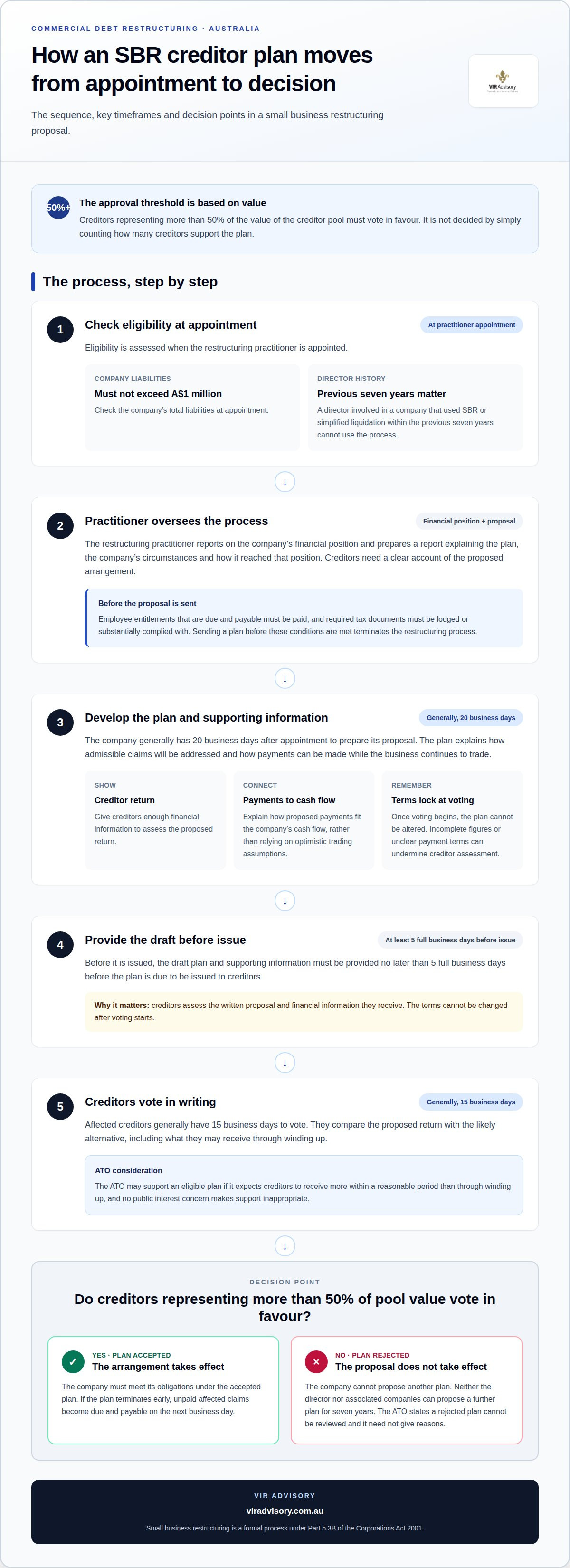
Approval depends on creditor votes and whether the proposal presents a credible return compared with winding up. For an eligible small business restructuring, creditors representing more than 50% of the value of the creditor pool must vote in favour.
Creditor voting on a plan
Creditor voting is the written process through which affected creditors decide whether to accept a restructuring proposal. The outcome depends on the value of votes, not simply the number of creditors voting in favour.
Creditors generally have 15 business days to vote. A proposal may cover existing unsecured debts, including ATO debt, and creditors assess what they are offered against the likely alternative. For example, they may support a plan if they expect a better return than liquidation. A company’s eligibility also matters: its total liabilities must not exceed A$1 million when the practitioner is appointed.
Developing a creditor plan
A creditor plan explains how the company will address admissible claims and make payments if creditors approve it. Creditors need enough financial information to assess the proposed return and the company’s ability to pay.
The company generally has 20 business days after appointment to prepare its proposal. Before it is issued, the draft plan and supporting information must be provided no later than 5 full business days before the plan is due to be issued to creditors. The proposal should show how payments fit the company’s cash flow, rather than relying on optimistic trading assumptions. Once voting begins, the plan cannot be altered, so incomplete figures or unclear payment terms can undermine creditor assessment.
Risks of rejection or non-completion
Rejection means the proposed arrangement does not take effect. Non-completion means the company fails to meet obligations under an accepted plan. Either outcome can significantly affect the company’s available options.
If creditors reject an SBR plan, the company cannot propose another plan, and neither the director nor associated companies can propose a further plan for seven years. The ATO may support an eligible plan if it expects creditors to receive more within a reasonable period than they would through winding up, and no public interest concern makes support inappropriate. The ATO states that a rejected plan cannot be reviewed and that it need not give reasons. If an accepted plan terminates early, unpaid affected claims become due and payable on the next business day.
Practitioners and creditor plans
A restructuring practitioner oversees the proposal process and reports on the company’s financial position. Creditors rely on this work for a clear account of the company’s circumstances and proposed arrangement.
The practitioner prepares a report explaining the plan, the company’s financial situation and how it reached that position. They also help ensure creditors receive the proposal and supporting information within the required timeframe. Before the proposal is sent, employee entitlements that are due and payable must be paid, and required tax documents must be lodged or substantially complied with. Sending a plan before meeting these conditions terminates the restructuring process.
Small business restructuring (SBR) as a formal debt restructuring process
Commercial debt restructuring in Australia involves changing how a company manages or repays business debts. The main options include SBR, voluntary administration and a scheme of arrangement. They differ in who controls the company and how creditors participate.
In Australia, small business restructuring is a formal debt restructuring process under Part 5.3B of the Corporations Act 2001, according to the Federal Register of Legislation.
Recognising business debt distress
Debt distress arises when a company struggles to meet obligations as they fall due, making timely assessment important. Under section 95A of the Corporations Act 2001 (Cth), a company is solvent if it can pay its debts as and when they become due and payable.
Warning signs can include unpaid supplier invoices, growing tax liabilities, or insufficient cash to meet payroll and loan repayments. For example, a business relying on new borrowing to cover routine bills should promptly assess its cash flow and liabilities. Continuing to trade while under financial pressure can deepen the shortfall, so directors should consider the company’s position and restructuring options early.
Comparing formal restructuring options
Formal restructuring options follow different processes to address company debts, affecting control and creditor involvement. In SBR, eligible directors remain in control while a restructuring practitioner oversees the process and creditors vote on a plan.
Voluntary administration is an out-of-court statutory process in which an administrator takes control from directors. The administrator must seek to maximise the chance of the company continuing under a deed of company arrangement or provide creditors with a better return than immediate liquidation. A scheme of arrangement is a court-sanctioned compromise with creditors, who are usually grouped into classes with similar rights and interests. A majority in each class must vote in favour, and the court must sanction the scheme.
SBR eligibility is assessed when the practitioner is appointed. The company’s total liabilities must not exceed A$1 million at that point, and a director involved in a company that used SBR or simplified liquidation within the previous seven years cannot use the process. These thresholds make an early review of company structure, liabilities and director history relevant before choosing this formal option.
Other commercial debt restructuring options depend on the company’s circumstances. A negotiated arrangement with creditors may be possible outside a formal process. Voluntary administration may be relevant when the company needs an administrator to assess available outcomes, while a scheme may suit a company seeking a court-sanctioned compromise across creditor classes. Company debt restructuring is distinct from personal bankruptcy, and an SBR plan does not automatically release a personal guarantee for company debt.
Appointment of an external restructuring practitioner
In small business restructuring, directors appoint an external practitioner to oversee the process while the company continues trading. The appointment starts a defined period for assessing eligibility, preparing financial information and developing a plan the business can afford to meet.
Directors appoint a restructuring practitioner under section 453B after resolving that the company is insolvent or likely to become insolvent. Only a registered liquidator can take this appointment. It is a formal role, not simply a finance consultant’s review: the practitioner examines the company’s position, considers its obligations and prepares a report for creditors explaining the plan and how the business reached its financial circumstances.
Appointment timing affects both eligibility and the work required. The company’s eligibility is assessed when the practitioner is appointed, including whether total liabilities exceed A$1 million. The practitioner requests financial records and details of creditors, employee entitlements and tax compliance to understand the company’s obligations. Missing or inconsistent records can make it harder to assess whether proposed payments match the business’s ability to trade and generate cash.
After appointment, the company generally has 20 business days to prepare its proposal. The plan can provide for payments on admissible claims for no longer than three years after acceptance. A realistic repayment schedule needs to account for operating costs and expected trading cash flow, rather than assuming every forecast invoice will be paid on time. This assessment helps show whether the proposed arrangement is workable across its full period.
Choosing a practitioner
An SBR practitioner must be a registered liquidator, able to assess the company’s circumstances and oversee the process. Their analysis informs both the proposal and creditors’ assessment.
Directors can consider whether the practitioner clearly explains the appointment, required records, reporting role and expected timetable. For example, a business with several lenders, overdue tax liabilities and employee entitlements needs to present its obligations coherently. A clear explanation of the practitioner’s role also helps directors understand which decisions remain theirs while the company continues trading.
Practitioner fees and total costs
Practitioner fees cover work during the initial SBR process and the plan phase, so the total cost matters when assessing the company’s cash flow.
These amounts are separate from payments to creditors under the plan. Directors should account for both when considering whether the business can fund the process and meet its proposed obligations while trading.
Plan duration, completion and default
An SBR plan sets out payments to creditors and the period for making them. Its terms should reflect trading cash flow, ongoing liabilities and tax compliance, so the company can meet its obligations.
Preparing the restructuring plan
Preparing a plan means turning the company’s financial position into a proposed arrangement for paying creditors. The practitioner’s report explains the company’s circumstances and how it reached them; the plan sets out payments on admissible claims.
Forecasts should account for operating costs, expected customer receipts and tax obligations. For example, a business with seasonal sales needs payment dates that allow for quieter trading periods, rather than assuming income will be even each month. Creditors assess the proposal on its stated terms, so realistic assumptions make it easier to judge whether the company can meet them.
Plan terms and duration
Plan terms establish which admissible claims are covered, the proposed payments and when they are due. Under SBR rules, payments on admissible claims cannot extend beyond three years after acceptance.
Many plans run for 6-to-12 months, although the business must follow its accepted terms until completion. A plan can provide for payments to creditors, but cannot transfer non-cash property to them. A plan should treat creditors fairly, rather than favouring a supplier simply because it is commercially important.
Tax compliance remains relevant throughout restructuring. Before the proposal is provided, the company must lodge required tax documents or substantially comply with those requirements. Falling behind on post-restructuring liabilities can also affect the use or refund of tax credits, so cash-flow forecasts should include both plan payments and current obligations.
For tax-related credits, the ATO applies offsetting to SBR plans in the same way as for a Deed of Company Arrangement, consistent with PS LA 2011/21. Credits relating to the pre-restructuring period must be applied to pre-restructuring debts, including debts treated as released under the plan.
While the plan remains in place, credits arising for a post-restructuring period are first applied to post-restructuring liabilities; any excess may be applied to earlier debts. After successful completion, credits for post-restructuring periods will generally be refunded if no post-restructuring liabilities remain. These rules explain how credits are applied, not every possible tax consequence of debt forgiveness.
The plan is complete when the company fulfils its obligations and the plan terminates. The company is then released from admissible claims covered by the plan. If the plan terminates early, unpaid affected claims become due and payable on the next business day. This can put immediate pressure on a business that has not kept funds available for its commitments.
Debt advisory and banking relationships
Australian banks and the ATO assess repayment proposals against the company’s financial position, proposed payments and likely recovery. The ATO generally supports an eligible restructuring plan if it expects creditors to receive more within a reasonable period than through winding up, and no public interest concern makes support inappropriate.
A bank’s assessment is separate from the creditor vote on an SBR plan. Directors should distinguish debts covered by the proposal from secured facilities and other lending arrangements, then assess what the business can pay while continuing to trade. A lender may review cash flow, account conduct, existing security and the company’s ability to service borrowing. These factors can shape discussions about repayments or continued access to finance.
For example, a company with seasonal receipts might propose staged payments aligned with forecast cash inflows, rather than fixed amounts unsupported by its trading pattern. A bank reviewing the same situation needs a clear picture of operating costs, existing facilities and the expected effect of restructuring on repayments. Overlooking a secured facility or assuming renewed lending without the lender’s agreement can leave a funding gap.
The ATO may reject a plan if director or related-entity loan accounts are not repaid, tax liabilities remain unpaid, the tax compliance history is poor, or the proposal gives the business an unfair advantage over others. It requests a draft plan and all supporting information before considering it. Complete creditor details, tax records and realistic payment forecasts are therefore important from the outset, not documents to assemble after discussions begin.
Banking relationships can change as directors address financial distress. A lender may reassess risk if trading conditions, repayment performance or the proposed debt structure changes. This does not automatically mean a facility will be withdrawn, but it may affect decisions about further funding, renewals or changes to existing terms. Before relying on continued access to credit, directors should map each facility, its security and repayment obligations against the proposed plan.
A practical review has three steps: identify each lender and facility; separate secured lending from debts addressed by the plan; then test proposed payments against forecast cash flow and current liabilities. This helps show whether working capital will remain sufficient after creditor payments. If the business relies on commercial property finance or equipment lending, include the relevant asset security and repayment commitments in the assessment.
For directors facing creditor pressure, debt advisory can help organise liabilities, cash-flow assumptions and lender discussions into a coherent finance position. The aim is to align proposed repayments with viable trading cash flow while assessing each bank facility and ATO obligation according to its terms and role in the restructuring.
Keep an up-to-date schedule of facilities, security and repayment dates alongside the trading forecast. When the forecast changes, updated figures can show which commitments remain affordable and support consistent discussions with each lender.
VIR Advisory
VIR Advisory is an experienced mortgage and finance brokerage specialising in home loans, refinancing, commercial finance, business lending and property investment finance. Its financial strategy guidance can help business owners assess how restructuring may interact with cash flow, existing lending and future funding requirements.
Consider a finance review when weighing creditor payments against working capital or assessing how a revised debt structure could affect borrowing needs. VIR Advisory can help clarify lending considerations and financing options as part of the broader restructuring decision.
Contact VIR Advisory to discuss your business’s financing position.
Plan the next finance decision around the business
Commercial debt restructuring in Australia should be considered alongside the business’s future funding needs, not as a separate exercise. A revised repayment structure may ease pressure on current cash flow, but the business still needs to fund stock, wages, equipment or property commitments while it trades.
Before deciding what comes next, identify which obligations the proposed arrangement covers and which financing needs remain outside it. Then consider how those needs affect cash flow, lender assessments and the business’s ability to meet ongoing commitments. This helps directors avoid treating short-term relief as a complete funding plan, particularly if trading conditions or borrowing needs may change.
VIR Advisory can discuss how business finance, home loans or refinancing relate to your broader financial position. Start with the obligations, facilities and cash-flow requirements that matter to your circumstances.
A considered next step can clarify the financing implications and help you approach the decision with greater confidence.
Frequently Asked Questions
What happens to court proceedings and enforcement?
During an SBR plan, a creditor bound by it generally cannot sue for a covered debt, wind up the company or enforce against company property while the plan remains in force. Exceptions and court orders can apply. Voluntary administration has statutory moratoriums that protect the company from creditor action and certain contract terminations because of the administration. Protections differ between processes, so identify the procedure that applies before assessing a particular enforcement action.
What do I need to know before deciding?
Before deciding, map the company’s debts, security and cash requirements against the proposed arrangement. For example, a director may need to distinguish a company facility secured over business assets from a personal guarantee for that debt. SBR does not automatically release personal guarantees. Consider whether forecast trading cash flow can cover both plan payments and ongoing liabilities, and whether the business remains viable with those commitments.
What Australian laws and insolvency rules apply to business debt restructuring?
Australia’s Corporations Act 2001 governs key company restructuring and insolvency processes. Small business restructuring sits under Part 5.3B, according to the Federal Register of Legislation; voluntary administration is governed by Part 5.3A. Section 95A defines when a company is solvent, while section 588GA contains the insolvent trading safe harbour provision. Sections 556 to 564 govern priority for certain unsecured debts in liquidation, including employee entitlements and administration expenses.
What eligibility criteria apply to Australia’s small business restructuring process?
For SBR, the company’s total liabilities must not exceed A$1 million when the practitioner is appointed. A director who was involved in a company using SBR or simplified liquidation within the previous seven years cannot use the process. Employee entitlements due and payable must be paid, and required tax documents lodged or substantially complied with, before the proposal is provided. Directors also resolve that the company is insolvent or likely to become insolvent before appointment.
What are the steps and typical timeline for restructuring business debt in Australia?
The process starts with the directors appointing a restructuring practitioner, followed by proposal preparation, creditor voting and, if accepted, performance of the plan. The company generally has 20 business days to prepare its proposal. Supporting information must be provided no later than 5 full business days before issue, then affected creditors generally have 15 business days to vote. A plan may provide payments for no longer than three years after acceptance.
How much do Australian insolvency practitioners and restructuring advisers charge?
These figures describe practitioner costs, not a quote for a particular company’s circumstances or separate advisory services.
What risks do directors face during business debt restructuring in Australia?
Directors must avoid insolvent trading and consider the company’s financial position as debts fall due. Under section 588GA, safe harbour protections may apply where directors take appropriate steps, including seeking expert advice and developing a turnaround plan reasonably likely to produce a better outcome than an insolvency appointment. During a safe harbour period, directors must have regard to creditors’ interests. Personal guarantees can also remain exposed after an SBR plan.
How can Australian businesses compare debt refinancing, informal workouts and formal restructuring?
Compare each option by its effect on repayments, security, creditor participation and business cash flow. Refinancing replaces or reshapes borrowing, subject to lender assessment. An informal workout relies on negotiated repayment changes, while formal processes such as SBR or voluntary administration follow statutory procedures. A scheme of arrangement requires creditor classes to approve it and the court to sanction it. Consider whether the business can meet revised payments and which obligations the arrangement covers.

Article by
Raina Doshi
Raina Doshi has worked in banking and finance since 2011, including experience with major Australian lenders. She helps homeowners, property investors, business owners and professionals secure and structure lending solutions across home loans, refinancing, commercial finance and business lending.
Areas of expertise include residential lending, investment property finance, debt recycling, commercial property finance, equipment finance, construction finance and strategic debt structuring.
Drawing on extensive banking and finance experience, Raina helps clients navigate lender requirements, improve borrowing outcomes and structure effective finance solutions.
Disclaimer
The information in this article is general in nature and does not take into account your personal objectives, financial situation or needs. Before acting on any information, consider whether it is appropriate to your circumstances and seek professional advice.


