

A construction loan isn’t usually paid out in one lump sum. In the construction loan process, the lender assesses your finances, plans and building contract, then releases funds progressively as agreed stages are completed and verified. Your builder’s payment schedule, the lender’s evidence requirements and your available cash flow all need to line up.
It’s understandable to want clarity on when each payment will arrive, particularly if a build is delayed or a variation changes the budget. Requirements differ between lenders, but applications commonly need documents such as council-approved plans, a fixed-price building contract, and details of the builder’s licence and insurance. Progress payments may also depend on evidence that the relevant work is complete.
This article explains the main steps from application and assessment through to the final payment, including how valuations and drawdowns fit together. You’ll also learn which financial, property and building documents to prepare, how to plan for delays or cost changes, and which loan terms to review before work begins. Understanding these requirements early can help you manage funding and reduce avoidable hold-ups during construction.
Key Takeaways
- The construction loan process separates application, lender assessment, approval conditions and construction drawdowns, so track each stage and its requirements.
- Review the lender’s progress-payment schedule and evidence requirements alongside the building contract before construction starts.
- Allow for delays and variations in your cash-flow planning, and keep project documents current if costs or timelines change.
- Prepare borrower financials, property details, builder information and project documents together to make assessment more straightforward.
- Compare lender-specific terms, including valuation requirements, construction time limits and repayment arrangements, before selecting a finance structure.
What is a construction loan, and how does the process differ from a standard home loan?
Construction finance is funding for an eligible building project, with the loan generally released in stages as building work progresses. This staged approach differs from a standard home loan, where funds are usually advanced at settlement to complete a property purchase. For borrowers, the key distinction is that construction funding depends on the build schedule and the lender’s requirements for each release, rather than one advance at the outset.
Owner-occupiers building a home and property investors undertaking an eligible residential build may consider this type of finance. The lender still assesses the borrower’s financial position and the project, but the way funds are accessed is tied to construction progress. The precise structure and conditions vary between lenders.
How staged funding changes the way a build is financed
Progress payments are linked to work completed or assessed at specified points in the build. The lender sets the acceptable evidence and release conditions, which may include documents from the builder or an assessment of completed work. A builder’s payment schedule and a lender’s drawdown requirements are related, but they aren’t automatically identical.
For example, imagine a borrower building a home under a contract with payments tied to the base, frame and lock-up stages. When the builder reaches the base stage, the borrower follows the lender’s process for requesting that drawdown and providing the required evidence. The lender assesses the request against its conditions before releasing funds. The same process applies at later stages, although the evidence and timing depend on the lender and the agreed arrangements.
This means the construction loan process needs coordination: borrowers should understand the payment schedule, evidence requirements and timing before work begins. If a payment is due but the required evidence hasn’t been provided or assessed, the release may take longer. That doesn’t mean funding will automatically be refused, but it can affect cash flow and the build schedule.
Which projects may use construction finance?
Eligible projects may include a new residential build or a major building project, subject to the lender’s criteria, project details and supporting documents. Owner-builder applications can be assessed differently under lender policies, so borrowers should establish the relevant requirements before relying on a particular funding structure.
Residential construction finance is designed around a home build, whether the borrower plans to live in the property or invest in it. Commercial property construction finance involves a commercial asset and may be assessed against different project, security and borrower considerations. The two shouldn’t be treated as interchangeable simply because both involve staged building work. For an overview of finance for commercial assets, VIR Advisory’s commercial property finance guide is relevant to that separate lending context.
Before proceeding, clarify whether the proposed work fits the lender’s construction criteria, how releases align with the contract, and what happens if the build scope or timing changes. Those details help distinguish a suitable staged facility from a standard home loan and make funding expectations clearer from the beginning.
How the construction loan process works, from application to final payment
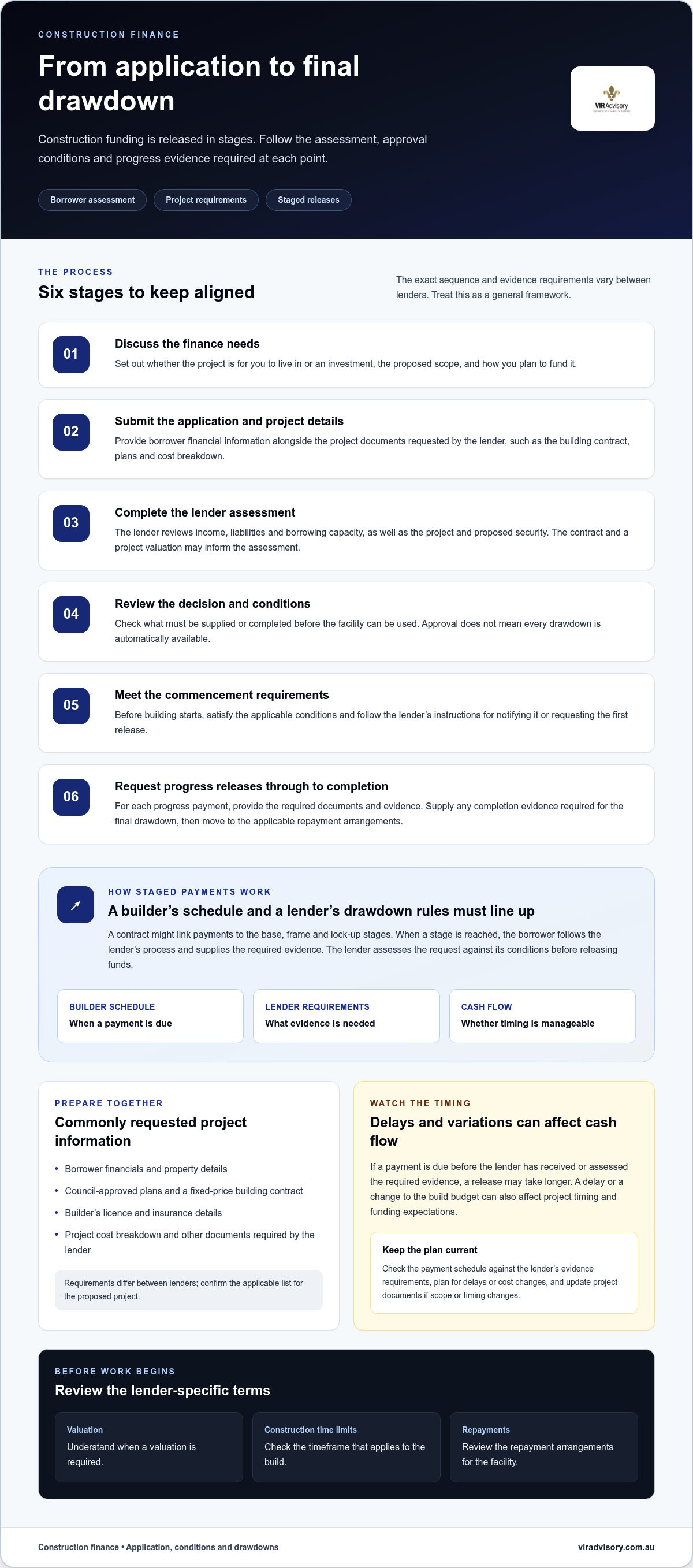
The construction loan process moves through distinct stages: the lender assesses you and the proposed build, sets approval conditions, and releases funds as construction progresses. The exact sequence, documents and payment controls vary by lender, so treat the steps below as a general framework rather than a universal schedule.
- Discuss finance needs. Set out whether the project is for you to live in or an investment, the proposed scope and how you plan to fund it.
- Submit the application. Provide financial information alongside project details, such as the building contract, plans and cost breakdown required by the lender.
- Complete lender assessment. The lender reviews your income, liabilities and borrowing capacity, as well as the project and proposed security. A contract and project valuation may inform this assessment.
- Review the decision and conditions. If finance is approved subject to conditions, understand what must be supplied or completed before the facility can be used. Approval isn’t the same as automatic access to every drawdown.
- Meet commencement requirements. Before building starts, satisfy applicable conditions and follow the lender’s instructions for notifying it or requesting the first release.
- Request staged releases and complete the build. Submit the required documents for each progress payment, then provide any completion evidence required for the final drawdown and move to the applicable repayment arrangements.
What happens before construction can start?
The application and financial assessment establish whether the proposed borrowing fits the lender’s criteria. Project information helps the lender assess what’s being built, its estimated costs and the security offered. A building contract may be reviewed as part of this process, while a valuation may help the lender assess the project at a relevant stage.
Read approval conditions before committing to a construction start date. They may specify documents, timing or other requirements that must be met before funds are released. Record who needs to provide each item and when; a missing document can delay a request even where the wider application has been approved.
For a general explanation of construction lending, the Consumer Financial Protection Bureau on construction loans outlines how staged funding can differ from a traditional mortgage. Its information is US-based, so Australian borrowers should rely on their own lender’s terms for local requirements.
How progress payments and completion are managed
At each payment point, check the builder’s invoice against the contract and the work completed. The lender’s policy determines what evidence it accepts and whether a valuation or inspection is needed. These controls aren’t identical across lenders, and a builder’s invoice alone may not meet every lender’s release requirements.
Keep copies of invoices, work evidence and lender correspondence, and allow time for assessment before a payment is due. At completion, follow the lender’s process for the final drawdown and any required completion evidence. Repayment arrangements during construction and after the final payment depend on the loan terms; don’t assume interest-only payments or an automatic switch to principal and interest. Confirm the applicable arrangements in your approval documents.
Construction loan risks and trade-offs: delays, variations and cash flow
Delays, budget changes and gaps in project paperwork can affect when construction funds are available, but they don’t automatically mean a loan will be rejected. The impact depends on the loan structure, lender conditions and the details of the change. If the build schedule or scope shifts, funding arrangements may need review before further payments are released.
Use this table to identify what could create pressure and what to do early:
| Issue | Potential finance impact | Practical action |
|---|---|---|
| Build delay | Drawdown timing may shift, and approval conditions or facility time limits may become relevant. | Document the revised schedule and understand the lender’s requirements for changes to timing. |
| Cost increase | The available facility may not cover costs beyond the approved project budget. | Identify the shortfall and discuss the funding implications with the lender before committing to extra work. |
| Variation to scope | A material change may affect the lender’s assessment of the project or release conditions. | Keep the variation and revised costs in writing, then establish whether lender review is needed. |
| Incomplete documents | A payment request may take longer to assess if required evidence is missing. | Keep invoices, variation records and other project documents organised and current. |
What if the build runs late or the scope changes?
A delay can move planned progress payments out of sequence, while a change to the plans or contract may alter the project the lender originally assessed. The lender’s conditions and construction time limits are specific to the facility, so don’t assume an extension is automatic or that every variation needs the same approval.
Record what has changed, why, and how it affects the cost and timing. Before proceeding with additional work, review the approval conditions and establish whether the lender requires updated documents, a revised valuation or another assessment. This helps avoid relying on funds that may not be available under the existing arrangements.
How to plan for budget pressure and repayment changes
Set a cash-flow buffer based on your project costs and personal or business commitments; there isn’t one contingency percentage that suits every build. Allow for costs that may fall due before a progress payment is released, and consider how a delay could affect rent, existing loan commitments or other household expenses.
Repayments may change as funds are drawn, but the effect depends on the facility structure and lender terms. Check the loan documents for how interest and repayments are calculated during construction and what applies after the build. A further drawdown or funding change may require lender review, and extra funds or approval aren’t guaranteed.
Borrowing capacity is also relevant: consider how existing debts, income and planned project costs affect the amount you can support. Understanding how borrowing capacity is calculated can help you assess the effect of taking on additional costs before agreeing to a variation. Keep the lender informed about material changes and retain updated project records so any required review can be based on accurate information.
Construction loan application checklist: documents, assessment and common mistakes
A complete application helps the lender understand both your financial position and the proposed build. In the construction loan process, requirements differ between lenders and applications, so the documents below are common examples rather than a definitive list. Check which records apply to your circumstances and keep figures consistent across the application, contract and project budget.
What information may lenders assess?
Lenders may consider income, existing debts, regular expenses, available deposit or equity, and your capacity to meet repayments. They also assess project costs and the proposed security. No single factor determines the outcome across all lenders; the application is considered as a whole under the lender’s criteria.
Project assessment may involve the building contract, plans, specifications, builder information and a valuation. These help the lender understand the proposed work and security. A self-employed applicant, for example, may need financial records that support the income stated in the application. The documents and assessment approach depend on the lender and the borrower’s circumstances.
A pre-application checklist to reduce avoidable delays
Use this checklist to organise information before applying. Some items may not apply to every borrower or project, and the lender may request additional evidence.
- Borrower finances: Gather current income records, details of loans and other credit commitments, regular expenses, and information about your deposit or available equity. Check that amounts and dates agree across the records.
- Property: Organise relevant ownership or purchase information and details needed to assess the proposed security. Include valuation information if requested or available.
- Builder: Collect the building contract and builder details, such as licence and insurance information where required. Check that the contract is complete and clearly reflects the agreed scope.
- Project documents: Keep plans, specifications, cost breakdowns and the payment schedule together. Reconcile the budget against the contract so costs aren’t missing, duplicated or inconsistent.
Document-readiness check
Borrower records → Do the income, liabilities and expense figures match?
Property and builder records → Are ownership, contract and builder details organised?
Project records → Do plans, specifications and budget align with the contract?
Application tracking → Is each lender condition matched to an evidence item and responsible person?
Common avoidable problems include incomplete financial figures, contracts that don’t clearly describe the work, and variations that aren’t reflected in project records. Missing a lender condition or submitting evidence in the wrong form can also delay assessment or a later funding request. These issues don’t mean rejection is automatic, but they can create extra steps.
Keep one checklist showing each lender condition, the required document, who will provide it and any relevant date. Update it when project details change, and retain copies of submitted records and lender communications. This helps identify gaps early and gives you a consistent record to refer to as the application progresses.
Getting construction finance support: how VIR Advisory can help with next steps
Construction finance involves more than estimating the total build cost. Borrowers also need to understand how a lender will assess their finances, project documents and proposed funding structure, then meet the conditions attached to approval and drawdowns. VIR Advisory is an Australian finance brokerage that connects clients with a lender network; it doesn’t lend directly.
Raina Doshi brings over 15 years of banking and finance experience to practical application guidance. That experience can help clarify what information a lender may need, how lender requirements can differ and which finance options may fit the borrower’s circumstances and project. Approval, rates and terms remain subject to the lender’s assessment and decision.
What a finance broker can contribute to a construction application
A broker can help organise the finance picture by bringing together income, existing commitments, available deposit or equity, project costs and security details. Reviewing these alongside the proposed build can help identify information gaps before an application is submitted, rather than treating the borrower’s finances and construction documents as separate tasks.
Lenders may assess construction applications differently, including how they consider the project, supporting documents and the borrower’s circumstances. A broker can explain those differences and connect the project details with suitable options across the lender network. For example, a self-employed applicant may need to present income records clearly alongside a builder’s contract and cost breakdown. This is practical application support, not a promise of approval or particular loan terms.
Prepare for an initial construction finance discussion
You don’t need every document finalised to have a useful discussion, but available information helps make it specific. Bring current income details, a summary of liabilities and regular expenses, and information about the property, deposit or equity. For the build, bring plans, specifications, the building contract if available, the proposed budget and payment schedule.
Also note what remains uncertain. Is the build timing still being finalised? Could the scope change, or are some costs not yet clear? How do you expect repayments to work during construction and after completion? Listing these questions helps focus the discussion on lender conditions, cash-flow planning and any additional information needed to assess options.
After the discussion, keep a record of the next steps: documents to gather, questions to resolve and lender requirements to understand. This gives you a clearer basis for preparing an application and managing the construction loan process without assuming all lenders use the same criteria. A finance discussion is also a useful point to review whether the proposed budget and funding structure remain aligned as project details develop.
To discuss your construction finance requirements with VIR Advisory, book a construction finance discussion.
Prepare your next construction finance decision
A build is easier to assess when the finance discussion reflects the project’s current details, rather than assumptions about costs or timing. Before making your next commitment, note what’s confirmed, what remains provisional and which decisions could affect the funding structure.
Use that information to focus your discussion of the construction loan process: does the proposed borrowing align with the project budget, how will you manage cash flow between funding stages, and which lender conditions need clarification? Keep a short list of open items, such as scope decisions, expected dates and how you’ll cover costs outside the planned finance.
A focused discussion can clarify what information is still needed and which questions to resolve before proceeding. The lender makes the assessment, but preparing your current figures and project details gives you a more organised basis for considering your next steps.
With the key details organised, you can approach the next decision with greater confidence.
Frequently Asked Questions
Can I get a construction loan as an owner-builder?
Some lenders consider owner-builder applications, but eligibility and loan structures vary. Before applying, prepare a clear outline of your building experience, the work you’ll manage yourself and how you plan to coordinate the project. This can help explain how the build will be delivered, rather than relying only on a general budget. Confirm the lender’s owner-builder criteria before committing to the project, as acceptance by one lender doesn’t establish eligibility with another.
What happens if my construction loan approval expires before the build is finished?
The consequences depend on the approval terms and lender policy. Check the approval documents for any expiry date and distinguish it from milestones or time limits applying to construction and drawdowns. If the expected completion date is approaching, ask the lender what information it needs to assess the remaining funding. Keep a dated record of that communication and the response; an extension or continued access to undrawn funds shouldn’t be assumed.
Can I change builders after my construction loan is approved?
A change may be possible, but approval for the original builder and contract shouldn’t be treated as approval for a replacement arrangement. Before ending the existing contract or entering a new one, prepare the proposed replacement contract and a summary of any changes to scope, cost or timing. This gives the lender a clear comparison to assess. Don’t make financial commitments on the assumption that the existing approval will transfer unchanged.
Can a construction loan cover renovations to an existing home?
Some lenders offer construction-style finance for eligible renovations, while other work may be assessed under a different lending structure. For example, substantial structural work may be treated differently from cosmetic updates, depending on lender policy and project details. Describe the work precisely, rather than relying on the broad label “renovation”. This helps the lender assess the actual project and avoids planning around a funding structure that may not match the proposed work.
Do I need to own the land before applying for a construction loan?
Not always. Some borrowers seek funding for land and construction together, while others apply for build finance after purchasing the block. The sequence can affect the timing and assessment of the overall borrowing, including how the land purchase and proposed build are presented. Before signing contracts, map out key dates for the land transaction and construction proposal, then establish how the lender will assess them together or separately.
Are construction loan progress payments made directly to the builder?
The payment destination and process depend on the loan documents. Check whether funds are paid to the builder or handled another way, and note any borrower authorisation required. A simple drawdown register can help: record each invoice reference, amount requested, payment date, amount released and remaining facility balance. This gives you a practical reconciliation record and can help identify a mismatch between an invoice and the lender’s payment record.
What if the final build cost is higher than the approved construction loan?
A lender isn’t obliged to increase an approved facility because the final cost has risen. Before committing to an upgrade or additional work, identify the likely funding gap and how you could meet it without relying on extra borrowing. Keep a separate record of approved project costs and proposed additions, so the difference is visible. If you seek more finance, the lender will determine whether it can be considered under its assessment criteria.

Article by
Raina Doshi
Raina Doshi has worked in banking and finance since 2011, including experience with major Australian lenders. She helps homeowners, property investors, business owners and professionals secure and structure lending solutions across home loans, refinancing, commercial finance and business lending.
Areas of expertise include residential lending, investment property finance, debt recycling, commercial property finance, equipment finance, construction finance and strategic debt structuring.
Drawing on extensive banking and finance experience, Raina helps clients navigate lender requirements, improve borrowing outcomes and structure effective finance solutions.
Disclaimer
The information in this article is general in nature and does not take into account your personal objectives, financial situation or needs. Before acting on any information, consider whether it is appropriate to your circumstances and seek professional advice.


