

Your current bank isn’t your only option: you can switch your home loan to another bank, or ask your existing lender to offer a lower rate. To reduce your mortgage interest rate, compare the full loan offer, including fees and features, rather than relying on the advertised rate alone. Market-leading Australian home loan rates are 5.69 per cent, while the right option for you depends on your circumstances and loan structure.
It’s understandable to think negotiating means calling your bank and asking for a discount. A stronger approach is to compare relevant offers first, then use them to support a discussion with your lender. A mortgage broker may also negotiate a lower interest rate with a lender on your behalf.
This article explains how to compare Australian home loan rates, prepare to negotiate, and weigh the costs and practical steps involved in refinancing. You’ll also learn what to consider before switching so you can assess whether a lower rate suits your repayments and broader finances.
Key Takeaways
- Compare home loans on their rates, fees and features so you can assess the overall value, not just the headline offer.
- Prepare a clear case for a rate review by gathering your current loan details and relevant alternatives.
- Weigh refinancing costs and loan features against the potential repayment benefit before switching lenders.
- Understand how your equity, income, expenses and loan structure can affect refinancing eligibility and the rates available to you.
- A mortgage broker can negotiate with lenders and help assess whether staying with your bank or refinancing better suits your circumstances.
Cheapest advertised rates in Australia
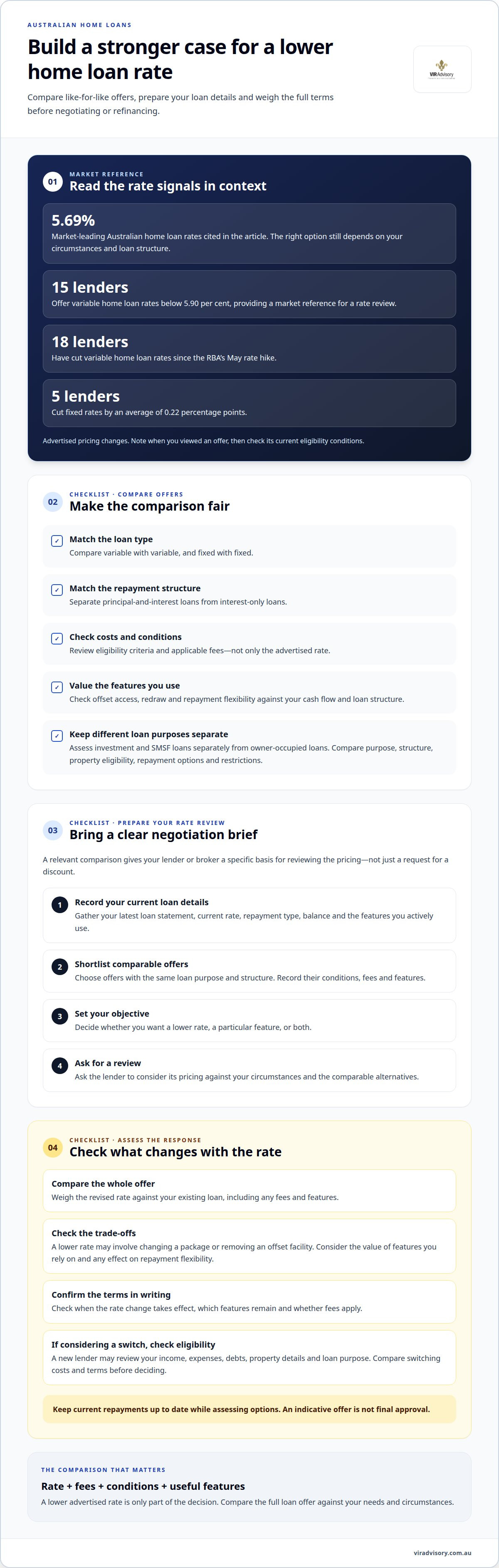
Advertised rates can help you identify lenders worth comparing, but the lowest figure isn’t automatically the most suitable loan. Fifteen Australian lenders offer variable home loan rates below 5.90 per cent. That gives borrowers a useful market reference when preparing a rate review, provided the offers being compared share the same loan purpose and structure.
Variable pricing has shifted across the market: 18 Australian lenders have cut variable home loan rates since the RBA’s May rate hike. For fixed loans, five Australian lenders cut rates by an average of 0.22 percentage points. These movements show that advertised pricing changes, so note when you viewed each offer and check its current eligibility conditions.
Compare the product terms, not just the prominent rate in an advertisement. Check whether the offer suits your repayment type, loan purpose and equity position. Review fees, repayment flexibility and features you use, too. A lower advertised rate may be less valuable if the conditions don’t suit your cash flow or loan structure.
- Match loan types: Compare variable rates with variable rates, and fixed with fixed.
- Check repayment structure: Distinguish principal-and-interest from interest-only loans.
- Review product conditions: Read the eligibility criteria and applicable fees.
- Assess useful features: Consider offset access, redraw and repayment flexibility.
Assess investment loan rates and features separately from owner-occupied lending. Consider the loan’s purpose, repayment type and features alongside expected rental cash flow and existing property commitments. For example, an interest-only structure changes repayments during its interest-only period, when scheduled principal repayments don’t reduce the loan balance. Assess whether the structure suits your needs, not just whether the rate looks attractive.
SMSF loans have distinct features and eligibility considerations. A lender assesses the fund, trustees, proposed property and the fund’s capacity to meet repayments under its lending criteria. Compare the rate with the loan structure, eligible property types, repayment options and restrictions on property use. A standard home loan advertisement isn’t a like-for-like benchmark for borrowing through an SMSF.
Before discussing pricing with your bank, note your current rate, repayment type, loan purpose and the features you rely on. Shortlist comparable offers and record their conditions. Keep comparisons for investment property and SMSF loans separate from owner-occupied products. This gives you a clearer basis for deciding whether an advertised offer applies to your circumstances.
Mortgage broker rate negotiation
A mortgage broker may negotiate a lower interest rate with your lender. The discussion is more focused when it draws on your current loan details, relevant competing offers and repayment needs. A broker can also assess whether a rate review may suit you better than replacing the loan, particularly if your existing structure still meets your requirements.
Start with a concise negotiation brief. Include your latest loan statement, current interest rate, repayment type, balance and any features you actively use. Add a comparable offer for the same loan purpose and structure, including its eligibility conditions and fees. This gives the broker a specific comparison to present rather than an unsupported request for a discount.
A lender may consider your loan balance, repayment history, equity position and overall circumstances. It may assess a simple owner-occupied loan differently from an investment loan, while a self-employed borrower’s income evidence may need careful presentation. A broker can explain these details clearly and ask what pricing or structure the lender can offer.
- Define the objective: Decide whether you want a lower rate, a particular feature, or both.
- Prepare the evidence: Gather current loan details and comparable offers with matching terms.
- Make the request: Ask the lender to review its pricing against your circumstances and alternatives.
- Assess the response: Compare the revised offer with your existing loan, including fees and features.
A broker can help you interpret the lender’s response. For example, a lower rate may require changing a package or removing an offset facility. If you use the offset account to manage savings, weigh its value against the proposed rate reduction. Similarly, a rate-only change may not improve your position if it reduces repayment flexibility or adds costs.
Negotiation can also show whether refinancing is worth considering. If your bank won’t improve its offer, a broker can compare alternatives and assess the application requirements for switching. A new lender may review your income, expenses, debts, property details and loan purpose. Keep your current repayments up to date while assessing options, and remember that an indicative offer isn’t final approval.
Before accepting, request the revised rate and loan conditions in writing. Confirm when the change takes effect, which features remain, and whether any fees apply. If you want help preparing a lender negotiation, book a mortgage rate discussion to review the available options.
Refinancing to a lower rate
You can apply to move your Australian home loan to another lender, which may prompt your current bank to make a retention offer. Before switching, compare the total loan costs and check that you meet the new lender’s assessment requirements.
Potential Savings from a Lower Rate
A lower rate can reduce the interest charged on your outstanding balance, but the benefit depends on your loan amount, repayment structure and remaining term. Estimate the difference using your current balance and repayments, then compare the proposed loan’s repayments over the same period. This gives you a clearer picture than comparing headline rates alone.
Include every cost associated with the change. A discharge fee, application cost, valuation charge or package fee can reduce the benefit of a lower rate. A fixed-rate loan may also have break costs if you leave before the fixed period ends. Ask for the relevant figures and include them in your comparison.
Compare like-for-like offers by matching the repayment type, loan purpose and features you use. If your current loan includes an offset account, for example, consider its value before switching to a product without one. Check whether the new rate applies to your full loan balance and whether the advertised offer has eligibility conditions.
Use a simple comparison process:
- Record your current rate, balance, repayments and useful features.
- Request the proposed rate, fees and repayment details in writing.
- Compare total costs and features across the same period.
- Consider whether the savings justify the work and expense of switching.
Applying with another lender may prompt your current lender to make a retention offer. Compare it with the proposed refinance, not just your original rate. A broker can manage lender discussions and help organise the comparison.
Refinancing Risks and Eligibility
Eligibility depends on the new lender’s assessment of your income, expenses, existing debts, repayment history and property. The lender also considers the loan purpose, property details and available equity. A change in employment, increased debt or altered property value can affect your application, even if you previously qualified for your current loan.
Refinancing may be less suitable if fees outweigh the interest benefit, your fixed-rate loan has break costs, or the new product removes features you rely on. Extending the loan term may lower repayments but increase the time you pay interest. Compare the remaining term with the proposed term instead of focusing only on the new repayment amount.
Prepare documents to support your application, including income evidence, details of regular expenses and current loan statements. Self-employed applicants may need clear records of business income and commitments. Keep existing repayments up to date while the new lender assesses your application, and avoid taking on new debts that could affect serviceability.
Check the steps involved before switching. Confirm the new lender’s approval and settlement requirements, understand how the old loan will be discharged, and clarify the repayment arrangements. If your current bank makes a retention offer during the process, compare its rate, fees and features with the refinance offer before deciding.
How much can I save by reducing my mortgage rate?
Potential savings depend on your outstanding balance, rate reduction, repayment structure and time remaining. A lower rate reduces interest charged on the loan balance, but fees or changes to loan features can offset the benefit. Compare repayments and total costs using your own loan details instead of relying on a headline rate or general example.
A simple daily interest illustration shows why the balance and rate matter. On an A$400,000 loan at 5% annual interest, daily interest is A$54.79, calculated by dividing annual interest by 365. This is an illustration of interest for a day, not a repayment estimate: actual repayments also reflect the loan’s structure and balance changes.
To estimate potential savings, use the same balance and repayment assumptions for your current loan and the proposed rate. A lender calculator can model repayments, while your loan statement shows the outstanding balance and current repayment. Keep the comparison consistent: changing the rate and extending the term at the same time makes it harder to isolate the effect of the rate change.
Consider the result in context. A lower repayment may improve cash flow, but paying less each time can also affect how quickly the balance falls if the loan term changes. If you maintain your current repayments after securing a lower rate, more of each payment may go towards reducing the principal, depending on the loan terms.
- Use your current balance: Don’t calculate against the original borrowed amount if you’ve already repaid principal.
- Compare matching terms: Keep the repayment type and remaining loan term consistent.
- Include costs: Account for switching fees, discharge costs and any package charges.
- Value the features: Consider whether an offset account or redraw access affects your cash flow.
When refinancing, compare the projected benefit with the costs of leaving your existing loan. A fixed-rate loan may involve break costs, while a replacement product may have different fees or features. Ask for the lender’s figures in writing, then assess the net difference over the period you expect to keep the loan.
Don’t treat a calculated saving as guaranteed cash in hand. The estimate changes as repayments reduce the balance, and a variable rate can change over time. Use a consistent method: compare the same loan balance, payment frequency, repayment type and period, then reassess if any term or fee differs.
How does loan-to-value ratio affect Australian mortgage rates and refinancing eligibility?
Your loan-to-value ratio (LVR) compares the amount borrowed with the lender’s accepted property value. Lenders use it as one factor in pricing and refinance assessments, alongside your financial position and proposed loan structure.
Calculate LVR by dividing the proposed loan amount by the property value, then multiplying by 100. If the lender’s valuation is lower than the figure you expected, the same loan amount produces a higher LVR.
Lenders set their own pricing tiers and criteria. A lower LVR may provide access to different pricing than a higher one, but the ratio alone doesn’t determine the offer. The lender also assesses whether repayments fit your income and expenses, and whether the requested structure meets its policies. Strong equity doesn’t automatically overcome a serviceability shortfall.
For a refinance, the lender uses its accepted property value and the amount needed to replace your existing debt. If you’re requesting additional borrowing, that amount forms part of the proposed loan and changes the LVR calculation. This can affect which products suit the application and how the lender assesses your request.
Visual summary: LVR and refinance assessment
Loan amount ÷ accepted property value × 100 gives the LVR.
Lower LVR: May fit different lender pricing tiers.
Higher LVR: May narrow eligible products or affect pricing.
Refinance decision: LVR is assessed alongside repayment capacity and loan requirements.
Use this checklist to prepare accurate figures:
- Confirm the debt: Use the payout amount or proposed total borrowing, not an old loan balance.
- Separate loan purposes: Identify owner-occupied, investment or other proposed borrowing.
- Review the valuation: Base calculations on the lender’s accepted property value.
- Check the structure: Include any additional borrowing or loan splits in the total.
If you’re an investor with several properties, assess each proposed security and loan arrangement on its own terms. Rental income and existing property commitments may also affect the lender’s broader assessment. Clearly present each loan purpose and security to avoid comparing one property’s LVR with a different borrowing arrangement.
Before proceeding, ask how the lender will value the property and calculate the amount being refinanced. This helps you assess whether the proposed loan fits its criteria, rather than relying on an estimated property value or incomplete debt figure.
VIR Advisory: Business Loans
VIR Advisory can help assess whether a home loan rate review or refinance suits your lending needs. Its home loan and refinancing solutions help borrowers compare loan structures, lender requirements and potential repayment changes. For business owners, separating personal home lending from business finance can clarify cash flow and the commitments a lender assesses.
Bring your current loan details, repayment structure and financial information to the discussion. This helps frame the options around your circumstances, including whether to negotiate with your existing bank or consider refinancing. VIR Advisory also provides Business Loans and financial strategy guidance for eligible business finance needs.
To discuss your home loan or business finance requirements, contact VIR Advisory.
Set your priorities before making the next move
Before approaching your lender, decide what a successful outcome means for your household. A lower repayment may matter most if cash flow is tight, while keeping an offset account or repayment flexibility may be more valuable to another borrower. If you share the loan, agree on your priorities so you can assess any revised offer against the same criteria.
To reduce your mortgage interest rate, focus on the outcome you want, not just the rate you hope to secure. Decide which features you need to retain, what costs you’re prepared to consider, and how you’ll compare a bank’s offer with refinancing. This gives you a practical basis for deciding whether to accept, negotiate further or pause.
A clear decision brief can make your next lender conversation more focused and help you weigh a proposed change against your household budget. To discuss your options, arrange a time to speak with VIR Advisory.
Frequently Asked Questions
Can you switch your mortgage to another bank?
Yes, you can apply to move your home loan to another bank or lender. Before deciding, consider what else is linked to your current banking arrangement, such as salary deposits, automatic payments or package features. You may need to update these separately when moving your loan. Make a transition list so direct debits and regular payments continue smoothly, and keep enough funds available while accounts and repayment instructions change.
What is a comparison rate and why does it matter?
A comparison rate combines an advertised interest rate with certain loan fees and charges in a single figure. Use it to examine the cost assumptions behind similar offers, not as a personalised quote. If a product’s comparison rate is higher than its advertised rate, for example, review the applicable charges and loan conditions. Your actual cost depends on your loan and selected features.
What is refinancing and how does it work?
Refinancing changes the lending arrangement for your home loan. It may involve replacing the loan with one from a new lender or changing arrangements with your existing lender. Before settlement, identify which account will receive the new repayments and when the old repayment authority ends. Keep sufficient funds available during the changeover, and check your first statement against the agreed loan amount, interest rate and repayment details.
How can I negotiate a lower mortgage interest rate in Australia?
To reduce your mortgage interest rate, make a specific request and explain the outcome you’re seeking. For instance, ask whether your lender can review the pricing while retaining a feature you regularly use. Have a clear alternative in mind, but don’t present an offer with different conditions as directly comparable. A broker may also negotiate with a lender, using your loan details and relevant alternatives to support the request.
How do Australian mortgage rates compare across banks and lenders?
Rates vary between lenders and products, so compare offers that match your circumstances instead of relying on a single ranking. An advertised rate, for example, may apply only to a particular repayment type or borrower group. Check the offer’s conditions and whether they fit your loan purpose. Then compare the rate with the features and charges that matter to your household, rather than assuming every borrower can access the same pricing.
What is the difference between refinancing and switching to a better rate with my current lender?
A rate change with your current lender may suit you if your existing loan structure still meets your needs. Refinancing can be useful if you’re considering a different lender or want to reassess the loan arrangement more broadly. A borrower seeking a different repayment structure, for example, may compare a broader refinance proposal, while someone satisfied with their current account may first request a pricing review.
What are the costs and fees for refinancing a home loan in Australia?
Costs depend on your existing loan and proposed replacement, so request an itemised estimate before committing. Separate one-off switching costs from ongoing charges, then compare both over the period you expect to keep the loan. This helps you avoid focusing on a short-term repayment change while overlooking recurring costs. If your current loan is fixed, ask how leaving that arrangement affects the overall calculation before deciding.
What documents and steps are needed to refinance a mortgage in Australia?
Prepare documents that give the lender a clear picture of your income, commitments and loan position. A salaried applicant may use recent payslips, while a self-employed applicant may need business financial records. Organise files by income, expenses, debts and property, then complete the lender’s application and respond to assessment requests. Before finalising, review the loan offer and confirm the repayment account and first payment arrangements.
For help assessing your home loan options, contact VIR Advisory.

Article by
Raina Doshi
Raina Doshi has worked in banking and finance since 2011, including experience with major Australian lenders. She helps homeowners, property investors, business owners and professionals secure and structure lending solutions across home loans, refinancing, commercial finance and business lending.
Areas of expertise include residential lending, investment property finance, debt recycling, commercial property finance, equipment finance, construction finance and strategic debt structuring.
Drawing on extensive banking and finance experience, Raina helps clients navigate lender requirements, improve borrowing outcomes and structure effective finance solutions.
Disclaimer
The information in this article is general in nature and does not take into account your personal objectives, financial situation or needs. Before acting on any information, consider whether it is appropriate to your circumstances and seek professional advice.


