

There’s no single release time for small business cash flow finance in Australia. Invoice finance depends on checks of outstanding invoices and completed work, while an approved overdraft or line of credit provides access up to its available limit. Lenders may ask for tax invoices and evidence that work is complete before advancing funds against invoices. Timing depends on the finance type and the steps needed to assess and set it up.
Cash pressure often comes from a timing mismatch: wages, supplier bills and other expenses fall due before customers pay. Taking on debt without understanding its costs and repayment structure can make the gap harder to manage. Consider collections and cash reserves alongside borrowing.
This article explains five ways Australian businesses can manage a shortfall, how each option works and what can affect access to funds. You’ll also learn how to tighten collections and spot a cash gap early, making it easier to compare funding choices and their risks.
Key Takeaways
- Use a regular cash-flow forecast to spot upcoming shortfalls early and identify which payments are driving the gap.
- Invoice finance can release funds against unpaid invoices; prepare tax invoices and evidence that the work is complete.
- Review billing and collection steps to reduce avoidable delays between completing work and receiving payment.
- Compare revolving credit options carefully: interest applies to the amount drawn, and an overdraft may be called in by the bank.
- Build super payments into cash planning: according to the Australian Taxation Office, employers will need to pay employee super as part of each pay cycle from 1 July 2026.
Invoice finance and access to unpaid invoice funds
Australian businesses can use invoice finance, business lines of credit, overdrafts, unsecured business loans, or vehicle and equipment finance. Invoice finance is one option for small business cash flow finance in Australia when customers owe payment for completed work. Cash-flow finance more broadly means funding operating costs when incoming payments and outgoing bills fall at different times.
That may help cover supplier payments or wages while customer payments remain outstanding. The advance depends on eligible invoices and the facility’s assessment, not the total value of every sale. These funds are an advance against receivables, not new sales revenue.
Eligibility assessment focuses on the invoices and the work behind them. Australian lenders may require tax invoices and evidence that work has been completed. They may also assess the business’s trading position and the customers responsible for payment. A start-up may have limited trading history, but records of completed work and valid invoices can still support an application.
Not every unpaid invoice will qualify. Disputed bills, incomplete work or unclear payment obligations can complicate assessment. Before applying, match each invoice to its contract, delivery record or completion evidence. Check whether the facility accepts the relevant debtors and invoice types, and whether customer payment terms fit the expected cash shortfall.
Invoice finance uses receivables as security, so property isn’t automatically required. However, security terms depend on the facility structure and lender. Read the agreement to see whether it also covers property or other business assets. Distinguish security over invoices from any separate guarantee or security obligation, as they can create different risks for the business.
Repayment generally follows the customer’s payment of the financed invoice. The agreement explains how the incoming payment is applied to the advance and any charges, and whether a balance is returned. Confirm who collects the invoice, where the customer pays and how receipts are allocated. This helps prevent an advance being mistaken for additional income.
Invoice finance draws against eligible receivables, while a business line of credit provides access to an approved limit. With revolving credit, interest applies to the outstanding amount. Invoice finance may suit uneven debtor payments, while a line of credit may suit recurring gaps. For small business cash flow finance in Australia, compare repayment sources, costs and facility terms before choosing a structure.
Include payroll obligations in the forecast. According to the Australian Taxation Office, employers will need to pay employee super as part of each pay cycle from 1 July 2026. Account for those payments alongside wages, supplier bills and invoice due dates when estimating the required funding.
Cash-flow tracking and warning triggers
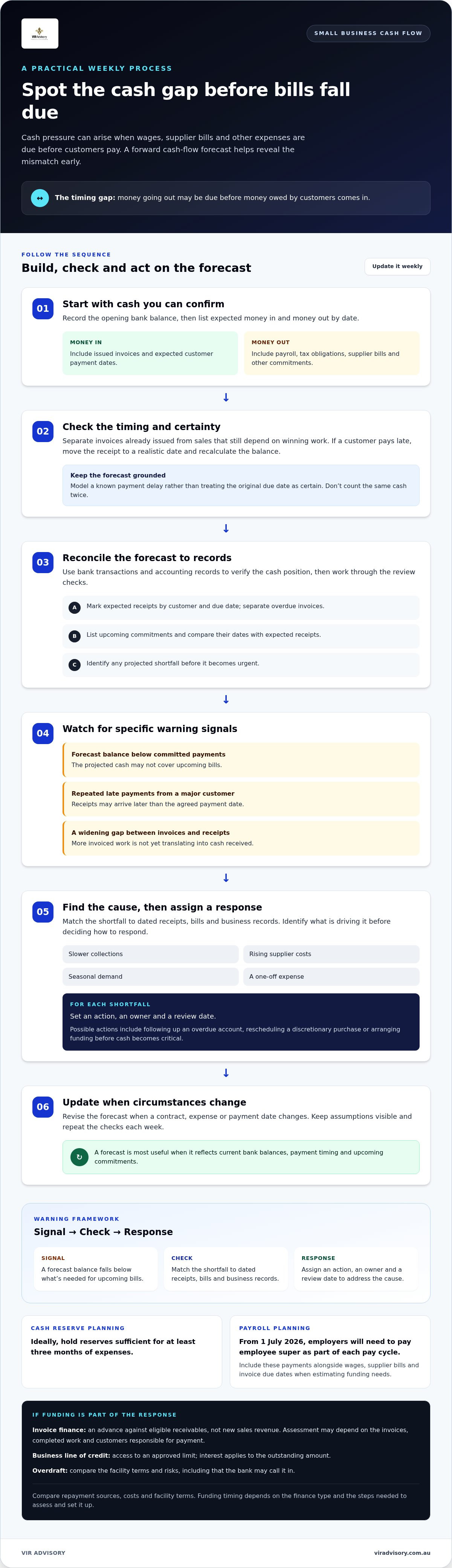
A cash-flow forecast turns expected receipts and bills into a forward view of available cash. Update it weekly using bank balances, customer payment dates, payroll, tax obligations and supplier due dates. A forecast can reveal a shortfall before urgent funding is needed.
Start with confirmed opening cash, then list expected money in and out by date. Separate invoices already issued from sales that still depend on winning work. For example, if a customer pays late, move that receipt to a realistic date and recalculate the balance. This shows whether the business can meet upcoming commitments without counting the same cash twice.
Set warning triggers against specific commitments, not a vague sense that cash is tight. Flag a projected balance below what’s needed for upcoming bills, repeated late payments from a major customer, or a widening gap between invoices and receipts. Identify the cause, such as slower collections, rising supplier costs, seasonal demand or a one-off expense. Ideally, a business should hold reserves sufficient for at least three months of expenses.
Cash-flow warning framework
Signal: A forecast balance falls below committed payments.
Check: Match the shortfall to dated receipts, bills and business records.
Response: Assign an action, owner and review date to address the cause.
Use this review sequence:
- Reconcile the forecast against bank transactions and accounting records.
- Mark expected receipts by customer and due date, separating overdue invoices.
- List upcoming commitments, then assign an action to each projected shortfall.
Actions might include following up an overdue account, rescheduling a discretionary purchase or arranging funding before cash becomes critical. Keep assumptions visible. If a large customer routinely pays later than agreed, model that delay instead of treating the original due date as certain. Update the forecast whenever a contract, expense or payment date changes.
How do bank and non-bank cash-flow lenders compare in Australia? Compare assessment criteria, documents, security, repayment structure and total facility costs. The better fit depends on how each lender assesses the business’s cash position and funding needs.
Are cash-flow finance interest and fees tax deductible in Australia? Tax treatment depends on how the funding is used and the business’s circumstances. Keep records of interest and fees separate, then ask a registered tax agent to assess their treatment.
What government grants or support can help Australian small businesses manage cash flow? Australian, state or territory, and local government programs may offer support, with eligibility linked to each program’s purpose. Grants are conditional, so don’t treat them as funds available for an immediate bill. Review program criteria and application timing before including potential support in a cash plan.
Improving billing and payment collection
A consistent billing process reduces avoidable delays between completing work and receiving payment. Define who prepares each invoice, who checks it and who follows up. For example, a project manager can confirm delivery while an accounts administrator checks the details before sending. A clear handover reduces missed billing and gives customers accurate information to process payment.
Send the invoice as soon as the agreed work or delivery milestone is complete. Include the customer’s legal name, purchase order reference where applicable, a clear description of the work, payment instructions and the agreed due date. If a customer requires a purchase order, obtain the reference before invoicing. Missing details can prompt queries, rejected invoices or processing delays.
Use this collection sequence for each account:
- Confirm the invoice reached the correct contact and accounts-payable address.
- Record the due date and the person responsible for follow-up.
- Contact the customer promptly if payment hasn’t arrived by the agreed date.
- Resolve disputes by identifying the specific line item or delivery issue.
- Record the customer’s response and any revised payment commitment.
For example, if a customer disputes one line in a multi-item invoice, ask which item needs clarification. Provide the supporting delivery record or agreed variation, then track the undisputed amount separately. A clear written record helps staff follow up on the same issue without sending repeated, conflicting requests.
Review payment behaviour by customer, not just total accounts receivable. A large balance owed by one slow-paying customer creates a different exposure from several smaller balances due from reliable accounts. Flag repeat delays, partial payments and unresolved disputes. Use these patterns to decide whether to accept new work on the same terms or request a deposit or milestone billing arrangement.
Make payment straightforward. Clearly state accepted payment methods and account details, and use a reference that makes the invoice easy to identify. Check that remittances are matched to the correct customer and invoice. Unallocated receipts can make overdue balances appear larger than they are, while an unrecorded credit can trigger unnecessary collection contact.
Set a regular accounts-receivable review, with a named owner and a written action for each overdue account. Keep the tone professional: confirm the invoice number, amount, due date and any outstanding query. Avoid sending identical reminders without checking the customer’s previous response. If payment timing remains unpredictable, update the cash forecast and assess whether the cause is billing errors, customer processes or agreed commercial terms.
Revolving credit, credit cards and overdrafts
Australian businesses can use corporate credit cards, business lines of credit and overdrafts as revolving credit. These facilities let a business draw funds as needed, up to an approved limit. With revolving credit, interest applies only to the outstanding amount, not the unused limit.
A business line of credit or overdraft may suit recurring gaps between bills and receipts. For example, a business could draw funds to cover a supplier payment, then repay the balance as customer payments arrive. Lines of credit and overdrafts tend to have higher limits than corporate cards, and costs may be lower, particularly when secured.
Compare all facility costs, not just the interest rate. That example illustrates a line fee, not the total cost of borrowing. Interest on drawn funds and other applicable charges also affect the facility’s cost.
Corporate credit cards can be useful for smaller, everyday business purchases, such as fuel or routine supplies. They provide a payment method for regular expenses, but balances can build if purchases aren’t repaid. Separate business spending from personal transactions, and track each card balance against planned cash receipts.
An overdraft provides access to a set limit, but it isn’t permanent cash. An Australian bank can call in an overdraft at any time. A business relying on the full limit for ongoing expenses could face repayment pressure if the facility is withdrawn. Use it for a defined timing gap, not to fund costs that exceed regular income.
Security can affect a lender’s assessment and facility pricing. A secured line may cost less, but pledged assets are exposed if the business doesn’t meet its obligations. Before accepting an offer, review the limit, interest calculation, fees, repayment terms, security and any right to reduce or call in the facility. Match these terms to the timing and size of the cash-flow gap.
Use this comparison before choosing:
- Corporate card: suitable for smaller, everyday purchases; monitor the balance and repayment dates.
- Line of credit: consider for recurring working-capital needs; compare the drawn balance cost and security terms.
- Overdraft: consider for short timing gaps; plan for repayment and the possibility of the bank calling it in.
Set a repayment source before drawing funds. For example, identify the customer receipts expected to clear the balance, then track them against the facility. If the balance stays high because the business cannot repay it, the problem may be structural rather than temporary. Further borrowing can add costs without fixing the underlying cash shortfall.
Application process and funding timeframes
Funding time depends on the facility, application completeness and lender assessment. An invoice-backed facility, overdraft and term loan each involve different checks. Approval is also separate from access to funds: documents may need signing, security arrangements completed and account details confirmed before drawdown.
Start by calculating the shortfall and when funds are needed. For example, list the supplier invoice due, expected customer receipts and the date the money is required. This gives the lender a defined purpose and helps distinguish a temporary working-capital gap from an ongoing trading deficit. Requesting more than the forecast requires can increase repayment pressure.
Prepare a consistent application pack before approaching a lender. Common items include:
- Recent business bank statements and financial accounts.
- Current cash-flow forecasts, outstanding debts and existing facility details.
- Customer invoices, contracts or evidence supporting expected receipts.
- Business structure, ownership information and identification documents.
- The amount sought, its purpose and proposed repayment source.
Complete records help an assessor reconcile turnover, account activity and forecast assumptions. If statements show irregular deposits, explain whether they are customer receipts, owner contributions or transfers between accounts. For invoice funding, link each invoice to completed work and its payment terms. Unclear records can prompt follow-up questions and extend assessment.
The lender may consider trading history, revenue consistency, existing liabilities, cash available for repayments and the requested facility structure. A secured application may also require assessment of the offered asset and documentation of security. Each additional assessment or missing item can affect the steps before drawdown, so respond to requests with complete, consistent records.
Use this sequence to manage the application:
- Set the required amount and explain the operating expense it will cover.
- Match the repayment plan to expected receipts or business income.
- Submit completed forms with supporting statements and transaction records.
- Review the offer’s limit, costs, repayment terms and security obligations.
- Complete signing and any required account or security steps before drawing.
Compare the proposed funding date with the bill’s due date, not just the approval date. For example, if a supplier requires payment before a facility is set up, approval alone won’t close the timing gap. Keep the forecast current during assessment and avoid committing funds based only on an expected drawdown date.
VIR Advisory: Business Loans
VIR Advisory helps business owners assess Business Loans against their cash-flow needs, repayment sources and lender requirements. This can be useful when invoice follow-ups and cash forecasts still show a funding gap, or an overdraft may not suit ongoing needs. Review the purpose of the funds, existing debts, expected receipts and available security before comparing loan structures. The application should reflect the business’s actual trading position, not just its most optimistic forecast.
Financial strategy guidance can help clarify how business borrowing fits alongside other commitments. If cash pressure also involves existing facilities, refinancing solutions may help review the current debt structure. The right option depends on the need being funded and the business’s capacity to manage repayments.
Make the next funding decision with a clear repayment plan
Before seeking a facility, define what the funds will cover and how repayments fit expected income. This helps distinguish a temporary timing gap from an ongoing mismatch between revenue and expenses. If cash pressure involves both business and personal commitments, assess them together rather than treating each borrowing decision in isolation.
For businesses considering small business cash flow finance in Australia, VIR Advisory can discuss Business Loans alongside relevant Home Loans or refinancing solutions. A clear picture of existing liabilities, cash-flow forecasts and repayment capacity helps frame the discussion around the actual need.
A considered funding decision starts with practical figures and a repayment source. Take the next step when you’re ready to review your options.
Frequently Asked Questions
How long does it take to access funds?
There isn’t one timeframe for every facility; access depends on the lender’s assessment and setup requirements. To understand the likely sequence, ask which stage remains: credit review, security documentation, signing or account setup. Also clarify whether the quoted timing refers to approval or cleared funds. That distinction matters if a supplier payment or payroll date is approaching.
Is property security required?
No, property security isn’t required for every facility. Security depends on the finance structure, and the agreement may distinguish business assets from any personal guarantee. Before signing, review the security schedule, who provides each guarantee and what conditions apply when the debt is repaid. This helps directors understand which assets or individuals may be exposed if the business cannot meet its obligations.
What’s a business overdraft?
A business overdraft lets a business transaction account move into an agreed debit balance, subject to an approved limit. It can help manage short-term fluctuations, such as a quiet trading period followed by customer receipts. For bookkeeping, record each drawdown as borrowing, not sales income, and reconcile interest and fees separately. This keeps operating revenue distinct from borrowed funds in management accounts.
What’s cash flow, and why’s it important?
Cash flow is the movement of money received and paid by a business. It helps owners judge whether the business can fund planned commitments, such as ordering stock or taking on a new contract. A cash-flow view also supports decisions about when to make purchases and hire. Compare forecast figures with actual bank activity to spot assumptions that no longer reflect trading conditions.
What eligibility criteria and documents do Australian lenders require?
Requirements vary by lender and facility, but an application generally needs to show who owns and controls the business, how it trades and how it can service the borrowing. Keep the business’s legal name and ownership details consistent across application forms and financial records. If several entities trade together, explain their roles and how money moves between them so the assessment reflects the actual structure.
How can an Australian small business apply for cash flow finance?
Begin by defining the business purpose, preferred facility structure and realistic repayment source. Before submitting, ensure the applicant has authority to act for the business and that directors or owners provide consistent information. Compare the proposed facility with existing borrowing, including any overlap in security. A clear application makes it easier to assess whether the new commitment fits the business’s wider debt position.
How quickly can businesses access cash flow finance in Australia?
Access may be quicker when a business already has an established facility with available funds than when setting up a new arrangement. For a new facility, timing depends on assessment, documentation and any security steps. Ask for the expected sequence and identify conditions that could delay drawdown. If funds are needed by a particular date, allow for each step rather than relying only on an approval estimate.
What are the risks and repayment terms of cash flow finance?
Risks include taking on repayments the business cannot sustain, granting security it may later need, or relying on further borrowing to meet existing obligations. Review the agreement for repayment dates, how payments are collected, fees, default conditions and any personal guarantees. Then test the commitment against a scenario where a key customer pays late or trading income falls. This can reveal whether the facility leaves enough operating cash.

Article by
Raina Doshi
Raina Doshi has worked in banking and finance since 2011, including experience with major Australian lenders. She helps homeowners, property investors, business owners and professionals secure and structure lending solutions across home loans, refinancing, commercial finance and business lending.
Areas of expertise include residential lending, investment property finance, debt recycling, commercial property finance, equipment finance, construction finance and strategic debt structuring.
Drawing on extensive banking and finance experience, Raina helps clients navigate lender requirements, improve borrowing outcomes and structure effective finance solutions.
Disclaimer
The information in this article is general in nature and does not take into account your personal objectives, financial situation or needs. Before acting on any information, consider whether it is appropriate to your circumstances and seek professional advice.


