

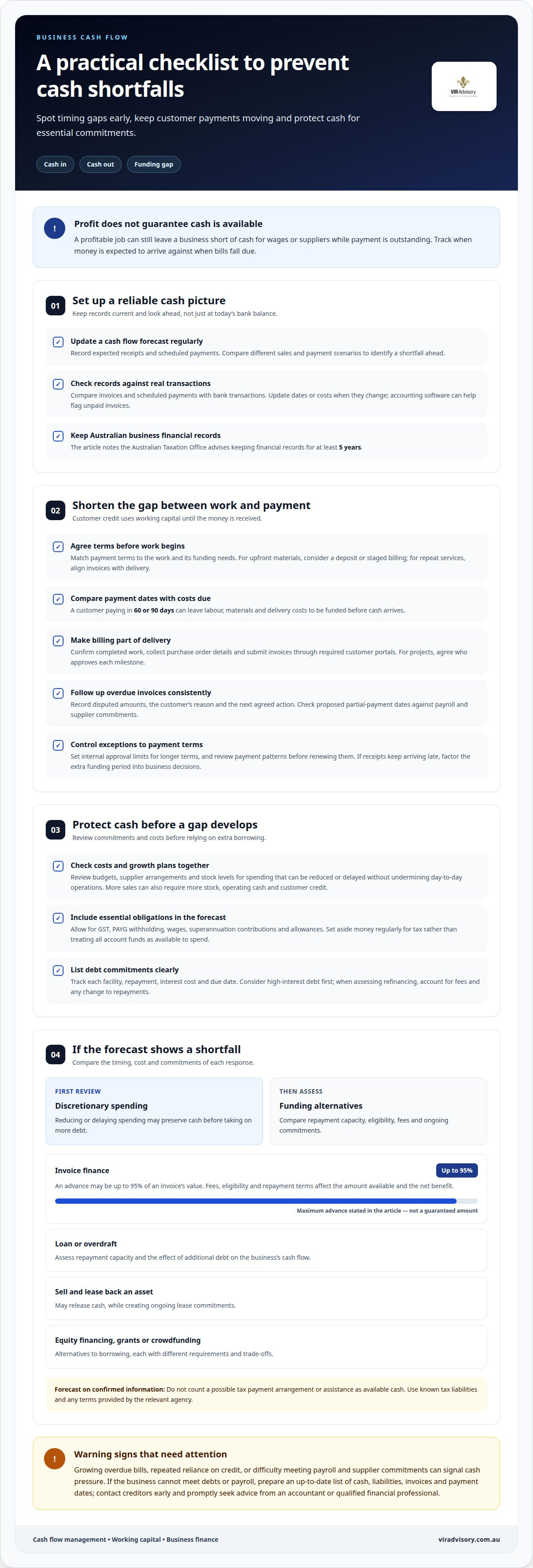
A profitable business can still run short of cash. To prevent business cash flow problems, set clear customer payment terms, forecast when money will come in and go out, and review costs before a shortfall develops. If a forecast shows a gap ahead, reducing or delaying spending may preserve cash without immediately taking on more debt.
Late customer payments can leave a business covering wages, supplier bills and overheads before the related revenue arrives. That timing pressure can affect day-to-day decisions even when sales are steady. Managing cash flow means looking beyond profit alone.
This article covers practical ways to set payment expectations, build a useful cash flow forecast and identify costs to control. It also explains how to assess funding options carefully, so you can respond to a cash shortfall without adding debt that puts further strain on the business.
Key Takeaways
- Set clear customer payment terms and follow up overdue invoices promptly to reduce the time cash is tied up in receivables.
- Use a regularly updated cash flow forecast to spot upcoming shortfalls early and compare different sales and payment scenarios.
- Review growth plans alongside working capital needs, as increased sales can also require more stock, operating cash and customer credit.
- Check budgets, supplier arrangements and stock levels for practical ways to reduce spending without undermining day-to-day operations.
- Keep Australian business financial records for at least 5 years, as advised by the Australian Taxation Office, and assess funding options against repayment capacity.
1. How to avoid running into a business cash flow problem?
Common causes include late customer payments, high debt repayments, seasonal revenue and costs falling due before income arrives. For example, a business may complete a profitable job but lack cash for wages while waiting for payment. Warning signs include growing overdue bills, repeated reliance on credit and difficulty meeting payroll or supplier commitments.
Keep financial records organised and compare them with bank transactions, invoices and scheduled payments. Australian businesses should keep financial records for at least 5 years, according to the Australian Taxation Office. Accounting software can help organise entries and flag unpaid invoices, but owners need to review records and update them when payment dates or costs change.
Manage debt by listing each facility, repayment, interest cost and due date. Prioritise high-interest debt and assess whether refinancing could reduce interest payments, taking fees and repayment changes into account. Avoid using short-term working capital for long-term assets unless the business has significant surplus working capital and does not expect to need it soon.
Factoring unpaid invoices means selling receivables to a third party for a cash sum. Invoice finance may provide an advance of up to 95% of an invoice’s value, but fees, eligibility and repayment terms affect the amount available and the net benefit. Selling an asset and leasing it back can also release cash, while creating ongoing lease commitments.
When cash is tight, include GST, PAYG withholding, wages, superannuation contributions and allowances in the budget and cash flow statement. Set aside money regularly for tax payments rather than treating all funds in the account as available to spend. Compare these obligations with expected receipts so essential payments are clear before discretionary spending is approved.
When considering government tax payment plans or small-business support, don’t count a possible arrangement or assistance as available cash in your forecast. Base decisions on known tax liabilities and any terms provided by the relevant agency. Regularly setting aside tax funds remains a practical way to manage cash pressure.
If a forecast shows a shortfall, review discretionary spending and consider funding alternatives before taking on more debt. Options to assess include a loan or overdraft, factoring unpaid invoices, or selling and leasing back an asset. Equity financing, grants and crowdfunding are alternatives to borrowing, each with different requirements and trade-offs.
If the business cannot meet debts or payroll, prepare an up-to-date list of cash, liabilities, invoices and payment dates. Contact creditors early, avoid commitments you cannot meet, and promptly seek advice from an accountant or qualified financial professional. A clear picture of immediate obligations helps you assess which actions may protect essential operations.
2. Extended customer payment terms and outstanding receivables
Extended payment terms transfer part of a customer’s operating funding requirement to the supplier. A business waiting 60 or 90 days for payment may need to cover labour, materials and delivery costs well before cash arrives. The longer that gap, the more working capital remains committed to completed work rather than available for current operations.
Set payment terms to match the work and its funding needs. A project requiring materials upfront may need a deposit or staged billing, while a repeat service could use regular invoices aligned with delivery. Before agreeing to longer terms, compare the expected payment date with when related costs must be paid.
Payment terms should also reflect the customer relationship and your exposure. A new customer placing a large order presents a different receivables risk from a long-standing account with a consistent payment record. Set internal approval limits for exceptions, and record who approved longer terms and why. This helps stop informal extensions from becoming standard practice.
For project work, link invoices to clear milestones, such as a completed stage or accepted delivery. Confirm who is responsible for approving each milestone before work begins. If approval is delayed, identify whether the hold-up involves missing documentation, a delivery issue or internal sign-off. Resolving the specific blockage can prevent the balance from remaining unpaid.
Respond to non-payment consistently. Record the amount in dispute, the customer’s stated reason and the next agreed action. If a customer proposes partial payments, compare the proposed dates with supplier and payroll commitments before relying on them in your cash plan. A written record helps staff manage the account consistently.
Monitor how much working capital is tied up in overdue balances and whether particular customers or projects account for a growing share. If one customer’s balance is delaying planned purchases or payroll, discuss revised terms before accepting further work on credit. Protecting the relationship matters, but so does retaining funds to meet other commitments.
Reduce avoidable delays by making billing part of delivery, not an afterthought. Assign responsibility for confirming completed work, collecting purchase order details and submitting invoices through any required customer portal. For example, a contractor can make completion sign-off and invoice submission standard close-out steps for each project stage.
Review payment patterns before renewing customer terms. If receipts regularly arrive later than agreed, account for the additional funding period in pricing and delivery decisions. A disciplined receivables process makes the cost and timing of customer credit visible, helping you decide which terms the business can support without destabilising operations.
3. Why is managing cash flow so important?
Growth can increase sales while putting pressure on the cash needed to deliver them. A business may need to buy stock, pay staff or fund customer credit before the related income arrives. If these costs rise faster than receipts, expansion can strain working capital even when demand is strong.
Consider a business winning larger orders from new customers. It may need more inventory and labour to fulfil each order, while payment arrives later. The additional revenue can therefore create an immediate funding need, rather than cash on hand to pay suppliers or operating expenses.
The working capital burn rate helps show how much cash growth consumes. A business with a 25% working capital burn rate needs $250k in working capital for every additional $1m in sales. Use this measure to test whether planned growth can be funded from available cash, rather than relying on sales targets alone.
Rapid growth can also increase reliance on a small group of customers. If one large account delays payment, the business may still need to fund stock and wages for other orders. Before accepting a major contract, map its delivery costs, payment schedule and expected receipts against existing obligations.
Review free cash flow, working capital burn rate and sustainable growth together when assessing expansion. Free cash flow shows what remains after operating expenses and capital expenditure. If it weakens while sales climb, examine whether inventory, debtor balances or investment spending are absorbing cash faster than the business can replenish it.
Growth plans can also increase debt repayments or create new fixed commitments. Before investing in equipment, premises or extra capacity, compare the expected operating benefit with the timing of repayments and other costs. If the business needs funding, assess whether projected cash flow can support repayments during quieter trading periods.
Review a growth plan before each major commitment. Test expected sales against delivery costs, customer payment timing and the cash needed to support existing operations. Then compare a slower-growth scenario with the planned case. This can show whether a smaller rollout or delayed investment would better protect cash.
Australian businesses have reason to take the issue seriously: inadequate cash flow is identified as the number one cause of business failure. That does not mean growth should stop, but its cash demands need active oversight. If forecasts show a persistent gap, reining in growth may preserve funds for essential obligations.
Sound cash management helps a business meet obligations, invest in viable opportunities and respond to market changes. Review the figures regularly, especially when sales volumes, prices or customer terms change. Growth decisions are stronger when funding needs and repayment impacts are clear before you commit.
4. Cash flow forecasting
A cash flow forecast estimates when money will enter and leave the business. A rolling 13-week forecast, updated weekly, can highlight a likely shortfall while there’s still time to respond. It should show expected receipts and payments by date, rather than treating all monthly revenue as immediately available cash.
Start with the opening bank balance, then record expected customer receipts, supplier payments, wages, tax commitments, loan repayments and planned purchases. Use invoice due dates and confirmed payment schedules, not simply the date a sale is recorded. For example, an invoice due later belongs in the forecast when payment is expected, not when the work was completed.
Seasonal demand and project-based work can make income uneven. A retailer may receive more customer payments during a peak trading period, while a contractor may face gaps between project milestones. Include these patterns in your forecast so lean periods and concentrated expenses are visible alongside expected revenue.
Compare the forecast with actual bank activity each week. If a customer payment expected on Friday hasn’t arrived, update the receipt date and review the closing balance. Regular updates keep the forecast useful for decisions instead of preserving an outdated assumption that could hide emerging cash flow issues.
Scenario planning tests how changes could affect available cash. Build a base case, then consider lower sales volumes, reduced prices or slower customer payments. For example, move an expected receipt to a later date and see whether the revised forecast still covers supplier invoices and payroll. This makes the timing and size of a potential gap clearer.
Use the forecast to identify the action required, not just the date of a shortfall. If projected cash falls below what’s needed for essential bills, consider delaying discretionary purchases, reducing spending or arranging another funding source. A shortfall identified four weeks ahead leaves more options than one discovered four days ahead.
Professional financial advice can help investigate a recurring gap or a forecast that doesn’t match actual results. An accountant or financial professional can review assumptions, payment patterns, major commitments and financial records. Bring current bank activity, debtor balances, supplier obligations and forecast versions to make the review specific.
After a forecast indicates pressure, record the decision and its expected cash impact. If a planned equipment purchase is postponed, update the forecast and compare the resulting closing balances. Revisit the assumptions during each weekly update, especially after a change in sales, prices or payment timing.
5. Reducing costs and improving cash flow
Cost control should protect cash without cutting the activity that generates income. Review expenses by purpose, timing and business impact, then separate essential operating costs from optional spending. For example, distinguish a maintenance contract needed to keep production running from a discretionary service that can be paused without affecting customer delivery.
Compare actual expenses with the budget and investigate differences before they become recurring commitments. Check supplier invoices, staffing costs, utilities and subscriptions for changes or duplicate charges. Regular budget reviews help identify spending that has drifted, while renegotiating supplier contracts may improve terms or reduce costs without disrupting supply.
Inventory deserves particular attention because unsold stock ties up working capital. An inventory management system can help track stock levels and predict order requirements. Compare recent sales with stock on hand before replenishing, and identify slow-moving lines that may be using funds or storage capacity unnecessarily.
Review supplier payment terms as part of the cash plan. Australian businesses may negotiate a 60-day supplier payment term instead of a 30-day term, subject to agreement. Longer terms can retain cash for longer, but they should remain manageable and honoured. A missed due date can affect supply arrangements precisely when the business needs reliable deliveries.
Set a cash reserve target based on operating commitments. One suggested approach is to build available cash from one month's worth of costs to two or three months' worth. Treat this as a staged target, with contributions linked to the business’s actual trading position rather than delaying essential payments or relying on uncertain receipts.
Cost reductions alone cannot resolve continuing unprofitability. If revenue repeatedly falls short of total expenses, examine margins, pricing and the cost of fulfilling each service or order. A product that sells steadily may still contribute little if materials, labour and delivery consume most of its revenue. Identify the source of the loss before making cuts.
Assess operational consequences before removing a cost. Cutting stock too far could delay customer orders, while reducing essential staffing may slow delivery and billing. For each proposed change, record the expected saving, its operational impact and when you’ll review the outcome. Compare the actual result with the budget once the change takes effect.
Use a consistent review process: identify the expense, establish its purpose, assess alternatives and monitor its cash impact. This helps distinguish useful investment from avoidable spending. If the business remains unprofitable after reviewing costs, address revenue and margins as well as expenses, since reducing outgoings alone may not create a sustainable cash position.
VIR Advisory: Business Loans
VIR Advisory can help assess whether a business loan suits a cash shortfall and the business’s repayment capacity. A discussion can cover the funding purpose, cash flow forecasts, financial records, existing liabilities and expected repayments. If the pressure comes from ongoing losses or slow customer payments, borrowing alone may add repayments without fixing the underlying cause.
Where funding is appropriate, the loan structure should reflect how the funds will be used and how the business expects to repay them. Reviewing these factors before applying can clarify the options and the information a lender may assess. Contact VIR Advisory to discuss your business’s cash flow and finance needs.
Make the next finance decision with clarity
Before choosing a funding response, distinguish a temporary timing gap from a persistent operating shortfall. Set out the purpose of any funds, the expected repayment source and the effect repayments could have on existing commitments. This gives a finance discussion a clear commercial basis instead of treating borrowing as the first remedy.
For a proposed loan, prepare current financial statements, bank activity, a cash flow forecast and details of existing debts. These records help explain how the business earns income, where pressure is arising and whether proposed repayments fit its cash position. Persistent business cash flow problems may require changes to costs or trading arrangements, not simply more borrowing.
VIR Advisory offers Business Loans for business funding needs, as well as Home Loans and Refinancing solutions for relevant personal or property finance requirements. The right conversation starts with the purpose of the funds and the business’s capacity to manage repayments.
A considered finance decision can help you address cash pressure while keeping repayment obligations in view.
Frequently Asked Questions
How can a business avoid running into a cash flow problem?
Base spending and credit decisions on cash expected to be available, not sales booked on paper. Before committing to a large stock order or owner withdrawal, check upcoming receipts and essential payments. For example, confirm when a major customer payment is due before committing those funds to a new expense. Clear purchase approval limits can also prevent unplanned commitments from accumulating.
What’s the difference between cash flow and profit?
Profit measures revenue remaining after expenses are deducted, while cash flow tracks money actually received and paid during a period. A business can record a profitable sale before the customer pays, so its accounts show profit while the bank balance remains unchanged. For example, completing work and issuing an invoice may generate revenue, but the cash arrives only when the customer pays.
Why is managing cash flow so important?
Managing cash flow helps a business meet operating commitments as they fall due and understand how much cash remains for business decisions. A company may need to pay wages or suppliers before receiving cash from customers. Without visibility over those dates, it can commit funds to expansion and then struggle to cover routine costs. Cash management also helps owners distinguish a timing gap from a continuing operating loss.
How are cash flows different from revenues?
Revenue records income earned from selling goods or services, while cash flow records money entering and leaving the business. The timing can differ: an invoice may count as revenue before the customer pays. Cash flow also includes movements that aren’t revenue, such as loan funds received or repayments made. Separating these items helps owners see whether sales are converting into cash and what is changing the bank balance.
How can a business diagnose a cash flow problem using a cash flow forecast?
Compare forecast closing cash with payments due on each date, then identify which assumptions create a projected gap. Check whether receipts are delayed, costs are higher than planned, or a large commitment falls due before customer payments. Reconcile the forecast against actual bank transactions and revise missed dates. This can show whether pressure comes from an unusual event or a repeating pattern.
How do Australian small businesses create a 13-week cash flow forecast?
Set up weekly columns for 13 weeks, then enter the opening cash balance, expected receipts and scheduled payments. Calculate each week’s closing balance by adding receipts and subtracting payments from opening cash; use that closing figure as the next week’s opening balance. Record the date and basis for each estimate, such as an invoice due date or confirmed supplier bill, then replace estimates with actuals as transactions occur.
What are practical ways to improve business cash flow quickly in Australia?
Start with actions that can affect cash timing soon: contact the largest overdue customers, resolve invoice disputes and ask whether staged payment is possible. Review purchases not yet committed and postpone discretionary spending that doesn’t support current delivery. For new project work, agree milestone billing so payment dates align more closely with completed work. Record each change in the forecast to see its effect on upcoming obligations.
How do business overdrafts, invoice finance and business loans compare in Australia, including costs?
An overdraft provides access to revolving funds up to an agreed limit, while invoice finance advances funds against eligible receivables. A business loan provides an agreed amount that is repaid under its facility terms. Compare total interest and fees, repayment timing, security, eligibility criteria and obligations if customers don’t pay. Costs depend on the facility and lender assessment, so compare written offers with the cash need and repayment source.

Article by
Raina Doshi
Raina Doshi has worked in banking and finance since 2011, including experience with major Australian lenders. She helps homeowners, property investors, business owners and professionals secure and structure lending solutions across home loans, refinancing, commercial finance and business lending.
Areas of expertise include residential lending, investment property finance, debt recycling, commercial property finance, equipment finance, construction finance and strategic debt structuring.
Drawing on extensive banking and finance experience, Raina helps clients navigate lender requirements, improve borrowing outcomes and structure effective finance solutions.
Disclaimer
The information in this article is general in nature and does not take into account your personal objectives, financial situation or needs. Before acting on any information, consider whether it is appropriate to your circumstances and seek professional advice.


