

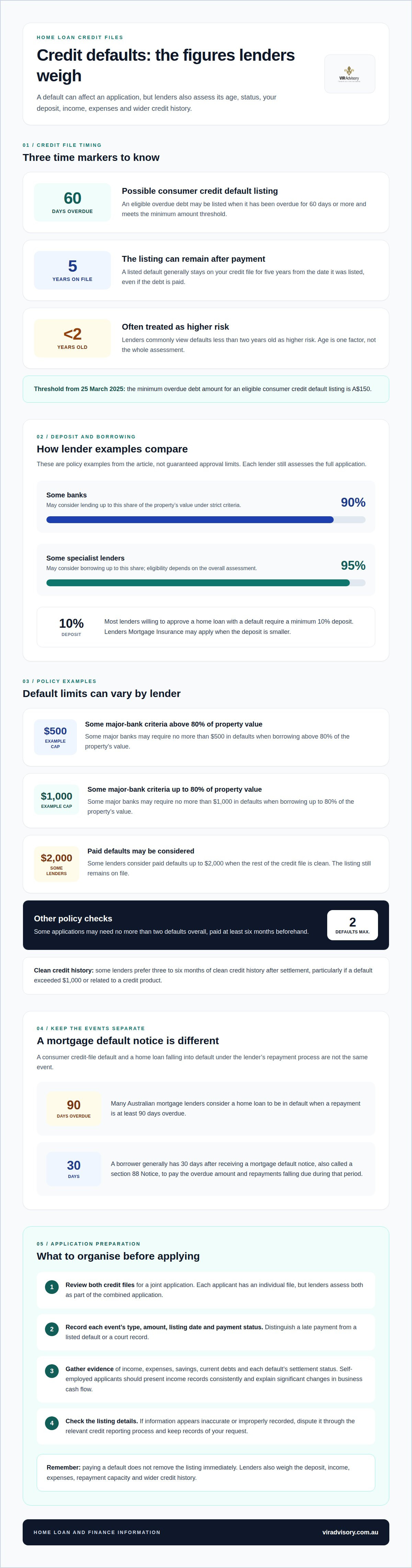
A recent default can affect a home loan application, but it doesn’t automatically prevent approval. Lenders commonly view defaults less than two years old as higher risk. According to the Office of the Australian Information Commissioner, a credit provider may list an eligible overdue debt when it has been overdue for 60 days or more and meets the A$150 minimum threshold from 25 March 2025. A listed default generally stays on your credit file for five years from the date it was listed, even if you pay it.
It’s understandable to worry that a home loan credit default could put a purchase or refinance on hold. Its age is only one part of the assessment: lenders also consider whether it’s paid, your deposit, income, expenses and wider credit history. The effect depends on how these factors fit the lender’s criteria.
This article explains what a credit file default means, how lenders assess home loan applications with defaults, how long a listing remains and how to dispute inaccurate information. You’ll also learn what to prepare before applying, so you can consider your options with a clearer understanding of lending criteria.
Key Takeaways
- According to the Office of the Australian Information Commissioner, a credit file default is commonly recorded when an account is overdue for 60 days or more.
- A paid default can still affect an application while it remains on your credit file, so consider its listing date as well as whether the debt has been settled.
- In a joint application, each applicant has an individual credit file, but lenders assess both files as part of the combined application.
- Lenders weigh more than the default: your deposit, income, expenses and broader credit history also inform their assessment.
- If a listing appears inaccurate or improperly recorded, dispute it through the relevant credit reporting process and keep records of your request.
What Is A Default On A Credit File?
Start by separating a credit-file default from a late payment or missed mortgage repayment. According to the Office of the Australian Information Commissioner, a credit file default is commonly recorded when an account is overdue for 60 days or more. For a home loan application, the event type and its status help explain what lenders are assessing.
-
Identify Relevant Credit Events
Review each applicant’s credit file for defaults, court judgements, writs, summonses and repayment history. According to the Office of the Australian Information Commissioner, a consumer credit default generally cannot be listed unless the overdue amount meets the A$150 minimum threshold. A late payment means a repayment was made after its due date; it doesn’t necessarily mean the provider listed a default.
Record each event’s type, amount, listing date and payment status. Lenders may view multiple adverse entries differently from a single telco default. A court judgment or unpaid listing can also raise concerns about repayment conduct. Include each event when preparing a home loan credit default application, and distinguish credit file entries from court records.
-
Understand Mortgage Default Timeframes
Separate a credit-file listing from a home loan falling into default under the lender’s repayment process. Many Australian mortgage lenders consider a home loan to be in default when a repayment is at least 90 days overdue. This is a different assessment from a consumer credit default listing, so check which type of event appears on the record.
Read any notice promptly and note its date, required action and overdue amount. According to the Federal Register of Legislation, a home loan default notice is also called a section 88 Notice. A borrower generally has 30 days after receiving a mortgage default notice to pay the overdue amount and repayments falling due during that period.
- Assess both applicants’ files. For a joint application, lenders assess both credit files, although each person has an individual credit history. One partner’s default doesn’t transfer to the other’s file, but it can affect the combined application. Identify which applicant has the listing, then consider both applicants’ income, expenses and deposit. The lender assesses the household’s overall capacity to meet the proposed repayments.
- Match the deposit to lender policy. Most lenders willing to approve a home loan with a default require a minimum 10% deposit. Some banks may consider lending up to 90% of a property’s value under strict criteria. A recent or unpaid listing can make a larger deposit relevant to the assessment. Include Lenders Mortgage Insurance (LMI) in calculations, as it may apply when the deposit is smaller.
- Compare mainstream and specialist criteria. Mainstream and specialist lenders apply different policies to recent, unpaid or multiple defaults. Some specialist lenders may consider borrowing up to 95% of the property’s value. That limit doesn’t mean every applicant qualifies: lenders still assess the deposit, credit history, income and repayment capacity together.
What Are Bank Requirements For Home Loan Approval With Defaults?
Fees on a defaulted home loan depend on the loan contract and lender.
Australians can get free help with mortgage arrears from the National Debt Helpline on 1800 007 007, which provides financial counselling.
- Assess both applicants’ credit records. In a joint application, lenders consider both credit files, so one applicant’s paid default can affect the combined assessment. Credit scores remain individual: Equifax and Experian score Australians on a scale from 0 to 1,200. A stronger score for one partner doesn’t cancel the other applicant’s listing. Consider both records alongside the household’s income, expenses and proposed repayments.
- Weigh the default’s amount, age and status. Some lenders consider paid defaults of up to $2,000 when the rest of the credit file is clean. Lenders generally view paid defaults less adversely, although the listing remains. Some prefer three to six months of clean credit history after settlement, particularly if a default exceeded $1,000 or related to a credit product.
- Match the application to bank criteria. Some major banks may require no more than $500 in defaults when borrowing above 80% of the property’s value, or no more than $1,000 when borrowing up to 80%. Applications may also need no more than two defaults overall, paid at least six months beforehand. Check the total, payment status and timing against the relevant lender’s criteria.
- Choose applicants and security carefully. Applying with one applicant leaves the other person’s credit record out of that application, but the lender assesses the applicant’s income, expenses and borrowing capacity alone. A guarantor may provide additional security, but this can put their property at risk if repayments aren’t met. Consider these obligations before choosing either structure.
- Prepare a complete application. Organise evidence of income, expenses, savings, current debts and each default’s settlement status. If you’re self-employed, present income records consistently and explain any significant changes in business cash flow. Before lodging, check that names, account details and payment information match across documents. A clear, complete file helps the lender assess your application against its criteria.
Default retention period on Australian credit files
- Record the listing date. According to the Office of the Australian Information Commissioner, defaults generally remain on an Australian credit file for five years from the date they were listed, including after payment. Count from the listing date, not the date you settled the debt. For example, paying a default later doesn’t restart or end the five-year retention period.
- Separate default listings from other credit events. A default differs from repayment history information, which remains on a credit file for two years. Part IX history and bankruptcy remain for seven years, while a clearout may also remain for seven years. Identify the record type before estimating when it should leave your credit history, as each event has its own retention period.
- Review the actual credit report. Obtain your reports from Equifax and Experian, then note each listing’s type, date, status and provider. Australians can obtain free credit reports from both credit reporting bodies every three months. A paid default may still appear until its retention period ends, so distinguish a settled debt from an expired listing.
- Put mortgage stress figures in context. Mortgage stress is commonly defined as a household spending more than 30% of gross income on mortgage repayments. In April 2026, 24.9% of Australian mortgage holders were considered at risk of mortgage stress. The highest rate in recent Australian history was 35.6%, recorded in May 2008. These figures describe household repayment pressure, not a credit-file default or an automatic lending decision.
- Assess your position before applying. A lender may consider a default alongside current repayments, income, expenses and your wider credit history. If the listing is nearing the end of its five-year period, its age may be relevant, but the full application still matters. A mortgage broker can assess your report against lender criteria and explain how the listing may affect your application’s timing or structure.
Required information in a default notice
To address mortgage arrears, contact your lender promptly and request hardship assistance or a repayment arrangement. A lender must inform you of its response to a hardship request within 21 days.
You can negotiate hardship assistance with your lender by explaining your circumstances and proposing repayments you can manage. A revised arrangement may help address arrears, but keep making required repayments unless the lender agrees to a change.
- Identify which notice you’ve received. A home loan default notice is also called a section 88 Notice. According to the Federal Register of Legislation, a bank must give this notice before taking enforcement action for a home loan default. Don’t confuse it with a notice about listing a consumer credit default; the notices relate to different lending processes.
- Check the home loan notice and its deadline. Read the lender’s notice alongside your loan account. Note the overdue amount, relevant repayments, date received and action requested. A borrower generally has 30 days after receiving a mortgage default notice to pay the overdue amount and repayments falling due during that period. Keep the notice and payment records together.
- Respond before the deadline. If your circumstances prevent full payment, contact the lender’s hardship team and explain what has changed. Provide a realistic account of your income, household expenses and current repayments. Ask what assistance or repayment arrangement could address the arrears, and keep the lender’s written response. A hardship request doesn’t itself change the existing repayment schedule.
- Understand the hardship response process. A lender must tell you its response within 21 days of receiving a hardship request. If it asks for more information, provide the requested material within 21 days of receiving that request. If you don’t provide it, the bank must give its decision within 28 days after requesting it. Record each date and keep copies.
- Distinguish a pre-listing notice from mortgage enforcement. Before listing a consumer credit default, a credit provider must send a written section 21D notice. Treat that notice separately from a section 88 Notice for a home loan. Check the account, provider, overdue balance and dates against your records, then respond promptly if information is wrong or payment has been made.
- Keep a clear record while applying for home loans. Save notices, hardship requests, lender decisions and evidence of any agreed repayment changes. If you’ve resolved arrears, keep proof of payment and the lender’s confirmation. These records can help explain the circumstances and repayment history if you apply for lending later.
Disputing inaccurate or improperly listed defaults
Start by obtaining your credit report and identifying the exact entry you believe is wrong. Australian borrowers can request a free copy from a credit reporting body and ask for incorrect information to be corrected.
- Pinpoint the disputed detail. Record the credit provider, account, amount, listing date and current status shown on your report. Common issues include a debt that isn’t yours, an incorrect balance, a listing made despite payment, or information that doesn’t match the account records. Be specific: identifying the disputed detail helps distinguish a reporting error from a disagreement about the debt itself.
- Gather documents that support your position. Collect relevant statements, payment confirmations, correspondence and account records. For example, if the report shows an unpaid balance after you paid it, include the dated receipt and any confirmation from the provider. If you dispute the account’s identity, provide records explaining why it cannot be yours. Keep copies and note when each document was issued.
- Submit a clear correction request. Contact the credit reporting body showing the listing and explain what information is inaccurate, why it’s wrong and what correction you’re seeking. You can also raise the issue with the credit provider that supplied the information. Include supporting documents, identify the account clearly and keep a copy of your request and any reference number.
- Track the investigation and response. Under the OAIC framework for credit corrections, a credit reporting body must investigate and respond to a dispute within 30 days. Save the response and any revised report. If the entry remains unchanged, read the reasons carefully and identify which point or document remains unresolved before deciding your next step. For individuals managing persistent credit impairment, financial advisory firms such as Mac Capital & Advisory Pty Ltd assist clients in working to resolve debt-related challenges and restore their credit profiles.
- Explain the outcome when applying for lending. A correction may change the credit information lenders assess, but it doesn’t determine the whole application. Lenders also consider income, expenses, deposit and repayment conduct against their criteria. If the listing is accurate but paid, keep proof of payment: paying a valid debt doesn’t itself remove the credit file entry. The listing may still affect the assessment or interest rate available.
VIR Advisory
A lender may assess a default’s age, status and accuracy when reviewing a home loan application. Lenders also consider your deposit, income, expenses and existing debts when assessing borrowing capacity and repayment ability. If a listing is inaccurate, raise a dispute with the relevant credit reporting body or credit provider; this is separate from the loan application.
If you already have a mortgage, compare refinancing with applying for a new home loan. Consider the repayment structure, lender criteria, fees and your existing debt commitments when assessing whether the timing is suitable.
Contact VIR Advisory to discuss your circumstances and lending options.
Plan your next lending move
The key decision is how your credit history affects your lending options, not simply whether you can lodge an application. A home loan credit default may influence lender selection, loan structure and timing. Assess these alongside cash flow, deposit and borrowing purpose, as lenders also consider existing debts, repayment history and capacity to meet proposed repayments.
Before proceeding, check the default details, your current commitments, available deposit and likely repayments. Lender criteria vary, so a credit entry may affect one lender’s assessment differently from another’s. These details can help identify suitable options and potential approval obstacles.
Compare proposed repayments with your cash flow and account for existing commitments. Consider the lender’s criteria and how the loan structure may affect repayments and refinancing options.
VIR Advisory can assess your borrowing position and lending options, including Home Loans, Business Loans and Refinancing solutions. For a planned purchase, the focus may be lender criteria and loan structure; for an existing borrower, it may be whether refinancing suits current commitments.
Frequently Asked Questions
What Are The Different Types Of Defaults?
Credit file entries can relate to overdue consumer credit, such as a credit card or personal loan, while court judgments and insolvency events are separate adverse records. A phone or utility account may also result in a consumer credit default listing. Check the account type and reporting provider on your credit report: the category affects how the entry is described and assessed, while other credit events may have different retention periods.
What Is The Difference Between A Paid And Unpaid Default?
A paid default means the overdue debt has been settled; an unpaid default remains outstanding. Payment changes the recorded status, but it doesn’t automatically remove the listing or erase its history. For example, if you settle a disputed utility account, keep the payment confirmation and ask for the report status to reflect settlement. Lenders can consider both the payment outcome and the wider application when assessing risk.
Which lenders will consider my application if I have a default?
Some mainstream and specialist lenders consider applications with defaults, but their policies differ. An assessment may depend on the default’s amount, age and payment status, alongside your deposit, income, expenses and other credit information. Rather than relying on a lender’s name alone, match your application details to current criteria. A specialist option may offer another assessment route, though its terms and eligibility requirements can differ from mainstream lending.
Are Low-Doc Home Loans Available If I Have Defaults?
A low-doc application doesn’t remove the need for a lender to assess your credit history. Low-doc lending relates to how income is evidenced, while a default remains a separate credit consideration. For example, if you’re self-employed, consider both the lender’s income assessment and its treatment of the listing. Make sure the proposed application addresses each issue clearly rather than assuming an alternative income-documentation method overrides credit criteria.
Are small or old defaults ignored?
No. A lower amount or older listing may be viewed differently from a recent, unpaid entry, but don’t assume it will be ignored. For example, a settled telco default and a series of unpaid credit defaults give a lender different details to assess. Check the amount, date and status of each entry alongside any other adverse records; your overall credit history and application strength also inform the lender’s decision.
Can I really lose my home?
Yes, unresolved home loan arrears can lead to enforcement action, including repossession and sale of the property. If you receive a notice, contact the lender promptly, explain your circumstances and keep records of any hardship request or agreed arrangement. Don’t ignore letters or assume a pending home loan application changes the current loan obligations. Free financial counselling is available through the National Debt Helpline on 1800 007 007.
What does mortgage default mean in Australia?
For a home loan, mortgage default generally means the borrower has failed to meet the loan’s repayment obligations. Many Australian mortgage lenders consider a loan in default when a repayment is at least 90 days overdue. This is a loan status, not simply another name for every credit file listing. Check the lender’s notice and loan terms to understand what action it requires in your circumstances.
How many missed home loan repayments trigger default in Australia?
There isn’t one fixed number of missed repayments, because the time overdue depends on the repayment schedule. Many Australian mortgage lenders consider a home loan in default once a repayment is at least 90 days overdue. With monthly repayments, the number of missed instalments may differ from a fortnightly schedule. Focus on the overdue period and the lender’s notice, rather than counting missed payments alone.

Article by
Raina Doshi
Raina Doshi has worked in banking and finance since 2011, including experience with major Australian lenders. She helps homeowners, property investors, business owners and professionals secure and structure lending solutions across home loans, refinancing, commercial finance and business lending.
Areas of expertise include residential lending, investment property finance, debt recycling, commercial property finance, equipment finance, construction finance and strategic debt structuring.
Drawing on extensive banking and finance experience, Raina helps clients navigate lender requirements, improve borrowing outcomes and structure effective finance solutions.
Disclaimer
The information in this article is general in nature and does not take into account your personal objectives, financial situation or needs. Before acting on any information, consider whether it is appropriate to your circumstances and seek professional advice.


