

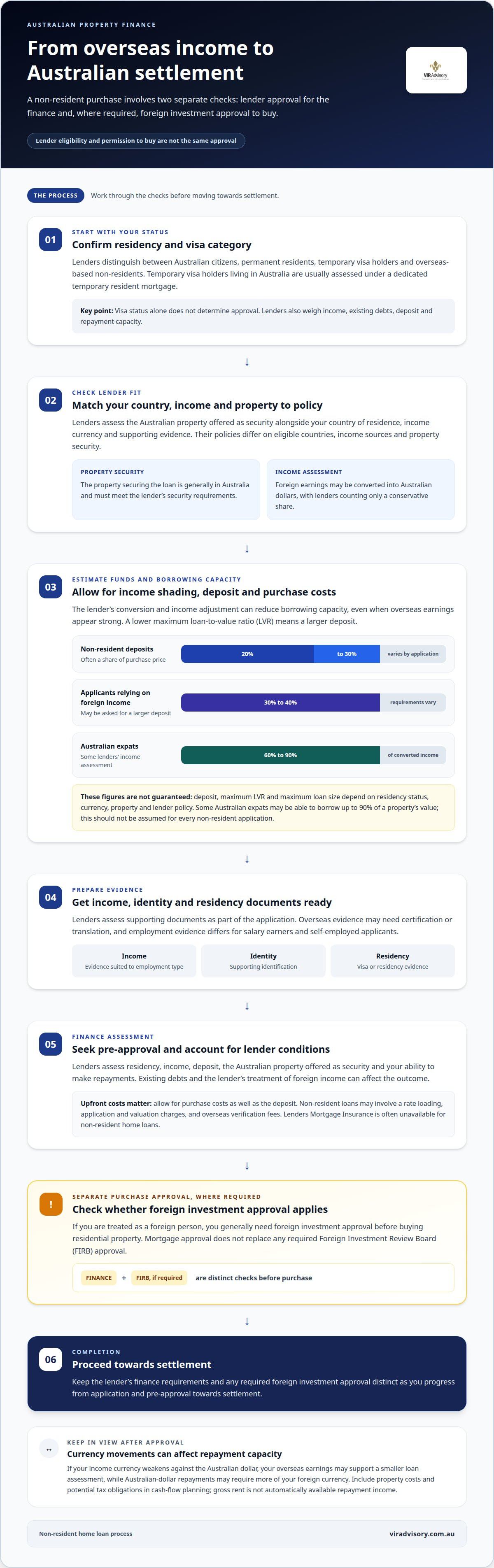
A mortgage approval is only one part of buying property in Australia as a non-resident. Non-resident home loans in Australia are assessed under lender rules that can differ from standard home loans, particularly for deposit size and foreign income. Deposits are often 20% to 30% of the purchase price, while lenders may convert overseas income to Australian dollars and count only a conservative share. If you’re treated as a foreign person, you generally need foreign investment approval before buying residential property.
It’s understandable to want clarity on whether your visa, income and deposit meet a lender’s criteria before committing to a property. Mortgage approval does not replace any required Foreign Investment Review Board approval, so you need to consider both parts of the purchase.
This article explains what non-resident home loans cover, how lenders assess foreign income and eligibility, and how FIRB approval can affect a purchase. It also outlines the application stages, from preparing documents and seeking pre-approval to settlement, so you can understand what may affect your finance options and timing.
Key Takeaways
- Separate lender eligibility from permission to buy: mortgage approval does not replace any required foreign investment approval.
- Build your borrowing estimate around how the lender treats overseas income, including currency conversion and the share it counts.
- Allow for a deposit and purchase costs; requirements vary with residency status, income currency, property and lender policy.
- Match the property type to the rules that apply to your residency status before progressing towards settlement.
- Prepare income, identity and residency documents early, as overseas evidence may need certification or translation.
What is a Non-resident Home Loan?
A non-resident home loan is finance to buy Australian property when the borrower lives overseas or has temporary residency status. Lenders assess residency, income, deposit, the Australian property offered as security, and the borrower’s ability to make repayments.
Eligibility by Residency and Visa Status
Eligibility depends partly on whether you’re an Australian citizen, permanent resident, temporary visa holder or overseas-based non-resident. Temporary visa holders living in Australia are usually assessed under a dedicated temporary resident mortgage rather than a non-resident loan. Some lenders may accept visa subclasses 457 or 482, but visa status alone doesn’t determine approval.
The Australian Government Department of Home Affairs provides visa and immigration information, while lenders assess how your status fits their lending criteria. For example, a borrower on a subclass 482 visa may need a different loan assessment from an Australian expat living overseas. The lender also weighs income, existing debts, deposit and repayment capacity. For overseas families planning relocation or international study pathways alongside their property search, educational consultancies like AusPak International can help guide study options and institutional applications.
Eligible Property Security and Countries
The property securing the loan is generally in Australia, while the borrower’s income or residence may be overseas. Lenders assess the property’s location and value alongside the applicant’s country of residence, income currency and supporting documents. Their policies differ on which countries and income sources they can assess, so your country of residence can affect the available loan options.
For example, an overseas-based buyer earning a foreign salary may need that income converted into Australian dollars for a serviceability assessment. Lenders may count only a conservative share of the converted income. The property must also meet the lender’s security requirements, so having a suitable deposit alone does not establish eligibility.
Repayments, Tax and Rental Income
Repayments follow the loan agreement, and borrowers earning overseas may need to manage currency movements when transferring funds to Australia. A change in exchange rates can affect how much foreign currency is needed to meet an Australian-dollar repayment. Rental income may contribute to a lender’s assessment, but the lender decides how it is treated.
Australian tax treatment can depend on residency status and how the property is used, including whether it earns rent. Include potential tax obligations and property costs in your cash-flow planning rather than treating gross rent as available repayment income. Lender approval covers the finance, not your personal tax outcomes.
Which Australian banks and lenders offer home loans to non-residents? Australian lenders with non-resident or temporary-resident lending policies may consider applications, but eligible visa types, countries and income rules differ. Each lender’s policy determines whether it can assess a particular borrower and property.
What are the risks and common reasons applications are declined? Applications may be affected by an insufficient deposit, restricted borrowing limits, foreign income that does not support repayments, or incomplete evidence of overseas income and residency. Currency movements can also put pressure on repayment capacity after settlement. A mismatch between visa status, property security and lender policy can prevent approval.
Will my foreign income count?
Yes, an Australian lender may count foreign income, but it usually converts earnings into Australian dollars and applies a conservative share. Non-resident deposits are often 20% to 30% of the purchase price, while applicants relying on foreign income may be asked for 30% to 40%. There’s no single deposit requirement: residency status, currency, property, lender policy and loan-to-value ratio (LVR) all matter.
For Australian expats, some lenders may use between 60% and 90% of converted income when assessing borrowing power. That conversion and income adjustment can reduce the amount available for repayments, even when overseas earnings appear strong. Employment type also matters: salary evidence differs from the financial records used to assess self-employed income.
LVR compares the loan amount with the lender-assessed property value. A lower maximum LVR means a larger deposit is required, and some lenders also limit the maximum loan size for non-residents. Australian expats may be able to borrow up to 90% of a property’s value, but that figure shouldn’t be assumed for every non-resident application.
A deposit below 20% may mean Lenders Mortgage Insurance (LMI) for Australian borrowers. However, mortgage insurance is often unavailable for non-resident home loans, so a borrower may need more deposit rather than relying on LMI to bridge the gap. A broker can model the deposit, likely loan amount and purchase costs together, instead of treating the deposit as the only upfront funding requirement.
Income earned in another currency also creates exchange-rate risk. If that currency weakens against the Australian dollar, overseas earnings may support a smaller loan assessment, while Australian-dollar repayments require more of the borrower’s foreign currency. Lenders may assess the currency, employment arrangement, income consistency and supporting evidence before deciding how much income to count.
Loan pricing and charges can also differ from resident lending. Non-resident home loans may involve a rate loading, application and valuation charges, and overseas verification fees. Include these costs alongside the deposit when assessing cash flow and the funds needed to complete the purchase. The interest rate, fees and maximum loan amount depend on lender policy and the application details.
For a clear assessment, organise your borrowing review around these factors:
- Income: currency, employment type, consistency and the share accepted by the lender.
- Deposit: available funds, purchase costs and the resulting LVR.
- Loan terms: maximum loan size, interest rate and applicable charges.
- Currency exposure: whether exchange-rate changes could affect repayment capacity.
Model repayments using the income figure the lender accepts, then compare them with your available cash flow.
Do foreign buyers need FIRB approval?
Often, yes. A person treated as a foreign person generally needs approval before buying Australian residential property, regardless of its value.
Permitted Property Types
Foreign investment rules generally direct foreign buyers towards new or near-new dwellings and vacant residential land for development. For a temporary resident, residency status and intended use affect which purchase rules apply. Clarify whether you are buying a home to live in or an investment property before signing a contract.
Temporary residents buying vacant land must build within four years, according to the Australian Taxation Office. Foreign investors may buy new dwellings, off-the-plan apartments or development land, subject to applicable approval and conditions.
Foreign Investment Approval and Restrictions
A temporary ban on foreign investors purchasing established dwellings applies from 1 April 2025 to 31 March 2027, with narrow exceptions. This makes the distinction between an established home and a new dwelling material: a lender’s approval does not override foreign investment restrictions.
Residential applications are administered by the Australian Taxation Office and decided by the Treasurer, with the Foreign Investment Review Board advising. Where required, approval must be in place before settlement. Buying without required approval can result in penalties, including divestment orders.
Application fees vary with property price. The stated fee is A$13,200 for Australian properties priced under A$1 million; fees can scale with property value. Approval is separate from finance, so include both processes in the purchase timeline and avoid treating loan pre-approval as permission to buy.
If you are a temporary resident or foreign investor, establish the approval requirements before committing to a purchase contract. Relevant checks include your status, property type, intended use and any conditions attached to approval. If an application is required, lenders often want it submitted or approved before issuing unconditional finance.
Budget for more than the deposit and loan charges. Foreign buyers may face Foreign Citizen Stamp Duty, as well as state or territory stamp duty and other purchase costs. Victoria has a foreign purchaser stamp duty surcharge; the applicable amount depends on the property and the buyer’s circumstances. Include these costs in your funding calculations rather than relying on rental income to cover them after settlement.
Keep the purchase sequence clear: identify your residency category, establish whether the property type is permitted, address foreign investment approval, then progress finance and settlement. Temporary residents and foreign investors can face different restrictions, even when both rely on overseas income. A property that meets a lender’s security rules may still fall outside foreign investment rules, so assess both before proceeding.
Application, pre-approval and settlement process
A broker coordinates lender assessment from the initial document review through approval and settlement. For a non-resident, the process also requires clear evidence of overseas income and correctly prepared identification documents.
The broker first compares the borrower’s residency, income currency, employment type and property plans with lender criteria. This can identify documentation gaps before a formal loan application is submitted. Pre-approval provides an initial borrowing assessment, but it is not unconditional finance or a guarantee of settlement funding.
Self-employed Expat Applications
Self-employed expats may be asked for two years of personal tax returns and six months of business bank statements. These records help lenders assess income consistency, business cash flow and the borrower’s ability to meet repayments. A broker organises financial evidence for assessment and identifies whether company accounts or other records may support the application.
Complete records matter: unexplained differences between declared income and bank credits can prompt lender questions and slow the assessment.
Documents for a Non-resident Home Loan
Applicants commonly provide certified identification, evidence of overseas income and residency, and proof of a way to repay into an Australian account. Lenders usually request three to six months of bank statements. Australian non-resident applications commonly require certified translations and notarised copies of documents.
Employees may need three months of bank statements showing salary credits. Some lenders may request tax returns for the last three years as evidence of creditworthiness. The documents required depend on employment and lender criteria, so the broker coordinates evidence relevant to the applicant’s circumstances.
Once the lender and loan structure are selected, the broker submits the application and responds to assessment requests. The lender reviews income, liabilities, deposit, property security and supporting documents. A valuation may be arranged to assess the security. If information is missing or inconsistent, the lender may request clarification before making a decision.
After conditional approval, you must meet outstanding requirements before receiving unconditional approval. These may relate to documents, property assessment or foreign investment approval, where required. The broker tracks lender conditions and coordinates finance steps with the purchase contract timeline. Loan approval does not replace any required foreign investment approval.
Before settlement, the lender prepares the mortgage and funding instructions. You need to meet the lender’s conditions and ensure the required funds are available for settlement. The broker liaises with the lender and relevant parties about finance progress, while the conveyancer or solicitor handles legal and settlement matters.
For a well-organised application, the broker’s process typically covers:
- Document review: identify missing, untranslated or inconsistent overseas evidence.
- Lender assessment: submit income, liability and security details for a decision.
- Approval conditions: track requirements through to unconditional finance.
- Settlement readiness: coordinate finance timing and confirm funding requirements.
How non-resident loans differ from standard Australian home loans
The key difference is how lender policy treats residency, income and funding risk. A resident borrower earning Australian dollars can be assessed using domestic income evidence. An overseas applicant may need foreign earnings converted and adjusted before the lender assesses repayment capacity.
That adjustment affects more than the maximum loan amount. If a lender counts only part of your foreign income, you may need to reassess your purchase budget, deposit contribution or expected cash flow. Exchange rates matter too: overseas earnings can change in value against Australian-dollar repayments, so affordability may shift even if your salary stays the same.
Deposit and LVR settings can also change the funding outcome. Non-resident applicants often face lower maximum LVRs, and mortgage insurance is often unavailable for these loans. This can mean you need more funds upfront than for a comparable resident loan. Include the deposit, purchase costs and lender charges in the same funding calculation.
Access to government schemes is another distinction. Non-residents generally do not qualify for most Australian government first home buyer schemes or grants. If you expect a grant to reduce your required cash contribution, you could overestimate your available funds. Assess scheme eligibility separately from lender approval.
Compare the application factors side by side before settling on a purchase budget:
Standard resident loan | Non-resident loan
Income: Australian-dollar income evidence | Foreign income may be converted and assessed conservatively
Deposit: Resident lending criteria apply | Lower maximum LVRs can require a larger contribution
Mortgage insurance: May be available in some lending situations | Often unavailable
Government schemes: Eligibility depends on the scheme | Generally ineligible for most first home buyer schemes or grants
Repayment exposure: Domestic income and repayments | Foreign-currency income can move against Australian-dollar repayments
The interest rate alone does not show the full difference. Assess the approved loan amount, required deposit, fees, repayment structure and currency exposure together. This gives you a clearer view of the funds needed to complete the purchase and the ongoing effect on cash flow.
- Funding: compare the deposit and purchase costs against available funds.
- Income: use the lender’s assessed amount, not the full overseas salary.
- Risk: account for exchange-rate changes and repayment exposure.
- Eligibility: treat scheme access and mortgage approval as separate decisions.
VIR Advisory
Residency status, foreign income, deposit size and property plans can affect Australian home loan options. Lenders may assess these factors differently, so borrowers should check the relevant criteria, documentation requirements and settlement timeframes before applying.
Before signing a purchase contract, consider how borrowing capacity, lender documentation and any foreign investment approval requirements fit with your finance plans. This is particularly relevant if you earn income overseas or lender policies differ based on your visa status and the property you plan to buy. Repayments and currency movements may also affect your cash flow.
Contact VIR Advisory to discuss your circumstances.
Set your next step around the purchase decision
Before progressing, define what you need the property to do for you. Buying a home to live in and buying an investment property can involve different decisions about cash flow, loan structure and how long you expect to hold the asset. For buyers considering non-resident home loans in Australia, this context connects the finance assessment to the property’s intended use, rather than focusing on borrowing capacity alone.
Consider how the purchase fits with your broader financial commitments, including existing lending and future plans. A clear picture of your priorities gives the lending discussion a practical focus and helps identify questions to resolve before you commit to a contract.
A considered next step can make the decisions ahead easier to manage.
Frequently Asked Questions
Do non-residents need approval from the Australian Government to get a mortgage?
No government approval is needed simply to apply for a mortgage, but foreign investment approval may be required to buy residential property. A person treated as a foreign person generally needs approval before purchasing, regardless of the property’s value. Residential applications are administered by the Australian Taxation Office and decided by the Treasurer, with the Foreign Investment Review Board advising. Mortgage approval and purchase approval are separate decisions.
How can a mortgage broker help you buy property in Australia while living overseas?
A mortgage broker can assess which lender policies may suit your residency, overseas income, currency and property plans, then coordinate the application and lender communications. For an overseas buyer, this can include organising certified identity and income evidence, clarifying lender requests and monitoring finance conditions against the purchase timetable. The broker arranges finance; you still need to meet the lender’s requirements and any separate property-purchase approval rules.
How much deposit do non-residents need?
Non-resident buyers often need a deposit of 20% to 30% of the purchase price, while applicants relying on foreign income may be asked for 30% to 40%. These are different lending situations, not a single universal rule. The lender’s maximum loan-to-value ratio, residency status, income currency, property and loan size all affect the deposit. Budget separately for purchase costs, as the deposit alone may not cover completion funds.
Who can qualify for a non-resident home loan in Australia?
Eligibility can include Australian citizens living overseas, foreign nationals and some temporary visa holders, depending on the lender’s policy. Temporary visa holders living in Australia are usually assessed under temporary resident lending rather than a non-resident loan. Some lenders may accept applicants holding subclass 457 or 482 visas. Lenders also assess income evidence, liabilities, deposit, credit conduct and repayment capacity, so residency status alone does not establish eligibility.
What interest rates, fees and loan terms apply to non-resident home loans in Australia?
Non-resident loans may include an interest-rate loading, application and valuation charges, and overseas verification fees. Rates and charges depend on lender policy and the application, so compare the total cost and repayment structure rather than the rate alone. Fixed-rate periods for non-resident loans are usually one to five years; interest-only periods for non-resident investment loans are typically one to five years. Loan limits and available features vary.
Can foreign non-residents buy residential property in Australia, and what FIRB approval is required?
Foreign buyers can generally pursue new dwellings, off-the-plan apartments or vacant residential land for development, subject to applicable approval and conditions. A temporary ban on foreign investors purchasing established dwellings applies from 1 April 2025 to 31 March 2027, with narrow exceptions. Required approval is separate from finance and must be obtained before settlement. The buyer’s foreign-person status and the property type determine which restrictions apply.
What steps does a mortgage broker manage to arrange a non-resident home loan and buy property in Australia?
A broker can organise the finance sequence: assess your position, identify lender criteria, prepare and submit the application, then track assessment questions and approval conditions. For an overseas purchase, the broker can also align finance milestones with the contract timetable and flag where foreign investment approval affects unconditional finance. You provide accurate documents and funds; legal professionals handle conveyancing and settlement duties.
How do home loan options differ for Australian citizens living overseas, temporary visa holders and foreign nationals?
Australian citizens living overseas may be assessed as expats, with overseas income converted to Australian dollars and a conservative share counted. Temporary visa holders living in Australia are usually considered under temporary resident lending criteria. Foreign nationals may face foreign investment restrictions and separate approval requirements. New Zealand citizens are exempt from many Australian property-purchase restrictions, including FIRB application requirements; subclass 444 is relevant to the special category visa context.

Article by
Raina Doshi
Raina Doshi has worked in banking and finance since 2011, including experience with major Australian lenders. She helps homeowners, property investors, business owners and professionals secure and structure lending solutions across home loans, refinancing, commercial finance and business lending.
Areas of expertise include residential lending, investment property finance, debt recycling, commercial property finance, equipment finance, construction finance and strategic debt structuring.
Drawing on extensive banking and finance experience, Raina helps clients navigate lender requirements, improve borrowing outcomes and structure effective finance solutions.
Disclaimer
The information in this article is general in nature and does not take into account your personal objectives, financial situation or needs. Before acting on any information, consider whether it is appropriate to your circumstances and seek professional advice.


