

There’s no published Australian cap on how many investment properties you can own. In practice, the limit is usually how much you can finance: lenders assess your debts, income, rental income and ability to meet repayments. Owning several properties is possible, but qualifying for another loan is a separate question.
It’s understandable to assume there’s a fixed property limit, especially when every purchase adds a loan and ongoing costs. There’s no legal ownership cap, but lenders assess your existing loans, rental income, equity and borrowing capacity. The result varies between borrowers, so consider your finances and portfolio before buying another property.
Key Takeaways
- There’s no published Australian limit on the number of investment properties you can own, but loan approval can become the practical constraint.
- When assessing another application, lenders consider existing debts held with them and other lenders, along with income and rental returns.
- Rental income may be assessed below the amount you actually receive, so allow for a gap when estimating borrowing capacity.
- APRA’s treatment of borrowers with five or more mortgaged investment properties relates to bank capital and risk-weighting, not a ban on borrowing.
- Before pursuing another purchase, consider how the ownership structure, loan commitments and portfolio cash flow fit together.
How does a lender assess the loans you already have with someone else?
A lender assesses your overall financial position, not only the loans you hold with that lender. APRA expects authorised deposit-taking institutions to apply buffers and floor rates to existing debt commitments, including loans held elsewhere. Your application needs to account for repayments across mortgages and other debts, alongside income, household expenses and rental income. Existing loan limits can matter even if you haven’t drawn the full amount.
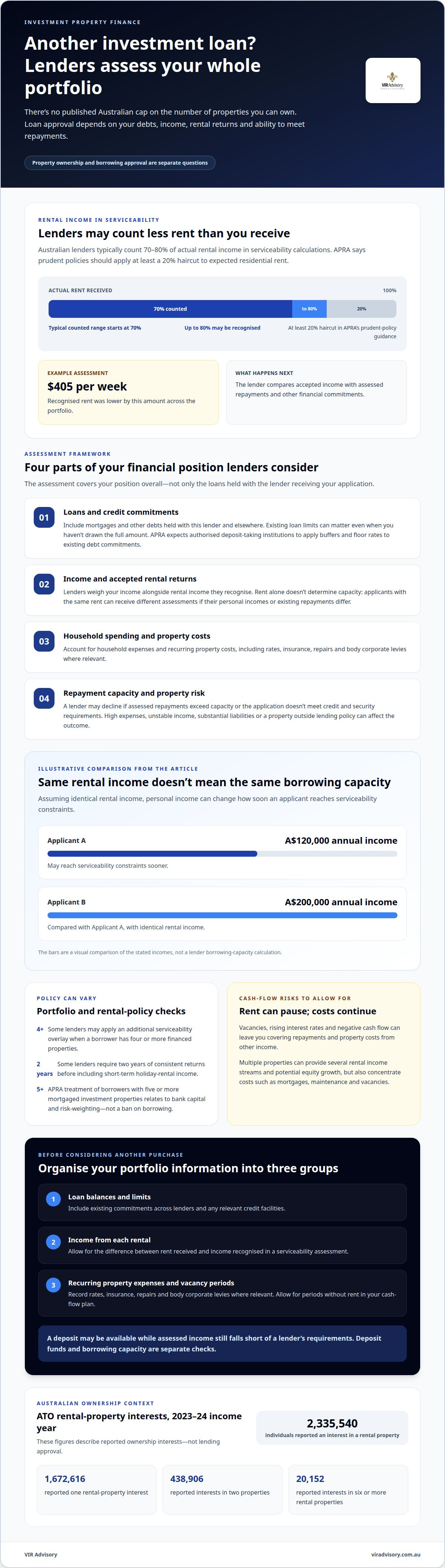
ATO figures show the range of Australian rental property ownership. In the 2023-24 income year, 2,335,540 individuals reported an interest in a rental property. Of those, 1,672,616 reported one interest, while 438,906 reported interests in two properties. The ATO table also recorded 20,152 individuals with six or more rental property interests. These figures describe ownership, not borrowing approval: lenders still assess each borrower’s debts, income and repayment capacity.
Rental income is generally discounted in serviceability calculations because rent can fluctuate and properties incur costs. Australian lenders typically count 70-80% of actual rental income, while APRA says prudent policies should apply at least a 20% haircut to expected residential rent. In an example assessment, recognised rent is lower by $405 per week across the portfolio. The lender then compares accepted income with assessed repayments and other commitments.
Risks include vacancies, rising interest rates and negative cash flow, which can leave you covering repayments and property costs from other income. Multiple properties can provide several rental income streams and potential equity growth, but also concentrate costs such as mortgages, maintenance and vacancies. Consistent tenant screening can help reduce avoidable disruption: assess applicants’ ability to pay, rental history and references, then allow for periods without rent in your cash flow plan.
For a practical assessment, organise your information into three groups: loan balances and limits, income from each rental, and recurring property expenses. Include rates, insurance, repairs and body corporate levies where relevant. A rental property may still reduce borrowing capacity if the assessed repayments and costs exceed the income a lender recognises. Clear records show how the portfolio performs, while realistic vacancy allowances help you judge whether repayments remain manageable when rent pauses.
Borrowing capacity and lender serviceability assessments
Borrowing capacity depends on how a lender weighs your income, commitments and proposed purchase. Policies differ, so an assessment with one lender may not represent the options available elsewhere.
Assessing existing debts
Assessing existing debt means considering your current financial commitments alongside the proposed mortgage. Loans and credit facilities can reduce the income available for new repayments, even if they’re held with another lender.
For example, a borrower with a personal loan and an unused credit limit has different commitments from someone with the same salary and no credit facilities. Lenders also consider household expenses and repayments on existing investment loans. Presenting a complete financial picture helps prevent a purchase decision based on an incomplete estimate.
Rental income and borrowing capacity
Rental income can support borrowing, while existing debts reduce the capacity available for another property. The effect depends on how the lender treats rent, the property’s costs and your other commitments.
For instance, two applicants with identical rental income may receive different assessments if their personal incomes or existing repayments differ. A borrower earning A$120,000 annually may reach serviceability constraints sooner than one earning A$200,000 annually, assuming identical rental income. This comparison shows why rent alone cannot determine capacity for another purchase.
Reasons for declining further borrowing
A lender may decline an application if its assessment finds insufficient capacity for the proposed repayments, or if the application doesn’t meet its credit and security requirements. High household expenses, unstable income, substantial existing liabilities or a property that falls outside lending policy can each affect the outcome.
Some lenders apply an additional serviceability overlay when a borrower has four or more financed properties. They may also treat short-term holiday-rental income cautiously; some require two years of consistent returns before including it. These policy differences can affect which lender is suitable for an application.
Exceptions to serviceability policy are limited and aren’t a standard borrowing strategy. APRA reported that banks used serviceability-policy exceptions for around five per cent of new housing loans over the year preceding November 2024. That figure describes bank lending activity, not an applicant’s likelihood of receiving an exception.
Before making an offer, separate the deposit question from the capacity question. A deposit may be available while assessed income still falls short of the lender’s requirements. A broker can review the application against different lender criteria and identify which commitments or evidence need closer attention. Discuss your borrowing capacity with a broker.
Is there a limit on how many investment properties I can own?
There’s no published Australian ownership cap, nor a property-count threshold that automatically requires a company or trust. Australian lenders also have no single universal maximum loan count. Approval depends on each lender’s policy, your borrowing capacity and portfolio risk.
Portfolio lending caps and LVR limits
Portfolio lending caps limit how much a lender will advance against properties collectively, while loan-to-value ratio (LVR) measures a loan against a property’s value. Both can affect the next purchase: some Australian lenders cap combined portfolio lending at 70% or 75% of portfolio value.
Many lenders typically lend up to 80% of a property’s value to avoid lenders mortgage insurance on a new investment loan. As multiple properties accumulate, some cap later purchases at 80% LVR or lower. A lender may also apply a portfolio limit, so available equity across properties doesn’t necessarily mean the full amount can be borrowed.
Using equity to grow a portfolio
Equity is the difference between a property’s current value and its secured debt. Accessing it means borrowing against that value. It can contribute to a deposit for another purchase, but the additional loan increases repayments and remains subject to a serviceability assessment.
For example, a property bought for A$550,000 and later valued at A$650,000 has gained A$100,000 in value before accounting for its existing loan. Depending on the LVR position, A$50,000 to A$80,000 may be accessible as deposit funds. The lender’s valuation, current debt and portfolio limits determine how much capital can actually be released.
Ownership structures and investment loans
There’s no rule requiring you to transfer properties into a company or trust after owning a particular number. The structure affects ownership and borrowing arrangements, so consider its legal and tax implications before buying. Changing ownership later can have consequences.
Lenders don’t apply one standard maximum number of investment property loans. One lender may limit the total number it will finance, while another assesses each application against income, debts, security and policy. APRA’s APS 113 and APG 113 require certain banks to identify borrowers with five or more mortgaged investment properties differently for capital and risk-weighting purposes. This is not a borrowing ban.
Equity is only one part of portfolio capacity. Growing debt can reduce serviceability even as property values rise, and a lender may include repayments on every existing loan in its assessment. Keep a buffer for repayments and property costs rather than treating accessible equity as spare capital.
Negative gearing doesn’t remove the need to cover a property’s cash-flow shortfall. From 1 July 2027, negative gearing of Australian residential property is limited to new builds, subject to the government’s transitional rules. Model the effect of that change alongside rental income, debt and purchase costs before expanding.
Does buying the next property in a trust or company create fresh borrowing capacity?
No. Buying through a trust or company doesn’t automatically increase borrowing capacity: lenders assess the entity’s finances and relevant borrowers’ commitments. Before another purchase, organise a full debt and cash flow review, then consider the proposed loan and ownership structure together.
Putting the property title in a different name doesn’t, by itself, make existing commitments disappear. A lender may assess the trust or company’s financial position, the proposed mortgage and any personal guarantees required for the application. If you have personal loans as well as entity borrowing, the lender needs a clear view of how those obligations interact.
Mortgage pre-approval can help establish whether a lender is prepared to consider a proposed purchase, but it isn’t a separate pool of borrowing capacity. The assessment relies on information provided with the application, including income, liabilities, living expenses and the proposed property. Changes to those details, the property or the loan structure can affect the decision before settlement.
Before buying again, work through these steps:
- Map the debt: list each mortgage, credit facility and other commitment, including loans held by a company or trust.
- Check cash flow: compare rent received with mortgage repayments and property expenses, allowing for vacancy and maintenance.
- Set the purchase structure: decide who will own the property and who will apply or provide support for the loan.
- Test the application: have the lender assess the proposed borrowing against documented income, expenses and existing liabilities.
Living expenses also influence how much you can repay. Two households with the same income may have different assessed capacity because their regular spending and existing commitments differ. For a director or self-employed borrower, consistent records of income and entity obligations help the lender understand the financial position behind the application.
APRA’s debt-to-income limit adds another consideration for some investor lending. From February 2026, APRA-regulated banks may write up to 20 per cent of new investor mortgage lending at a debt-to-income ratio of six or higher, measured quarterly. This is a limit on the share of a bank’s new lending in that category, not an individual property-count limit or automatic approval threshold.
Pre-approval is most useful when the proposed purchase, ownership structure and loan applicants are accurately represented. If a trust or company is involved, align its financial information with the borrower’s debts and income before proceeding. Otherwise, the lender may assess an application that differs materially from the one initially considered.
No legal cap on investment property ownership
There’s no published Australian cap on the number of investment properties a person can own. The practical limit is shaped by borrowing capacity, available capital and the ability to manage each property’s costs. Some Australian investors own more than 50 houses in their own names, while others hold hundreds through trusts or companies. Those examples show ownership can extend well beyond a small portfolio, but they don’t indicate what a lender will approve for an individual borrower.
Ownership and finance are separate questions. You may be legally able to acquire another property but unable to borrow enough to complete the purchase or comfortably meet repayments. For example, a portfolio with several mortgages and a vacant rental may face tighter cash flow, even if property values have risen. The practical limit is often financial and operational, rather than a fixed number set by Australian ownership rules.
APRA doesn’t publish a property-count threshold for when a residential portfolio becomes more like commercial lending. There’s no simple rule that automatically changes a portfolio’s status after a particular number of properties. Banks apply their lending and risk policies, and an investor’s total debt, income, rental performance and security can shape how an application is assessed.
If you’re considering another purchase, assess the portfolio as a whole rather than focusing only on the deposit. Review each property’s rent, loan repayments, recurring costs, vacancy exposure and available cash reserves. A vacancy, for instance, can reduce incoming rent while mortgage repayments and maintenance continue. That pressure can affect your ability to hold existing properties, even before you add another loan.
Negative gearing is a tax outcome, not a measure of how many properties someone can own or finance. It does not remove the need to fund repayments when rental income falls short of costs. From 1 July 2027, negative gearing of Australian residential property is limited to new builds, subject to the government’s transitional rules. Investors considering purchases across that change need to account for tax treatment as well as borrowing capacity and cash flow.
A company or trust structure may suit particular ownership or lending arrangements, but it doesn’t create automatic borrowing capacity. Lenders can assess the entity, its debts and income, and any individuals supporting the application. Before buying through a different structure, consider how the ownership, loan obligations and portfolio cash flow fit together. The structure affects the transaction, but it doesn’t erase existing commitments.
The practical takeaway is to set a portfolio limit based on sustainable cash flow, not a headline property count. For example, you might pause buying if another vacancy or repayment increase would leave too little in reserve for existing properties. This recognises that portfolios with the same number of properties can carry very different debt, rental income and risk.
VIR Advisory
A finance review can help organise the information behind a property purchase, including the ownership structure, proposed loan and relevant financial commitments. This gives you a clearer basis for considering how the purchase fits your wider finances before proceeding.
Plan the next purchase around your full position
The useful question isn’t just how many investment properties you can own. It’s whether another purchase fits your finances and portfolio plan without leaving cash flow too exposed. Before making an offer, set out what you want the property to contribute, how you’ll fund it, and what repayment level remains manageable if rent is interrupted.
VIR Advisory can assess your borrowing position and consider how its Home Loans, Business Loans and Refinancing solutions fit your circumstances. This can help you understand the finance implications of a proposed purchase before committing, rather than relying on a property count to measure your capacity.
A clear finance assessment gives you a firmer basis for deciding whether to proceed, adjust the purchase or wait until your position changes.
Frequently Asked Questions
Do rules and taxes differ by state in Australia for purchasing multiple properties?
State rules can affect the purchase calculation and ongoing ownership costs. Before signing a contract, identify the property’s location, purchaser names and intended use, then account for relevant state charges and any concession eligibility. For example, an investor buying in a personal name shouldn’t assume that an owner-occupier concession also applies to an investment purchase. Build these checks into your acquisition plan.
What are the benefits of buying multiple rental properties?
A larger portfolio can give you more choice in how assets contribute to your plan. One property might be selected for rental return, while another may suit a longer holding period or a different market. Multiple holdings can also allow you to sell or retain assets individually as circumstances change. The benefits depend on each property’s performance and your capacity to manage its obligations.
How do people buy multiple properties in just the span of a few years?
Investors often plan purchases in stages, reviewing the previous acquisition’s costs, performance and finance arrangements before proceeding. A practical sequence is to settle, establish reliable rent and expense records, then reassess the next purchase against current income and commitments. This avoids assuming an earlier loan approval will automatically support a later purchase, especially if your finances or plans have changed.
Is there a legal limit on how many investment properties you can own in Australia?
There’s no general legal maximum on the number of investment properties an Australian individual can own. A separate consideration applies to foreign investors: they need Foreign Investment Review Board approval before purchasing multiple properties in Australia. Ownership structure, purchaser eligibility and property type can affect the requirements, so distinguish the general ownership position from approvals that may apply to a particular buyer.
How do Australian banks assess borrowing capacity for multiple investment properties?
Banks review more than the number of properties. They consider who will borrow, the proposed loan purpose, the security offered and the evidence supporting the application. For example, an application involving a trust may require details about the entity and the individuals supporting the borrowing. Clear, consistent records help the lender understand how the proposed purchase and ownership arrangement fit together.
What are the tax implications of owning multiple investment properties in Australia?
Rental income and eligible property expenses affect an investor’s tax position, while selling a property may have capital gains tax consequences. Keep records for each property, including rent received, expenses paid, purchase documents and sale costs, so income and costs can be accounted for accurately. The ownership structure can also affect how income and gains are treated. Tax outcomes depend on your circumstances and the applicable rules.
How do land tax thresholds apply when you own multiple properties in each Australian state and territory?
Land tax assessments generally focus on taxable land value, not simply the property’s purchase price or total market value. Keep separate records of each property’s land details and ownership structure, as these can inform the relevant assessment. If you own several properties, distinguish the land component from buildings and other improvements when estimating exposure. The applicable assessment depends on state or territory rules and ownership circumstances.

Article by
Raina Doshi
Raina Doshi has worked in banking and finance since 2011, including experience with major Australian lenders. She helps homeowners, property investors, business owners and professionals secure and structure lending solutions across home loans, refinancing, commercial finance and business lending.
Areas of expertise include residential lending, investment property finance, debt recycling, commercial property finance, equipment finance, construction finance and strategic debt structuring.
Drawing on extensive banking and finance experience, Raina helps clients navigate lender requirements, improve borrowing outcomes and structure effective finance solutions.
Disclaimer
The information in this article is general in nature and does not take into account your personal objectives, financial situation or needs. Before acting on any information, consider whether it is appropriate to your circumstances and seek professional advice.


