

A construction loan is usually released in progress payments as building work reaches agreed stages, rather than as one lump sum. Construction loan approval depends on the lender’s assessment of your borrowing capacity, build documents, builder and contract. Gaps in any of these can delay or derail an application.
Saving a deposit may seem like the main challenge, but the lender also needs to see that the project is viable and repayments are manageable. A fixed-price contract, council plans and permits, builder details and an ‘as if complete’ valuation can all form part of the assessment.
This article explains how lenders assess construction finance, when progress payments are released and how budgets, repayments and borrowing limits can affect the outcome. You’ll also find practical steps to prepare your application, spot common approval obstacles and understand how your deposit and lenders mortgage insurance may affect how much you can borrow.
Key Takeaways
- Prepare your income and debt details alongside council plans, permits, builder information and a fixed-price contract to help address common application gaps.
- Understand how progress payments work so you can plan for invoices, staged fund releases and the timing of payments to your builder.
- Build a clear picture of your total project budget, including how you would manage costs that exceed the agreed contract amount.
- Allow for repayments to change as funds are drawn down, and consider how the loan may be structured once construction is complete.
- Assess your deposit, borrowing capacity and potential lenders mortgage insurance together, as each can affect the amount available for your build.
What is a construction loan?
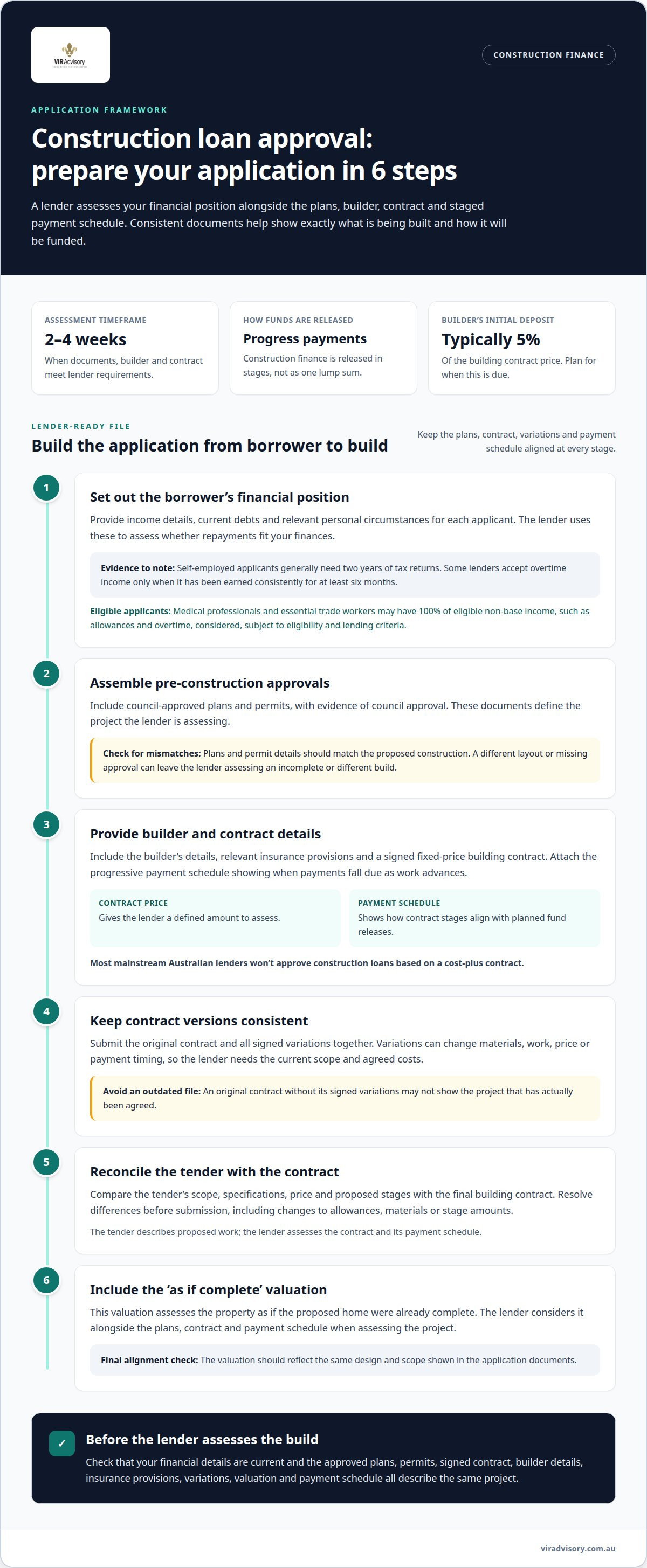
A construction loan funds a new build through progress payments, not one upfront payment. To support construction loan approval, prepare a complete application package covering you, the property and the build.
- Set out the borrower’s financial position. Provide income details, current debts and relevant personal circumstances for each applicant. These details help the lender assess whether repayments fit the household’s finances. Self-employed applicants generally need two years of tax returns. Eligible medical professionals and essential trade workers may have 100% of eligible non-base income, such as allowances and overtime, considered, subject to eligibility and lending criteria.
- Assemble the pre-construction documents. Include council-approved plans and permits, along with evidence of council approval for the build. These documents describe the project the lender is assessing. Check that the plans and permit details match the proposed construction, because a mismatch can leave the lender assessing an incomplete or different build.
- Provide the builder and contract details. Include the builder’s details, relevant insurance provisions and a signed fixed-price building contract. Attach the contract’s progressive payment schedule, which shows when payments are due as work advances. The lender needs to see how the contract stages align with planned fund releases, not just the total contract price.
- Keep each contract version consistent. Submit the original contract and all signed variations together so the lender can assess the current scope and price. A variation that changes materials, work or payment timing may affect the budget and schedule. If the application contains an outdated version, the lender may need updated documents to complete its assessment.
- Include the ‘as if complete’ valuation. This valuation assesses the property as if the proposed home were already complete. The lender considers it alongside the plans, contract and payment schedule when assessing the project. If it reflects a different design or scope, it may not support the same funding assessment as the documents in your application.
- Prepare the final construction documents before funding. Make sure the approved plans, permits, signed contract, builder details, insurance provisions and payment schedule align. The lender needs the final versions to assess the build and arrange progress payments. An original contract without its signed variations, for example, may not show the agreed project.
How do construction loans work?
Unlike a standard home loan, construction finance also involves assessing the builder, approved plans, contract and staged payment schedule. The process usually takes two to four weeks when the documents, builder and contract meet lender requirements.
Eligible first-home buyers may qualify for a 5% deposit under the Australian Government 5% Deposit Scheme; eligible single parents or legal guardians may qualify with 2%. Grant eligibility and amounts vary by state and territory, and Revenue NSW states eligible first-home buyers can receive $10,000 for a first new home.
-
Complete the lender assessment
Provide current income, debt and personal details, and make sure they reflect your financial position. The lender assesses your repayment capacity alongside the builder’s credentials, contract and project costs. Some lenders accept overtime income only if it has been earned consistently for at least six months. A mismatch between your financial evidence and declared commitments can affect the assessment, even when the construction documents are complete.
-
Plan deposits and staged construction costs
Map the builder’s deposit and each later progress payment against available funds. A builder’s initial deposit is typically 5% of the building contract price, while construction costs are funded in instalments. Check the schedule’s timing against your cash flow, including costs that must be paid before lender drawdowns. This helps identify a shortfall before a payment falls due, rather than relying on the full approved limit being immediately accessible.
- Match council approvals to building specifications. Include council-approved plans and permits, then compare them with the proposed build and contract. Lenders assess the project described in these documents. Changed specifications or missing approvals can leave the application incomplete. For example, if the plans show a different layout from the tender, resolve the discrepancy before submitting the final build details.
- Prepare a fixed-price building contract. Use a signed contract that describes the work and sets out progressive payments. Most mainstream Australian lenders won’t approve construction loans based on a cost-plus contract. A fixed price gives the lender a defined amount to assess, while signed variations record subsequent changes. Ensure the contract and variations describe the same project scope and agreed costs.
- Reconcile the tender with the contract. Compare the tender’s scope, specifications, price and proposed stages with the final building contract. The tender describes the builder’s proposed work, but the lender assesses the contract and payment schedule. Resolve differences before submission, especially if an allowance, material choice or stage amount changes the stated project cost.
- Submit progress invoices against completed work. The lender arranges payment to the builder or supplier after receiving the builder’s invoice. Submit the invoice for the relevant stage and link each request to the contract schedule, so it’s clear that the required work has been completed.
What happens if construction goes over budget?
A cost overrun can leave a gap between the remaining loan funds and the builder’s next progress payment. Compare the revised project cost with the available loan balance, then work out how to fund any shortfall before work or payments fall behind.
- Recalculate the remaining budget. List the original contract amount, variations, invoices already paid and funds still available. Compare the balance with the builder’s updated estimate to identify any shortfall. For example, a variation that changes materials may increase the contract cost while the approved loan limit stays the same. Keep the updated figures together to make the size and cause of the gap clear.
- Separate contract variations from unexpected costs. Match each new charge to the relevant work, variation or invoice, and note whether it changes the agreed scope. A signed variation records an agreed change; an unexpected charge may need clarification before it can be included in the project budget. Don’t treat undrawn loan funds as spare cash until you’ve matched them against upcoming progress payments.
- Review the timing against construction deadlines. For a BOQ construction loan, the builder must start within six months of the offer date and finish within 12 months from the first progress payment. Delays can compress the time available for later stages, while overruns may affect the planned completion date. Compare the revised build schedule with those dates and the loan’s terms before relying on the original timeline.
- Prepare for any funding shortfall. If the remaining loan funds don’t cover revised contract costs, you’ll need another funding source or an agreed change to the project. Extra borrowing requires a fresh assessment of your finances and the revised build details. It isn’t an automatic increase to the existing limit. Work out the amount and timing of each shortfall before the related progress payment is due.
- Plan the final inspection and loan transition. At completion, the lender may require a valuation or other evidence of completion before the final payment. Include the final progress payment, outstanding variations and completion requirements in your cash-flow plan. Once construction is complete, the loan switches to a regular home loan with principal and interest repayments, depending on the lender agreement. Budget for this change rather than assuming construction-stage repayments will continue.
- Track the revised schedule through to completion. Update the budget whenever a variation is agreed or a progress payment is made. Keep the builder’s revised schedule, invoices and payment records aligned so you can see whether the remaining funds cover the next stage. If the completion date changes, compare it with the loan’s applicable criteria and the expected repayment change.
Interest-only repayments during construction
- Base your construction budget on drawn funds. During construction, borrowers generally pay interest only on the amount drawn from an Australian construction loan. The approved limit isn’t necessarily the amount already owing. For example, after the first progress payment, interest applies to the funds drawn for that stage, not automatically to the undrawn balance. Early repayments can therefore be lower than repayments later in the build.
- Track how each stage changes the balance. As the lender pays invoices across construction stages, the drawn balance can increase. Record each payment against its invoice and stage, then update your cash-flow forecast. If the lender pays the slab invoice and later the frame invoice, interest is based on more funds than after the first drawdown. Staged releases align borrowing with project progress, but repayments can rise as more funds are used.
- Allow for interest as the build advances. Don’t assume an early repayment amount will stay the same throughout construction. Map expected progress payments against household income and other loan commitments, and allow for repayments to change as drawdowns accumulate. A build that has reached several payment stages has a different drawn balance from one awaiting its first invoice. This helps you assess whether your cash flow can absorb the increase.
- Check what triggers each payment. Construction loan funds are released as work progresses, rather than transferred to you as a single lump sum. Before arranging a drawdown, make sure the builder’s invoice and completed work correspond to the relevant stage. For example, an invoice submitted before the stated stage is reached may not fit the payment sequence. Clear records help you track the amount borrowed and interest payable after each release.
- Budget for the repayment change after completion. Interest-only repayments cover interest during construction, so they don’t reduce the principal balance. Once construction is complete, the loan switches to a regular home loan with principal and interest repayments, depending on the lender agreement. Include this change in your forward budget rather than treating the construction-stage repayment as a guide to the ongoing amount.
- Test the full repayment against your finances. Compare current construction-stage interest with the later principal and interest commitment, alongside existing debts and regular expenses. Model cash flow at an early stage and again after several drawdowns. The difference shows how increased use of the loan affects available income. Include household costs that continue during the build, so your repayment plan accounts for more than construction invoices.
Borrowing amounts and lender’s mortgage insurance
- Calculate the project funding gap. Add the land cost, building contract and other project expenses, then subtract your available deposit and equity. Australian construction loan deposits typically range from 10% to 25% of the total cost. This is a general range, not a borrowing limit: the lender also assesses your finances and the project valuation. A larger deposit can reduce the amount you need to borrow, but it must still leave enough cash for costs outside the loan.
- Compare the loan request with the completed valuation. Lenders assess the proposed borrowing against the property’s ‘as if complete’ valuation and your financial position. A lower-than-expected valuation can increase the loan-to-value ratio, or LVR, and affect how much the lender will advance. For example, if the build cost exceeds the valuation, you may need to fund the difference yourself. Check both figures in your funding plan before committing to the full project cost.
- Factor lenders mortgage insurance into the borrowing decision. Lenders Mortgage Insurance, or LMI, protects the lender if a borrower defaults; it doesn’t insure the borrower’s repayments. A smaller deposit can mean a higher LVR and may lead to LMI, depending on lender criteria. Include any applicable insurance cost when calculating the funds required, because it can affect your total borrowing and cash contribution. The amount you can afford to borrow and the lender’s maximum are not necessarily the same.
- Check whether a deposit scheme fits your eligibility. Eligible first-home buyers may be able to buy or build with a 5% deposit under the Australian Government 5% Deposit Scheme without paying LMI. Eligible single parents or legal guardians may be able to purchase with a 2% deposit under the scheme. These options depend on eligibility and lender criteria. Compare the scheme’s deposit requirement with your project budget and borrowing capacity rather than assuming a lower deposit increases the amount you can borrow.
- Assess owner-builder lending separately. Australian owner-builder construction loans may be capped at an 80% LVR, and owner-builder applicants may need at least a 20% deposit to avoid LMI. That can mean a larger cash contribution than a standard build, even where income supports repayments. Before settling on an owner-builder budget, compare the deposit, valuation and lender’s LVR limit. The key takeaway is to size the build around the lowest supported funding amount, not the largest amount you hope to borrow.
VIR Advisory: Construction Finance
VIR Advisory helps borrowers arrange construction finance for a new build or address a funding obstacle. Its finance brokerage can help structure an application around the project budget, your finances, building contract and staged drawdowns. This support can be useful if a lender has declined your application, the proposed borrowing doesn’t align with the valuation, or repayments need to be assessed alongside existing commitments.
Before you apply, VIR Advisory can review how the requested loan amount relates to build costs, your deposit and lender requirements. Understanding these factors can help identify issues to address and support a considered construction loan approval application. The finance structure should also account for interest during construction and principal and interest repayments after completion.
Contact VIR Advisory to discuss construction finance for your build.
Set up your next finance decision
Before committing to a building contract, align the proposed funding with your broader borrowing needs. A construction loan approval application is one part of the assessment. Existing debt, cash flow and future plans can also shape a workable finance structure.
VIR Advisory can discuss construction finance in the context of your circumstances. Where relevant, this may include considering how Home Loans, Business Loans or Refinancing solutions relate to your funding needs. This can help if the build is part of a wider property or business decision, or if your application needs a clearer structure.
A clear understanding of your project and finance requirements gives you a practical basis for deciding what to do next.
Frequently Asked Questions
Can I make changes to my plan partway through construction?
Yes, but the lender may need to assess a material change before it affects the funded project. Start by documenting what is changing, why and how it affects the construction timeline. For example, substituting materials may change the specifications without affecting the layout. Keep a dated record of revised plans and the builder’s instructions so the project details remain traceable.
How much deposit do I need?
The deposit required depends on the lender’s assessment of the project and your finances. Separate the amount committed to the land from cash reserved for construction expenses. Using all available funds upfront can leave little room for costs as the build progresses. The lender’s valuation and assessment of your contribution affect the funding structure, so model the cash required at settlement and during later stages.
What is progressive drawdown?
Progressive drawdown means releasing loan funds in stages as building work advances. The payment schedule must align with the relevant state or territory requirements and applicable standard contract terms issued by the Housing Industry Association or Master Builders Association. Stage descriptions matter: a builder’s claim needs to match the agreed schedule, not simply a preferred payment date.
What repayments do I make while the house is under construction?
Repayment arrangements depend on the loan agreement and the amount drawn. Ask for repayment illustrations at different points in the build, including when only early stages have been funded and when most of the loan is drawn. Comparing those scenarios with household cash flow can reveal whether another commitment or a delayed build could create pressure before completion.
What are the eligibility requirements for a construction loan in Australia?
Eligibility depends on whether both the borrower and proposed build meet the lender’s criteria. Timing matters too: Australian construction loan approvals are usually valid for three to six months before building must commence. An application made too early may therefore lose relevance before work starts. Consider the approval period and expected commencement date alongside your finances and project readiness.
What documents are needed to apply for construction loan approval in Australia?
Alongside the core application, keep one current set of project records for the lender’s assessment. This can include correspondence explaining changes between the tender and final specifications, plus clear records of signed variations. A document register with each file’s date and version helps prevent an outdated plan or contract from being treated as the current project description.
How much deposit is required for a construction loan in Australia?
The lender determines the required contribution through its assessment; there isn’t one deposit amount for every build. If you already own the land, available equity may form part of your funding position, subject to valuation and lender criteria. Keep the land, construction costs and available cash clearly separated in your calculations so the proposed loan reflects the full project funding need.
How do lenders assess borrowing capacity and construction loan applications?
Lenders consider whether income can support the proposed commitments, including existing debts and the repayments expected once the home is complete. They also assess the project’s timing: borrowers should apply no more than 12 months before construction is due to start. A useful preparation step is to align the expected start date, financial information and application documents so the assessment reflects the position at commencement.

Article by
Raina Doshi
Raina Doshi has worked in banking and finance since 2011, including experience with major Australian lenders. She helps homeowners, property investors, business owners and professionals secure and structure lending solutions across home loans, refinancing, commercial finance and business lending.
Areas of expertise include residential lending, investment property finance, debt recycling, commercial property finance, equipment finance, construction finance and strategic debt structuring.
Drawing on extensive banking and finance experience, Raina helps clients navigate lender requirements, improve borrowing outcomes and structure effective finance solutions.
Disclaimer
The information in this article is general in nature and does not take into account your personal objectives, financial situation or needs. Before acting on any information, consider whether it is appropriate to your circumstances and seek professional advice.


