

The rate that looks safest may not suit your budget best. With fixed vs variable home loan rates in Australia, a fixed rate generally keeps repayments steady during the fixed term, while a variable rate can move up or down when the lender changes it. Fixed terms commonly run for one to five years, and a split loan divides borrowing between fixed and variable portions.
It’s understandable to focus on the interest rate, especially when repayments need to fit around household costs, business income or investment plans. But the rate is only part of the decision. Repayment flexibility, offset and redraw features, fees, and the possibility of changing or refinancing the loan also matter.
This article explains how fixed and variable loans work, what a split structure can offer, and which features to compare. It also outlines a practical way to test affordability if rates rise, so you can weigh the trade-offs against your cash flow and plans before choosing.
Key Takeaways
- Before fixing, consider how long you need predictable repayments and whether you may want to make extra repayments or refinance during the fixed term.
- Choose a split based on how much repayment certainty you need versus how much flexibility you want, then compare the costs and conditions across both portions.
- Assess whether an offset or redraw feature suits how you manage savings and access to extra repayments, as these options can differ between variable loans.
- Test your budget against a 3% interest-rate increase and consider how changing repayments could affect household or business cash flow.
- Compare the overall loan structure, including rates, fees, features and conditions, rather than choosing on the interest rate alone.
What is a fixed rate home loan?
A fixed-rate home loan keeps its interest rate unchanged for an agreed term, so repayments generally stay the same during that period. In Australia, fixed terms commonly run for one to five years. Unlike a variable rate, a fixed rate won’t move when the lender changes its variable rates.
For example, a borrower who prioritises predictable repayments may fix part or all of a loan. The table compares the main repayment trade-offs.
To see how the two loan structures work in practice, watch this video:
| Option | Rate and repayments | Flexibility | Key consideration |
|---|---|---|---|
| Fixed | Rate and repayments stay steady during the fixed term | Extra repayments may be restricted or capped | Break costs may apply if you leave early |
| Variable | Repayments can rise or fall as the lender changes the rate | May allow extra repayments | Budget for possible rate movements |
With principal-and-interest repayments, each scheduled payment covers interest and reduces the principal, or amount borrowed. The split between those components changes over the loan term. A fixed rate makes the repayment amount predictable during its term, but it doesn’t mean every dollar goes towards principal at the same pace throughout the loan.
Interest-only repayments cover the interest charged for an agreed period, rather than reducing the principal through scheduled payments. Repayments may be lower during that period, but the debt remains to be repaid. When principal-and-interest repayments begin, check whether the new amount fits your budget.
Australian fixed-rate periods usually last one to five years, while borrowers can typically fix for a maximum of 3-5 years. When the term ends, the loan usually reverts to the lender’s variable rate unless you switch loans or agree to another fixed term. Note the expiry date and compare the available loan structure before it arrives.
Break costs can apply if you leave a fixed-rate contract before its term ends, including by switching loans, selling the property or paying off the loan early. These costs are normally higher when interest rates fall. Some Australian lenders may also charge a rate-lock fee to guarantee a fixed rate before settlement. The amount depends on the lender and loan terms.
At the end of a fixed term, a lender may move the loan to its standard variable rate, which can be higher than the introductory variable rate offered to new customers. Refinancing means replacing the existing loan with another one. Weigh potential rate or feature benefits against any applicable break costs, as well as the new loan’s fees and conditions.
Variable repayments can change when a lender adjusts its rate. RBA cash-rate decisions may influence variable home-loan rates, but lenders can change rates for other reasons and decide whether, and by how much, to move them. A variable rate may suit borrowers who want to make extra repayments, but changing repayments require room in the budget.
Choose by comparing repayment certainty, flexibility and the loan’s overall conditions against your expected cash flow and plans during the fixed term.
Choosing the fixed and variable portions of a split loan
A split home loan divides borrowing into two portions, one fixed and one variable. The fixed portion keeps its agreed rate during its term; the variable portion’s rate may change when the lender adjusts it.
Fixed portion of a split loan
The fixed portion applies its rate to the amount allocated to it, making repayments on that share more predictable during the fixed term. For example, a 70/30 split fixes 70% of the borrowing and leaves 30% variable. This allocation may suit borrowers who want most repayments held steady while retaining some variable-loan flexibility.
Set the fixed share by considering the repayment amount your budget can reliably support. Account for planned changes, such as a property sale or refinance, too, because changing the loan before the fixed term ends can affect the cost of that portion. Choose a percentage that reflects your plans, not simply a preference for a larger fixed share.
Variable portion of a split loan
The variable portion applies a changing rate to its allocated balance. A 60/40 split, for instance, leaves 40% exposed to variable-rate movements. That share can provide room for features or repayment options attached to the variable facility, depending on its conditions.
Choose the variable share based on how much repayment movement your cash flow can absorb. A larger variable portion exposes more of the loan to rate changes; a smaller portion limits that exposure but also reduces the balance under variable terms. Compare each allocation with your household or business budget.
Before settling on a ratio, assess both portions as one overall loan. They may have different rates, fees, features and conditions, and managing two accounts could involve additional fees. A lower rate on one portion doesn’t necessarily make the combined structure cheaper once account charges and feature restrictions are included.
Use this allocation check:
- Set the fixed share against the repayment amount you want predictable.
- Choose the variable share with your cash-flow capacity in mind.
- Compare both portions’ rates, account fees and conditions together.
- Review the split against planned property or borrowing changes.
A 70/30 or 60/40 division is an example, not a default rule. Compare the total loan structure and choose the balance that fits your budget and expected plans.
Variable-loan features such as offset and redraw
For an Australian variable home loan, an offset account and a redraw facility can affect how you manage spare cash. Both relate to money held or paid against the mortgage, but they work differently and aren’t necessarily included with every loan.
How an offset account works
Money in an offset account linked to a variable-rate home loan is subtracted from the loan balance when interest is calculated. This can reduce interest payable and the loan term. For example, savings in the linked account can lower the balance used for the interest calculation while remaining accessible in that account.
Many Australian variable-rate home loans offer one or more linked offset accounts. Compare the account conditions and loan fees with the way you manage cash. If income arrives regularly and savings remain in the account, an offset may be useful. If the balance is usually low, its value to you may be limited.
How redraw differs
A redraw facility generally lets you access additional repayments made above the minimum. Most Australian variable-rate home loans offer redraw, but the money has first been paid into the loan. That differs from an offset account, where savings stay in a separate linked account while reducing the balance used to calculate interest.
Consider a borrower who makes extra repayments but later needs funds for a planned expense. Redraw may provide access to eligible extra repayments, subject to the facility’s conditions. Before paying more into the mortgage, understand how redraw works and whether it suits the timing of your expected expenses.
Fixed-loan feature restrictions
Fixed-rate loans can restrict extra repayments or cap them at an annual amount. A fixed portion may therefore allow fewer additional payments than a variable portion, even when both are part of one split loan.
Don’t assume an offset or redraw feature works the same way across fixed and variable portions. Check the terms for each portion, including which balance the feature applies to and any repayment limits. In a split loan, the variable portion may offer redraw or linked offset access, while the fixed portion has separate restrictions.
Use this comparison before choosing a feature:
- Offset: Compare the linked account conditions with your regular savings and cash flow.
- Redraw: Check how additional repayments become available for withdrawal.
- Fixed portion: Confirm the extra-repayment cap and any offset or redraw conditions.
- Overall cost: Compare loan rates, fees and features together, not in isolation.
The practical choice depends on how you hold savings, make extra repayments and need access to funds. Match the facility to those circumstances to assess its value, rather than choosing an offset or redraw facility by name alone.
Testing affordability against higher interest rates
Current Australian fixed and variable home loan rates differ between lenders and loan products, so there isn’t one rate for every borrower. Compare the rates available for your loan, then test whether repayments would remain manageable if interest rates rise.
Calculating home loan interest
Home loan interest is charged on the amount still owing, so repayments and additional payments affect the balance over time. For example, paying extra reduces the principal used in later interest calculations, subject to the loan’s conditions. An advertised interest rate shows the rate attached to a product; compare it with the comparison rate, fees, charges, features and repayments.
Compare the same loan amount and repayment type across lenders. A rate that is 0.5% lower could save thousands of dollars over the life of a loan, but fees and features also affect the overall comparison. For a buying decision, calculate repayments using the advertised rate and examine the comparison rate and loan conditions together.
Variable rates and affordability
A variable home loan rate can change when a lender adjusts it. An increase may lift repayments; a decrease may reduce them. The RBA cash rate can influence variable rates, but lenders also make rate decisions for other reasons. Budget for a potential increase rather than relying only on today’s repayment amount.
Test the budget using an interest-rate increase of 3%. Include housing costs, existing credit commitments and regular household expenses, then see what cash remains for unexpected bills. In 2022, 60% of Australian homeowners experienced rising monthly mortgage payments. For homeowners with a median A$700,000 property, monthly mortgage payments rose by A$1,000 that year.
Those 2022 examples show why a repayment test should use the household’s own loan and cash flow. Homeowners with a typical property worth A$1.2 million saw monthly mortgage payments rise by A$1,700 in 2022. The effect on a particular budget depends on the amount borrowed, loan structure and rate movement.
Use this affordability check before choosing a fixed or variable structure:
- Calculate repayments at the quoted rate and record the monthly amount.
- Recalculate with a 3% interest-rate increase, then compare both figures.
- Subtract credit repayments, essential costs and planned expenses from take-home income.
- Review how fees, charges and loan features affect the remaining cash flow.
A fixed rate can provide repayment certainty during its term, while a variable rate exposes repayments to lender rate changes. A split loan shares those effects across fixed and variable portions. Before committing, compare the tested repayment with your available budget, not just the advertised rate.
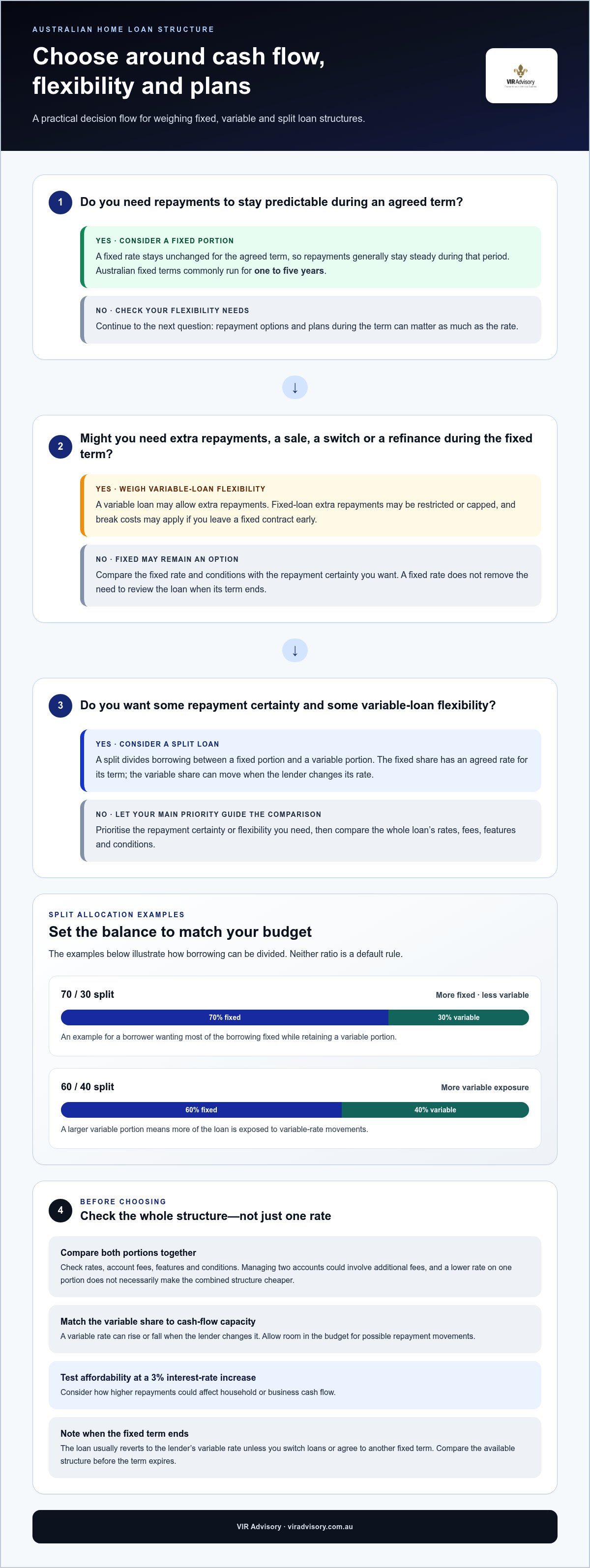
Choosing between fixed and variable home loan rates
Test your choice against how you earn, spend and plan, rather than relying on an interest-rate forecast. A salaried borrower with stable expenses may weigh the options differently from a self-employed borrower whose income changes during the year.
Fixed-rate home loan pros and cons
A fixed structure can suit borrowers who need a defined repayment amount for household budgeting. For example, a first home buyer managing regular bills may value knowing the loan commitment while adjusting to new housing costs. The trade-off is less flexibility if plans change during the term, so consider expected renovations, a sale or a change in employment before fixing.
Investors can compare the fixed term with their expected property plans. If they intend to hold the property and keep the loan structure unchanged, repayment certainty may help with cash-flow planning. If they expect to sell or restructure sooner, the timing of that decision is key to assessing whether a fixed arrangement fits.
Variable-rate home loan pros and cons
A variable structure may suit borrowers who value ongoing flexibility and can accommodate changes in repayments. A professional expecting a future income increase, for instance, may prefer options for managing the loan as their circumstances develop. But repayment changes can make budgeting less predictable, so assess available cash flow rather than relying on expected income alone.
For self-employed borrowers and company directors, income timing can matter as much as annual income. Consider whether business receipts arrive consistently enough to meet scheduled home-loan commitments during quieter periods. A variable arrangement may offer useful flexibility, but it doesn’t remove the need to manage personal commitments alongside business cash flow.
Use this comparison framework before selecting a rate loan:
- Map your plans: list likely changes to your income, property use or loan needs during the period under consideration.
- Review your cash flow: compare regular income with household costs and existing credit commitments.
- Match structure to timing: consider whether a fixed term aligns with how long you expect to keep the current loan arrangement.
- Compare lender offers: assess eligibility, repayment conditions, fees and features across the full loan, not only the headline rate.
For borrowers with mixed priorities, a split can be considered as a structure in its own right, but its suitability depends on the combined terms and how each portion fits the budget. Choose based on plans and repayment capacity you can support now, not an assumed direction for future rates.
VIR Advisory: Business Loans
VIR Advisory helps borrowers assess Home Loans and Refinancing solutions when comparing fixed, variable or split structures. For business owners and company directors, separating business commitments from household cash flow matters too. Business Loans may address business funding needs without treating a home loan as the only finance requirement.
Consider reviewing your loan structure when repayments are changing, a fixed term is approaching its end, or you’re weighing refinancing against staying with your current lender. VIR Advisory provides Financial strategy guidance to help assess loan features, repayment capacity and how home and business lending interact. Bring together your current loan details, expected cash flow and property plans so the options can be considered in context.
Contact VIR Advisory to discuss your home loan or business finance needs.
Make your next loan review count
Choosing between fixed and variable home loan rates in Australia is also a decision about timing. Before changing your loan, consider what may alter your income, expenses or property plans during the period you’re assessing. A change in employment, business cash flow or plans to sell can affect how much flexibility you need, even if the current repayment seems manageable.
Use your next loan review to bring those moving parts together. Set out your expected cash flow, likely property decisions and upcoming changes to your financial commitments. Then compare the loan structure with those priorities, rather than treating the interest rate as the only measure. If your circumstances change later, revisit whether the existing structure still fits before automatically switching or refinancing.
A clear comparison can turn an uncertain choice into a practical decision based on your plans and borrowing needs. Take time to assess the details, then choose the option that best fits your circumstances.
A considered review can help you make your next lending decision with greater clarity.
Frequently Asked Questions
What are home loan interest rates?
A home loan interest rate is the lender’s charge for allowing you to borrow money. It affects the interest component of repayments, while the loan balance, repayment schedule and structure also influence what you pay. For example, two borrowers offered the same rate may still have different repayment amounts if their balances or repayment types differ. Compare offers using the same borrowing amount and repayment assumptions.
What are the advantages of a split rate?
A split rate lets you allocate different portions of a loan to fixed and variable terms. This can help when your priorities differ across the borrowing: you might want one portion to support predictable household budgeting and another to suit planned repayments from a future bonus. Before choosing an allocation, decide how you’ll track each portion and keep its repayment and term details clear in your records.
What happens if interest rates increase or decrease?
A rate change can affect the interest charged on a variable portion and may alter its repayment requirements. If your lender changes the rate, review your next loan statement and scheduled debit rather than assuming your payment changed by a particular amount. If your household has several automatic payments, update your budget after the lender communicates the change, then check that enough funds remain in the repayment account.
What’s the best option?
The best fit depends on your income pattern, planned property decisions and capacity to handle repayment changes. Lenders assess applications using information such as income, expenses, existing debts and repayment capacity. Incomplete income records, high existing commitments or expenses that leave little room for repayments can complicate an application. Organise accurate records and review your budget before applying.
- Budget: Can your cash flow absorb repayment changes?
- Plans: Could your property or loan needs change?
- Evidence: Are income, expenses and debts clearly documented?
Who takes the risk?
Borrowers carry the direct budget impact of repayment changes and the consequences of choosing terms that don’t fit their plans. Lenders assess the risk of providing credit by reviewing the application and repayment capacity. For example, a borrower with variable income should consider whether quieter earning periods still leave room for scheduled repayments. Keeping personal and business commitments visible can help clarify that capacity.
How do RBA cash rate changes affect variable home loan rates in Australia?
RBA cash-rate decisions can influence variable home loan rates, but they don’t determine the exact rate a borrower pays. A practical step is to distinguish the RBA announcement from your lender’s communication about your own loan. Use the lender’s stated rate and repayment details when updating your household budget, rather than changing a scheduled payment based only on an announcement.
Can Australian borrowers make extra repayments or use an offset account on a fixed-rate loan?
Possibly, but the permitted features depend on the fixed loan’s terms. Before relying on extra repayments, read the loan documents for any limit and note whether it applies to the whole loan or a particular portion. If you keep savings for upcoming expenses, establish which account can hold those funds and whether that arrangement gives you the access you need.
Can borrowers split a home loan between fixed and variable rates in Australia?
Yes, borrowers can structure a home loan with fixed and variable portions. Keep a clear record of each portion’s balance, repayment details and term end date, as these may differ. For example, a borrower approaching the end of one fixed term can review that portion separately from the rest of the loan. This helps assess the next decision without overlooking the remaining borrowing.

Article by
Raina Doshi
Raina Doshi has worked in banking and finance since 2011, including experience with major Australian lenders. She helps homeowners, property investors, business owners and professionals secure and structure lending solutions across home loans, refinancing, commercial finance and business lending.
Areas of expertise include residential lending, investment property finance, debt recycling, commercial property finance, equipment finance, construction finance and strategic debt structuring.
Drawing on extensive banking and finance experience, Raina helps clients navigate lender requirements, improve borrowing outcomes and structure effective finance solutions.
Disclaimer
The information in this article is general in nature and does not take into account your personal objectives, financial situation or needs. Before acting on any information, consider whether it is appropriate to your circumstances and seek professional advice.


