

A business can be profitable on paper and still face a cash gap while customers take 30-90 days to pay. Invoice finance in Australia can release part of the value tied up in unpaid business invoices, helping cover working capital needs without relying on a new unsecured term loan. It’s still a finance facility with costs and obligations, so it’s important to understand how it works before deciding whether it suits your business.
That timing gap can affect wages, supplier payments and the ability to take on new work, even when customers are expected to pay. Invoice finance uses eligible receivables to support funding, with the advance and assessment shaped by factors such as invoice quality and customer payment risk.
This article explains how invoice and debtor finance work, how factoring differs from discounting, and which businesses may suit this type of funding. It also covers practical trade-offs, including who collects the invoices and how the facility may affect day-to-day cash flow.
Key Takeaways
- Assess whether your trading history, receivables and customer mix align with common lender eligibility criteria before applying.
- Choose between factoring and discounting by weighing who will manage collections and whether customer visibility matters to your business.
- Map how an advance, withheld balance and fees affect the cash available to meet operating costs.
- Invoice finance is generally better suited to businesses invoicing other businesses than those relying mainly on point-of-sale payments.
- Compare the facility’s costs and obligations with your cash flow needs so short-term funding doesn’t create avoidable pressure later.
What is Invoice and Debtor financing?
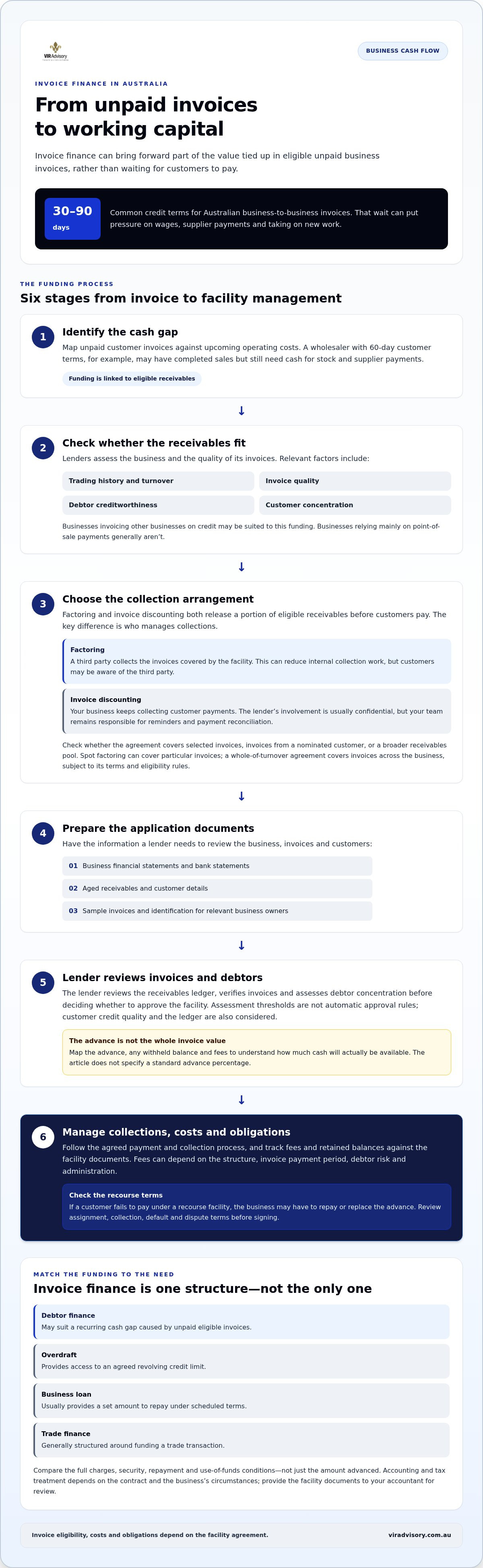
Invoice or debtor finance lets a business access funds against eligible unpaid invoices, rather than waiting for customers to settle them. Invoice finance in Australia commonly supports business-to-business invoices issued on 30-90-day credit terms.
Eligibility depends on the business and its receivables. Lenders assess factors such as trading history, turnover, invoice quality, debtor creditworthiness and customer concentration. Businesses that sell goods or services to other businesses on credit may be suited to this funding; those that mainly take payment at the point of sale generally aren’t.
Watch this video for a basic explanation of how invoice finance works:
For example, a wholesaler with 60-day customer terms may have completed sales but still need cash for stock and supplier payments. A finance facility can bring forward some invoice value, while the business remains responsible for the facility’s costs and agreed obligations.
Provider Fees and Eligibility Thresholds
These are assessment thresholds, not automatic approval rules. Lenders also assess the receivables ledger and customer credit quality.
Fees depend on the facility structure, invoice payment period, debtor risk and administration. Compare the full charges and conditions, not just the advance amount.
Comparing Invoice Finance Options
Unlike an overdraft, invoice finance is assessed against eligible receivables. An overdraft provides access to an agreed revolving credit limit. A business loan usually provides a set amount to repay under scheduled terms, while trade finance is generally structured around funding a trade transaction.
Choose a facility that matches the cash gap. Recurring unpaid invoices may suit debtor finance, while a defined purchase or broader funding need may call for another structure. The agreement sets the security, repayment and use-of-funds conditions.
Tax and Accounting Treatment
Accounting treatment depends on the contract structure and whether receivables are assigned, sold or used as security. Record advances, retained balances and fees consistently with the facility documents, and provide those documents to your accountant to determine the treatment for your business.
Tax treatment also depends on the transaction and the business’s accounting position. Don’t assume an advance is recorded as sales income, or that fees receive a particular tax treatment, without reviewing the arrangement.
Applications, Documents and Finance Risks
To apply, prepare business financial statements, bank statements, aged receivables, customer details, sample invoices and identification for relevant business owners. The lender reviews the ledger, verifies invoices and assesses debtor concentration before deciding whether to approve the facility.
Check whether the contract is with recourse. If a customer fails to pay, the business may have to repay or replace the advance. Confirm who collects invoices and whether customers are notified. Factoring can involve third-party collections, while discounting usually leaves collections with the business.
Australian protections depend on the facility agreement, its security arrangements and the parties involved. Review the contract’s assignment, collection, default and dispute terms before signing. For tax and legal interpretation, discuss the agreement and transaction details with the relevant professional.
What do Invoice Factoring and Invoice Discounting mean?
Invoice finance is the broader funding category; factoring and invoice discounting are two ways to structure a facility. The main difference is who collects customer payments and which invoices the agreement covers.
Factoring and Discounting Compared
With factoring, a third party collects unpaid invoices. With invoice discounting, the business keeps control of customer collections, and the lender’s involvement is usually confidential. Both arrangements can release a portion of eligible receivables before customers pay.
Compare collection responsibilities, customer notification terms and invoice eligibility rules. For example, a business that values direct control of customer relationships may prefer discounting, while one that needs collection support may consider factoring.
Invoice finance can be arranged around selected invoices or a broader receivables pool. Spot factoring funds particular invoices, which may suit a business with occasional cash gaps or a specific large job. A whole-of-turnover agreement covers invoices across the business, subject to the contract’s scope and eligibility rules.
Before choosing, map the invoices you want funded and when customers are expected to pay. Check whether the agreement requires all eligible invoices, invoices from a nominated customer, or only those selected for each funding request. These differences affect flexibility and administration.
Factoring and Collections Management
With factoring, the factor collects the invoices included in the facility, following the agreed process. This can reduce internal collection work, but customers may learn that a third party is involved. Review how payment instructions and overdue follow-ups will be communicated.
With discounting, your business keeps collecting payments, so your team continues issuing reminders and reconciling receipts. This preserves direct contact but requires consistent ledger records and prompt allocation of payments to the correct invoices.
Customer notification is a contractual and practical distinction, not just a label. If customers pay the factor directly, tell relevant staff how to direct remittances and handle queries. If your business collects payments under discounting, reconcile receipts promptly and meet the facility’s reporting requirements.
Distinguish recourse from collections. Collections describe who pursues payment; recourse determines what happens if an invoice remains unpaid or is disputed. A business could keep responsibility for collections under discounting and still face repayment obligations under its agreement.
Before assessing a facility, identify who collects, which invoices qualify, whether customers are notified and what happens when payment is late. This comparison helps align the contract with your receivables process.
How debtor finance advances funds against unpaid invoices
Debtor finance advances funds against eligible unpaid invoices, using their value and payment prospects to determine the amount available. Australian providers may advance 80-85% of an invoice, with the balance dealt with after the customer pays.
Once an invoice has been issued and verified, funds may be released within 24-48 hours. The timing and amount depend on verification, debtor quality and the facility’s advance rate.
Advance Percentages and Invoice Balances
For an illustrative A$20,000 invoice at an 85% advance rate, the initial advance is A$17,000. The remaining 15% is not automatically available as immediate cash; it is retained until the customer settles the invoice.
The amount released after the customer pays can depend on the fees and adjustments in the agreement. Check the agreement to see how fees and adjustments affect the final release.
Advance Rates and Borrowing Capacity
An advance rate sets the proportion of an approved invoice’s value available upfront.
That percentage alone doesn’t establish total borrowing capacity. The lender also assesses which invoices meet eligibility rules, how much customers owe and whether the ledger shows reliable payment patterns. Disputed, overdue or otherwise ineligible receivables can reduce the amount available.
For a business with several approved invoices, available funding depends on the eligible receivables pool and facility limit. A strong ledger can support a larger available balance, while reliance on one debtor or slow payment patterns may constrain it.
Invoice Payments and Released Balances
When the customer pays, the payment is applied to the relevant invoice and reconciled against the facility’s advance. The retained balance can then be released, less applicable fees and any agreed deductions. Under factoring, the factor collects payment; under discounting, the business generally continues collecting.
Track each invoice in sequence: record the amount issued, confirm the verified value, calculate the advance, then reconcile the customer’s payment and final balance.
Funding speed also depends on invoice verification. Providers may make an advance within 24 hours of an invoice being raised, while release can take 24-48 hours after verification. Keep invoice records and delivery evidence organised so verification doesn’t delay cash needed for wages, stock or supplier payments.
How invoice finance works
Invoice finance makes some cash tied up in eligible receivables available before the customer pays. A lender assesses the business, its ledger and the invoices submitted, then sets the facility terms and advance amount.
For example, a wholesaler may have delivered stock and issued an invoice but need funds for its next supplier order. Subject to the lender’s verification and contract requirements, the facility can connect that receivable to working capital.
Invoice finance at a glance
Business and ledger information → Lender assessment → Invoice verification → Advance under facility terms → Customer payment and reconciliation
Key checks: invoice eligibility, debtor concentration, payment status, reporting duties and recourse terms.
The process begins when the business supplies the information the lender needs to assess the facility. Financial records and an accounts receivable ledger show customer balances, invoice dates and payment status. Accurate entries help distinguish current receivables from overdue amounts and invoices subject to a credit note.
The lender then reviews the debtors and invoices. The assessment may consider customer credit quality, ledger concentration and whether each receivable meets the facility’s eligibility rules. If the business relies heavily on one customer, understand how that exposure affects the assessment and funding available.
Before accepting an offer, examine the advance calculation, fees, reporting obligations, security and recourse provisions. These terms determine how the facility operates, which records the business must maintain and what happens if an invoice isn’t paid as expected.
After supplying goods or completing services, the business issues an invoice and submits it with any supporting records required by the lender. Verification checks that the receivable is valid under the facility. Keep delivery evidence and customer correspondence organised, particularly for staged work or a complex order.
After receiving an advance, the business still needs to manage its cash commitments. Match expected customer receipts against planned payments to suppliers, staff and other operating costs. This makes the timing of the advance visible in the cash forecast rather than treating it as unrestricted cash.
When the debtor pays, allocate the payment to the correct invoice and reconcile it under the agreement. For example, a part-payment or customer dispute can change the receivable balance, so update the ledger and follow the facility’s reporting process promptly. An unreconciled amount can complicate later funding requests.
Invoice finance can address a timing gap between issued invoices and business outgoings, but it doesn’t remove the customer’s payment obligation or the business’s contractual duties. Review the facility alongside the cash forecast to understand how advances, collections and outstanding balances affect day-to-day working capital.
Businesses and industries suited to invoice finance
Invoice finance generally suits Australian businesses that sell goods or services to other businesses on credit. It can be a clear fit when the business has accounts receivable from completed work and operating costs due before customers are expected to pay.
Industry alone doesn’t determine suitability. A manufacturer supplying components to commercial clients may invoice after dispatch, while a recruitment firm may bill a company after a placement begins. In either case, the lender can assess the invoices, debtor payment record and customer concentration rather than relying on the industry label alone.
Businesses taking payment at point of sale, such as a shop selling directly to the public, generally have fewer qualifying receivables. A café collecting payment at checkout has little outstanding B2B debt to fund. By contrast, a catering company invoicing corporate clients after an event may have receivables that better match this funding structure.
Use this practical fit check before preparing an application:
- Identify the paying customer. Separate invoices owed by businesses from sales paid immediately by consumers.
- Check what the invoice represents. Distinguish completed work from deposits, draft invoices, credit notes and disputed amounts.
- Review customer concentration. Consider whether one debtor accounts for most receivables or whether payments come from several customers.
- Match receipts to outgoings. Compare expected customer payments with costs such as wages, materials or supplier invoices.
Project-based businesses can face a particular timing mismatch. For example, an IT services firm may invoice a corporate client after completing a project phase while paying specialist subcontractors before the client settles. Funding against eligible receivables may help bridge that gap, but it won’t resolve disputed work or replace a reliable collection process.
Confidentiality may also shape the decision. Invoice discounting is generally confidential, so customers usually aren’t aware that a lender is involved; factoring assigns collections to a third party. A professional services firm that manages client relationships closely may weigh customer contact and internal collection capacity against its working capital needs.
Before applying, map customer types, invoice terms, payment patterns and recurring disputes. A business facing cash pressure from delayed commercial receipts may be a closer fit than one whose main issue is weak sales or consumer point-of-sale income. Specify how each proposed advance would meet an operating cost and how expected receipts will support the facility’s obligations.
VIR Advisory: Business Loans
VIR Advisory can help assess whether a business loan or another funding structure better matches your cash flow requirements. This can be useful when the funding need extends beyond eligible invoices, or when repayments and facility terms need to be considered alongside existing business commitments.
The assessment can consider the purpose of the funds, current liabilities, repayment capacity and how customer payment timing affects working capital. If invoice finance is under consideration, these details help clarify whether receivables-based funding aligns with the business’s cash cycle or whether a business loan may better suit a defined expense.
VIR Advisory also provides financial strategy guidance and refinancing solutions for reviewing existing debt structures. Contact VIR Advisory to discuss your business funding requirements.
Set your next funding decision around the cash gap
Before selecting a facility, map the timing difference between customer receipts and essential outgoings. Then identify whether the pressure comes from delayed B2B payments, a defined purchase, or a wider funding requirement. That distinction helps frame an application and compare invoice finance with other borrowing structures.
Invoice finance in Australia should be assessed against the available receivables, collection process and facility repayment obligations. If the need extends beyond unpaid invoices, a business loan or refinancing may be a relevant alternative; home loans address a separate personal or property borrowing need. The right structure depends on the purpose of the funds, cash flow and the obligations the business can manage.
Bring your receivables information, upcoming commitments and funding purpose to a discussion with VIR Advisory. A clear picture of these details makes it easier to consider finance options that fit your business requirements.
A considered funding decision starts with a clear view of what needs to be paid and when. That gives you a practical basis for deciding what to do next.
Frequently Asked Questions
How fast can I get funded?
Funding can be released within 24-48 hours of invoice verification. The timeline depends on how quickly the lender verifies the invoice and receives the required information. For example, a business submitting a clear invoice and delivery evidence can avoid delays caused by missing records. Build verification time into your cash forecast, rather than treating the expected advance date as the day funds are requested.
What can I do if my business doesn’t meet the eligibility criteria?
First, identify the specific issue: it may be the trading record, debtor profile, invoice status or requested facility size. Then organise current accounts receivable records, resolve invoice disputes and review customer concentration before applying again. If the cash need relates to a purchase rather than unpaid invoices, compare a business loan or another suitable funding structure instead of relying on receivables finance.
What happens if my customer doesn’t pay their invoice?
The outcome depends on the agreement’s recourse terms. With recourse, the business may have to repay the advance or replace the unpaid invoice if the debtor fails to pay. A disputed invoice can also affect eligibility and the amount available. Before signing, locate the clauses covering late payment, insolvency, disputes and replacement invoices, then assess whether the business can meet those obligations.
What is invoice finance in Australia and how does it work?
Invoice finance gives a business access to funding against eligible receivables before customers pay. After reviewing the business and its invoices, the lender establishes the facility terms and advances funds against approved invoices. Customer payment then settles the receivable, with any remaining balance handled under the agreement. For planning, match each expected invoice receipt to the supplier, wage or other expense it needs to cover.
What types of invoice finance are available in Australia, including invoice factoring and discounting?
Common structures include invoice factoring, invoice discounting and selective invoice funding. Factoring assigns collections to a third party, while discounting generally leaves collections with the business and is usually confidential. Selective funding applies to chosen invoices; broader arrangements may cover a wider receivables pool. Compare collection processes, customer notification, invoice coverage and recourse provisions before choosing a structure.
What are typical invoice finance fees, interest rates and advance rates in Australia?
Australian factoring fees generally range from 1.5% to 4.5% of the invoice amount. Invoice finance interest rates generally start at 7.99% p.a. and can reach 20% p.a. or higher for high-risk borrowers. Providers may advance 80-85% of an outstanding invoice’s value. Compare the total charges, how they accrue, and the balance released after payment, not just the advance percentage.
Which Australian invoice finance providers are available, and how do their fees and terms compare?
Australian businesses can assess invoice finance offers from providers operating in the local market; fees and terms vary by facility and applicant. Compare the advance rate, fee basis, interest, minimum facility limit, invoice coverage, customer notification and recourse conditions in each written offer. A lower headline rate may not mean a lower overall cost if other charges or reporting obligations apply. Compare equivalent facility structures for a fair assessment.
What eligibility requirements do Australian invoice finance lenders have for businesses and invoices?
Lenders commonly assess trading history, turnover, customer credit quality, debtor concentration and the reliability of the receivables ledger. Eligible invoices generally relate to completed business-to-business sales, with clear payment obligations and no unresolved dispute that could affect collection.

Article by
Raina Doshi
Raina Doshi has worked in banking and finance since 2011, including experience with major Australian lenders. She helps homeowners, property investors, business owners and professionals secure and structure lending solutions across home loans, refinancing, commercial finance and business lending.
Areas of expertise include residential lending, investment property finance, debt recycling, commercial property finance, equipment finance, construction finance and strategic debt structuring.
Drawing on extensive banking and finance experience, Raina helps clients navigate lender requirements, improve borrowing outcomes and structure effective finance solutions.
Disclaimer
The information in this article is general in nature and does not take into account your personal objectives, financial situation or needs. Before acting on any information, consider whether it is appropriate to your circumstances and seek professional advice.


