

Securing the lowest interest rate is often the least significant factor in the long-term cost of your mortgage. While a competitive rate is important, the underlying framework of your debt determines whether you can actually access your equity or if you'll be trapped by restrictive lender policies when your circumstances change. Many borrowers realise too late that a rigid setup has hampered their borrowing capacity or resulted in missed tax benefits on investment properties.
We understand the frustration of choosing between an offset account and a redraw facility without a clear explanation of how each impacts your liquidity. Learning how to structure a home loan effectively allows you to configure your mortgage components to maximise interest savings and align with Australian lender requirements. This article provides a technical breakdown of split loans, offset strategies, and the specific frameworks required to support future property acquisitions while maintaining a healthy cash flow.
Key Takeaways
- Understand why the configuration of your mortgage components often has a greater impact on the total cost of debt than the headline interest rate alone.
- Identify the mechanical differences between offset accounts and redraw facilities to ensure you maintain liquidity while protecting the tax deductibility of investment debt.
- Learn how to structure a home loan by separating non-deductible personal debt from deductible investment debt to facilitate efficient equity release for future property acquisitions.
- Avoid common structural mistakes, such as over-fixing loan terms, which can result in significant exit fees and restricted flexibility during a refinance.
- Align your mortgage framework with specific lender assessment criteria to ensure your debt setup supports long-term borrowing capacity and cash flow stability.
Understanding Home Loan Structure and Its Impact on Cash Flow
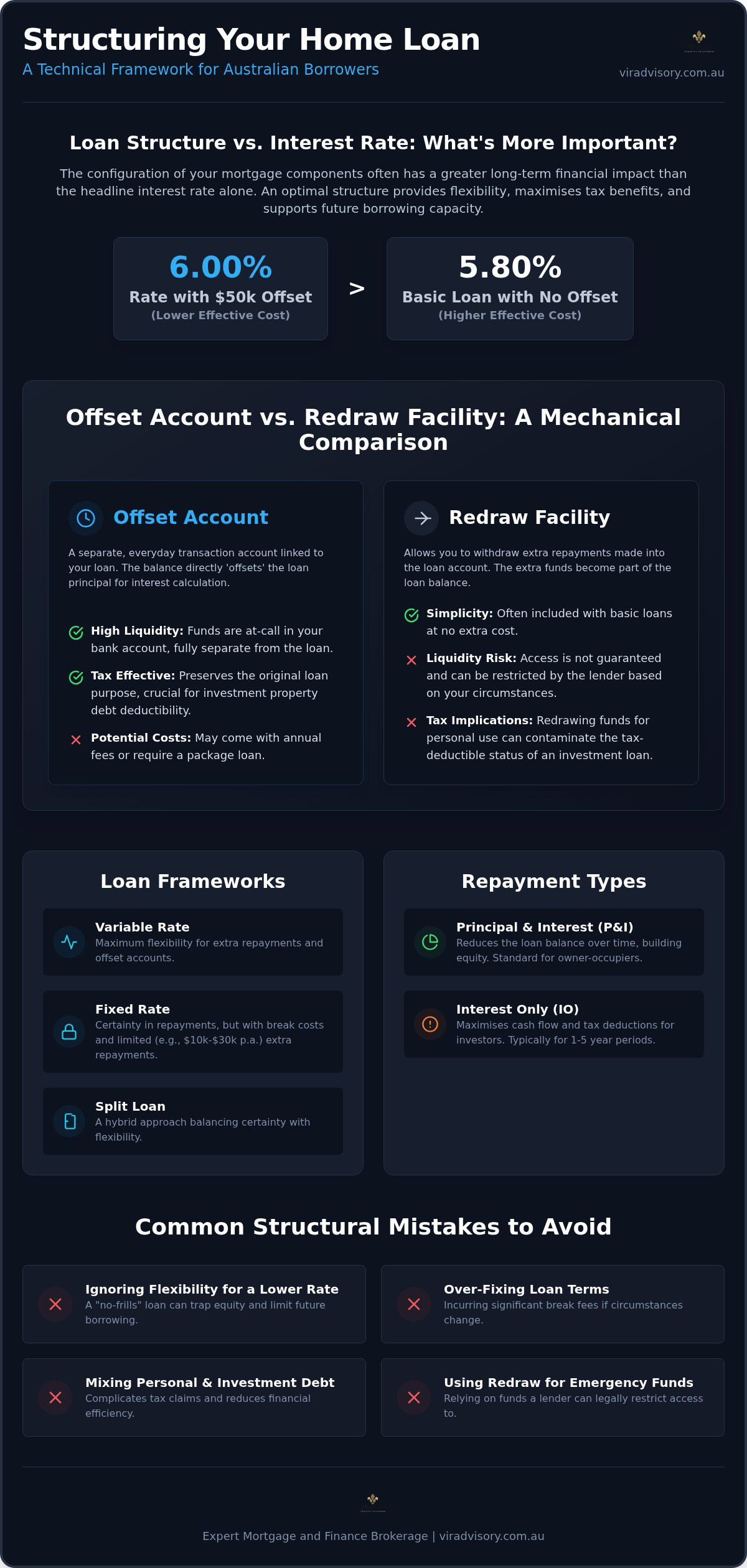
Loan structure refers to the technical configuration of your mortgage, encompassing interest rate types, repayment methods, and linked facilities like offset accounts. While many borrowers fixate on the headline interest rate, the structural design often has a more profound impact on the total cost of ownership. For instance, a borrower with a 6.00% rate and a fully linked offset account containing $50,000 will often pay less total interest than a borrower on a 5.80% "no-frills" basic loan with no offset capability. This is because every dollar in the offset account reduces the daily interest charge, providing a level of liquidity that a basic loan cannot match.
Your Loan-to-Value Ratio (LVR) acts as the primary gatekeeper for these options. Lenders typically reserve the most flexible structures, such as interest-only repayments or higher borrowing limits, for applicants with an LVR of 80% or lower. Understanding how to structure a home loan involves balancing these technical requirements with your specific cash flow needs to ensure the debt remains manageable throughout its term.
Principal and Interest vs Interest Only Repayments
Lenders generally permit Interest Only (IO) periods for one to five years, though these are subject to stricter assessment criteria and higher interest rates. While IO repayments improve short-term cash flow, they increase the total interest paid over the life of the loan because the principal balance remains stagnant. Investors frequently use IO structures to prioritise tax-deductible debt while redirecting surplus cash to pay down non-deductible home debt. Conversely, owner-occupiers usually benefit from Principal and Interest (P&I) repayments to build equity and reduce long-term risk.
Variable, Fixed, and Split Loan Frameworks
Variable rates provide the greatest flexibility, allowing for unlimited extra repayments and immediate redraw access. This is ideal for borrowers with fluctuating income or those planning to sell in the near future. Fixed rates offer budget certainty but come with the risk of high break costs and limited additional repayment caps, usually around $10,000 to $30,000 per year depending on the lender's policy. A "Split Loan" strategy combines these frameworks. By fixing a portion of the debt for stability and keeping the remainder variable for offset access, you can hedge against market fluctuations without sacrificing the ability to reduce interest through your savings.
Strategic Components: Offset Accounts and Redraw Facilities
An offset account is a transactional bank account linked directly to your mortgage. The balance in this account is subtracted from your loan balance before interest is calculated, which occurs daily. In contrast, a redraw facility allows you to withdraw any additional repayments you've made above the minimum requirement. While both mechanisms aim to reduce interest, their impact on your tax position and liquidity differs significantly. Understanding these nuances is a core part of learning how to structure a home loan for long-term flexibility.
Lender policies regarding redraw access vary between institutions. Some allow instant transfers via mobile apps, while others may impose daily limits or processing delays. It's also vital to recognise that redraw access is rarely a "guaranteed" right; banks technically reserve the power to restrict redraw if your financial situation changes or the property value drops significantly. This makes the offset account a more robust choice for those prioritising immediate access to their cash.
Maximising Interest Savings with Offset Accounts
Strategic use of an offset account involves directing all income, including salaries and rental payments, into the account to keep the daily loan balance as low as possible. Many Australian lenders now offer multiple offset accounts under one loan facility. This setup allows you to organise your savings for specific purposes, such as tax provisions, school fees, or emergency funds, while every cent still works to reduce your interest bill.
Consider a $500,000 mortgage with an interest rate of 6.00% per annum. By maintaining $50,000 in a linked offset account, you only pay interest on $450,000. This configuration saves approximately $250 in interest charges every month, which effectively increases your principal reduction without requiring extra cash flow. If you're unsure which configuration suits your current income, you might find it helpful to book a strategy session to review your options.
Redraw Facilities: Benefits and Liquidity Risks
Redraw facilities are typically found on "basic" home loans which often feature lower or no annual fees compared to "package" loans. However, the tax implications of redraw are complex for future investors. If you redraw funds from an owner-occupied loan for personal use and later convert that home into an investment property, the redrawn portion of the debt may not be tax-deductible. The Australian Taxation Office (ATO) views a redraw as a new borrowing, and the purpose of that borrowing determines its deductibility status.
Package loans that include offset accounts usually carry an annual fee, often around $395. For many professionals and investors, this cost is easily justified by the tax flexibility and interest savings provided. Choosing between a basic loan with redraw and a premium package with offset depends on your future investment plans and how frequently you need to access your surplus cash without triggering tax complications.
Structuring for Purpose: Owner-Occupiers vs Property Investors
The primary objective of debt architecture is to distinguish between non-deductible debt, associated with your principal place of residence (PPOR), and deductible debt, which relates to income-producing assets. When determining how to structure a home loan, the goal for owner-occupiers is typically rapid debt reduction, whereas investors often prioritise tax efficiency and capital growth. Maintaining separate loan accounts for each purpose is essential for clean accounting and ensuring that interest claims remain compliant with Australian Taxation Office (ATO) requirements.
Lenders apply different assessment criteria based on the loan purpose. Investment loans generally attract higher interest rates and require more rigorous servicing calculations, as banks often apply a "shade" or discount to rental income when testing your borrowing capacity. Effective structuring at the outset ensures you can release equity for future acquisitions without cross-collateralising your properties, which keeps each asset's risk profile isolated and provides greater control over your portfolio.
Effective Structures for Principal Places of Residence (PPOR)
For a home loan, the most effective strategy involves directing all surplus cash flow into a linked offset account. This reduces the non-deductible interest expense while keeping funds accessible for personal use. To avoid "lazy equity," where capital sits idle in the property, you can establish an equity split or a standby facility. This allows you to access the increased value of your home for investment purposes without needing to apply for a completely new loan from scratch when an opportunity arises. Lenders often offer the most competitive rates for owner-occupiers with a Loan-to-Value Ratio (LVR) below 80%, as this represents a lower risk to the institution.
Investment Loan Structuring and Debt Recycling
Debt recycling is a methodical strategy used to convert non-deductible home debt into deductible investment debt. This involves using surplus cash or equity to pay down a portion of the home loan and then immediately redrawing those funds into a separate investment loan account to purchase income-producing assets. By doing so, the interest on that redrawn portion becomes tax-deductible. Many investors utilise Interest Only (IO) periods on these accounts to maximise cash flow, allowing them to redirect the saved principal repayments toward their non-deductible home loan balance.
While debt recycling can accelerate the reduction of a home mortgage, it carries inherent risks. Market volatility can affect the value of the underlying investment, and changes in interest rates may impact the cost of servicing the debt. This strategy requires a long-term outlook and a stable income to manage the increased complexity of the loan framework. Ensuring your lender's policy allows for multiple loan splits is a critical step in making this structure functional.
Common Mistakes in Loan Structuring and How to Avoid Them
Many borrowers prioritise interest rates on comparison sites, but this often leads to a restrictive technical setup. Focusing on the rate before the framework can result in a mortgage that lacks the flexibility required for future property acquisitions or changes in income. A "Structure First, Rate Second" checklist ensures you select a lender whose policies align with your long-term objectives before negotiating the cost of the debt. Learning how to structure a home loan correctly involves verifying that your chosen product supports multiple offset accounts, allows for easy equity release, and provides a clear mechanism for debt recycling.
Over-fixing the loan balance is another frequent error. While a fixed rate provides repayment certainty, it introduces significant exit fees if you sell, refinance, or make large repayments during the term. These break costs can be substantial, particularly in a falling interest rate environment where the bank's loss is calculated against current market yields. A "set and forget" mentality often leads to missed opportunities. A structure that served your needs years ago may no longer be efficient if your equity has increased or lender assessment criteria have shifted, potentially leaving you with an uncompetitive product or restricted access to capital.
The Risks of Cross-Collateralisation
Cross-collateralisation occurs when a lender uses more than one property as security for a single loan or a suite of loans. While this is often the simplest path for a bank to approve an application, it grants them excessive control over your portfolio. If you decide to sell one property, the lender may require you to use the sale proceeds to pay down other debts to maintain a specific Loan-to-Value Ratio (LVR), rather than allowing you to keep the cash for your next investment. Keeping each property "standalone" with its own separate loan facility ensures your assets remain independent and your equity stays accessible. This methodical separation is a core component of professional debt management.
Misalignment of Loan Terms and Financial Goals
Choosing a standard 30-year term is common, but it's not always the most efficient choice for professionals with stable cash flow. Reducing the term to 25 or 20 years can save significant interest over the life of the loan. It's also vital to consider how personal liabilities impact your borrowing capacity. Even a credit card with a $10,000 limit can reduce your maximum loan amount by approximately $45,000 due to how lenders assess potential risk. Similarly, HECS/HELP debt is assessed based on your gross income, which can dampen your servicing results. Understanding these nuances is why some borrowers find that one bank says no while another says yes.
The VIR Advisory Approach to Custom Lending Strategies
Identifying the optimal mortgage framework requires an expert understanding of the diverse and often conflicting policies held by Australian lenders. At VIR Advisory, we specialise in debt optimisation, ensuring that your loan components are configured to support your specific financial objectives rather than simply fitting a generic bank product. A regular mortgage health check is a vital component of this approach, as it ensures your current structure remains relevant as market conditions shift and your equity position evolves. This unhurried, evidence-based review helps to diminish the stress often associated with complex financial transitions by providing a clear, logical overview of your options.
Understanding how to structure a home loan involves more than selecting a feature; it requires a methodical match between your income profile and a lender's specific appetite for risk. For self-employed borrowers or professionals with complex bonus structures, the choice of lender can be the difference between a standard approval and a restrictive, high-LVR requirement. We take the time to listen and provide decisive, high-value input that ensures your loan setup is robust enough to handle future acquisitions and changing market variables.
Navigating Lender Policies and Approval Requirements
Lender policies vary significantly in how they assess different income streams. Some institutions may apply a 20% shade to rental income, while others are more generous, allowing for higher borrowing capacity. Presentation to a credit assessor is critical, especially when explaining self-employed distributions or irregular commission payments. A professional broker acts as a technical intermediary, ensuring your application is viewed through the most favourable lens by providing a structured, well-evidenced case. This strategic oversight is particularly useful when deciding whether debt consolidation or refinancing is the more appropriate solution for your specific cash flow requirements.
Expert Mortgage Brokerage for Professional Borrowers
High-net-worth individuals and company directors often require bespoke structures that standard retail banking channels struggle to accommodate. With over 15 years of banking experience, including a decade within major Australian banks, our founder Raina Doshi brings a depth of technical knowledge to every application. We focus on securing favourable lending terms that respect the complexity of your business entities and personal assets, ensuring your residential and commercial debt is perfectly aligned with your broader financial strategy. By navigating diverse lender assessment criteria with precision, we provide a stable anchor for your property and business finance requirements.
Submit your enquiry for a strategic loan review
Optimising Your Mortgage Framework for Long-Term Stability
Structuring your mortgage correctly is a technical exercise that requires a deep understanding of lender assessment criteria and tax-effective debt management. By prioritising the framework over the headline interest rate, you ensure your debt remains flexible enough to support future property acquisitions while protecting your liquidity. Avoiding common structural errors, such as cross-collateralisation or excessive fixed terms, is essential for maintaining control over your assets. It's important to remember that a structure that works today must also align with your future borrowing capacity and cash flow needs.
Raina Doshi brings over 15 years of banking and finance experience to ensure every client receives a methodical strategy tailored to their specific income profile. Whether you require comprehensive lending solutions across residential, commercial, or SMSF sectors, the focus remains on precise execution and long-term stability. Learning how to structure a home loan effectively is the first step toward reducing interest costs and optimising your total borrowing capacity without sacrificing the ability to access your equity when it's needed most.
We look forward to providing the professional oversight and meticulous attention to detail required to secure a robust financial foundation for your property portfolio.
Frequently Asked Questions
Can I change my home loan structure after the loan has settled?
Yes, you can modify your loan structure after settlement by requesting a loan variation or refinancing to a different product. Lenders often allow you to switch from principal and interest to interest-only repayments, provided you meet their current servicing requirements. You can also split an existing variable loan to fix a portion of the debt. If you're currently in a fixed-rate period, changing the structure may trigger significant break costs.
What is the most tax-efficient home loan structure for Australian investors?
The most tax-efficient structure typically involves an interest-only loan with a linked offset account to maximise deductible interest while preserving cash for non-deductible debt. By keeping your investment debt separate from your home loan, you ensure that the interest remains fully deductible under ATO guidelines. Learning how to structure a home loan this way allows you to redirect your surplus cash flow to pay down your non-deductible home mortgage faster.
How does an offset account affect my borrowing capacity with other lenders?
An offset account generally doesn't increase your borrowing capacity, as lenders assess your ability to repay the full loan limit regardless of the offset balance. However, having significant savings in an offset account demonstrates strong financial conduct and a solid asset position, which can support your application. Some lenders may look more favourably on your overall risk profile if you have substantial liquid buffers available to cover unexpected changes in your income.
Is a split loan better than a fully fixed loan in 2026?
A split loan is often superior to a fully fixed loan because it combines budget certainty with the technical flexibility of a variable rate. By fixing a portion, you protect yourself against interest rate increases; the variable portion allows you to utilise an offset account or make unlimited extra repayments. This balanced approach ensures you aren't locked into a rigid structure that prevents you from reducing your interest charges as your savings grow.
What exactly is cross-collateralisation and why should I avoid it?
Cross-collateralisation occurs when a lender uses multiple properties as security for a single loan facility. You should avoid this because it gives the bank total control over your assets. If you sell one property, the bank can dictate how the sale proceeds are distributed across your remaining debt rather than allowing you to use the cash for your next acquisition. Keeping properties standalone with separate loan accounts ensures your equity remains accessible and your portfolio flexible.
How often should I review my home loan structure with a mortgage broker?
You should review your mortgage structure at least every 12 to 18 months or whenever your financial circumstances change significantly. Regular health checks ensure your current setup still aligns with the latest lender policies and competitive market rates. A review is particularly important if you're planning to transition from an owner-occupier to an investor, as the optimal way how to structure a home loan shifts when tax deductibility becomes a priority.
Do all Australian lenders offer 100% offset accounts on fixed-rate loans?
No, most Australian lenders do not offer 100% offset accounts on fixed-rate products; these are typically reserved for variable-rate loans. A small number of specialist lenders provide this feature, but it often comes with a higher interest rate or specific fee requirements. If you require a fixed rate but want to save interest with your savings, a split loan is usually the most practical alternative to access the benefits of an offset account.
What is the difference between a basic home loan and a packaged home loan?
A basic home loan offers a lower interest rate with fewer features, whereas a packaged loan includes an offset account and credit card for an annual fee. Basic loans often have redraw facilities but lack the full liquidity and tax flexibility of a linked offset account. Professionals and investors often prefer packaged structures because the interest savings and tax benefits frequently outweigh the cost of the annual package fee, which is often around $395.

Article by
Raina Doshi
Raina Doshi has worked in banking and finance since 2011, including experience with major Australian lenders. She helps homeowners, property investors, business owners and professionals secure and structure lending solutions across home loans, refinancing, commercial finance and business lending.
Areas of expertise include residential lending, investment property finance, debt recycling, commercial property finance, equipment finance, construction finance and strategic debt structuring.
Drawing on extensive banking and finance experience, Raina helps clients navigate lender requirements, improve borrowing outcomes and structure effective finance solutions.
Disclaimer
The information in this article is general in nature and does not take into account your personal objectives, financial situation or needs. Before acting on any information, consider whether it is appropriate to your circumstances and seek professional advice.


