

Why continue paying the full cost of your mortgage when a portion of that interest could be working to reduce your tax bill? Debt recycling Australia is a structural lending strategy that allows homeowners to convert non-deductible mortgage debt into tax-deductible investment debt. This is achieved by paying down a portion of your principal home loan and immediately redrawing those funds into a separate investment loan account to purchase income-producing assets. By redirecting the resulting investment income and tax savings back into the non-deductible loan, you can accelerate mortgage repayment while building an investment portfolio tax-effectively.
You likely recognise that your home loan is your most significant after-tax expense, and with the cash rate at 4.35%, the cost of non-deductible debt is substantial. This article provides a clear framework for debt conversion using proven Australian lending structures to help you manage cash flow more effectively. We will examine the methodical setup of loan splits, the impact of recent tax reforms on residential property, and the specific lender requirements you must meet to ensure your strategy remains compliant with Australian taxation rules and banking policies.
Key Takeaways
- Understand how to legally convert non-deductible home loan interest into tax-deductible debt to improve your net cash flow and tax position.
- Learn the methodical 5-step framework for debt recycling Australia, focusing on equity assessment and the precise setup of separate loan accounts.
- Recognise lender requirements for equity release, including why maintaining an 80% Loan-to-Value Ratio (LVR) is essential for cost-effective loan structuring.
- Identify critical risk management strategies to avoid mixing investment funds with personal accounts, ensuring a clear audit trail for the ATO.
- Discover how comparing lender policies and professional debt management can accelerate your mortgage repayment while building an investment portfolio.
What is Debt Recycling in Australia?
Debt recycling Australia is a structural lending strategy where you replace non-deductible debt, such as a standard home loan, with deductible debt used for investment. The primary objective is to convert the interest you pay into a tax deduction, thereby reducing your overall tax liability while simultaneously building an investment portfolio. Unlike a typical investment loan used to purchase a new property, debt recycling utilises the existing equity in your primary place of residence (PPOR) to fund the acquisition of income-producing assets like shares or managed funds.
The Australian Taxation Office (ATO) maintains strict guidelines regarding the deductibility of interest, focusing primarily on the purpose of the borrowing rather than the security used for the loan. If the funds are redrawn specifically to purchase assets that generate assessable income, the interest costs are generally deductible. This allows you to utilise your home's equity without increasing your total debt level, provided you pay down the non-deductible portion before redrawing the funds into a separate, dedicated investment split.
The Difference Between Deductible and Non-Deductible Debt
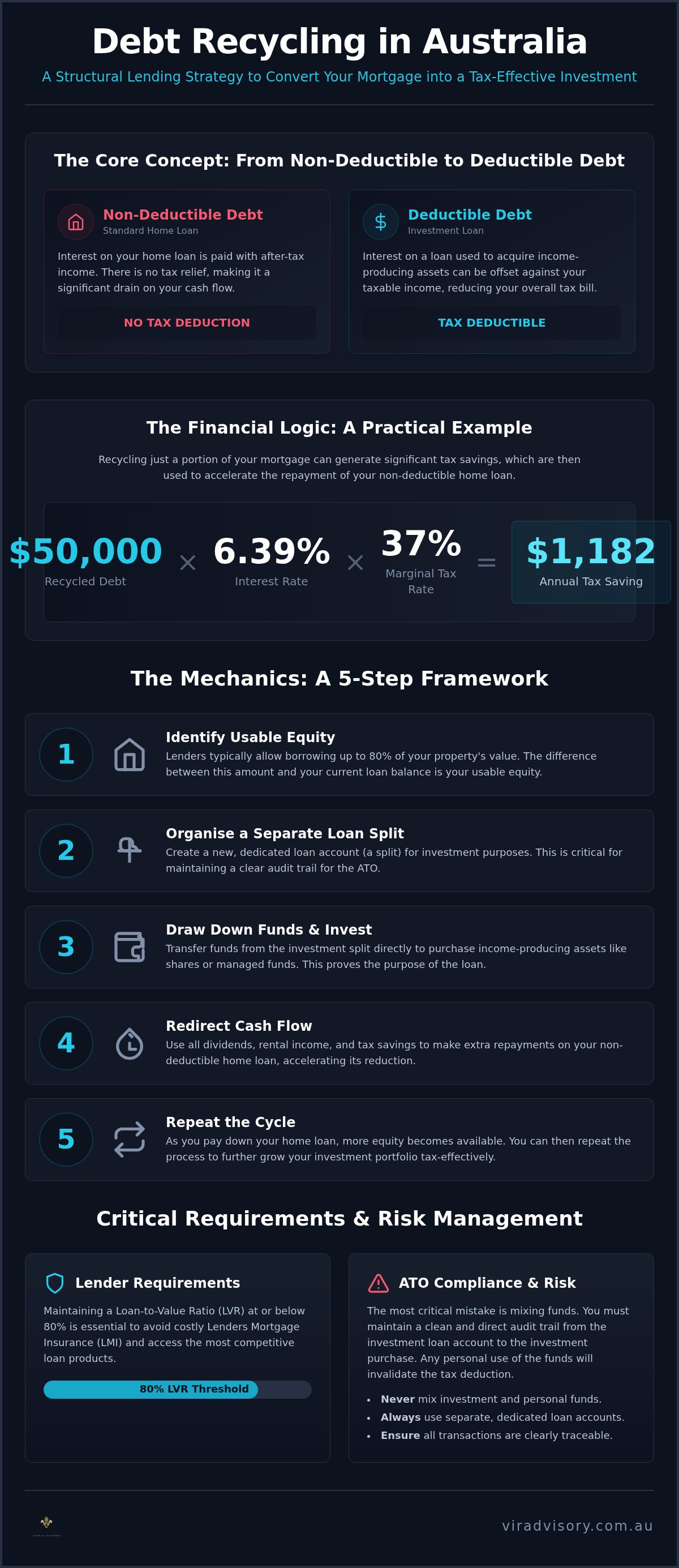
Interest charged on a standard mortgage loan for your home is classified as non-deductible. This means you must earn income, pay tax on it at your marginal rate, and then use the remaining funds to cover the interest. It's a significant drain on cash flow because there is no tax relief available for these payments. In contrast, interest on debt used for investment purposes can be offset against your taxable income, effectively reducing the net cost of the loan to an after-tax figure. This structural change is particularly effective for high-income earners in the 37% or 45% tax brackets.
For Australian tax purposes, assessable income includes all gross income received, such as salary, dividends, or rent, that must be declared in a tax return before any allowable deductions are subtracted.
The Financial Logic of Recycling Debt
The efficiency of this strategy lies in how you use the resulting tax savings to accelerate debt reduction. By directing tax refunds and any investment income, such as dividends or rent, back into your non-deductible home loan, you reduce the principal at a faster rate than through standard repayments alone. This creates a managed momentum where your non-deductible debt shrinks while your deductible debt and investment assets grow simultaneously.
Consider a homeowner with a $500,000 mortgage. If they pay an additional $50,000 into the loan and then redraw that same $50,000 into a separate investment loan split to buy shares, their total debt remains $500,000. However, the interest on that $50,000 split is now tax-deductible. At a 37% marginal tax rate and an investment loan rate of 6.39%, this simple restructure generates an annual tax saving of approximately $1,182, which can be immediately applied to the remaining $450,000 home loan balance.
The Mechanics of Debt Recycling: A 5-Step Framework
Implementing debt recycling Australia involves a structured sequence of lending actions rather than a single transaction. To ensure the strategy remains compliant with Australian Taxation Office (ATO) requirements, you must follow a methodical 5-step framework designed to maintain clear separation between different debt purposes.
- Step 1: Identify usable equity. Lenders typically allow you to borrow up to 80% of your property's value without incurring Lenders Mortgage Insurance (LMI). If your home is worth $1,000,000 and your mortgage is $600,000, you potentially have $200,000 in usable equity.
- Step 2: Organise a separate loan split. Your broker will help you partition a portion of your home loan into a new, dedicated investment account. This is not a new loan application in the traditional sense but a restructure of your existing debt.
- Step 3: Draw down the funds into an income-producing asset. The money must move from the investment split directly to a brokerage account or property settlement. Direct transfers are essential to prove the purpose of the borrowing.
- Step 4: Redirect cash flow. Use all dividends, rent, and tax savings generated by the investment to pay down the principal of your non-deductible home loan. This accelerates the reduction of your most expensive debt.
- Step 5: Repeat the cycle. As your home loan balance reduces, you can increase the investment split to purchase more assets, effectively "recycling" the debt again.
Why Loan Splitting is Non-Negotiable
A clean audit trail is the foundation of a successful debt restructure. You must avoid "mixed purpose" loans where investment funds and personal funds are combined in a single account. The ATO requires a clear nexus between the borrowed funds and the income-producing asset. If you contaminate the loan by using investment redraws for personal expenses, you lose the ability to accurately calculate deductible interest. Learning how to structure a home loan correctly from the start prevents these administrative complications and protects your tax position.
Choosing the Right Investment Assets
For interest to be deductible, the asset must have a reasonable expectation of generating assessable income. Common choices include Australian shares, diversified ETFs, or residential investment properties. If an asset is held solely for capital growth with no income potential, the ATO may challenge the deductibility of the interest costs. Selecting assets that provide franked dividends or reliable rent allows you to maximise the cash flow redirected toward your home loan. If you're unsure if your current equity is sufficient to begin, you can book a technical debt strategy session to review your lending structure.
Lender Requirements and Approval Criteria
Lenders evaluate debt recycling applications with the same rigour as a fresh mortgage request. While you are technically restructuring existing debt, the creation of an investment split is viewed as an equity release. This necessitates a full credit assessment where the lender reviews your borrowing capacity based on current income, existing liabilities, and the projected yield from the new assets. Even if your total debt remains static, the change in loan purpose triggers a review of your ability to service the debt under current market conditions.
A critical component of this assessment is the Loan-to-Value Ratio (LVR). Most lenders cap equity releases for debt recycling Australia at 80% of the property's value. Exceeding this threshold typically triggers Lenders Mortgage Insurance (LMI), which is an upfront cost that can significantly erode the financial efficiency of the strategy. Lenders also require a formal "investment purpose" declaration. You must prove that the redrawn funds will be used to acquire income-producing assets to satisfy both lender policy and ATO requirements. Current interest rates also play a decisive role in approval. With the Reserve Bank of Australia's cash rate at 4.35% as of June 2026, lenders apply a serviceability buffer, often assessing your ability to repay at an interest rate 3% higher than the actual product rate. This means your cash flow must be robust enough to withstand a hypothetical rate of approximately 9.39% based on current investment loan averages.
Equity Release and Valuation Requirements
Formal valuations determine your usable equity. This is the specific amount you can borrow against your home without exceeding the 80% LVR limit. The calculation is methodical: (Current Property Value x 80%) minus your existing mortgage balance. For instance, if a property is valued at $1,200,000 and the current debt is $700,000, the usable equity is $260,000. If your property value has decreased since your last application, your usable equity will shrink, which may limit the amount you can effectively recycle until the market recovers or the principal is further reduced.
Servicing and Cash Flow Considerations
Lenders don't treat all income sources equally. When assessing your borrowing capacity, most banks apply "shading" to investment income, typically only recognising 80% of projected dividends or rent. This conservative approach ensures you can maintain repayments if investment returns fluctuate or properties experience vacancies. Because every institution has a unique appetite for risk, lender assessment criteria can vary significantly between the big four banks and non-bank lenders. Some institutions offer streamlined split-loan facilities designed for debt recycling, while others require a more complex application process.
Common Mistakes and Risk Management
Debt recycling Australia is a sophisticated structural manoeuvre that requires precision to remain effective. The most frequent errors involve administrative oversights that compromise the tax-deductibility of the debt or financial miscalculations regarding serviceability. While the framework is legally sound, the Australian Taxation Office (ATO) maintains a high level of scrutiny on how funds are moved between accounts. Any deviation from a clean audit trail can lead to the disqualification of interest deductions, effectively reversing the benefits of the strategy.
Interest rate risk is a primary concern in the current economic environment. While the 4.35% cash rate serves as a baseline, your actual investment loan rate will be higher, narrowing the margin between investment returns and borrowing costs. If rates rise further, the cash flow required to service the deductible split increases, which could slow your ability to pay down the non-deductible home loan. Managing this requires a robust buffer in your finance strategy to ensure the structure remains sustainable through market cycles.
Investment risk is equally significant because debt recycling is a form of leverage. It magnifies your potential gains but also your potential losses. If the value of your shares or property decreases, the loan balance remains unchanged. You must be comfortable with the volatility of your chosen assets and ensure you aren't forced to sell during a market downturn to cover loan repayments. This is why lenders assess your borrowing capacity so conservatively, often shading your investment income by 20% or more.
Avoiding Fund Contamination
The ATO requires a direct link between the borrowed funds and the purchase of an income-producing asset. A common mistake is redrawing funds into a personal offset account before making an investment purchase. This "mixes" the funds with your daily spending, making it nearly impossible to prove which portion of the interest relates to the investment. You must use a direct drawdown from the loan account to the investment platform to maintain a clean audit trail. A dedicated investment offset account provides a clear boundary for interest calculations while preserving the tax-deductible status of the loan principal.
Managing the Risks of Gearing
Your strategy may involve negative gearing, where the cost of the debt exceeds the investment income, or positive gearing, where the income covers the interest. In either scenario, maintaining liquid cash reserves is essential to manage unexpected expenses or income shocks. If your current loan features aren't suited to this level of control, you may need to refinance home loan facilities to access more flexible splitting options. Consulting a qualified tax accountant is also mandatory to ensure your specific implementation aligns with current tax law and reporting requirements.
Implementing a Debt Recycling Strategy with a Broker
The technical execution of debt recycling Australia requires a lender that supports multiple loan splits without administrative friction. Your current bank may not necessarily be the most suitable institution for this strategy, as many lenders lack the flexible sub-account structures needed to maintain a clean audit trail. A finance specialist compares policies across a broad panel of lenders to identify those that allow for seamless equity release and dedicated investment splits. This methodical approach ensures that the lending architecture supports your tax objectives rather than hindering them with high fees or restrictive redraw policies.
A broker acts as the central point of coordination between your professional team, including your accountant and financial planner. While your tax professional confirms the deductibility of the interest, the broker manages the practical application process, from ordering formal valuations to negotiating competitive investment interest rates. This partnership ensures that the loan purpose is correctly coded from the outset, preventing the fund contamination issues discussed previously. Ongoing management is equally vital; reviewing your loan structure every 12 to 24 months allows you to adjust for changes in property values or borrowing capacity as your non-deductible debt reduces.
Selecting a Lender with Flexible Split-Loan Features
Lenders with sophisticated offset and split-loan facilities are generally preferred for debt recycling. You should prioritise institutions that offer multiple sub-accounts without charging separate monthly fees for each split. Choosing an "interest-only" option for the investment portion can also be a strategic move to maximise cash flow, as it allows you to direct all available principal repayments toward the non-deductible home loan instead. A broker identifies which lenders are currently offering the most competitive rates for investment-purpose splits, ensuring the cost of the strategy doesn't outweigh the tax benefits.
Next Steps for Australian Homeowners
If you have built significant equity in your residential property, the transition to a recycled debt structure begins with a clear assessment of your current financial position. You can prepare by following these steps:
- Gather documentation: Collect your most recent home loan statements and any current property valuations to determine your usable equity.
- Verify tax eligibility: Consult with a qualified tax professional to confirm how your specific investment choices will interact with Australian tax law.
- Assess borrowing capacity: Work with a lending specialist to calculate your serviceability under current interest rate buffers.
- Formalise the structure: Apply for the necessary loan splits and ensure the drawdown process moves directly to your investment platform.
To begin reviewing your current lending structure and determining your eligibility for an equity release, you can submit your enquiry for a technical debt strategy assessment.
Optimising Your Loan Architecture for Debt Conversion
Mastering debt recycling Australia requires a methodical approach to loan architecture and a clear understanding of current lender assessment criteria. By prioritising the separation of personal and investment debt through precise loan splitting, you can legally convert non-deductible interest into a valuable tax deduction. This strategy not only accelerates your mortgage repayment but also allows you to build an income-producing portfolio with greater cash flow efficiency and robust risk management.
VIR Advisory provides national brokerage services across Australia, bringing over 15 years of specialist banking experience to every client engagement. We specialise in complex investment loan structures and debt optimisation strategies that are meticulously designed to align with your specific borrowing capacity and lender policies. Professional oversight is essential to ensure your application remains compliant with ATO guidelines while avoiding common approval obstacles like fund contamination or LVR breaches.
Aligning your mortgage with your broader investment goals ensures every dollar of interest paid works toward your long-term financial stability. We look forward to assisting you in refining your lending structure to achieve a more efficient outcome.
Frequently Asked Questions
Is debt recycling legal in Australia?
Debt recycling Australia is a legal tax-minimisation strategy provided you adhere to Australian Taxation Office (ATO) guidelines regarding the purpose of the borrowing. The interest on a loan is deductible if the redrawn funds are used specifically to acquire income-producing assets. You must maintain a clear distinction between your non-deductible home loan and your deductible investment debt. Professional loan structuring ensures that the nexus between the borrowed funds and the income generation is transparent and defensible.
How much equity do I need to start debt recycling?
You typically require enough usable equity to ensure your total loan-to-value ratio (LVR) remains at or below 80%. Usable equity is calculated as 80% of your property's value minus your current mortgage balance. For example, on a $1,000,000 home with a $600,000 loan, you have $200,000 in usable equity. Maintaining an 80% LVR is standard practice to avoid the additional cost of Lenders Mortgage Insurance (LMI), which would otherwise erode your tax benefits.
Can I use debt recycling for my first home?
You can use debt recycling Australia for a first home if you have sufficient equity and meet lender serviceability requirements. Many first home buyers start with high LVRs, meaning they may need to wait until their property increases in value or they pay down a portion of the principal before they can access usable equity. Once you reach an LVR below 80%, you can begin the methodical process of splitting your loan to fund income-producing assets.
What is the best loan structure for debt recycling?
The most effective structure is a split-loan facility that provides separate sub-accounts for your home loan and investment debt. This creates a clean audit trail for the ATO and prevents the "mixing funds" trap that occurs when personal and investment monies are combined. Many borrowers choose interest-only repayments for the investment split to maximise cash flow, allowing them to redirect all principal repayments toward the non-deductible portion of their mortgage.
Do I need a specific type of investment to claim a tax deduction?
You must invest in assets that have a reasonable expectation of generating assessable income, such as dividends or rent. Common examples include Australian shares, diversified ETFs, or residential investment properties. If you invest in assets purely for capital growth without any income potential, the interest on the debt may not be tax-deductible. It's essential to consult with a tax professional to ensure your chosen assets meet the specific requirements for interest deductibility.
What happens if the value of my investments falls?
If your investment value falls, you remain liable for the full amount of the debt redrawn from your equity. Debt recycling is a form of leverage that magnifies both capital gains and losses, meaning a market downturn can result in your debt exceeding the value of your assets. Maintaining an emergency buffer of three to six months of expenses is a critical risk management strategy to ensure you can continue servicing the loan during periods of market volatility.
Can I do debt recycling with a fixed-rate home loan?
It is possible but technically challenging to implement debt recycling with a fixed-rate home loan. Fixed-rate products often have restrictive redraw policies and limited ability to split the loan without incurring substantial break costs. Most homeowners prefer to use a variable-rate portion of their mortgage for the recycling process. This provides the necessary flexibility to pay down the principal and redraw funds into a new investment split as equity becomes available.
How does debt recycling affect my borrowing capacity for future loans?
Debt recycling can impact your future borrowing capacity because lenders assess the total debt you hold, including the newly created investment splits. When calculating your serviceability, lenders typically "shade" your investment income, recognising only about 80% of the dividends or rent received. They also apply a serviceability buffer, assessing your ability to repay the debt at an interest rate roughly 3% higher than your actual product rate to account for potential future rate rises.

Article by
Raina Doshi
Raina Doshi has worked in banking and finance since 2011, including experience with major Australian lenders. She helps homeowners, property investors, business owners and professionals secure and structure lending solutions across home loans, refinancing, commercial finance and business lending.
Areas of expertise include residential lending, investment property finance, debt recycling, commercial property finance, equipment finance, construction finance and strategic debt structuring.
Drawing on extensive banking and finance experience, Raina helps clients navigate lender requirements, improve borrowing outcomes and structure effective finance solutions.
Disclaimer
The information in this article is general in nature and does not take into account your personal objectives, financial situation or needs. Before acting on any information, consider whether it is appropriate to your circumstances and seek professional advice.


