

A business loan isn’t automatically the better way to clear a tax debt. An ATO payment arrangement for a business lets you repay tax debt in weekly, fortnightly or monthly instalments. A business loan can clear the ATO balance, but leaves you with a separate lender debt. The better fit depends on whether repayments and costs work with your cash flow.
It’s understandable to want the debt dealt with quickly, but a lower immediate payment doesn’t always mean a lower overall cost. Interest may continue to accrue on the unpaid ATO balance, so compare the arrangement’s cost with the loan’s interest, fees and repayment terms.
This article explains how ATO payment plans work, including how to arrange instalments for different tax accounts and what to weigh against business finance. You’ll also find practical steps for forecasting cash flow, keeping up with future tax obligations and responding early if your business can’t meet a payment.
Key Takeaways
- Compare an ATO instalment arrangement with a business loan by assessing repayment affordability, interest and the effect on working capital.
- Map expected cash inflows and outflows before proposing instalments, and consider whether an upfront payment can reduce the balance attracting interest.
- Before arranging repayments, identify each tax account and its balance, as payment arrangements can depend on the type of debt.
- The Australian Taxation Office’s General Interest Charge annual rate was 10.65 per cent as of January 2026; factor ongoing interest into your comparison.
- If a payment may be missed, contact the ATO before its due date and review the cash-flow pressures that could affect future tax obligations.
What Should You Do If You Are Experiencing Financial Difficulties Or Defaults?
An ATO payment plan spreads tax debt across instalments. Business tax debt finance replaces it with lender debt, while insolvency options address an inability to pay debts. Compare repayments, interest, lender assessment and whether the business can meet future tax obligations.
-
Check payment plan eligibility
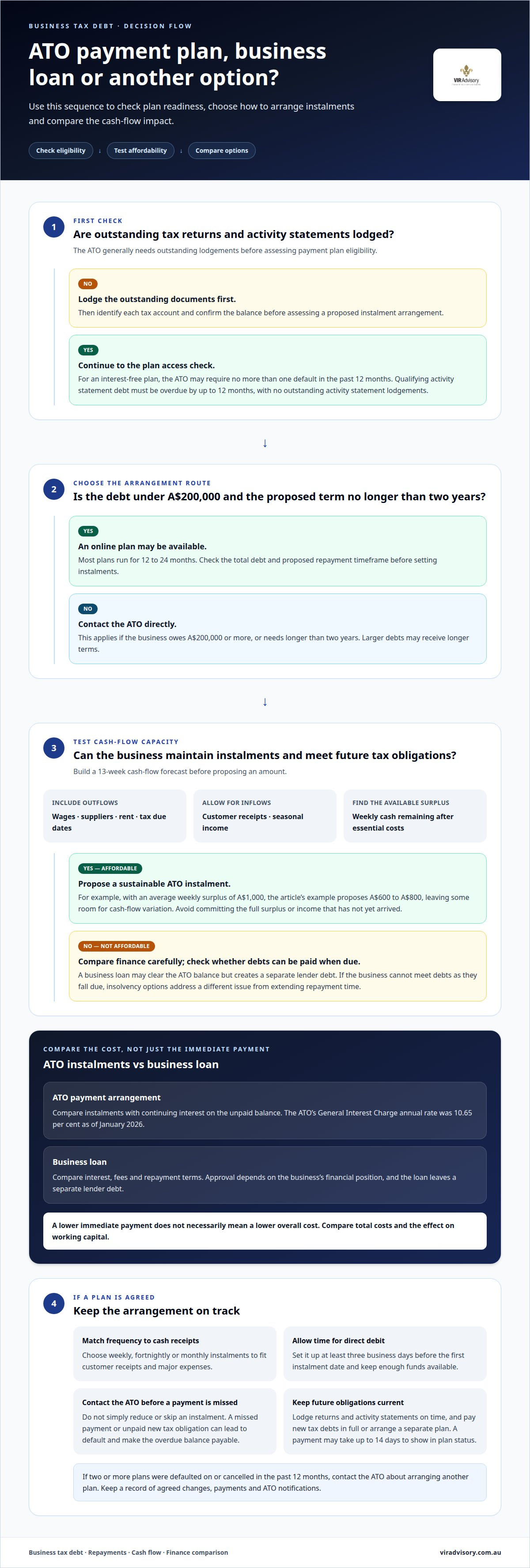
Start by lodging outstanding tax returns and activity statements, because the ATO generally needs these before assessing eligibility. Check each debt and your payment history: an interest-free plan may require no more than one default in the past twelve months. Qualifying activity statement debt must be overdue by up to twelve months, with no outstanding activity statement lodgements.
-
Review plan limits and duration
Check the total debt and proposed repayment timeframe before setting instalments. Businesses with debt under A$200,000 may arrange a plan online; businesses owing A$200,000 or more, or needing longer than two years, must contact the ATO directly. Most plans run for 12 to 24 months, though larger debts may receive longer terms.
-
Compare debt management options
Compare the ATO plan’s instalments and continuing interest with a business loan’s repayments, interest and fees. A loan may clear the ATO balance, but lender approval depends on the business’s financial position, and the loan creates a separate debt. If the business cannot meet debts as they fall due, consider how insolvency options differ from simply extending repayment time.
-
Prepare information for the application
Gather tax account balances, lodged returns and activity statements, recent income records, a cash-flow forecast and a proposed instalment amount. These details help you assess what the business can afford and explain the request. If the ATO issued a warning about firmer recovery or legal action in the past six months, it may ask for extra information.
-
Respond early to payment difficulty
Contact the ATO before an instalment falls due if cash flow means you cannot pay. If you defaulted on or cancelled two or more plans in the past twelve months, contact the ATO about arranging another plan. The ATO may treat a plan as defaulted if new tax obligations go unpaid, making the full overdue balance immediately payable.
-
Keep credits and ongoing obligations in view
Allow for tax refunds or credits reducing the debt, but don’t treat them as a replacement for required plan instalments. Keep lodging future returns and activity statements on time, and pay new tax debts in full or arrange a separate plan. The Australian Taxation Office states the General Interest Charge annual rate is 10.65 per cent as of January 2026.
What is an ATO payment plan?
An ATO payment plan divides tax debt into instalments over a fixed period, usually with weekly, fortnightly or monthly payments. The ATO may refuse or vary a proposal that doesn’t meet its requirements. Missed payments or unpaid ongoing tax obligations can put an existing plan into default.
-
Calculate affordable instalments
Map business inflows and outflows over the next 13 weeks before setting an instalment. Include wages, suppliers, rent, tax due dates and seasonal income, then identify the weekly surplus after essential costs. For example, if the average weekly surplus is A$1,000, a proposed payment of A$600 to A$800 leaves some room for cash-flow variation. Avoid offering the full surplus, because one late customer payment could leave the account short.
-
Agree on instalments and upfront payments
Offer an instalment amount the business can maintain throughout the agreed period, supported by a cash-flow forecast. An upfront payment reduces the outstanding balance on which the ATO applies General Interest Charge, while smaller regular payments can preserve cash for wages and suppliers. Set out the proposed amount, payment frequency and start date clearly. Don’t commit expected income before it arrives or count a possible tax credit as cash already available.
-
Set a standard instalment schedule
Choose weekly, fortnightly or monthly payments to match the timing of customer receipts and major expenses. A business paid by customers throughout the week may prefer weekly instalments; a business with monthly invoicing could align payments with receipts. Direct debit is a practical method for regular instalments. Set it up at least three business days before the first instalment date, and retain enough funds to cover the payment.
-
Change or miss an instalment
Review the ATO account and bank balance before each due date, then contact the ATO promptly if the agreed payment no longer fits available cash. Don’t simply reduce or skip an instalment without addressing the arrangement. A missed payment or unpaid new tax obligation can lead to default and make the overdue balance payable. Check the account after paying: a payment may take up to 14 days to show in plan status.
- Keep a record of each agreed change, payment and ATO notification, including the date and amount. If a scheduled debit fails, check whether funds were available and whether the payment method remains active, then respond to any ATO notice. Continue lodging activity statements and returns by their due dates. Separating tax money from operating funds can help prevent a new liability from undermining the existing instalment schedule.
Separate plans for income tax and activity statement accounts
Identify which ATO account holds each debt before setting up a payment plan. Income tax and activity statement debts require separate plans, so one arrangement may not cover both balances.
-
Set up plans through ATO online services
Sign in to Online Services for Business and review the business’s ATO account balances before arranging payments. You can use online services to set up a plan, but only one payment plan at a time can be established through this channel. Check which debt the proposed plan covers, then record its instalment amount, frequency and due dates.
- Match each debt to its account before submitting an arrangement. Income tax belongs to the income tax account, while GST and other activity statement amounts appear against an activity statement account. Activity statement accounts use a three-digit account sequence, such as 001, 003 or 010. Use the account details shown for the business rather than assuming every liability shares one balance.
-
Manage business payment plans online
Keep a separate record for each plan, including the account type, outstanding balance, next instalment and payment status. Because online services allow only one plan at a time, manage the arrangement carefully and don’t assume a second debt is included automatically. If both account types have debt, distinguish their balances and keep the payment records separate.
- Check the account after each payment and compare the updated balance with the plan schedule. For example, if a payment appears against activity statement debt, don’t assume it has reduced an income tax balance. ATO payments may take up to four business days to appear on an account, so retain the payment confirmation while the account updates.
- Review each account when new obligations arise. A business with an existing plan must continue lodging returns and activity statements on time, and new tax debts must be paid by their due dates or covered by a separate plan. Keep the relevant account sequence and lodgement status with your records, so a new activity statement liability isn’t confused with income tax instalments.
- Before finalising the arrangements, compare proposed dates with the business’s cash receipts and obligations for each account. Record which bank payment relates to which plan, then check that the payment method and account details match. This simple reconciliation can help identify a missed instalment or misallocated payment early, rather than treating two separate ATO balances as one debt.
Payment frequencies and terms
Choose a payment frequency that matches business receipts, then compare the term with the total interest cost. The Australian Taxation Office may consider the debt, proposed instalments and the business’s circumstances.
- Match weekly, fortnightly or monthly instalments to when income reaches the business account. Weekly payments can suit frequent customer receipts, while monthly payments may align with regular invoicing cycles. Compare each option with payroll, supplier payments and the next tax bill. A schedule that looks manageable during a quiet week may strain cash flow when several expenses fall together.
- Set a term that clears the debt within the shortest period the business can sustain. Standard plans may run from six months to two years, while short-term arrangements last under three months. A longer term reduces each instalment but leaves the balance unpaid for longer. Compare the total amount repaid, including interest, before choosing a schedule.
- Check whether the business could qualify for an interest-free arrangement before relying on that feature. Eligibility includes an agreed twelve-month direct debit arrangement and other criteria, including turnover and the type and age of qualifying debt. Direct debit can make payments consistent, but the nominated account needs enough funds on each due date.
- Use the online payment plan process only after confirming the debt amount and payment dates. Check each instalment against the business’s cash-flow forecast, including periods with lower income or larger supplier bills. Record the dates in the accounts calendar and set aside the required amounts before they fall due. Don’t select a frequency solely because it offers a smaller first payment.
- Keep each tax account and its instalment schedule separate in the business records. For example, list the account, payment amount, frequency and due date for each plan. This helps prevent an income tax payment being mistaken for an activity statement payment. Reconcile the bank transaction against the relevant ATO account after paying, and retain the confirmation for bookkeeping.
- Review the schedule when circumstances change, such as delayed customer payments or an unexpected operating expense. Compare the revised forecast with upcoming instalments before a due date passes. If the existing amounts no longer fit, contact the ATO to discuss the arrangement rather than changing payments without agreement. Keep lodging new obligations and account for them separately from the existing balance.
- For an eligible interest-free plan, arrange direct debit at least three business days before the first instalment date. Check the bank account details and ensure the first debit won’t coincide with a major payroll or supplier run. Direct debit is described as the quickest way to handle plan instalments, but you still need sufficient funds on the scheduled date.
Cash-flow planning for current and future tax
Build tax payments into operating cash flow rather than treating an ATO arrangement as the whole solution. An ATO payment arrangement for a business addresses existing tax debt; separate cash-flow planning helps fund upcoming obligations and preserve working capital.
- Map customer receipts against wages, suppliers, rent, tax due dates and current plan instalments. Update the forecast as invoices are paid, because expected income isn’t the same as cleared funds. If you’re assessing an ATO payment arrangement for your business, use this comparison to see whether repayments remain affordable without drawing on money needed for daily operations.
Cash-flow framework
- Current tax debt: Track the balance and agreed repayments.
- Future tax: Allocate receipts towards upcoming tax obligations.
- Operating reserve: Protect funds for essential business costs.
-
Keep an operating reserve separate from cash allocated to tax. A suggested buffer is 2 to 4 weeks of operating expenses. If a large customer pays late, this reserve can help meet payroll without diverting funds from a tax instalment. Treat the reserve as protection against timing gaps, not as surplus cash for an upfront payment.
- Allocate money towards future tax as income arrives, then reconcile that provision against upcoming activity statement and income tax obligations. Record what has been reserved, what is due and what has been paid. This makes the next tax bill visible in cash-flow forecasts, so it doesn’t unexpectedly draw on funds intended for suppliers or wages.
- Weigh an upfront payment against retaining working capital for essential costs. Paying upfront reduces the balance attracting General Interest Charge, but using too much available cash can leave the business short before receipts clear. Test the proposed amount against forecast outgoings and the operating reserve, then check that the remaining instalments still fit the business’s cash flow.
- Include the cost of overdue tax in funding comparisons. General Interest Charge on unpaid tax debts compounds daily, so a longer repayment period can increase the outstanding amount. From 1 July 2025, Australian businesses cannot claim General Interest Charge as a tax deduction. Include this in the comparison with business borrowing, alongside repayments and the effect on working capital.
- Revisit the forecast when customer receipts, operating costs or tax obligations change. If the scheduled payment no longer fits, contact the ATO before the instalment falls due. Compare alternative funding by its repayment structure and impact on operating cash, not only by whether it clears the immediate tax balance. Keep future tax provisions separate from repayments on existing debt.
VIR Advisory: Business Loans
VIR Advisory can assess whether a Business Loan may suit your tax debt and broader cash-flow needs. A loan may clear an ATO balance, but it creates a separate debt with repayments, interest and lender approval requirements. An ATO payment plan may be more appropriate when the business can meet instalments while keeping current tax obligations up to date.
Consider discussing finance when the proposed ATO schedule strains working capital, or when consolidating tax debt into a suitable business finance structure may improve repayment management. Lenders assess the business’s financial position and ability to service repayments, so prepare current accounts, tax records and cash-flow forecasts for a clear comparison. VIR Advisory also provides financial strategy guidance to help assess available finance options alongside the business’s existing commitments.
Contact VIR Advisory to discuss your business finance requirements.
Make the next funding decision with cash flow in view
Before choosing finance, consider how the repayment structure will affect working capital and the business’s ability to meet upcoming commitments. An ATO payment arrangement for a business may suit a manageable tax debt, while borrowing may be relevant if the existing schedule puts essential operating cash under pressure. The decision should account for the business’s wider debts and cash flow, not just the immediate tax balance.
VIR Advisory offers Business Loans, Home Loans and Refinancing solutions. If tax debt is affecting broader borrowing plans, reviewing these commitments together can help clarify which funding option fits the business’s position and priorities.
A considered comparison can help you take the next step with a clearer view of repayments and cash flow.
Frequently Asked Questions
How much should you offer to pay?
Offer an amount the business can maintain after accounting for slower trading and unexpected expenses. Check whether customer receipts arrive before major commitments, and allow for seasonal dips, overdue invoices and supplier payment changes. A useful final test is whether the proposed instalment remains affordable if an expected receipt is delayed. Don’t rely on a single strong month as evidence that the same amount will work throughout the arrangement.
What Are ATO Payment Plans And When Should You Use Them?
An ATO payment plan helps manage tax liabilities when immediate payment would pressure business cash flow. Consider one when the business can keep current obligations under control while reducing the existing liability. If the underlying problem is a persistent inability to pay debts as they fall due, an instalment arrangement alone may not address it. Compare the business’s complete commitments before settling on an option.
What costs and conditions apply?
Account for interest that may accrue on the unpaid balance, as well as the consequences of not meeting the agreed terms. Conditions can depend on the liability, lodgement history and payment record. Before accepting an arrangement, note its start date, instalment dates, payment method and any requirements for future obligations. Compare those commitments with any proposed borrowing, considering total repayments and the effect on funds available for business operations.
How can an Australian business apply for an ATO payment arrangement?
Prepare the business’s tax account details and an instalment proposal, then use the applicable ATO channel for the debt and requested term. Before submitting, reconcile the amount shown with the business’s records and identify any liabilities held in another account. Keep a copy of the proposal and the ATO’s response. Once agreed, enter each due date in the accounts calendar and assign responsibility for monitoring payments.
What information does the ATO require to set up a business payment plan?
Have the business’s account details, current tax position and proposed payment schedule ready. The ATO may also seek information supporting the amount offered, such as cash-flow records or details about expected receipts and essential costs. Organise source documents by account and liability so you can explain the figures consistently. If the ATO requests more material, respond with records that directly support the proposal.
Can a business arrange an ATO payment plan online through Online Services for Business?
Yes, Online Services for Business can be used to arrange eligible payment plans. Sign in with the business’s authorised access, review the account information displayed and follow the available arrangement process. Before confirming, check the nominated payment method and proposed dates against the business’s bank records. Save the confirmation and check that the arrangement details match the intended liability, rather than relying only on a draft or submitted request.
What interest and charges apply to ATO business payment arrangements, including the general interest charge?
General Interest Charge may apply while tax remains unpaid, so include it when estimating the cost of clearing the liability. The applicable rate can change, and the total charge depends on the outstanding balance and time taken to repay it. Compare the expected cost over the proposed repayment period with the total interest and fees on alternative funding. Don’t rely only on headline rates, which may not reflect the full cost.
What repayment terms and instalment frequencies can the ATO offer a business?
Available schedules can use weekly, fortnightly or monthly instalments, with the term shaped by the debt and the business’s capacity to pay. Choose dates that fit actual cash receipts, rather than simply copying the usual bill cycle. Check how public holidays, delayed customer payments and payroll timing affect available funds. Record the agreed schedule separately from forecast dates, and reconcile each completed payment against the relevant account.
For help comparing business finance options with an ATO arrangement, contact VIR Advisory.

Article by
Raina Doshi
Raina Doshi has worked in banking and finance since 2011, including experience with major Australian lenders. She helps homeowners, property investors, business owners and professionals secure and structure lending solutions across home loans, refinancing, commercial finance and business lending.
Areas of expertise include residential lending, investment property finance, debt recycling, commercial property finance, equipment finance, construction finance and strategic debt structuring.
Drawing on extensive banking and finance experience, Raina helps clients navigate lender requirements, improve borrowing outcomes and structure effective finance solutions.
Disclaimer
The information in this article is general in nature and does not take into account your personal objectives, financial situation or needs. Before acting on any information, consider whether it is appropriate to your circumstances and seek professional advice.


