

A home loan for Defence Force personnel in Australia can combine standard mortgage options with DHOAS support, but there isn’t one loan that suits every serving member or veteran. To qualify for DHOAS, members must have served on or after 1 July 2008, and the Department of Veterans’ Affairs recognises at least 2 consecutive years of Permanent ADF service as a qualifying period. A fixed-rate loan may help keep repayments predictable, while its rate and features still need to be compared with variable options.
It’s understandable to expect Defence-related benefits to make borrowing simpler or cheaper. In practice, DHOAS eligibility, any eligible-customer discount and the lender’s assessment all affect the outcome. A subsidy doesn’t remove the need to assess the loan’s total cost and structure.
This article explains how DHOAS works, what to compare when lenders offer Defence customer benefits, and how fixed rates may fit your plans. It also covers key eligibility and application considerations to help you assess options against your income, posting circumstances and repayment priorities.
Key Takeaways
- Assess DHOAS eligibility against your service history and loan circumstances before including a subsidy in your repayment budget.
- Compare Defence customer discounts with the loan’s overall rate, fees and features rather than judging the offer by its headline rate alone.
- Check rates beyond the DHOAS lender panel to understand how lender competition may affect the options available to you.
- Weigh the repayment certainty of a fixed rate against the limits it can place on flexibility and changes to your loan.
- Prepare clear records of your income, service details, debts and expenses to support the lender’s assessment of your borrowing capacity.
Defence Home Ownership Assistance Scheme (DHOAS)
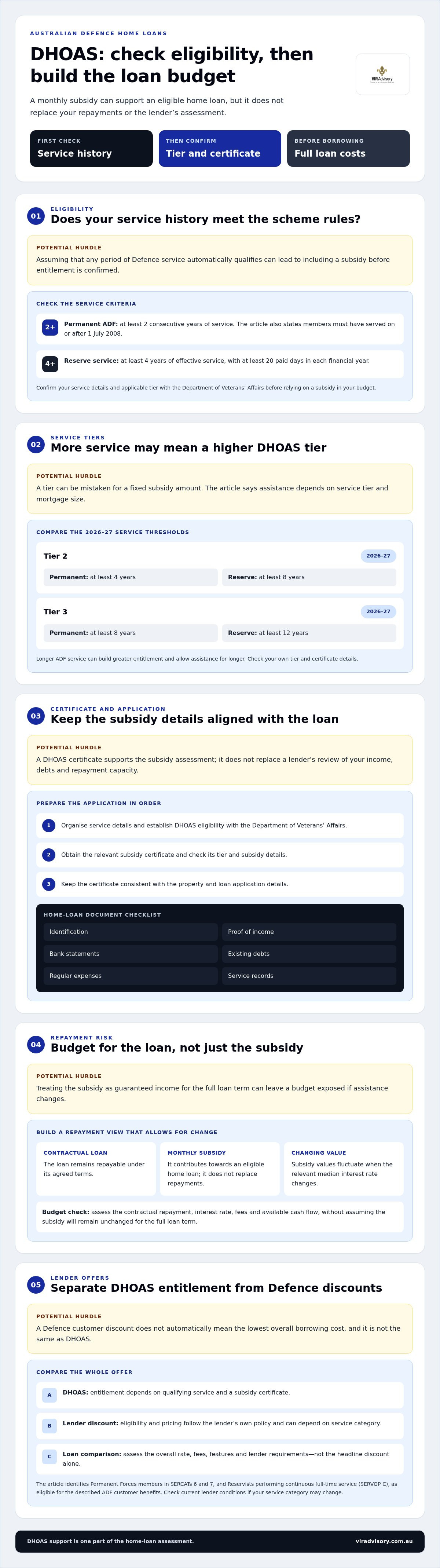
DHOAS provides eligible ADF members and veterans with a monthly subsidy towards a home loan. Eligibility, service tier and mortgage size determine how much assistance applies.
DHOAS eligibility
According to the Department of Veterans' Affairs, a qualifying period includes at least 2 consecutive years of Permanent ADF service. For Reserve members, a qualifying period includes at least 4 years of effective Reserve service, with at least 20 paid days in each financial year.
For 2026-27, DHOAS tier 2 requires at least 4 years of Permanent service or 8 years of Reserve service, according to the Department of Veterans' Affairs. For 2026-27, tier 3 requires at least 8 years of Permanent service or 12 years of Reserve service, according to the Department of Veterans' Affairs.
Longer ADF service can build greater entitlement and allow assistance for longer. Before including a subsidy in your home-loan budget, current and former members should establish their service history and applicable tier.
DHOAS certificates and the DVA
The Department of Veterans' Affairs administers DHOAS on behalf of the Department of Defence. A DHOAS subsidy certificate records an eligible member’s entitlement and is used in the home-loan application process. Review its tier and subsidy details alongside the proposed loan amount, as the subsidy depends on service and mortgage size.
For veterans who left service, the five-year deadline to access their final DHOAS subsidy certificate no longer applied from January 2023. The Department of Veterans' Affairs can provide eligibility and application information by phone on 1300 434 627.
Application steps and required documents
Start by organising your service details and establishing DHOAS eligibility with the Department of Veterans' Affairs. Obtain the relevant subsidy certificate and include it when discussing a home loan with a lender. Keep the certificate consistent with the property and loan application details so the subsidy assessment relates to the borrowing being considered.
For a home-loan application, prepare identification, proof of income, bank statements, details of existing debts and regular expenses, and service records. The lender uses these documents to assess income, commitments and repayment capacity; the DHOAS certificate supports the separate subsidy component.
Scheme operation, risks and repayment obligations
DHOAS pays a monthly subsidy towards an eligible home loan, rather than replacing the borrower’s repayment obligation. These estimates use the October 2026 median interest rate, and subsidy values fluctuate when that rate changes.
Budget for the contractual loan repayment without treating the subsidy as guaranteed income for the full loan term. Compare the repayment, rate, fees and available cash flow, and consider how a changing subsidy could affect your household budget. The loan remains repayable under its agreed terms.
Interest-rate discounts for eligible Defence customers
Defence customer discounts vary by lender, so eligibility and the value of an offer depend on the lender’s policy. Compare the rate, loan features and assessment requirements together. A Defence benefit does not automatically mean the lowest overall borrowing cost.
Eligibility for serving and former members
Eligible-customer benefits described for the Australian Defence Force apply to Permanent Forces members in SERCATs 6 and 7. Reservists performing continuous full-time service, known as SERVOP C, receive the same benefits. Check which service category applies to your current circumstances before relying on a discount in your repayment calculations.
Former members should distinguish lender discounts from DHOAS eligibility. The schemes have separate rules: a lender’s customer pricing follows its own eligibility policy, while DHOAS entitlement depends on qualifying service and a subsidy certificate. Organise service and income records before comparing loan offers.
Service requirements and eligibility changes
Service status can change, so record transitions between Permanent Forces service, Reserve service or civilian employment. A lender may assess the reliability and continuation of salary and allowances, while a Defence-related discount can have separate eligibility conditions. Find out how a change in service category affects the lender’s assessment before choosing a loan structure.
Compare the advertised offer with the rate and features available after the lender assesses your application. For example, a discount that applies only while a particular service condition is met may not suit someone expecting a change soon. Review ongoing eligibility, repayment flexibility and the effect of any lost allowance on household cash flow.
Overseas postings and deployment
An overseas posting or deployment does not replace the lender’s assessment of income and commitments. Prepare evidence of salary, applicable allowances, existing debts and regular expenses, and explain how you’ll manage repayments while away. Clear, consistent records help the lender assess your actual financial position.
ADF members paid fortnightly should organise recent payslips and supporting information for allowances. If a posting changes housing costs or household expenses, include those details in the application budget. This gives the lender a clearer view of cash flow during the posting, rather than only income beforehand.
Can ADF members use the First Home Guarantee or other Australian government home buyer schemes? Yes, ADF members can consider the First Home Guarantee if they meet its eligibility criteria. The scheme operates through an open panel of 33 accredited lenders, while the Australian Government’s five per cent deposit scheme has more than 30 lenders.
Can DHOAS be used with a deposit guarantee, first-home buyer grant or stamp duty concession? DHOAS provides a loan subsidy; guarantees, grants and concessions are separate assistance programs. Assess each program’s eligibility requirements alongside the proposed purchase and loan.
How do ADF salary, allowances and service status affect borrowing capacity? Lenders assess documented income, ongoing allowances, debts and living expenses. Service status helps establish income continuity, while an allowance’s regularity and expected continuation can affect how the lender treats it.
Compare this assistance with any applicable lender discount and government scheme, then assess the resulting repayments against income expected to continue after the purchase.
To compare Defence customer pricing with your income and service circumstances, discuss your borrowing options.
Competition and mortgage interest rates
For a home loan for Defence Force personnel in Australia, compare panel and non-panel offers using the same loan assumptions. On 11 May 2026, comparable non-panel lenders advertised rates between 5.34 and 5.84 per cent, a difference of up to 80 basis points from panel lenders. This comparison shows why scheme access alone doesn’t establish the most competitive borrowing option.
The DHOAS lender panel comprises NAB, Australian Military Bank and Defence Bank. Panel membership may matter when assessing scheme access, but it doesn’t determine whether a lender’s rate or loan structure suits your needs. Compare the offer available to you with alternatives, using similar loan amounts, terms and repayment types.
Look beyond the advertised interest rate. Compare fees, repayment features, discount conditions and any limits that affect how you manage the loan. A lower rate may not suit a borrower who needs repayment flexibility, while a feature-rich loan may have costs that change the overall comparison. Review the full offer, not just the headline rate.
The impact of a rate difference depends on the amount borrowed and how long it remains outstanding. For a home loan for Defence Force personnel in Australia, this shows why even a modest-looking rate gap warrants a whole-loan comparison.
Use this process to compare offers:
- Match each offer by loan amount, term and repayment structure.
- Record the interest rate, fees, features and discount conditions.
- Compare repayments and overall interest using the rates offered for your application.
- Assess whether each loan’s features suit your cash flow and repayment plans.
DHOAS and mortgage pricing play different roles. The scheme provides assistance towards an eligible loan, while the lender sets the rate and contractual payments. Compare both, but assess affordability against the loan repayment itself. This helps you see whether the assistance and loan terms work within your household budget.
Request written details of the offers you’re comparing, then review them using consistent assumptions. Include any applicable assistance as a separate budget item and keep the required mortgage payments visible. This can help veterans and serving members identify meaningful differences in rates, fees and flexibility before choosing a lender.
Defence Force fixed-rate home loans
A fixed-rate home loan can make repayments more predictable during the fixed period. For serving members managing postings, allowances or household changes, that certainty can help with budgeting. It doesn’t automatically make the loan cheaper: assess the fixed rate, loan features and any DHOAS subsidy together.
With a fixed rate, the interest rate stays unchanged for the agreed period, so scheduled principal-and-interest repayments are generally more stable during that time. A variable rate can change and affect repayments as rates move. Fixed repayments can help organise household cash flow, but borrowers may not benefit if rates fall during the fixed period.
For Defence households, consider whether a posting could change living costs, where the property will be occupied, or how soon savings may be available for extra repayments. Depending on the terms, a fixed loan can restrict extra repayments or access to redraw. These limits matter if a member expects a posting allowance, sale proceeds or another lump sum.
Consider a fixed rate alongside Defence Home Ownership Assistance Scheme (DHOAS). DHOAS provides a subsidy towards an eligible home loan, but it doesn’t determine the lender’s fixed-rate terms. Compare how the lender structures the eligible loan and applies the subsidy, then budget separately for the contractual repayments. The subsidy is not a substitute for assessing the rate and loan conditions.
A split loan may place part of the borrowing on a fixed rate and the rest on a variable rate. This can balance repayment certainty with some flexibility, but you’ll need to manage two loan portions and their separate terms. Compare the structure with your expected income, savings and planned repayments rather than choosing a split simply because it appears to combine both options.
Before selecting a fixed-rate loan, work through these points:
- Compare the fixed interest rate with variable alternatives for the same loan amount and repayment structure.
- Read the fixed period, repayment conditions and restrictions on extra repayments or redraw.
- Assess whether planned moves, property changes or lump-sum payments could conflict with the loan terms.
- Include the DHOAS subsidy in a separate budget line, while testing affordability against the full scheduled repayment.
For example, a member expecting a posting-related change in expenses should test the fixed repayment against current and anticipated household costs. If you may need to repay, refinance or change the loan before the fixed period ends, the contract’s conditions become especially important. Any costs or limits associated with changing the loan can affect the value of rate certainty.
Compare fixed, variable and split structures using the same borrowing assumptions. The suitable option depends on your repayment priorities, cash-flow needs, expected changes and the lender’s terms. Focus on the whole loan arrangement, not just the fixed interest rate.
How does the Defence Home Ownership Assistance Scheme (DHOAS) work, and who is eligible?
DHOAS eligibility depends on service history, service type and the applicable qualifying rules. For current members, start with a clear record of Permanent or Reserve service. Former members should also establish their first service date and retain records showing how their service meets the relevant criteria.
According to the Department of Veterans' Affairs, a qualifying period for DHOAS eligibility includes at least 4 years of effective Reserve service, with at least 20 paid days in each financial year. Reserve members should review their paid-day records financial year by financial year, rather than relying on a combined total across several years.
First service dates can help distinguish DHOAS from other Defence housing assistance. Housing loan assistance through DHOAS may be available to people whose first defence force service began on or after 15 May 1985. The separate Defence Service Homes Scheme relates to former ADF members with qualifying service before 15 May 1985, so the applicable service period is important.
Current and former ADF members should map their service history before treating themselves as eligible. Include changes between Permanent and Reserve service, any breaks and relevant service periods. A former member’s circumstances may differ from a currently serving member’s, so record actual dates and service types, not just the total duration.
Use this preparation checklist before progressing an application:
- Set out each period of Permanent and Reserve service separately.
- For Reserve service, organise paid-day records by financial year.
- Record the date first service began and any later service changes.
- Keep the service chronology consistent across application information and supporting records.
Accuracy matters. For example, a Reserve member who has completed the overall service duration should still distinguish years that meet the paid-day condition from those that do not. A former member should not assume a service date alone establishes eligibility, as the qualifying service conditions also matter.
Once your service record is organised, use it to establish which scheme and eligibility criteria apply before making housing or borrowing decisions. Keep the details available as your application progresses, and update the chronology if further service changes your position.
VIR Advisory: Business Loans
VIR Advisory can help you assess how DHOAS, lender requirements and repayment structures fit your home-loan application. Its mortgage brokerage helps borrowers compare home loans and refinancing options, including how income, existing debts and expected expenses affect borrowing capacity.
Consider speaking with VIR Advisory when you have a DHOAS certificate, are comparing fixed and variable loan structures, or need to review your mortgage. Its financial strategy guidance can help organise lending considerations and clarify questions to resolve before applying. If you’re managing business and household commitments together, Business Loans may also be relevant to your broader finance needs.
Contact VIR Advisory to discuss your home-loan or refinancing needs.
Prepare your next borrowing decision
Turn this information into a clear borrowing brief. Note whether you’re buying to live in the property or investing, your intended purchase timeframe and the deposit funds available. For a home loan for Defence Force personnel in Australia, include any service-related circumstances that could affect the application’s timing or structure.
Use the brief to identify what you need to resolve before making an offer. A clear list of priorities can focus discussions and help you understand what information is needed for the next step. VIR Advisory can discuss home loans and refinancing in light of your circumstances.
With your purchase details and questions organised, you’ll be better prepared to make an informed decision at the next stage.
Frequently Asked Questions
What home loan benefits are available to Australian Defence Force personnel?
Potential benefits include DHOAS support, lender-specific Defence customer offers and access to government home-buyer schemes. Their value depends on separate eligibility rules and how each applies to the purchase. Start by identifying which benefits you may qualify for, then assess their combined effect on your deposit needs and ongoing repayments. Don’t assume that receiving one benefit automatically establishes eligibility for another.
Which Australian lenders offer home loans for ADF members, and how do their rates and fees compare?
NAB, Australian Military Bank and Defence Bank are the DHOAS panel lenders. Their assessment policies, loan features and costs can differ, so compare terms that matter for your intended use. If you plan to make extra repayments, check the loan conditions; if you’re buying an investment property, confirm the product supports that purpose. Review the full contract, not just the advertised rate.
What steps should an ADF member take to apply for a home loan in Australia?
Set a purchase budget that includes the deposit, purchase costs and a cash reserve for ongoing expenses. Decide whether the property will be owner-occupied or an investment, then establish a borrowing range before committing to a purchase. Once you understand the likely loan structure, assess whether its repayments fit your household budget. Keep new spending and credit applications under control while the lender reviews your finances.

Article by
Raina Doshi
Raina Doshi has worked in banking and finance since 2011, including experience with major Australian lenders. She helps homeowners, property investors, business owners and professionals secure and structure lending solutions across home loans, refinancing, commercial finance and business lending.
Areas of expertise include residential lending, investment property finance, debt recycling, commercial property finance, equipment finance, construction finance and strategic debt structuring.
Drawing on extensive banking and finance experience, Raina helps clients navigate lender requirements, improve borrowing outcomes and structure effective finance solutions.
Disclaimer
The information in this article is general in nature and does not take into account your personal objectives, financial situation or needs. Before acting on any information, consider whether it is appropriate to your circumstances and seek professional advice.


