

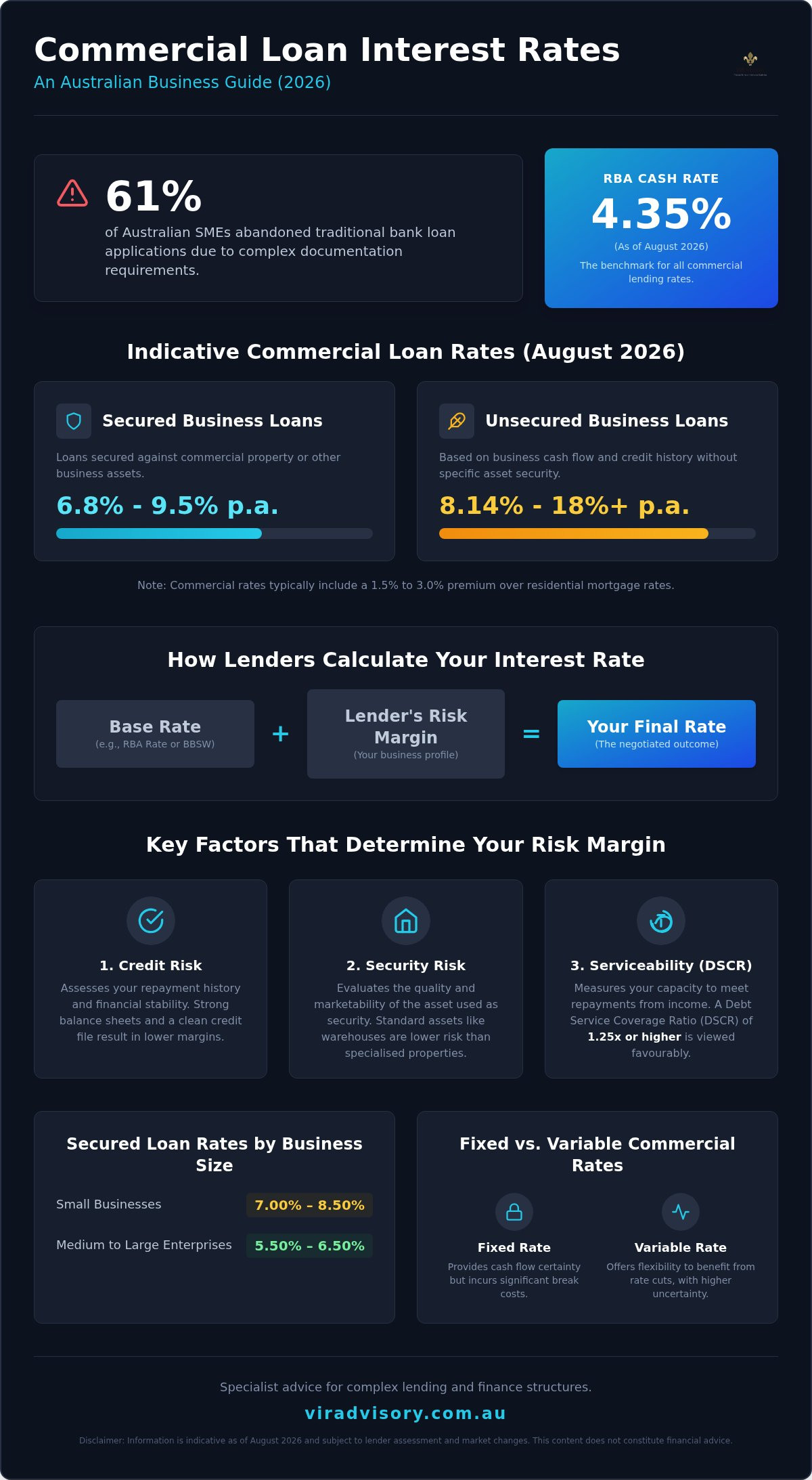
61% of Australian SMEs abandoned their loan applications with traditional banks this year because of complex documentation requirements. As of August 2026, commercial loan interest rates for secured facilities generally range from 6.8% to 9.5% p.a., while unsecured options vary between 8.14% and 18% p.a. With the Reserve Bank of Australia cash rate holding at 4.35%, the specific rate your business secures is rarely a fixed product; it's a negotiated outcome based on your serviceability and risk profile.
It's understandable to feel frustrated by inconsistent offers or the opaque nature of risk-based pricing models. This analysis clarifies the current 2026 lending landscape, showing you exactly how lenders calculate risk margins and what's required to meet strict serviceability benchmarks. We'll examine the specific criteria banks use to assess applications, explain common approval obstacles, and provide a framework to help you reduce interest costs through better loan structures and debt management.
Key Takeaways
- Benchmarking current commercial loan interest rates for 2026 to establish a baseline for both owner-occupied and investment property finance.
- Understanding how lenders apply risk margins to the base rate and the specific impact your Loan-to-Value Ratio (LVR) has on the final pricing.
- Evaluating the transparency premium of low-doc lending compared to the more competitive rates available through full financial disclosure.
- Using the Interest Cover Ratio (ICR) as a key metric to improve borrowing capacity and negotiate more favourable lending terms.
- Navigating the diverse assessment criteria of bank and non-bank lenders to align your debt structure with business cash flow requirements.
Current Commercial Loan Interest Rates in Australia (2026)
As of August 2026, Australian commercial loan interest rates typically range from 6.00% for prime owner-occupied properties to over 14% for private, short-term business funding. The foundation for these figures remains the Reserve Bank of Australia (RBA) cash rate, which currently sits at 4.35%. Lenders use this benchmark to determine their indicator rates, adding a risk margin that reflects the borrower's specific circumstances. Understanding how central bank rates are set is essential for any business director, as it explains why commercial lending costs fluctuate in response to broader economic shifts.
Major banks often quote "indicator rates" as a baseline, but the actual cost for most SMEs is the "weighted average" rate, which accounts for the specific risk profile of the business. Commercial rates carry a natural premium over residential mortgages, often by 1.5% to 3.0%. This gap exists because lenders must account for higher vacancy risks, market volatility, and the specialised nature of commercial assets. While a home loan is secured by a liquid residential market, a warehouse or office space is more sensitive to industry-specific downturns.
To better understand the nuances of commercial lending structures and rate expectations, watch this helpful video:
Market Benchmarks by Business Size
Lending appetites vary significantly based on the scale of your operations. Small business rates for secured loans typically sit between 7.00% and 8.50% p.a., reflecting the higher administrative costs and perceived risk of smaller balance sheets. Conversely, medium to large enterprises often secure tighter margins, with rates ranging from 5.50% to 6.50% due to higher turnover and established credit history. For those seeking unsecured business finance to manage cash flow gaps, rates can exceed 15%. These products prioritise speed and flexibility over cost, serving as a tactical tool rather than long-term commercial property finance.
Fixed vs. Variable Commercial Rates in 2026
Most commercial fixed-rate terms currently span one to five years. Choosing between a fixed or variable rate depends on your view of the 2026 economic environment. Variable rates offer flexibility in a stabilising market, allowing you to benefit from potential rate cuts without penalty. However, fixed rates provide certain cash flow management by locking in your interest expense. It's vital to recognise that "break costs" on commercial fixed-rate contracts are calculated differently than residential ones. They're often tied to wholesale market movements and can be significantly more expensive if you need to refinance or sell the asset before the term expires.
How Lenders Calculate Your Specific Interest Rate
Lenders don't simply select a figure from a standardised list when determining commercial loan interest rates. Instead, they apply a "Base Rate plus Margin" formula. The base rate is typically tied to the RBA cash rate or the Bank Bill Swap Rate (BBSW), while the margin represents the lender's assessment of your specific risk profile. This margin is where most of the price variation occurs. It covers the lender's operating costs, their required profit, and a loading that offsets the probability of default. Understanding the factors lenders consider during this calculation is vital for any borrower looking to reduce their annual interest expense.
Repayment capability is often measured through the Debt Service Coverage Ratio (DSCR). Lenders calculate this by dividing your net operating income by your total annual debt obligations. If your ratio is 1.25x or higher, you're generally viewed as a lower risk, which can lead to a more competitive margin. If you're unsure how your current debt structure aligns with these risk metrics, it's worth reviewing your finance strategy to identify potential cost savings.
The Risk Margin Components
The margin applied to your loan isn't arbitrary. It's built from three primary risk layers. Credit risk focuses on your business credit score and historical financial performance; a clean repayment history and strong balance sheet lead to tighter margins. Security risk evaluates the asset itself. Industrial warehouses are often viewed as "standard" assets because they're easy to re-lease or sell, whereas specialised assets like childcare centres or medical suites carry a premium due to their limited buyer pool. Finally, market risk accounts for industry-specific volatility. If your sector is facing economic headwinds, lenders may increase the margin to compensate for the heightened uncertainty.
LVR Tiers and Rate Pricing
Your Loan-to-Value Ratio (LVR) is perhaps the most direct lever you can pull to influence your interest rate. Lenders categorise applications into specific tiers, each with its own pricing bracket:
- Tier 1 (Below 50% LVR): These applications represent the lowest risk to the lender. Borrowers in this tier often secure "headline" rates because the lender has a significant equity buffer if the property value fluctuates.
- Tier 2 (50% to 70% LVR): This is the standard market range for most commercial property finance. Rates are competitive, but lenders will scrutinise cash flow and DSCR more closely than in Tier 1.
- Tier 3 (Above 70% LVR): Rates in this tier include significant loadings. Lenders may also require additional security, such as a director's guarantee or a charge over other business assets, to mitigate the higher leverage.
Comparing Rates by Loan Type and Documentation
Lenders view the purpose of your loan as a primary risk indicator. If you're an owner-occupier buying a premises for your own business, you'll generally access lower commercial loan interest rates compared to a pure investor. This discount reflects the lender's confidence that a business owner will prioritise their own mortgage over other operating expenses, effectively eliminating the vacancy risk associated with external tenants. Banks often subsidise these rates because they value the broader relationship, including merchant facilities and business transaction accounts.
While property loans offer stability, working capital finance serves a different purpose. These rates are typically higher because the facility is often unsecured or relies on a general charge over business assets rather than a specific piece of real estate. Similarly, debtor finance is structured with a discount rate and a service fee. This provides liquidity based on your accounts receivable, allowing you to access cash tied up in unpaid invoices without the need for additional property security.
Full Doc, Low Doc, and Lease Doc Options
The level of transparency you provide directly impacts your pricing. A "Full Doc" application, requiring two years of financial statements and tax returns, secures the most competitive terms available in the market. Conversely, "Low Doc" options allow you to use accountant letters or BAS statements to prove income. This convenience comes with a "transparency premium," typically adding a 1% to 2% loading to the interest rate. For sophisticated investors, "Lease Doc" lending assesses only the rental income of the property. If the lease covers the interest at a specific ratio, the lender may approve the loan without reviewing your personal or business tax returns, though rates are higher to compensate for the limited disclosure.
Specialised Commercial Lending Structures
Lending through a Self-Managed Super Fund (SMSF) requires strict adherence to limited recourse borrowing arrangements. Because of the compliance burden and the lender's restricted ability to recover funds, these rates are often higher than standard commercial products. For machinery or vehicles, asset finance provides a fixed-rate solution for the life of the loan. This protects your cash flow from market fluctuations and simplifies your monthly budgeting. Construction finance involves a distinct transition; during the build, you'll pay higher development margins. Once the building reaches practical completion and is tenanted, you can refinance to lower-rate "take-out" finance to reduce your long-term interest costs.
Strategies to Secure More Favourable Lending Terms
Negotiating competitive commercial loan interest rates is rarely about accepting the first offer presented by your primary bank. It involves a deliberate process of positioning your business to meet the specific risk-weighting criteria used by Tier 1 lenders. By creating "competitive tension" between multiple bank and non-bank lenders, you force them to sharpen their margins to win your business. This strategy is most effective when you can demonstrate that your debt management and cash flow are managed with professional oversight.
Step-by-Step: Preparing for Approval
- Step 1: Audit your credit file. Before submitting any application, resolve any minor defaults or late payment markers. Even small discrepancies can push your application into a higher-risk pricing bracket.
- Step 2: Maximise your DSCR. Consolidate high-interest short-term debts to improve your Debt Service Coverage Ratio. A cleaner repayment profile suggests lower volatility to a potential lender.
- Step 3: Prepare a professional business case. Don't just state the funding amount; detail the purpose of the funding and how it will improve your business's financial position. This helps the credit manager understand the underlying logic of the request.
Improving your Interest Cover Ratio (ICR) is often more effective than simply providing a larger deposit. While a deposit reduces the lender's capital at risk, the ICR proves your ongoing ability to meet interest payments from operational cash flow. Lenders look for "clean" financial statements where non-recurring expenses or one-off "lumpy" costs are clearly identified as add-backs. If you've had a one-off legal fee or a major equipment repair that won't repeat, ensure your accountant highlights this to increase your reportable profit and strengthen your borrowing capacity.
Common Approval Obstacles and How to Avoid Them
A primary obstacle is the lack of a "secondary source" of repayment. Lenders want to see back-up liquidity, such as cash reserves or other unencumbered assets, in case your primary business income fluctuates. Lenders also scrutinise specialised property assets. Properties like cold storage facilities or specialised manufacturing plants have a limited tenant pool, which increases the lender's security risk. If you're purchasing such an asset, you might need to offer additional security to secure the lowest rates.
Outstanding tax debt remains a significant red flag for most lenders. Most Tier 1 commercial institutions will not consider an application if there's an active ATO debt arrangement in place, as it suggests underlying cash flow instability. Addressing tax obligations before applying is non-negotiable if you want to move from high-rate private funding to a more affordable bank facility.
Navigating the 2026 Lending Market with VIR Advisory
Led by Raina Doshi, VIR Advisory utilises over 15 years of banking and finance experience to interpret the technical nuances of lender assessment criteria. This deep institutional knowledge allows us to decode the specific risk-weighting models that determine commercial loan interest rates, which often remain opaque to borrowers. Instead of simply searching for the lowest headline rate, we focus on the underlying finance strategy that supports your operational requirements. By accessing a broad network of both bank and non-bank lenders, we identify funding solutions that align with your specific risk profile and borrowing capacity.
It's a common mistake to assume the cheapest rate is always the superior option. A low-rate facility often comes with restrictive covenants, such as onerous reporting requirements or limitations on future capital expenditure, which can stifle business growth. We help you evaluate the total cost of the debt, including the flexibility of the loan structure and the lender's appetite for annual reviews. This level of technical oversight is particularly valuable for complex applications involving commercial property through SMSF or specialised asset finance.
The Value of Expert Finance Strategy
A robust finance strategy extends beyond the initial approval. It requires a meticulous examination of redraw facilities, offset accounts, and the potential for debt consolidation as your equity grows. We manage the entire application process to ensure professional oversight, allowing you to maintain focus on your core business operations. By linking your current loan structure to your long-term fiscal health, we ensure your debt remains a tool for expansion rather than a liability that restricts your movement.
Next Steps for Your Business Funding
The 2026 lending market moves quickly, making regular commercial loan health checks essential. A confidential assessment of your current debt structure can reveal if your existing interest margins are still competitive or if your lender's serviceability requirements have shifted. You can find more information on common borrower queries in our frequently asked questions. If you haven't reviewed your facilities in the last 12 months, you may be paying a "loyalty tax" that could be mitigated through a strategic refinance or a negotiated rate reduction.
Submit your enquiry for a professional review of your commercial finance options.
Optimising Your Debt Structure for 2026
Securing competitive commercial loan interest rates in the current market requires a technical understanding of how lenders weigh risk against serviceability. The difference between a Tier 1 bank offer and a private facility often hinges on the quality of your financial disclosure and the strength of your Interest Cover Ratio. By addressing common approval obstacles such as outstanding tax debt or insufficient secondary repayment sources before you apply, you position your business to negotiate from a place of strength.
Led by Raina Doshi with over 15 years of banking expertise, VIR Advisory provides specialised advice on debt optimisation and complex finance structures. We leverage our access to extensive bank and non-bank lending panels to create the competitive tension necessary for favourable outcomes. Regular health checks of your existing facilities ensure your loan structure continues to support your operational cash flow as market conditions evolve.
Contact VIR Advisory for a strategic commercial lending assessment
It's possible to reduce your annual interest expense while maintaining the flexibility required for future expansion. Taking a methodical approach to your funding today ensures your business remains resilient and well-capitalised for the year ahead.
Frequently Asked Questions
Why are commercial loan interest rates higher than residential rates?
Commercial rates carry a premium because business assets are generally less liquid than residential homes. Lenders face higher vacancy risks and industry-specific volatility, which requires a larger risk margin to offset potential losses. While a home loan is secured by a basic necessity, a commercial warehouse or retail space is sensitive to economic shifts and business failure rates. This increased complexity in security assessment naturally leads to higher commercial loan interest rates compared to standard mortgages.
Can I get a fixed interest rate on a commercial loan in Australia?
Yes, fixed-rate options are widely available in the Australian commercial market, typically ranging from terms of one to five years. These facilities provide cash flow certainty by locking in your interest expense for a set period. It's vital to remember that commercial fixed-rate contracts often involve significant break costs if you refinance early. These costs are calculated based on wholesale market movements and differ substantially from residential fixed-rate penalties that are often more predictable.
What is the minimum deposit required for a commercial property loan in 2026?
Lenders typically require a minimum deposit of 20% to 35% for a commercial property loan, depending on the asset class and your risk profile. For prime owner-occupied assets, you might secure a 70% to 80% Loan-to-Value Ratio (LVR). Specialised properties or those with higher vacancy risks often require a larger equity contribution from the borrower. Maintaining a lower LVR remains a primary strategy to qualify for more competitive commercial loan interest rates.
How does a business credit score affect the interest rate offered?
Your business credit score is a primary component of the risk margin calculation used by lenders during the assessment process. A strong score indicates a history of meeting financial obligations, which allows the lender to offer a tighter margin above the base rate. Conversely, a poor score or evidence of minor defaults suggests higher volatility. This results in a higher interest rate loading to compensate the lender for the increased probability of default on the facility.
What are the typical fees associated with a commercial loan application?
Typical fees include establishment or application fees, which are often calculated as a percentage of the total loan amount. You'll also encounter valuation fees to assess the security property and legal fees for the preparation of complex commercial loan documents. Ongoing facility fees or line fees may apply to maintain the credit limit over time. These costs should be factored into your total finance strategy alongside the headline interest rate to determine the true cost of debt.
Is it possible to refinance a commercial loan to get a better rate?
Refinancing is a common strategy to optimise debt and secure more favourable terms as your business matures and equity grows. If your financial position has improved or the market has shifted, you can create competitive tension between lenders to force a rate reduction. A successful refinance often involves moving from a higher-rate private lender to a Tier 1 bank facility once you meet stricter serviceability requirements and provide full financial documentation.
What is a "weighted average" interest rate for small businesses?
The "weighted average" rate is a metric used to describe the actual interest cost paid by small businesses across various lending products. Unlike a single "indicator rate" quoted by a bank, this figure accounts for the different margins applied to secured and unsecured facilities. It provides a more accurate benchmark for SMEs to compare their current interest expenses against the broader Australian market average for similar business sizes, revenue levels, and specific industry sectors.
How does an SMSF commercial loan rate differ from a standard business loan?
SMSF commercial loans typically attract higher interest rates because they are structured as Limited Recourse Borrowing Arrangements (LRBA). This structure limits the lender's ability to recover funds from other assets within the super fund if a default occurs. The increased compliance burden and higher capital adequacy requirements for lenders mean these loans carry a natural premium. Rates for SMSF property finance are generally 1% to 2% higher than standard commercial business loans due to this risk profile.

Article by
Raina Doshi
Raina Doshi works with homeowners, property investors, business owners and professionals to secure and structure lending solutions across home loans, refinancing, commercial finance and business lending. Areas of expertise include investment property finance, debt recycling, commercial property finance, equipment finance and strategic debt structuring.
Disclaimer
The information in this article is general in nature and does not take into account your personal objectives, financial situation or needs. Before acting on any information, consider whether it is appropriate to your circumstances and seek professional advice.


