

Why does a profitable business often struggle to meet its payroll or BAS obligations during a period of rapid growth? It's a common frustration for Australian company directors who find that while their order books are full, the timing difference between paying suppliers and receiving customer payments creates a restrictive cash flow gap. You likely recognise the pressure of managing daily operations when your capital is tied up in outstanding invoices or inventory, particularly if traditional banks have previously declined your application due to rigid serviceability criteria.
This article explains how to secure the right working capital finance to bridge these gaps, ensuring you have the liquidity to maintain momentum and meet your financial commitments. We'll examine specific funding structures such as debtor finance and trade credit, detailing exactly how lenders assess your borrowing capacity and the common obstacles to approval. By following our methodical framework, you can select a facility that aligns with your cash conversion cycle and avoids the risks associated with poorly structured debt, providing a stable foundation for your business operations.
Key Takeaways
- Understand how the cash conversion cycle impacts liquidity and why profitable Australian firms still require external funding to manage timing gaps between payables and receivables.
- Learn the methodical criteria lenders use to assess borrowing capacity, including the critical role of up-to-date financial reporting and BAS compliance.
- Identify the most suitable working capital finance solutions for your specific business model by comparing debtor finance, trade credit, and overdrafts based on security and cost.
- Navigate common approval obstacles for self-employed borrowers by preparing the precise documentation required to satisfy strict bank and non-bank serviceability requirements.
- Implement debt optimisation strategies to ensure your funding costs remain below your profit margins, supporting sustainable growth through well-structured finance.
Understanding Working Capital Finance and the Cash Flow Gap
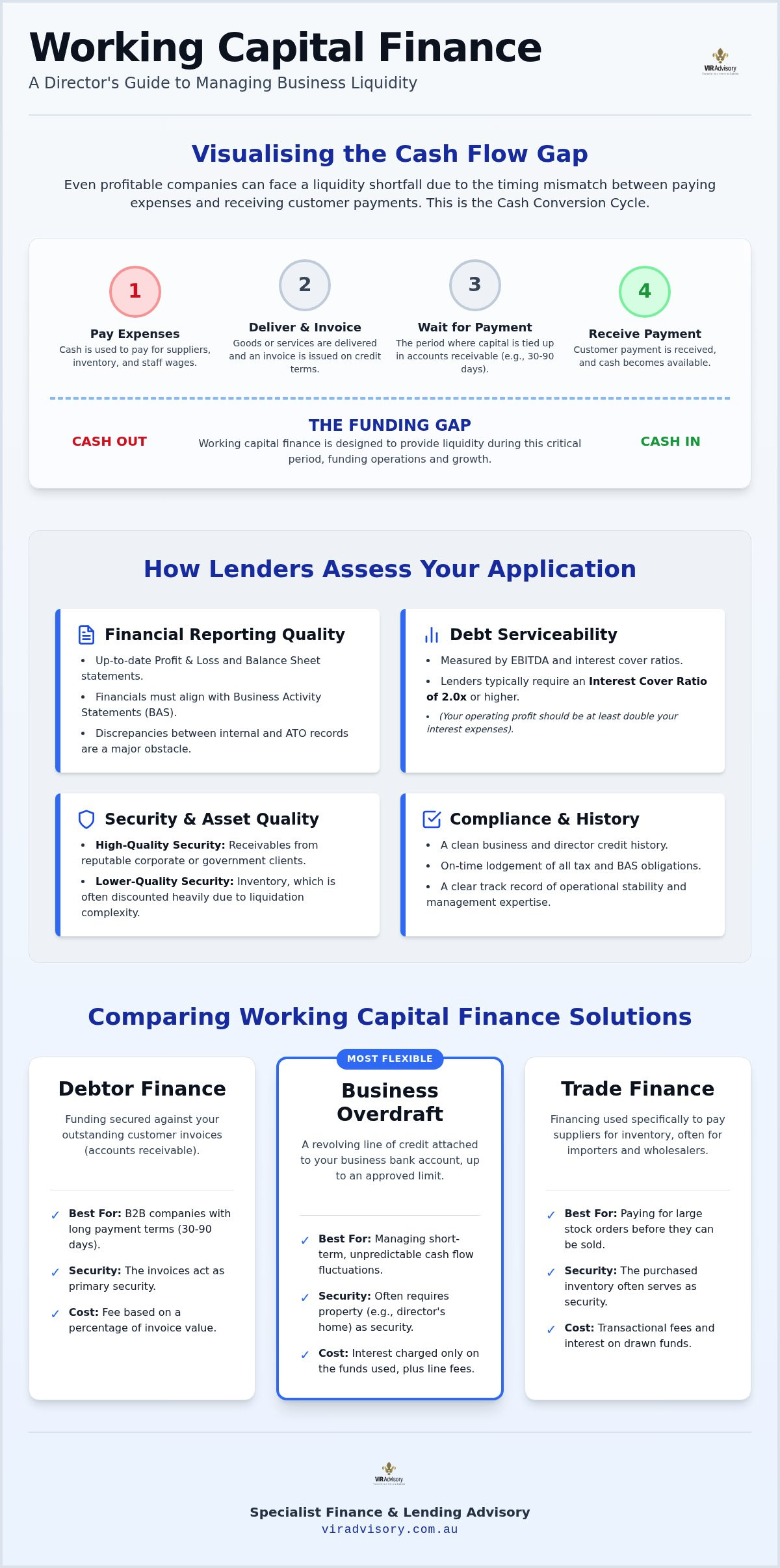
At its core, working capital finance is a specialised facility designed to resolve the timing mismatch between when you pay your overheads and when your customers settle their accounts. It's a common misconception that only struggling businesses require external funding. In reality, the most frequent users of these facilities are profitable, high-growth companies that need to manage their Cash Conversion Cycle (CCC). This cycle represents the number of days it takes for your investment in inventory or labour to be converted back into cash via customer payments.
In the Australian market, SMEs often operate on 30, 60, or even 90-day payment terms. While your Profit and Loss statement might show a healthy margin, your bank account may not reflect those figures until months after the work is completed. The primary purpose of these facilities is to provide the liquidity required to meet immediate obligations, such as payroll, rent, and BAS payments, without depleting the capital you need for long-term growth. This is particularly vital during seasonal peaks or when taking on large, capital-intensive contracts that require significant upfront expenditure.
The Liquidity Gap: Why Profitability Doesn’t Equal Cash Flow
Profitability is an accounting metric, but liquidity is a functional reality. Many Australian businesses "grow themselves out of cash" by scaling faster than their internal reserves can support. When you secure a major contract, you must often pay for materials and labour weeks before you can even issue an invoice. If that invoice then sits on a 60-day term, you face a significant funding gap.
Consider a wholesale business that pays an overseas supplier upfront for stock. By the time the goods arrive, are distributed, and the retailer pays the invoice, four months may have elapsed. It's essential to distinguish between your requirements:
- Permanent working capital: The baseline level of liquidity needed to maintain daily operations and minimum stock levels.
- Temporary fluctuations: Short-term spikes in cash requirements caused by seasonal demand or one-off large orders.
Why Traditional Bank Loans Might Not Suit Short-Term Needs
Applying for a standard five-year term loan to solve a 30-day cash gap is often an inefficient use of debt. Term loans are structured for long-term assets like commercial property or heavy equipment. They lack the flexibility required for operational cash flow management because you pay interest on the full principal from day one, regardless of whether you need the entire amount.
Structured working capital finance usually takes the form of a revolving facility. This allows you to draw down funds only when a gap exists and repay the balance as soon as your customers settle their invoices. By using tailored cash flow solutions, you ensure that you only pay for the finance you actually use, preserving your borrowing capacity for other strategic investments.
How Australian Lenders Assess Working Capital Requirements
Lenders employ a methodical assessment process to determine whether a business can sustainably manage short-term debt obligations. Unlike a mortgage, where the property value is the primary focus, working capital finance relies heavily on the quality of your balance sheet and the reliability of your cash flow. Lenders prioritise serviceability, which they typically measure through EBITDA (Earnings Before Interest, Taxes, Depreciation, and Amortisation) and interest cover ratios. Most Australian commercial lenders seek an interest cover ratio of at least 2.0x, meaning your operating profit should be double your interest expenses.
High-quality financial reporting is non-negotiable for a successful application. You must provide up-to-date Profit & Loss statements and Balance Sheets that align with your Business Activity Statements (BAS). Discrepancies between management accounts and ATO filings are a common reason for rejection. Lenders also differentiate between asset classes; blue-chip receivables from reputable companies are viewed as high-security assets, whereas inventory is often discounted due to the complexities of liquidation.
Key Financial Ratios Lenders Scrutinise
Lenders use specific metrics to gauge your liquidity and operational efficiency. The Current Ratio is a primary indicator, where current assets are divided by current liabilities. A ratio of 1.2:1 is generally considered the minimum threshold, providing a 20% safety buffer to cover unexpected expenses. The Quick Ratio, or Acid Test, takes this a step further by excluding inventory, focusing only on cash and receivables that can be converted immediately.
Receivable Turnover is another critical metric. It measures how many times, on average, your business collects its accounts receivable during a year. A slow turnover rate suggests that your capital is trapped in your debtor ledger, which may limit your borrowing capacity unless you discuss a structured debt solution that specifically targets these timing lags.
The Role of Asset Quality in Approval Prospects
The "borrowing base" is the total value of assets a lender is willing to finance. However, not all assets are treated equally. Lenders typically exclude "aged" receivables, those outstanding for more than 90 days, because the probability of collection decreases significantly over time. Concentrating your sales on a single customer, known as debtor concentration, can also be viewed as a risk, as the default of that one client could jeopardise your entire facility.
Inventory valuation is similarly nuanced. Raw materials are often valued higher than specialised finished goods because they are easier for a lender to resell in a default scenario. To improve your approval prospects, maintain a "clean" debtor ledger by promptly writing off bad debts and ensuring your terms of trade are strictly enforced. This methodical approach to record-keeping demonstrates professional oversight and reduces the lender's perceived risk.
Comparing Working Capital Finance Solutions for SMEs
Selecting the most appropriate facility requires a precise understanding of how different debt structures interact with your operational cycle. The methodical comparison of cost, speed, and security requirements is essential for maintaining liquidity without compromising your long-term borrowing capacity. While traditional banks remain a staple for many Australian SMEs, there is a distinct shift toward non-bank lenders who offer faster approvals and more flexible terms for high-growth firms. For deeper insights into specific products, you can explore tailored commercial finance services that match your business's unique risk profile and cash flow needs.
Business Overdrafts and Lines of Credit
A business overdraft or line of credit is a revolving facility that integrates directly with your transaction account, providing a safety net for daily operational costs. Unlike term loans, these are typically "fully fluctuating" facilities, meaning you only pay interest on the balance you've actually drawn down. Lenders usually charge a "line fee" or "facility fee" for the right to access these funds, which is calculated as a percentage of the total limit. It's important to differentiate between an unsecured line of credit and an overdraft secured by residential or commercial property, as the latter will typically offer a lower interest rate but requires a more rigorous assessment of your equity position.
Debtor Finance and Invoice Factoring
Debtor finance, often called invoice factoring or discounting, allows you to unlock up to 85-90% of an invoice's value within 24 hours of issuance. This is a self-liquidating form of working capital finance because the debt is repaid automatically when your customer settles their account. You can choose between "disclosed" facilities, where the lender manages the collection process, or "confidential" arrangements that remain invisible to your clients. This solution is particularly effective for businesses with long payment terms and high-quality "blue-chip" receivables, as it turns your sales ledger into an immediate source of liquidity.
Trade and Supply Chain Finance
Trade and supply chain finance are designed to bridge the gap between ordering goods and receiving payment from your end customer, providing the necessary capital to pay domestic or international suppliers upfront. These facilities often utilise Letters of Credit to mitigate risk for both the buyer and the seller, ensuring that payment is only released once shipping documents are verified. If your growth requires physical machinery alongside stock, you might also consider asset finance for equipment and vehicles to preserve your cash reserves for operational costs. By aligning your funding with the specific point of the supply chain where the capital is needed, you can maintain a steady momentum without overstretching your balance sheet or risking supplier relationships.
Approval Requirements and Common Funding Obstacles
Securing working capital finance requires more than just a strong balance sheet; it demands a high level of transparency and "lending readiness." Self-employed borrowers often find the approval process complex because their personal and business finances are frequently intertwined, leading to additional scrutiny from credit departments. To navigate this, you must present a methodical case that demonstrates professional oversight of your cash flow and a clear understanding of your operational risks.
Common Approval Obstacles to Mitigate
Lenders are particularly sensitive to ATO debts and BAS compliance. If you have outstanding tax obligations, most lenders will require a formal, up-to-date payment plan to be in place before they consider your application. Without this, the ATO is viewed as a preferred creditor that could theoretically freeze your accounts, creating an unacceptable risk for the financier. Poor record-keeping also significantly hinders your prospects; messy or reconciled accounts suggest a lack of control, which often results in higher interest rates or outright rejection.
Concentration risk is another frequent hurdle, especially for businesses seeking debtor finance. If a single customer represents more than 30% of your total revenue, lenders may be hesitant to fund that specific portion of your ledger. You can often mitigate this by implementing risk management strategies such as trade credit insurance, which provides the lender with an additional layer of security against customer default. This proactive approach shows the lender that you've identified potential vulnerabilities and have a structured plan to manage them.
The Checklist for a Successful Application
To streamline your application and improve your borrowing capacity, you should have a standard suite of documentation ready for review. Lenders use these documents to verify your historical performance and project your future ability to service the debt. A comprehensive application package typically includes:
- Financial Statements: The last two years of accountant-prepared Profit & Loss statements and Balance Sheets, along with the corresponding tax returns.
- Aged Reports: Current Aged Receivables and Aged Payables reports that are no older than 30 days, providing a snapshot of your current liquidity.
- Bank Statements: Six months of business bank statements to verify your actual cash flow patterns against your management accounts.
- Purpose of Funds: A concise explanation of how the capital will be deployed and the expected return it will generate for the business.
Strategic Finance Structures for Sustainable Business Growth
A sustainable growth strategy requires more than a simple cash injection; it demands a sophisticated architecture of debt that aligns with your operational reality. Effective working capital finance isn't merely a stop-gap for quiet months but a strategic lever that, when structured correctly, allows a business to scale without compromising its fiscal health. At VIR Advisory, we focus on debt optimisation, ensuring that the total cost of your capital remains consistently lower than the net margin earned on the funded activity. This methodical approach prevents the debt spiral that often occurs when businesses rely on high-interest, poorly structured facilities to cover systemic cash flow deficiencies.
Aligning Finance with Business Cycles
Choosing the right facility depends on the nature of the requirement. Fixed-term injections are appropriate for specific, one-off projects with a defined end date, while revolving facilities are better suited for the daily fluctuations of a standard trading cycle. A common mistake in Australian SME lending is the asset-term mismatch, where short-term working capital is used to fund long-term asset purchases. This creates immediate liquidity pressure because the debt must be repaid long before the asset has generated a return. Finance Strategy is the deliberate matching of loan terms to the useful life of the funded asset. By adhering to this principle, you protect your cash flow and maintain a stable borrowing capacity for future requirements.
Risk Management in Debt Structuring
Lenders often require a balance between secured and unsecured components, frequently involving Director Guarantees. While unsecured lending offers greater speed and protects specific assets, it typically carries a higher interest rate to compensate the lender for the increased risk. A well-structured finance plan includes a liquidity buffer, ensuring your business remains resilient during unexpected market downturns or supply chain disruptions. Professional oversight is critical here; navigating the nuances of bank and non-bank lending pools requires a specialist who understands how to negotiate terms that protect the director's interests while providing the necessary funding.
To discuss a tailored finance strategy for your company, book a 30-minute consultation with Raina Doshi.
Ultimately, the goal of any capital raise should be to provide a reliable anchor for your operations. By moving away from reactive borrowing and toward a methodical, long-term debt structure, you reduce the stress of complex financial transitions. Expert guidance ensures that every detail of your facility is handled with precision, allowing you to focus on your core business activities with complete confidence in your funding solution.
Optimising Liquidity for Sustainable Business Operations
Securing appropriate working capital finance is a critical step in transitioning from reactive cash flow management to a methodical growth strategy. By aligning your funding structure with your specific cash conversion cycle, you ensure that your business remains resilient during seasonal fluctuations and capital-intensive projects. We've explored how lenders assess serviceability through EBITDA and the importance of maintaining high-quality financial reporting to satisfy strict Australian lending requirements. Taking a proactive approach to your debt structure ensures you don't grow yourself out of cash during periods of rapid expansion.
Navigating these complex credit markets requires a specialist who can provide access to a broad network of bank and non-bank lending pools. With over 15 years of experience in the Australian banking sector, Raina Doshi provides the technical expertise needed to organise tailored debt structures that prioritise long-term stability. This professional oversight allows you to focus on your core operations while your liquidity requirements are handled with precision and care, providing a stable foundation for your future success.
Establishing a resilient finance strategy today will empower your business to capitalise on tomorrow's opportunities with complete confidence.
Frequently Asked Questions
Is working capital finance a loan or a line of credit?
It can be both, though it's most commonly structured as a revolving line of credit. Unlike a standard term loan where you receive a lump sum and pay it back over years, a line of credit allows you to draw down and repay funds as your cash flow fluctuates. This flexibility is essential for managing daily operational gaps. Term loans are usually reserved for specific capital expenditures, whereas revolving facilities are the standard for operational liquidity.
How does debtor finance work for Australian small businesses?
Debtor finance allows you to access cash tied up in your unpaid invoices immediately. Once you issue an invoice to a business customer, the lender advances a percentage, typically between 80% and 90%, of the total value. When the customer pays the invoice into a dedicated account, the lender receives their funds back, and you receive the remaining balance minus a small fee. This effectively turns your accounts receivable into immediate cash flow.
What are the requirements for an unsecured business line of credit?
Lenders typically require at least six to twelve months of trading history and a minimum annual turnover, often starting around A$200,000. You'll need to provide business bank statements to demonstrate consistent cash flow and a clean credit history. While no physical asset like property is pledged, a Director’s Guarantee is almost always mandatory. Interest rates are generally higher than secured facilities to account for the increased lender risk and lack of collateral.
Can I get working capital finance if I have an ATO debt?
Yes, it's possible, provided you have a formalised payment plan in place with the Australian Taxation Office. Lenders view outstanding tax as a significant risk because the ATO has priority over other creditors in a default scenario. To improve your approval prospects, you must demonstrate that you're meeting your current BAS obligations and that the new funding will support profitable growth rather than simply covering historical losses.
How long does it take to get approval for working capital funding?
Approval times vary significantly between traditional banks and non-bank lenders. Fintech and private lenders can often provide approval within 24 to 48 hours, provided your digital bank feeds and financial statements are ready. Traditional big-four banks typically take two to four weeks as they require more manual assessment and rigorous documentation. Having your aged receivables and payables reports ready for review can expedite this process considerably for any lender.
What is the difference between factoring and invoice discounting?
Factoring involves the lender managing your sales ledger and collecting payments directly from your customers, which is a disclosed arrangement. Invoice discounting is typically a confidential facility where you maintain control over your collections and your customers remain unaware of the finance. Discounting is generally preferred by larger businesses with established internal credit control processes, while factoring suits smaller firms looking to outsource their accounts receivable management and reduce administrative overheads.
Do I need to provide property as security for working capital finance?
No, property security is not always a requirement for these facilities. Many working capital finance solutions, such as debtor finance or unsecured lines of credit, use the business’s assets or cash flow as the primary security. However, using residential or commercial property as collateral can often secure a higher borrowing capacity and a lower interest rate. Lenders will assess your specific balance sheet to determine which security structure best supports your operational needs.
How do lenders calculate my business borrowing capacity for these facilities?
Lenders calculate capacity by analysing your historical cash flow, EBITDA, and the value of your current assets. For debtor finance, your capacity is linked directly to the size and quality of your accounts receivable ledger. For unsecured lines of credit, they often look at your average monthly turnover and bank statement data. They seek to ensure that your business generates sufficient surplus cash to cover interest payments and principal reductions comfortably without straining operations.

Article by
Raina Doshi
Raina Doshi works with homeowners, property investors, business owners and professionals to secure and structure lending solutions across home loans, refinancing, commercial finance and business lending. Areas of expertise include investment property finance, debt recycling, commercial property finance, equipment finance and strategic debt structuring.
Disclaimer
The information in this article is general in nature and does not take into account your personal objectives, financial situation or needs. Before acting on any information, consider whether it is appropriate to your circumstances and seek professional advice.


