

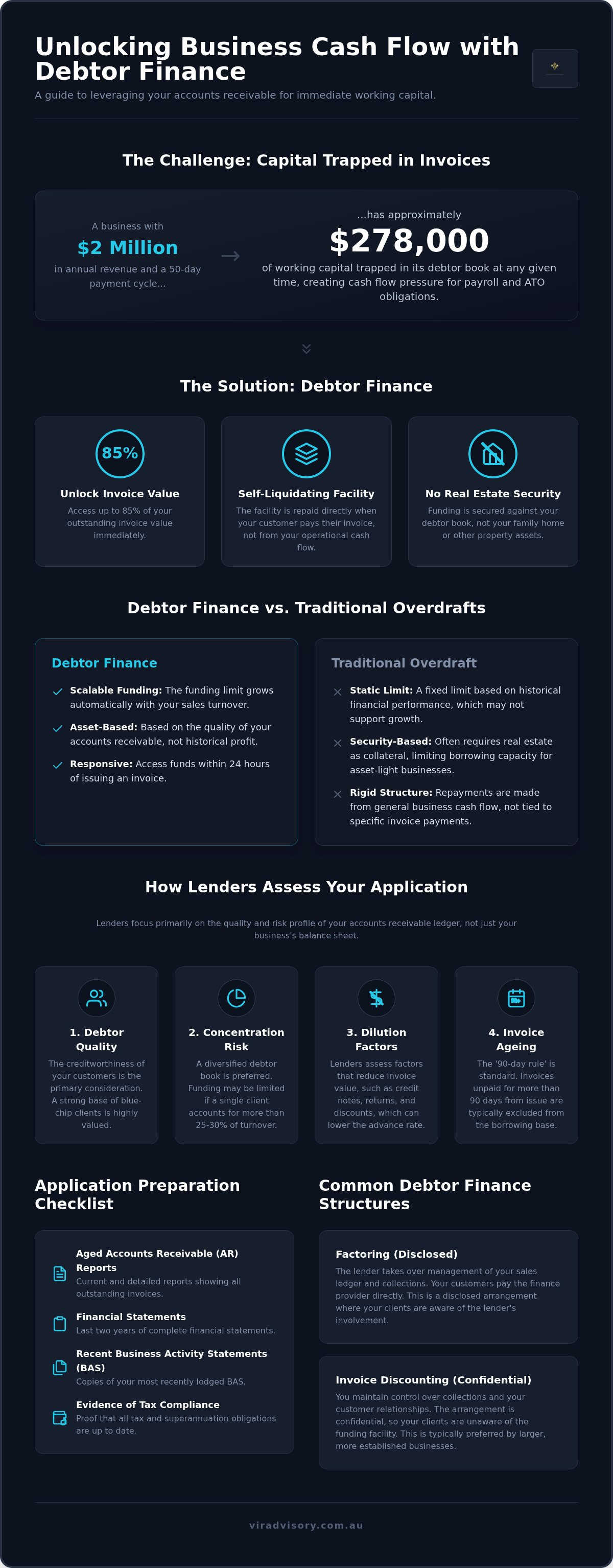
For an Australian business with $2 million in annual revenue and a 50-day payment cycle, you're effectively lending your customers $278,000 interest-free at any given time. This trapped capital often creates critical gaps when you need to meet payroll or ATO obligations. Utilising debtor finance allows you to unlock up to 85% of your outstanding invoice value immediately, providing a flexible funding solution that doesn't require you to pledge your family home as security.
It's a common frustration for directors when traditional banks overlook the strength of a high-quality debtor book and instead demand residential property as collateral. This guide analyses the most effective debtor finance structures to improve your business cash flow while maintaining professional relationships with your debtors. We'll examine lender assessment criteria, compare confidential and disclosed facilities, and provide a framework for securing funding that grows alongside your turnover.
By understanding how lenders evaluate the quality and diversity of your accounts receivable, you can better position your business for a facility that offers managed momentum without the restrictive covenants of a traditional overdraft.
Key Takeaways
- Access immediate working capital by using your accounts receivable as collateral, eliminating the need to pledge real estate security.
- Learn why lenders prioritise the creditworthiness of your customers over your balance sheet and how "dilution" factors like credits affect your funding limit.
- Compare the costs and operational impacts of factoring versus confidential invoice discounting to determine the most efficient debtor finance structure for your firm.
- Implement a methodical five-step preparation process to ensure your bookkeeping meets strict lender requirements and improves your approval prospects.
- Understand the role of specialist advisers in assessing multiple bank and non-bank providers to secure a facility that grows in line with your business turnover.
What is Debtor Finance? Improving Cash Flow Without Real Estate Security
At its core, What is Debtor Finance? It is a facility where a business uses its accounts receivable as collateral for a revolving line of credit. Instead of waiting 30, 60, or 90 days for customers to pay, you receive an advance, typically up to 85% of the invoice value, within 24 hours of issuing the bill. This structure provides immediate access to working capital that would otherwise be trapped on your balance sheet. Unlike traditional business loans, debtor finance is a self-liquidating form of debt. This means the loan isn't repaid through your monthly cash flow; instead, it's settled directly when your customer pays their invoice. Perhaps most importantly for Australian directors, this is an unsecured facility in terms of real estate. You don't need to provide your family home as collateral to access these funds.
The Role of Debtor Finance in Working Capital Management
Bridging the timing gap between delivering a service and receiving payment is a primary challenge for growing SMEs. When you're managing large contracts or rapid sales growth, your expenses for labour and materials often precede your revenue by several weeks or months. Debtor finance acts as a bridge, ensuring you have the liquidity to meet payroll, purchase inventory, or manage BAS and superannuation obligations without delay. Maintaining a robust working capital finance strategy is essential for any expanding enterprise that wants to avoid the cash crunch that often follows a period of successful growth.
Asset-Based Lending vs. Traditional Overdrafts
Lenders view your outstanding invoices as a highly liquid asset class, making them an ideal foundation for funding. While a traditional bank overdraft usually has a static limit based on your historical financial performance, debtor finance is scalable. As your turnover increases and your debtor book grows, your available funding limit expands automatically. This flexibility makes it a more responsive tool than asset finance for businesses, which is typically tied to specific equipment or vehicles. By leveraging your accounts receivable, you create a funding solution that mirrors your business's actual performance rather than its past balance sheet strength.
How Australian Lenders Assess Debtor Finance Applications
Lenders evaluate debtor finance applications through a lens of risk management that differs significantly from standard term loans. While your business's profitability is considered, the primary focus is the quality of your accounts receivable ledger. Lenders prioritise the creditworthiness of your customers, as they are the ultimate source of repayment for the funds advanced to you. This approach allows businesses that may be asset-poor but have a strong blue-chip customer base to access substantial funding.
A critical technical concept in this assessment is "dilution". This refers to anything that reduces the final amount a customer pays, such as returns, credit notes, or early payment discounts. If your business has a high rate of product returns, a lender will apply a higher dilution reserve, effectively reducing the percentage of the invoice value they're willing to advance. Additionally, most Australian lenders adhere to the 90-day rule. Invoices that remain unpaid for more than 90 days from the date of issue are typically deemed stale and are excluded from your borrowing base.
To begin the assessment, you'll generally need to provide:
- Current aged accounts receivable (AR) reports.
- The last two years of financial statements.
- Recent Business Activity Statements (BAS).
- Evidence of up-to-date tax compliance.
Understanding Concentration Risk and Debtor Quality
Concentration risk occurs when a single customer represents a disproportionate percentage of your total sales. Most lenders prefer a diversified ledger; if one client accounts for more than 25% or 30% of your turnover, it may limit your borrowing capacity unless that debtor is a government entity or a large ASX-listed company. Lenders also identify unfundable invoices. These include progress claims in the construction industry or "pay-when-paid" contracts, where the debt is contingent on future events rather than a completed delivery of goods or services.
Lender Requirements for Approval
While requirements vary between bank and non-bank providers, most look for a minimum annual turnover of $500,000. Maintaining a clean Australian Taxation Office (ATO) portal is non-negotiable; lenders are hesitant to fund businesses with significant undisclosed tax arrears or missed lodgements. Navigating Complex Lending Markets requires a thorough understanding of these nuances to ensure your application is presented effectively.
A specialist broker helps by auditing your ledger before submission, identifying potential obstacles like high concentration or stale debt. If you're unsure how your current ledger stacks up against lender criteria, you might consider a pre-application review to identify and rectify any compliance gaps before approaching a lender.
Roundup of Business Working Capital Solutions: Factoring, Discounting, and Selective Finance
The Australian market offers three primary variations of debtor finance, each tailored to different operational capacities and privacy requirements. Choosing the right structure depends on whether you prefer to outsource your credit control or retain full confidentiality over your lending arrangements. Costs are typically split between a service fee, which covers the administration of the facility, and a discount rate, which is the interest charged on the funds you actually draw down. Understanding these distinctions is vital for directors who want to align their funding with their existing internal processes.
Invoice Factoring: Full Ledger Management
Factoring is a disclosed facility where the lender manages your sales ledger and handles the collections process directly with your customers. This is often an effective solution for smaller businesses or those experiencing rapid growth that haven't yet established a dedicated accounts receivable department. While the "disclosed" nature means your customers are aware of the lender's involvement, it provides the added benefit of professional credit control, reducing your internal administrative burden. It's a practical way to ensure your debtor days remain low while you focus on core operations.
Invoice Discounting: Confidential Cash Flow
For established companies with robust internal bookkeeping, invoice discounting is generally the preferred option. It's a confidential facility, meaning your customers remain unaware that you're using their invoices as collateral. You retain full control over your customer relationships and the collections process, while the lender provides the funding behind the scenes. This structure requires a higher level of financial reporting and is usually accessible once a business demonstrates consistent internal systems and a larger turnover. It offers a seamless way to improve liquidity without altering the professional image your clients perceive.
Selective Invoice Finance: Funding Specific Contracts
Selective or "spot" finance allows you to fund specific high-value invoices or contracts rather than your entire ledger. While the cost per transaction is often higher than a whole-of-ledger facility, it offers unparalleled flexibility without long-term lock-in contracts. This is particularly useful for project-based businesses or those with significant seasonal spikes where a permanent facility isn't required year-round. It's a targeted tool for managing specific gaps in your cash flow cycle without committing your entire accounts receivable book.
To determine the most efficient path, you should assess your internal resources using this framework:
- Limited Administrative Support: Factoring provides the necessary external credit control to manage your ledger effectively.
- Strong Internal Bookkeeping: Confidential Invoice Discounting offers lower service fees and maintains your direct customer relationship.
- Irregular Funding Needs: Selective Finance provides on-demand liquidity for high-value contracts without ongoing monthly fees.
The Application Framework: 5 Steps to Securing Favourable Lending Terms
Securing debtor finance on optimal terms requires a methodical approach to your internal financial hygiene. Lenders aren't just looking at your profit; they're looking at the reliability of your systems and the quality of your customers. A well prepared application can be the difference between a restrictive facility and one that provides the flexibility your business needs to scale. You must demonstrate that your accounts receivable process is robust and that your tax obligations are managed with precision.
Step 1: Audit Your Accounts Receivable
The first step is to identify your "clean invoices" to determine an accurate borrowing base. Clean invoices are those where the goods or services have been fully delivered and accepted without dispute. You must remove any progress claims, related-party transactions, or "sale or return" agreements from the ledger you intend to fund. Additionally, you should verify the aging of your debt. Lenders almost universally exclude invoices older than 90 days, so ensuring the majority of your ledger sits under the 60-day mark will significantly improve your funding limit.
Step 2: Consolidate Financial Reporting
Prepare your last two years of financial statements alongside your most recent interim management accounts. Lenders will scrutinise your Australian Taxation Office (ATO) portal for any outstanding BAS or superannuation debts. Having these documents ready and transparent is essential for building trust with a potential credit provider. You can review our services offered for expert guidance on ensuring your documentation meets the specific standards required by bank and non-bank lenders.
Step 3: Evaluate and Compare Lender Covenants
Don't focus solely on the headline interest rate. Compare the advance rate, which typically sits between 80% and 90%, and the concentration cap, which limits how much you can draw against a single large customer. You should also assess termination notice periods and any minimum usage fees that may apply if your turnover fluctuates. Learning how to secure favourable lending terms often involves negotiating these secondary covenants to ensure the facility remains cost-effective during seasonal dips.
Step 4: Mitigate Concentration Risk
If a single customer represents more than 25% of your total ledger, lenders may "cap" the funding available against that specific debtor. To mitigate this, provide additional credit information on your major clients or consider a lender with higher concentration tolerances. Demonstrating a diversified customer base or providing evidence of the creditworthiness of your largest debtors can help unlock higher borrowing capacity.
Step 5: Prepare for the Lender Audit
Before final approval, most lenders will conduct a survey or audit of your books. Ensure your internal ledger perfectly matches your accounting software and that all proof of delivery documents are easily accessible. Discrepancies found during this stage can lead to reduced advance rates or immediate rejection of the application.
Navigating Complex Lending Markets with Strategic Financial Guidance
Securing a debtor finance facility is often only the initial step in a broader strategy to optimise your balance sheet. While the immediate goal is usually to bridge a cash flow gap, the long-term objective should be to integrate this funding into a sustainable debt structure that supports growth without compromising fiscal health. Navigating the diverse landscape of Australian bank and non-bank lenders requires a technical understanding of how different credit policies interact with your specific industry and customer base.
Bespoke Debt Structures for Growth
A sophisticated approach to business lending involves coordinating multiple facilities to ensure they work in tandem. For instance, your accounts receivable funding can be structured to complement equipment loans or commercial property finance, providing a comprehensive working capital solution. Effective risk management is essential here; drawing down too heavily against your ledger without considering seasonal fluctuations can lead to over-leverage. With over 15 years of banking and finance experience, Raina Doshi provides the technical oversight required to ensure your debt portfolio remains balanced. This insider perspective allows for the anticipation of lender requirements before they become obstacles to your approval.
The Advantage of Specialist Brokerage
The Australian lending market is increasingly fragmented, with non-bank providers often offering more flexible covenants than traditional institutions. A one-size-fits-all approach from a single bank rarely accounts for the nuances of your debtor book or your specific growth trajectory. As an independent specialist, VIR Advisory acts as your advocate, assessing multiple providers to find a facility that offers the highest advance rates with the fewest restrictive conditions. We handle the heavy lifting of the application process, from the initial audit of your ledger to final settlement, ensuring your business case is presented with professional precision.
By focusing on the quality of your debtors and the accuracy of your financial reporting, we help you secure terms that a generalist might overlook. This professional oversight diminishes the stress of complex transitions and allows you to maintain managed momentum in your operations. If you're ready to explore how a tailored facility can improve your liquidity, you can submit an enquiry for a confidential assessment of your borrowing capacity and finance strategy.
Optimising Your Working Capital Strategy
Implementing a well-structured debtor finance facility allows you to unlock trapped capital without the burden of real estate security. By prioritising the quality of your accounts receivable and ensuring your internal bookkeeping meets strict lender requirements, you create a scalable funding solution that mirrors your actual performance. This approach provides the liquidity needed to meet payroll or ATO obligations while your business continues to expand.
Founder Raina Doshi brings over 15 years of industry expertise to help you navigate the complexities of the Australian lending market. As a specialist in bespoke commercial finance and debt structures, she provides national service across Australia with a personal point of contact. This professional oversight ensures your application is positioned to meet the specific assessment criteria of both bank and non-bank providers while maintaining your professional debtor relationships.
Taking the time to audit your ledger and compare lender covenants now establishes a foundation of managed momentum for your future operations. If you're ready to improve your borrowing capacity, it's essential to have a specialist advocate who understands the nuances of risk management and lender expectations. You can move forward with the confidence that your working capital is handled with precision and professional care.
Frequently Asked Questions
Is debtor finance more expensive than a traditional business bank loan?
Generally, the interest rate and service fees for this facility are higher than a secured term loan because it's an unsecured, revolving product. However, it often replaces the need for more expensive unsecured overdrafts or high-interest credit cards. Lenders assess the risk based on the strength of your debtor book rather than tangible assets. You should consider the total cost of capital against the benefit of immediate liquidity.
Will my customers know that I am using a debtor finance facility?
This depends on whether you select a disclosed or confidential facility. With invoice factoring, the lender manages collections, so your customers will be aware of the arrangement. If you choose invoice discounting, the facility remains confidential, and you continue to handle all customer interactions and payments as usual. This allows you to maintain your professional reputation while accessing the working capital you need behind the scenes.
Can I get debtor finance if I have an outstanding debt with the ATO?
Yes, it's possible to secure funding even with an outstanding ATO debt, provided you've a formal payment plan in place. Lenders prioritise your current tax compliance and lodgement status over the existence of a debt itself. During the application process, we help you present a clear strategy for debt management, as a clean ATO portal is a significant factor in lender assessment and approval prospects.
What is the difference between invoice factoring and invoice discounting?
The primary difference lies in credit control and disclosure. Invoice factoring involves the lender taking over your accounts receivable management and collections, making the facility visible to your customers. Invoice discounting is a confidential form of debtor finance where you retain full control over your ledger and collections process. Discounting is typically preferred by larger businesses with established internal bookkeeping systems that wish to keep the funding arrangement private.
How much of my invoice value can I actually receive upfront?
Most Australian lenders will advance up to 85% of the total invoice value within 24 hours of the bill being issued. The remaining 15% is held as a reserve to cover potential dilution factors such as returns or credit notes. Once your customer pays the invoice in full to the lender, this remaining balance is released to you, minus the agreed service fees and interest charges incurred during the funding period.
What happens if my customer fails to pay the invoice?
Most facilities in Australia are with recourse, meaning you remain liable if a customer fails to pay. If an invoice remains unpaid past the 90-day threshold, the lender will usually re-assign it back to you, and the advanced funds must be repaid or swapped for a new, valid invoice. Some lenders offer non-recourse options that include credit insurance to protect against bad debts, though these facilities typically carry higher service fees.
Do I need to provide my family home as security for debtor finance?
No, one of the most significant advantages of debtor finance is that it generally doesn't require residential property as collateral. The facility is secured against your accounts receivable ledger, which lenders view as a liquid asset. This allows directors to protect their personal assets while still accessing substantial business funding. It's a strategic alternative for those who've reached their borrowing capacity with traditional banks or wish to avoid personal risk.
How quickly can a debtor finance facility be established?
A facility can often be established within five to ten business days, depending on the complexity of your debtor book and the speed of your documentation. Once the initial setup and audit are complete, ongoing funding is nearly instantaneous. You can typically upload new invoices to the lender's portal and receive the advanced funds on the same day, ensuring your working capital remains fluid as your sales turnover grows.

Article by
Raina Doshi
Raina Doshi works with homeowners, property investors, business owners and professionals to secure and structure lending solutions across home loans, refinancing, commercial finance and business lending. Areas of expertise include investment property finance, debt recycling, commercial property finance, equipment finance and strategic debt structuring.
Disclaimer
The information in this article is general in nature and does not take into account your personal objectives, financial situation or needs. Before acting on any information, consider whether it is appropriate to your circumstances and seek professional advice.


