

A lower monthly repayment can leave a larger bill waiting at the end. With vehicle finance business owners need to compare the full cost and obligations, not just the regular repayment. The right structure depends on how the vehicle will be used, how long the business expects to keep it and what its cash flow can support. A goods loan or chattel mortgage, finance lease and hire purchase affect repayments and ownership differently, so the lowest regular payment isn’t automatically the best fit.
This article explains how lenders commonly assess business vehicle finance applications, including business and personal credit history, financial statements, tax returns and Business Activity Statements (BAS). It compares common funding structures, explains how a balloon payment can reduce regular repayments while leaving a lump sum due at the end, and covers practical considerations for cars, utes, trucks and commercial equipment. Use the checklist to prepare a clear funding brief before comparing options.
Key Takeaways
- Compare vehicle finance structures by ownership, repayment profile and any end-of-term obligations.
- Match the funding approach to the vehicle’s role. A truck used daily for deliveries may call for different priorities from a car used occasionally for client visits.
- Weigh the deposit against cash reserves, and consider how long the business expects to keep the vehicle before choosing a term.
- Prepare a funding brief covering the vehicle, its business use, existing commitments and repayment capacity.
- Review the proposed terms as a whole, including fees, security, repayment obligations and any final payment.
Business vehicle finance: what it covers and when businesses use it
Business vehicle finance is funding used to acquire a vehicle for operational or commercial purposes, with the finance linked to an identified asset. It can cover a car used for client visits, a ute carrying tools between jobs or a truck supporting deliveries. Unlike general business lending, the application centres on a specific vehicle, its intended use and the proposed repayment arrangement, rather than a broad range of business expenses.
Business vehicle finance is funding secured or structured around an identified vehicle, with terms and eligibility determined by the lender. Depending on the arrangement, the business may own the vehicle from the outset or use it under a lease agreement. The structure, security and ownership position depend on the lender’s offer and contract.
Which business vehicle needs may prompt a finance application?
A business might seek finance to replace a vehicle that no longer meets its needs or to add transport capacity as operations change. For example, a trades business may need a ute configured to carry equipment, while a distributor may consider a truck for regular deliveries. The intended use helps define the vehicle specification and the operational need behind the application.
Before applying, consider how often the vehicle will be used, what work it needs to perform and how long the business expects to keep it. A vehicle needed for daily operations may warrant different funding priorities from one used occasionally. These details help frame the amount and term, but don’t determine approval. Lender criteria and appetite vary.
How vehicle finance fits within business funding
Vehicle finance is a form of asset finance: it relates to a specific vehicle rather than an unrestricted pool of business funds. This keeps the purpose of the borrowing clear. By contrast, a business seeking funds for wages, stock or other operating costs has a broader working capital requirement.
Leasing is one way to fund access to a vehicle, though the agreement determines how use, payments and ownership are treated. For background on the concept, see Vehicle leasing for businesses. Assess a lease against the vehicle’s intended use and expected holding period rather than assuming it suits every business.
Keep the funding purpose specific. List the vehicle type, its main tasks, expected use and likely retention period before comparing offers. This gives lenders a clearer account of the asset and helps the business assess whether the commitment fits its operations. Finance provides a way to fund an acquisition; it doesn’t, by itself, guarantee lower costs or improved business performance.
How business vehicle finance structures affect ownership and cash flow
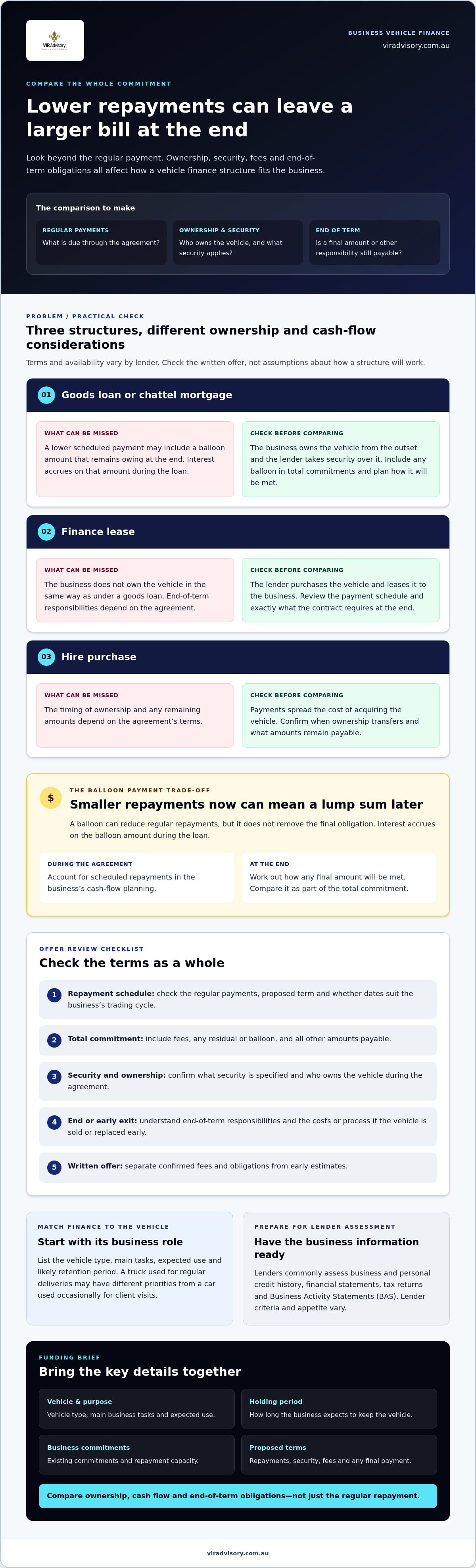
The finance structure affects more than the regular repayment. It can determine who owns the vehicle during the agreement, what security the lender holds and what the business must do when the term ends. Compare each offer with the vehicle’s expected working life and the business’s ability to manage scheduled payments and any final obligation.
The lowest repayment alone doesn’t establish the best overall fit. Compare the full commitment, ownership position and flexibility if the business needs to sell, replace or repay the vehicle early.
Common structures and their trade-offs
| Structure | Ownership and cash-flow considerations |
|---|---|
| Goods loan or chattel mortgage | The business owns the vehicle from the outset, with the lender taking security over it. Repayments spread the purchase cost, and the agreement may include a balloon amount that accrues interest. |
| Finance lease | The lender purchases the vehicle and leases it to the business. Regular payments may help make cash outflows predictable, but the business doesn’t own the vehicle in the same way as under a goods loan. End-of-term responsibilities depend on the agreement. |
| Hire purchase | The business pays to acquire the vehicle, with ownership transferring under the agreement’s terms. Payments spread the cost, but check when ownership transfers and what amounts remain payable. |
These structures aren’t available on identical terms from every lender. Repayments, fees, residuals, security arrangements and end-of-term responsibilities depend on the offer. If a balloon is included, interest accrues on that amount during the loan, so include it when comparing total commitments. Treat figures discussed before a formal offer as estimates, not confirmed terms.
What to compare in an offer
Review the payment schedule alongside the total commitment, proposed term and any final amount. Check what security is specified and what the business must do at the end of the agreement. Read the early exit conditions too, particularly if the vehicle could be sold or replaced before the finance term finishes.
- Separate confirmed fees and obligations in the written offer from early estimates.
- Work out how any final amount will be met and include it in cash-flow planning.
- Check whether repayment dates suit the business’s trading cycle.
Match the term to vehicle use and asset life
Estimate kilometres, work demands and likely replacement timing. A truck used on demanding routes may be replaced sooner than a car used for occasional client visits. If the business expects to change vehicles before the finance ends, understand the agreement’s process and costs for doing so.
Predictable repayments can help with budgeting, while a different term or end-of-term arrangement may involve other trade-offs. Don’t assume an overseas incentive applies in Australia: the IRS Commercial Clean Vehicle Credit describes a United States tax credit, not Australian eligibility. Assess Australian tax treatment separately with a qualified tax professional.
Compare business vehicle finance by vehicle type, use and funding need
Start with the job the vehicle needs to do, not just its purchase price. A van used every day to reach worksites may be central to operations, while a car used occasionally for meetings may have a less direct role. That distinction can shape how much cash the business is prepared to contribute upfront, what repayments it can manage and how long it expects to keep the vehicle.
For a vehicle finance business application, set out the vehicle’s purpose, expected use and likely replacement timing. Then weigh the deposit against cash needed for wages, stock, suppliers and other operating expenses. A larger deposit reduces the amount borrowed, but using too much available cash may leave less room for normal trading demands. A smaller deposit preserves cash, while the resulting finance commitment may be higher.
Compare funding priorities by use
| Vehicle use | Funding priorities to weigh |
|---|---|
| Central to daily operations, such as a delivery truck or work ute | Consider reliability, capacity, expected kilometres and the impact of repayments during quieter trading periods. Compare the proposed term with how long the business expects to use the vehicle. |
| Occasional use, such as a car for periodic client visits | Assess whether the vehicle’s cost and ongoing commitment are proportionate to its use. Preserving cash may matter more if the vehicle isn’t essential to day-to-day work. |
| Specialised or higher-demand use | Match the specification to the work required, then consider whether the business can manage the commitment if usage, maintenance needs or replacement timing differ from expectations. |
A longer term may spread repayments over more time and ease regular cash-flow pressure, but it also extends the commitment. If the business expects to replace the vehicle sooner, understand the consequences of selling or changing it before the finance ends. Don’t base the decision on a deposit or repayment in isolation. Check the total commitment against reserves and planned vehicle use.
New, used and specialised business vehicles
Vehicle age, condition and type can affect lender criteria, and lenders may have different requirements for particular categories or vehicle ages. Before settling on a vehicle, compare its make, model, age, condition and intended business use with the lender’s requirements. This can identify a mismatch early, rather than relying on assumptions before the vehicle and funding request are assessed.
Vehicle finance or broader asset finance?
When the funding need is a particular car, ute or truck, vehicle finance keeps the request tied to that asset. If the purchase is other equipment, such as machinery, the requirement may be better considered under asset or equipment finance. Property funding has different security and assessment considerations, so it isn’t interchangeable with vehicle funding.
VIR Advisory’s business and asset finance services cover funding needs across these categories. For a practical comparison, list the asset, its operational role, the cash contribution available and the expected holding period, then assess the proposed commitment against repayment capacity.
Prepare a business vehicle finance application and avoid common delays
A well-prepared application gives the lender a clearer picture of the vehicle requirement and how the business expects to meet repayments. Lenders may assess business performance, existing financial commitments and repayment capacity, alongside details of the vehicle and finance request. A clear funding brief can help identify gaps before an application is submitted.
An initial finance discussion is not formal lender approval. Any preliminary indication remains subject to the lender’s assessment, requested information and final offer terms.
Prepare in a clear sequence
- Define the need. Explain why the business needs the vehicle, what work it will support and whether it’s replacing an existing vehicle or adding capacity.
- Record the vehicle details. Note the make, model, age, condition, purchase details and intended business use. The lender may apply criteria to the vehicle being financed.
- Set out the funding request. State the amount sought, any deposit or contribution available and the repayment structure being considered. Keep estimates separate from confirmed purchase details.
- Summarise business finances. Prepare a current view of cash flow, existing debts and regular commitments. Test whether repayments remain manageable through quieter trading periods, not only during a strong month.
- Review the proposed terms. Once an offer is available, check repayment amounts and timing, fees, security, the term and any residual or balloon payment. Read the end-of-term and early exit conditions before committing.
Organise information and requested documents
Document requirements vary by lender and application. A lender may request financial statements, tax returns, Business Activity Statements (BAS), bank statements, vehicle details or evidence of the purchase price. These are examples, not a universal checklist. Follow the lender’s specific request and provide complete, consistent information.
Before submitting, check that the funding amount aligns with the vehicle details and that supporting figures are current. If the business has several existing facilities, include their repayment commitments in the cash-flow summary so the proposed vehicle repayment isn’t assessed in isolation.
Reduce avoidable delays and risks
Don’t choose a repayment solely because it appears affordable today. Test it against changing cash flow and account for any final payment, fees, security terms and early exit conditions. Incomplete information or figures that don’t reconcile can prompt follow-up requests. Avoid committing to a vehicle on the assumption that finance will be approved. Approval depends on the lender’s assessment and conditions.
For a vehicle finance business application, keep a short written brief with the vehicle purpose, proposed funding, cash-flow position and documents requested by the lender. This makes it easier to identify missing information and compare the final offer with the original requirement.
How VIR Advisory can help assess business vehicle finance options
Choosing a finance structure involves more than comparing repayments. The vehicle’s role, expected holding period and cash available for repayments all help shape the funding brief. VIR Advisory is a finance brokerage, not a direct lender. It assesses the business’s requirements and connects it with lenders whose options can be compared against those circumstances.
Raina Doshi brings over 15 years of banking and finance experience. VIR Advisory considers the proposed vehicle, the business’s funding needs and the terms that matter, including repayment patterns, security and any end-of-term obligation. Finance remains subject to the lender’s criteria, assessment and approval.
What a finance discussion can cover
A discussion can clarify whether the request is for a car used in client work, a ute required for daily operations or a truck supporting regular transport. The business can outline the purchase details, intended use, contribution available and preferred timing. These specifics help distinguish the asset requirement from broader business funding needs.
Cash flow is part of the comparison. A repayment that appears manageable in a strong trading period may feel different when revenue fluctuates or other commitments fall due. Consider repayment capacity alongside existing obligations, then compare lender options and structures with the intended holding period in mind.
VIR Advisory doesn’t make the lending decision. The lender sets its requirements and assesses the application, including the business and vehicle details. A discussion can help organise the request and identify relevant considerations, but it can’t guarantee approval or particular terms.
Preparing for an initial conversation
You don’t need every application document ready to explain the requirement. A concise overview makes the discussion more specific and helps identify what information may be needed next. Have these details available where possible:
- The vehicle type, purchase details and intended business use.
- The amount sought and any deposit or business contribution under consideration.
- A high-level summary of existing business commitments and repayment capacity.
- The expected holding period and any preference about ownership or a final payment.
Bring the vehicle’s role and the business’s cash-flow position into the comparison rather than assessing a repayment figure in isolation. If specifications or purchase timing are still being finalised, note what is confirmed and what may change. This helps clarify what the lender will need to assess.
Set up your next finance discussion with clarity
Before taking the next step, turn the vehicle decision into a short funding brief. Set out the cash available after any upfront contribution, a repayment level that remains manageable if trading fluctuates, and the questions that need a lender’s answer. This gives the discussion a practical focus and separates firm requirements from assumptions that may change during assessment.
A vehicle finance business commitment should fit the work the vehicle needs to perform and the business’s capacity to meet the terms. If either is unclear, identify what information would resolve it, such as final vehicle details or a clearer view of existing obligations. A concise brief can make the next discussion more useful.
A considered funding brief is a practical first step towards comparing vehicle finance options. Contact VIR Advisory to discuss your business vehicle finance requirements.
Frequently Asked Questions
Can a company or sole trader apply for business vehicle finance?
Yes, a company or sole trader may apply, subject to the lender’s criteria. The application should identify the correct borrowing entity and explain how the vehicle relates to its business activities. A company director applying on behalf of a company should have the company’s details and authority to act available. Sole traders should be ready to distinguish business income and expenses from personal finances if the lender requests that information.
Does business vehicle finance require the vehicle to be used only for work?
Not necessarily, but describe the intended use accurately in the application. A vehicle used for both work and personal trips has mixed use, which may affect the lender’s assessment or the terms offered. Keep records that help explain the business use, such as a log of work-related trips, if relevant. Tax treatment is a separate question and depends on the business’s circumstances.
Can a business finance a used vehicle?
Potentially, depending on the lender and the specific vehicle. For a used vehicle, keep the seller’s details, purchase documents and vehicle identification information together, and make sure they match the finance request. A private sale may involve different paperwork from a dealer purchase. Confirm the proposed funding arrangement before paying a deposit or completing the sale, as approval and settlement conditions can affect timing.
Will applying for vehicle finance affect an existing business loan application?
It can be relevant if both applications are being assessed at the same time. Tell each lender about the other application and provide updates if either facility is approved, declined or drawn down. This is especially useful if the business loan is close to settlement, since its terms may rely on information provided earlier. The effect depends on the applications and lender assessment, so don’t assume one decision leaves the other unchanged.
Can a business refinance a vehicle it already owns?
Possibly, although a vehicle owned outright may involve a different request from replacing an existing vehicle loan. A lender may consider whether the vehicle can support the proposed finance and how the funds will be used. Gather proof of ownership and purchase records, then compare the proposed contract’s security and repayment obligations with the amount and purpose of the funding. Conditions depend on the lender’s assessment.
What happens if the business can no longer meet vehicle finance repayments?
Review the finance agreement and contact the lender promptly to explain the change in circumstances and ask what options may be available. Keep copies of communications and note any agreed next steps. If selling the vehicle is being considered, first understand the lender’s requirements for releasing its security and how sale proceeds must be applied. Don’t ignore formal notices or assume that returning or selling the vehicle automatically clears the outstanding balance.

Article by
Raina Doshi
Raina Doshi has worked in banking and finance since 2011, including experience with major Australian lenders. She helps homeowners, property investors, business owners and professionals secure and structure lending solutions across home loans, refinancing, commercial finance and business lending.
Areas of expertise include residential lending, investment property finance, debt recycling, commercial property finance, equipment finance, construction finance and strategic debt structuring.
Drawing on extensive banking and finance experience, Raina helps clients navigate lender requirements, improve borrowing outcomes and structure effective finance solutions.
Disclaimer
The information in this article is general in nature and does not take into account your personal objectives, financial situation or needs. Before acting on any information, consider whether it is appropriate to your circumstances and seek professional advice.


