

With 32.5% of Australian mortgage holders now classified as being at risk of mortgage stress, the margin for error in financial planning has narrowed significantly. When using a loan repayment calculator, it's vital to understand that the figure on your screen is only one part of a broader lender assessment. Most borrowers feel a sense of uncertainty regarding interest rate fluctuations and the technical differences between Principal and Interest (P&I) versus Interest Only structures. You likely want a clear, accurate estimate of your weekly, fortnightly, or monthly commitments that accounts for the current 4.35% RBA cash rate and the mandatory 3.0% serviceability buffer applied by banks.
In this guide, you'll learn exactly how lenders calculate your repayments and discover the strategic variables that can reduce your total interest bill. We'll examine the impact of establishment fees, ongoing charges, and different repayment frequencies on your cash flow. By understanding lender assessment criteria and loan structuring, you can move from a state of uncertainty to having a precise debt management strategy. This article provides the practical lending insights needed to organise your finance effectively in the 2026 market.
Key Takeaways
- Understand how to use a loan repayment calculator to amortise your principal balance and accurately estimate periodic cash flow commitments across different payment frequencies.
- Learn why lenders apply a 3.0% serviceability buffer to your application and how your Loan-to-Value Ratio (LVR) directly impacts the interest rate used in your assessment.
- Discover a practical framework for reducing your total interest bill through the strategic implementation of offset accounts and debt management structures.
- Identify the critical differences in repayment structures between residential property finance and commercial lending, including the impact of shorter loan terms and residual payments.
- Recognise why a calculator is only the initial step and how professional debt advisory helps you compare multiple lenders to optimise your final finance strategy.
How a Loan Repayment Calculator Estimates Your Finance Costs
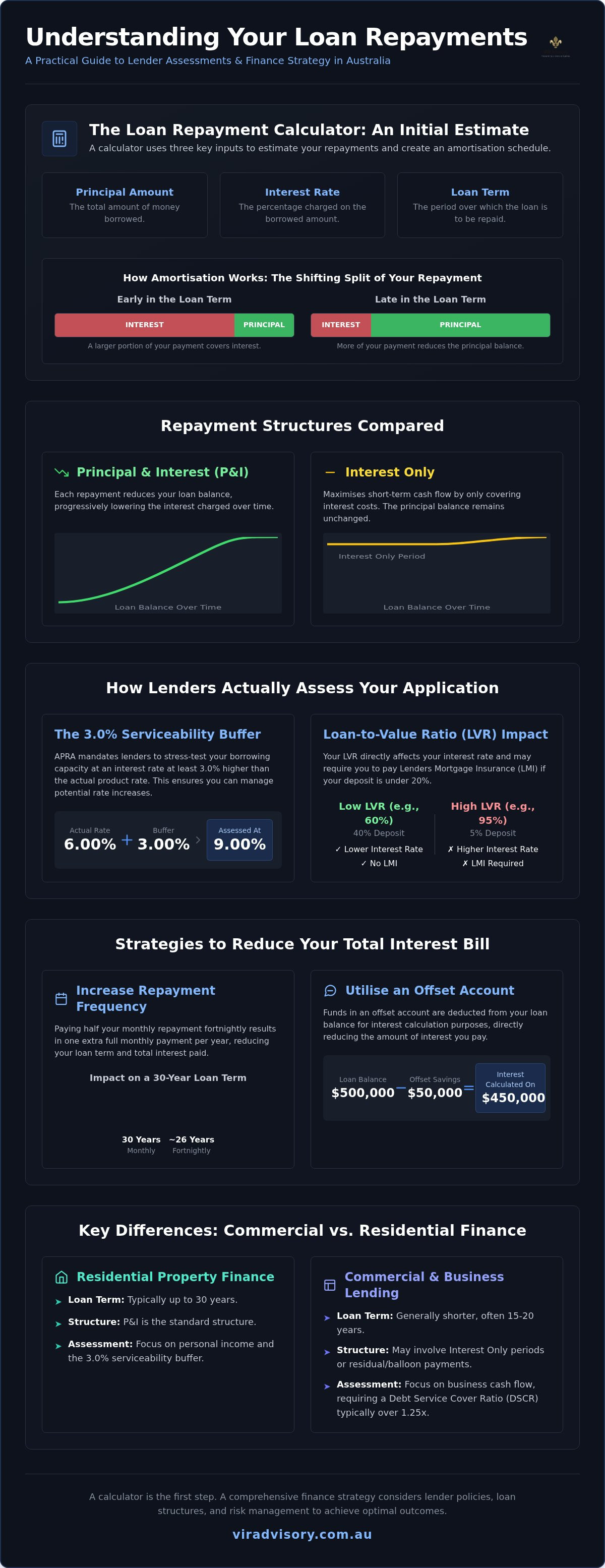
A loan repayment calculator determines your periodic commitment by amortising the principal amount over a set term at a specific interest rate. This mathematical tool generates an Amortization schedule, which details how each payment is distributed between the original debt and the interest charged. Accuracy is paramount. It's essential for business owners and property investors who need to maintain strict cash flow management. It's also a precursor to lender serviceability checks, where banks apply a 3.0% buffer to ensure you can handle potential rate rises. You should treat online results as indicative figures. Formal lender offers will always incorporate specific fees and your individual risk profile.
To better understand how these variables influence your monthly commitments, watch this helpful video:
Principal and Interest (P&I) vs Interest Only
P&I payments ensure your loan is fully cleared by the end of the term. Each instalment reduces the principal balance. This progressively lowers the interest charged in subsequent months. In contrast, Interest Only periods are often used in investment or business lending to maximise short-term cash flow. While this strategy keeps initial outgoings low, it's a more expensive long-term option. You aren't reducing the principal. Consequently, you'll pay more in total interest over the life of the loan. Lenders often view Interest Only periods as higher risk. This can result in a higher interest rate compared to P&I terms.
The Impact of Repayment Frequency
Switching from monthly to fortnightly or weekly payments is an effective finance strategy. If you pay half your monthly amount every two weeks, you'll complete 26 half-payments in a year. This equates to 13 full monthly payments. You effectively contribute one extra month's worth of principal reduction annually. On a standard 30-year mortgage, this can reduce the loan term by several years. It saves a significant amount in interest. This is a methodical way to build equity faster without needing to increase your income.
Lender Requirements and Assessment Criteria
While an online loan repayment calculator offers a useful baseline for your outgoings, the internal calculations performed by Australian banks are far more conservative. Lenders don't assess your application based on the current market rate you'll actually pay. Instead, they apply a series of risk-mitigation filters to ensure you can maintain commitments if economic conditions shift. This is a critical distinction for professionals and self-employed borrowers whose income may fluctuate. Understanding these assessment layers is the key to moving from a generic estimate to a successful finance approval.
Serviceability Buffers Explained
The Australian Prudential Regulation Authority (APRA) currently mandates a serviceability buffer of at least 3.0% above the loan's interest rate. If you're applying for a home loan at 6.0%, the bank tests your ability to meet repayments at 9.0%. This stress test ensures long-term financial stability for the lender and the borrower alike. In commercial lending, these requirements can be even more nuanced. Lenders often look at Debt Service Cover Ratios (DSCR), requiring your business's net operating income to exceed the proposed debt repayments by a specific margin, typically 1.2 to 1.5 times.
Common Approval Obstacles
Many borrowers overlook how their Loan-to-Value Ratio (LVR) dictates the interest rate used in a loan repayment calculator. Lenders typically offer tiered pricing. A borrower with a 40% deposit (60% LVR) will almost always secure a lower rate than someone with a 5% deposit. If your deposit is under 20%, you must also factor in Lenders Mortgage Insurance (LMI). This is a significant upfront cost that is often capitalised into the loan, increasing your total debt and monthly repayments. You can find more detail on how these variables interact in our guide on How Borrowing Capacity Is Actually Calculated in Australia.
Other common hurdles include credit card limits and existing debts. Banks assess credit cards based on their total limit, not the balance you owe. A $10,000 limit might be treated as a $300 monthly liability, even if you pay it off in full every month. For self-employed directors, lenders may also apply floor rates; a minimum interest rate used for assessment regardless of how low the actual product rate is. If you're unsure how these criteria apply to your situation, discussing your specific borrowing capacity with a specialist can clarify your position before you submit a formal application.
Strategic Variables: Reducing Your Total Interest Bill
The output of a loan repayment calculator represents a baseline, not a fixed destiny. Effective debt management requires a shift from passive repayment to active principal reduction. By applying specific structural variables, you can lower your total interest bill and shorten your loan term without needing to increase your annual salary. This involves a methodical approach to how you hold your cash and how you allocate surplus funds towards your principal balance.
Offset Accounts vs Redraw Facilities
An offset account is a transaction account linked to your loan where the balance is subtracted from the principal before interest is calculated. If you hold $50,000 in an offset account against a $500,000 loan, the bank only charges interest on $450,000. This provides immediate liquidity while reducing costs. A redraw facility, however, involves paying extra funds directly into the loan account itself. While both mechanisms reduce interest, they differ significantly in tax treatment. For investors, funds held in an offset account maintain the integrity of the loan's purpose, whereas redrawing funds can sometimes complicate tax deductibility. You can find more detail in our analysis of Offset Account vs Redraw: Which Is Better for Investors?.
The Power of Extra Repayments
Making extra contributions early in the loan term delivers the greatest benefit due to the way interest compounds over time. Consider a case study of a $500,000 loan with a 30-year term at 6.0% interest. By consistently paying an additional $200 per month, you could reduce your loan term by over four years and save more than $95,000 in total interest. This strategy targets the principal balance before interest can accumulate on it, effectively accelerating your equity position.
It's vital to check lender restrictions before accelerating your repayment schedule. Variable-rate loans generally offer total flexibility, allowing for unlimited extra payments and redraw access. Fixed-rate loans are more rigid, often capping extra contributions at $10,000 or $20,000 per annum. Exceeding these thresholds can lead to significant break costs or economic cost fees. Balancing these features requires a finance strategy that prioritises both flexibility and cost-efficiency to ensure your debt remains an effective tool rather than a burden.
Commercial vs Residential Repayment Calculations
Calculating repayments for a business or commercial property requires a different set of assumptions than those used for a standard residential mortgage. While a residential loan repayment calculator typically defaults to a 30-year term, commercial loan terms are generally compressed into 15 to 25 years. This shorter duration means your principal reduction occurs faster; however, it also results in higher monthly commitments. Commercial interest rates are rarely 'off the shelf' products. Lenders utilise risk-based pricing, where the rate is determined by the strength of your balance sheet, the type of security provided, and your industry's stability.
Business lending often involves specialised structures like debtor finance or working capital loans. These facilities may not have a fixed end date. Repayments are instead tied to your accounts receivable or turnover. For equipment and vehicle finance, 'balloon' or 'residual' payments are frequently used to manage cash flow. By deferring a percentage of the principal until the end of the term, you reduce your ongoing monthly costs. You must plan for the eventual refinancing or payout of that residual amount.
Business Loan Assessment Criteria
Lenders specialising in business finance prioritise your Earnings Before Interest, Taxes, Depreciation, and Amortisation (EBITDA). They use this to calculate your Debt Service Coverage Ratio (DSCR). This ensures your net profit can comfortably cover all debt obligations. For SMEs, seasonal cash flow is a vital consideration. Some lenders offer flexible repayment schedules that align with peak trading periods. This allows for lower payments during quieter months. You can explore these requirements further in our guide on Commercial Property Finance: What Business Owners Need to Know.
Asset and Equipment Finance Structures
The choice between a chattel mortgage and a finance lease significantly alters your repayment profile. Under a chattel mortgage, the business takes ownership at the time of purchase. This often allows for an upfront GST claim on the asset's price, which can reduce the initial loan amount. In a finance lease, the lender retains ownership. GST is typically charged on each monthly instalment. Aligning these repayment structures with the asset's useful life and your depreciation schedule is essential for maintaining a healthy balance sheet and tax position.
Optimising Your Finance Strategy with Professional Advice
While a loan repayment calculator serves as a useful starting point, it remains a static tool within a rapidly shifting economic environment. Relying solely on automated outputs can lead to a narrow view of your actual borrowing potential. Professional debt advisory bridges the gap between these raw numbers and a structured finance strategy. An experienced broker provides access to a panel of over 30 lenders, often identifying specialised funding solutions that offer more competitive repayment terms than the standard products advertised by major banks. This comparison is essential for professionals and business owners who require a debt structure that aligns with their specific cash flow requirements.
Avoiding Common Calculation Mistakes
Many borrowers inadvertently use skewed data when estimating their outgoings. One frequent error is forgetting to include annual loan fees in the effective interest rate. With the average ongoing home loan fee now reaching $278 per year, ignoring these costs can result in an underestimation of your total commitment. Another mistake is assuming a fixed rate will inherently provide better value than a variable rate over the long term. Fixed rates offer payment certainty, but they lack the flexibility of offset accounts and can involve significant break costs if you need to refinance early. You must also account for potential rate rises in your long-term budget. With the RBA cash rate currently at 4.35% and forecasts suggesting further volatility, your budget should always incorporate a buffer beyond the headline rate.
When to Seek a Professional Refinancing Assessment
Existing borrowers often fall victim to a loyalty tax, where lenders offer lower rates to new customers while keeping long-term clients on higher-margin products. If you haven't reviewed your debt structure in the last 18 to 24 months, you're likely missing out on significant interest savings. A mortgage health check identifies these discrepancies and highlights opportunities to optimise your cash flow through strategic refinancing. For a deeper look at these techniques, refer to our Refinance Home Loan Guide: Strategic Debt Optimisation for 2026.
To ensure the rates in your calculation match an actual offer, you must prepare your documentation with precision. Lenders require clear evidence of income, realistic living expense declarations, and a comprehensive overview of existing liabilities. Providing a clean data set allows for a more accurate assessment of your borrowing capacity from the outset. If you're ready to move beyond estimates, you can Submit Your Enquiry for a personalised repayment and borrowing capacity assessment.
Mastering Your Debt Management Strategy
Using a loan repayment calculator provides a vital baseline for your cash flow planning. However, moving from an estimate to a formal approval requires a methodical understanding of lender serviceability buffers and risk-based pricing. By implementing strategic variables like offset accounts or optimised repayment frequencies, you can significantly reduce your total interest bill and build equity faster. Whether you're navigating the shorter terms of commercial finance or the long-term structure of a residential mortgage, precision in your initial calculations is the key to financial stability.
VIR Advisory brings over 15 years of banking expertise to your finance strategy. We provide access to a broad network of Australian lenders, ensuring you receive specialised commercial and residential advice tailored to your professional profile. Interpreting data into a viable funding solution is a process that requires both technical knowledge and market insight.
Effective debt management is a long-term commitment that rewards those who take a proactive approach to their principal reduction.
Frequently Asked Questions
How accurate are online loan repayment calculators?
Online tools are indicative only because they cannot account for specific lender credit policies or your individual risk profile. While a loan repayment calculator provides a helpful baseline for budgeting, your actual offer will include establishment fees and potentially a higher interest rate based on your Loan-to-Value Ratio (LVR). Lenders also apply their own internal serviceability buffers, which are typically 3.0% above the actual product rate, to ensure long-term stability.
What is the difference between a comparison rate and an interest rate?
The interest rate is the percentage charged on your principal balance, whereas the comparison rate represents the true cost of the loan including most upfront and ongoing fees. For example, if a loan has a low headline rate but high monthly account-keeping fees, the comparison rate will be significantly higher. In the 2024-2025 financial year, Australian households paid an average of $278 in ongoing fees, making the comparison rate a vital metric for accurate assessment.
Can I change my repayment frequency after the loan has started?
Most lenders allow you to change your repayment frequency from monthly to fortnightly or weekly at any time, provided you have a variable interest rate. This is a common finance strategy to reduce the total interest bill. By paying half your monthly amount every fortnight, you effectively make one extra month's repayment each year. This targeted approach reduces the principal balance faster and can shave several years off a standard 30-year residential loan term.
How do interest rate rises affect my monthly repayments?
When the RBA increases the cash rate, lenders typically pass this hike on to variable rate products, which directly increases your required monthly commitment. For a $500,000 loan, a 0.25% rate rise can increase repayments by approximately $75 to $100 per month. Because the cash rate currently sits at 4.35%, it's prudent to use a loan repayment calculator with a 3.0% buffer to stress-test your household or business cash flow against future fluctuations.
Are repayments different for self-employed borrowers?
The repayment amounts themselves are calculated the same way, but the assessment process for self-employed borrowers is more rigorous. Lenders closely scrutinise your net profit, EBITDA, and Debt Service Coverage Ratio (DSCR) to ensure income stability. You may also be subject to floor rates, which are minimum interest rates used for serviceability testing regardless of the actual market rate. Providing clear documentation, such as two years of tax returns, ensures your calculated repayments match the final offer.
What happens to my repayments at the end of a fixed-rate period?
At the end of a fixed-rate period, your loan will usually revert to the lender’s standard variable rate, which is often higher than the most competitive market offers. This transition often leads to a significant loyalty tax if left unmanaged. It's the ideal time to conduct a mortgage health check and consider refinancing solutions. Negotiating a new rate or switching lenders can prevent a sudden spike in your monthly cash flow commitments when the fixed term expires.
Should I choose a longer loan term to lower my repayments?
Choosing a longer term, such as 30 years instead of 20, lowers your immediate monthly outgoings, which can assist with short-term cash flow management. However, the trade-off is a substantial increase in the total interest paid over the life of the loan. While this strategy improves your borrowing capacity in the eyes of some lenders, it's often more cost-effective to opt for a shorter term or use an offset account to achieve similar liquidity without the long-term interest expense.
How does an offset account actually lower my repayments?
An offset account is a transaction account linked to your loan where the balance is subtracted from your principal before interest is calculated. If you have $50,000 in an offset account against a $500,000 loan, the bank only charges interest on $450,000. While your scheduled monthly payment amount might remain the same, a larger portion of that payment goes towards reducing the principal rather than covering interest. This accelerates your equity growth and reduces the total loan term.

Article by
Raina Doshi
Raina Doshi has worked in banking and finance since 2011, including experience with major Australian lenders. She helps homeowners, property investors, business owners and professionals secure and structure lending solutions across home loans, refinancing, commercial finance and business lending.
Areas of expertise include residential lending, investment property finance, debt recycling, commercial property finance, equipment finance, construction finance and strategic debt structuring.
Drawing on extensive banking and finance experience, Raina helps clients navigate lender requirements, improve borrowing outcomes and structure effective finance solutions.
Disclaimer
The information in this article is general in nature and does not take into account your personal objectives, financial situation or needs. Before acting on any information, consider whether it is appropriate to your circumstances and seek professional advice.


