

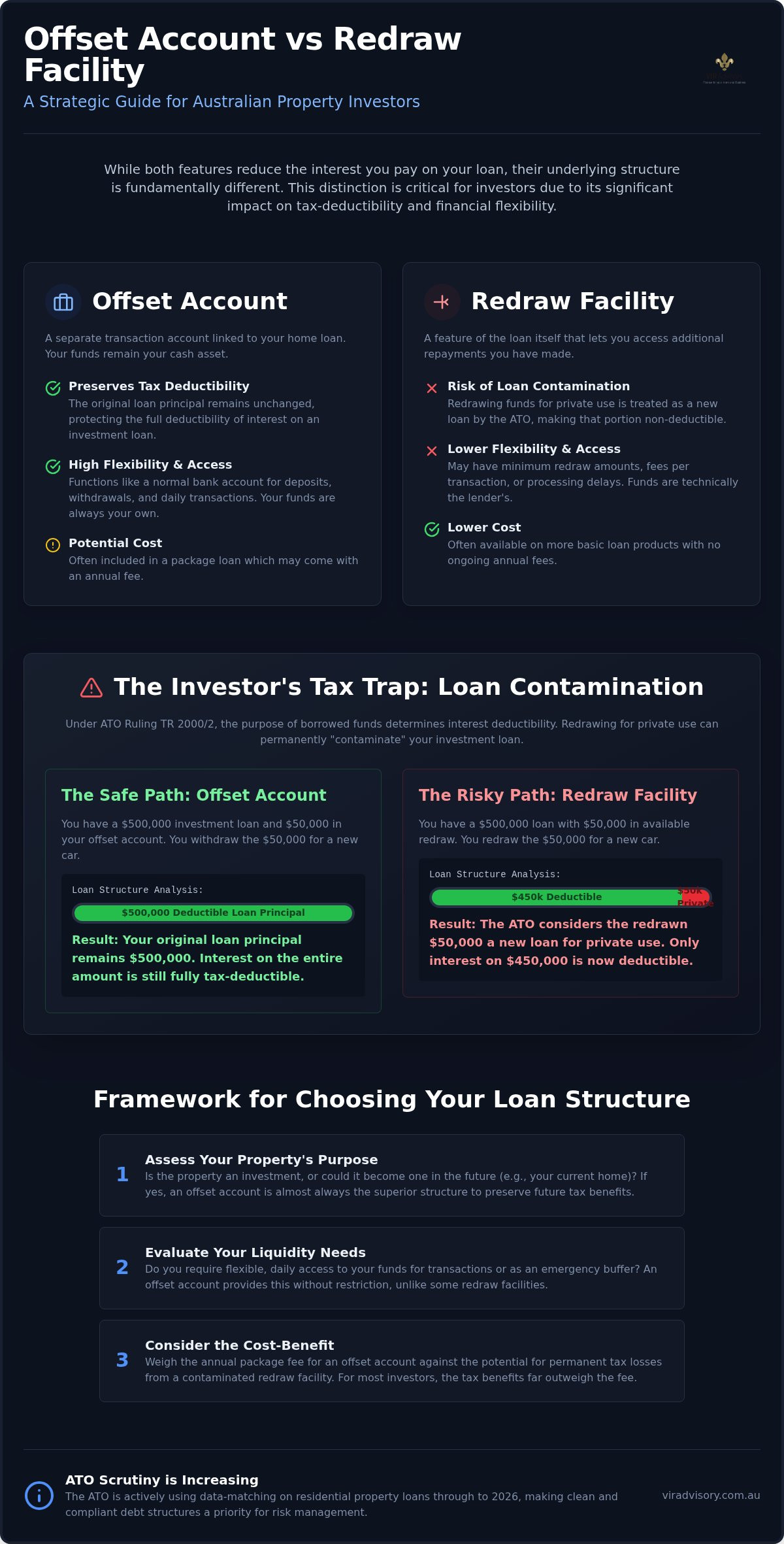
The choice between an Offset Account vs Redraw often seems like a minor administrative detail, yet for property investors, it's a structural decision that can lead to permanent tax losses. While both facilities reduce interest by offsetting your loan balance against your savings, an offset account is a separate deposit account, whereas a redraw facility consists of additional repayments made directly into the loan. For investors, the offset account is almost always the superior choice. It maintains the original loan principal, ensuring that interest remains fully tax-deductible even if you withdraw funds for personal use later. Under ATO ruling TR 2000/2, redrawing funds for private purposes is treated as a new loan, which can contaminate your debt and strip away valuable deductions.
It's natural to feel uncertain about which structure best supports your finance strategy, especially with the ATO currently using data-matching programs to scrutinise investment claims. You'll learn the technical mechanics of both options to help you avoid costly tax errors and maximise your cash flow. We'll examine lender assessment criteria, the impact of the 4.35% RBA cash rate on your repayments, and the specific frameworks required to keep your debt structure clean and compliant.
Key Takeaways
- Understand the structural distinction between a separate transaction account (offset) and a principal reduction facility (redraw) to manage your interest costs effectively.
- Identify the tax risks inherent in the Offset Account vs Redraw debate, specifically how redrawing funds for private use can lead to permanent debt contamination.
- Evaluate the cost-benefit of paying annual package fees for an offset account versus the potential loss of tax deductions on a more basic redraw loan.
- Apply a methodical framework to select a loan structure that aligns with your long-term property intent and immediate liquidity requirements.
- Recognise how the ATO’s current data-matching programs target investment loan interest claims, making precise debt structuring a priority for risk management.
Understanding Offset and Redraw Mechanics
To understand the debate of Offset Account vs Redraw, you must first recognise the fundamental accounting difference between a deposit and a repayment. An offset account is a separate transaction account linked to your loan, whereas a redraw facility is a feature within the loan account itself that allows you to access extra repayments you've made. While both reduce the interest you pay, they do so through different legal and financial structures. One is your cash held in a bank account; the other is the lender's money that you've prepaid.
In the Australian lending market, interest is calculated daily and charged monthly. Lenders apply your interest rate to the net balance, which is the total loan amount minus whatever is held in your offset or redraw. For example, on a $500,000 loan with $60,000 in either facility at a 5.9% p.a. variable rate, you only pay interest on $440,000. This saves approximately $3,540 in interest annually. While the interest-saving mechanic is identical, the way these funds are treated for tax and accessibility purposes varies significantly.
How an Offset Account Functions
An Offset mortgage structure functions as a standard transaction account where you can deposit your salary, receive rental income, and use a debit card for daily expenses. Most competitive investment loans offer a 100% offset, meaning every dollar in the account cancels out interest on a dollar of debt. Crucially, your money remains your own cash asset. The gross loan balance stays the same on your statement, which is vital for maintaining clear records for the ATO and ensuring your debt structure remains flexible for future property acquisitions.
How a Redraw Facility Functions
A redraw facility operates differently because the money you put in is technically a principal repayment. You aren't saving the money in a separate account; you're paying down the loan faster than the lender requires. While you can withdraw these funds later, the lender technically owns the money in the interim. Some basic loan products may impose restrictions, such as minimum redraw amounts or processing delays of up to 48 hours. Because these payments reduce the actual loan balance, they can complicate your tax position if you ever decide to move out and turn your home into an investment property.
The Tax Trap: Why Investors Must Choose Carefully
The Australian Taxation Office (ATO) takes a very specific view of debt: the deductibility of interest is determined by the purpose of the funds, not the asset used as security. This fundamental rule is where the Offset Account vs Redraw debate becomes critical for your long-term finance strategy. When you pay extra money into a redraw facility, you're effectively reducing the loan principal. If you later withdraw that money, the ATO treats it as a new borrowing. If those redrawn funds are used for a private purpose, such as a holiday or a car, the interest on that portion of the loan is no longer tax-deductible, even if the loan is secured against an investment property.
Understanding Offset and Redraw Mechanics from a regulatory perspective highlights that while these features are common, their tax treatment is vastly different. For a professional or investor who may eventually convert their current home into an investment property, using a redraw facility can be a permanent financial error. By paying down the principal, you're reducing the amount of future interest you can claim as a tax deduction against rental income.
Redraws and Loan Contamination
When you mix private and investment funds within a single loan account, you create a "contaminated" loan. For example, if you have a $500,000 loan and redraw $30,000 for a personal expense, you've created a split-purpose loan. Calculating the deductible interest for the life of that loan becomes a complex accounting task that often leads to errors. Because the ATO is currently conducting data-matching programs on residential property loan data through to 2026, maintaining clean loan structures is a priority. Most experienced investors avoid redraw facilities on their primary residence to ensure the debt remains "clean" for future deductibility.
Preserving Deductibility with Offset Accounts
An offset account avoids these complications because the money never technically leaves your possession to pay down the debt. The original loan principal remains intact on the lender's ledger. If you decide to move out and rent the property, you can simply move your cash from the offset account to your new home's offset without changing the original loan's tax status. This keeps the full interest amount deductible against the rental income, provided the original purpose of the loan was for the property purchase.
For many, an interest-only loan paired with a 100% offset account provides the highest level of tax efficiency and cash flow control. To ensure your current structure isn't creating a future tax liability, you can book a debt optimisation review to assess your specific requirements.
Comparing Accessibility, Fees, and Interest Savings
While the mathematical interest savings of an Offset Account vs Redraw are identical, the operational costs and accessibility differ significantly. Most lenders offer offset accounts as part of a packaged loan product, which typically carries an annual fee of around $395. Conversely, basic loan products often include a redraw facility without an ongoing annual fee, making them appear more cost-effective on the surface. However, for many investors, the convenience and structural security of an offset account justify the additional expense.
Costs and Lender Assessment Criteria
Deciding if an offset account is worth the cost requires a calculation based on your average cash balance. For an annual fee to be cost-neutral on a loan with a 5.9% p.a. interest rate, you would need to maintain a minimum average balance of approximately $6,700 in the account. If your cash reserves are consistently higher, the interest saved far outweighs the fee. During a mortgage health check or refinancing application, lenders scrutinise these balances differently. An offset account is viewed as a liquid asset, whereas funds in a redraw facility are seen as a reduction in debt. This distinction can influence your borrowing capacity when applying for additional investment finance, as lenders may have different policies on how they treat available redraw versus cash on hand.
Liquidity and Risk Management
For self-employed professionals and business owners, liquidity is a core component of risk management. Offset accounts provide immediate accessibility through debit cards, Osko, and PayID, allowing for instantaneous transfers. Redraw facilities are often less flexible. Some lenders require 24 to 48 hours to process a redraw request, and many impose a minimum withdrawal amount per transaction. This delay can be a significant obstacle when you need to deploy working capital quickly.
It's vital to understand that redraw funds are not legally your money in the same way a deposit is. Lender terms and conditions often allow the bank to restrict access to redraw facilities or absorb the balance to reduce the loan limit if your financial circumstances change or if the property value drops. Over the life of a loan, many lenders also automatically reduce the available redraw amount as the scheduled loan balance decreases. This makes an offset account a more secure anchor for your emergency fund or investment deposits, as the lender cannot typically restrict access to your own savings account without extreme cause.
A Framework for Choosing Your Loan Structure
Selecting the right loan structure is a technical exercise in debt management rather than a simple preference. When evaluating the Offset Account vs Redraw dilemma, professionals and investors should follow a methodical assessment to ensure their choice supports both current cash flow and future borrowing capacity. This framework helps you move beyond the surface-level features to consider the long-term impact on your finance strategy.
- Determine Long-Term Property Intent: If there is any possibility that your current home will become an investment property, you must prioritise an offset account. As discussed previously, preserving the original loan principal is vital for future tax deductibility.
- Evaluate Liquidity Requirements: Business owners and self-employed borrowers often require immediate access to working capital. An offset account functions as a standard transaction account with instant access, whereas redraw can involve lender-imposed delays or minimum withdrawal limits.
- Calculate the Fee Break-Even Point: Compare the annual package fee, which is often around $395, against the interest saved. At a variable rate of 5.9% p.a., you need an average balance of approximately $6,700 to make the offset account cost-neutral.
- Assess Spending Discipline: For some borrowers, having a high balance visible in a transaction account encourages discretionary spending. Redraw facilities provide a psychological and administrative barrier that helps some individuals stay focused on debt reduction.
- Review Future Expansion Plans: Lenders often view liquid cash in an offset account as a strong indicator of financial health during a refinance assessment. Consider how your choice impacts your ability to demonstrate cash reserves for a deposit on your next acquisition.
When to Choose an Offset Account
This structure is ideal for high-income earners and professionals who maintain significant cash reserves. It's particularly effective for those who receive bonuses or irregular commissions, as every dollar offsets interest daily from the moment it is deposited. If you're a self-employed borrower, an offset account allows your business's tax provisions or GST collections to work for you by reducing your personal mortgage interest until the funds are required by the ATO. It remains the superior choice for anyone planning to transition their primary residence into a rental property in the future.
When a Redraw Facility May Suffice
A redraw facility is often sufficient for borrowers who are focused solely on paying off their mortgage and have no intention of turning the property into an investment. It's a valid, low-cost option for pure investment loans where the debt purpose is fixed and will never transition to personal use. It suits those who want to avoid annual fees and don't require the features of a full-service transaction account. For borrowers who rarely need to access their extra repayments, the redraw facility provides a simple way to reduce interest without the overhead of a package fee.
Optimising Your Finance Strategy with VIR Advisory
Selecting between an Offset Account vs Redraw is not a isolated decision; it is a core component of your broader debt management strategy. VIR Advisory, led by Raina Doshi with over 15 years of banking and finance experience, specialises in assessing your specific cash flow needs to recommend a structure that supports your long-term objectives. We look beyond the immediate interest savings to understand how your loan setup influences your borrowing capacity for future acquisitions. By examining your professional circumstances, whether you are a company director or a self-employed borrower, we ensure your debt is structured to maximise both flexibility and tax efficiency.
Integrating these features into a sophisticated investment strategy often involves debt recycling or complex refinancing. For investors, the ability to move cash freely without contaminating a loan is a significant advantage of the offset structure. We help you navigate lender-specific restrictions that are often buried in the fine print, such as policies that allow banks to reduce your available redraw limit as the loan balance decreases. Our role is to provide the professional oversight required to ensure your finance structure remains a stable anchor for your wealth-building efforts.
Beyond Interest Rates: Structural Finance
The "cheapest" interest rate on the market often belongs to basic loan products that only offer a redraw facility. While a lower rate is attractive, it can become a costly mistake if it limits your future tax deductions or restricts your liquidity during a market downturn. We evaluate lender assessment criteria to ensure you aren't sacrificing long-term wealth for a short-term saving. For professionals and business owners, aligning your loan structure with your risk management profile is essential. This means maintaining access to liquid capital while ensuring your debt remains "clean" for the ATO, a balance that requires meticulous planning and expert structural knowledge.
Next Steps for Australian Borrowers
Refining your debt structure starts with a clear understanding of your current position. We recommend reviewing your recent loan statements to identify any unused redraw balances or opportunities to implement a 100% offset account. A mortgage health check is a practical way to ensure your current loan still matches your 2026 financial goals, especially following recent RBA rate decisions and the implementation of stricter debt-to-income limits. If your current structure is no longer serving your needs, refinancing to a more sophisticated product may be the most effective way to optimise your cash flow.
To explore how a tailored finance strategy can support your property or business goals, you can learn more about VIR Advisory services and our approach to debt optimisation.
Securing Your Structural Debt Advantage
Selecting the correct facility within the Offset Account vs Redraw debate is a technical decision that dictates your tax efficiency and liquidity for years to come. While a redraw facility offers a simplified method to reduce interest, the offset account remains the structural benchmark for those who may transition a primary residence into an investment property. Maintaining the original loan principal is a vital requirement to satisfy ATO purpose-of-loan rules and ensure your future interest claims remain fully deductible.
Founder Raina Doshi offers over 15 years of expert banking insights to help you navigate complex lender assessment criteria. We provide a personalised finance strategy tailored to the specific needs of professionals and investors, ensuring your debt structure supports your broader objectives. By aligning your loan features with your risk management profile, you create a stable anchor for your financial operations. Professional oversight is the most reliable way to avoid costly structural errors.
We look forward to helping you optimise your debt structure with precision and care.
Frequently Asked Questions
Can I have both an offset account and a redraw facility on the same loan?
Yes, it is common for Australian lenders to offer both features on a single loan product, particularly within professional packages. When comparing an Offset Account vs Redraw for daily use, having both allows you to use the offset for cash flow and the redraw for long-term principal reductions. This provides a layer of redundancy, ensuring you can manage your debt effectively while maintaining liquidity for unexpected investment opportunities or property maintenance costs.
Does withdrawing money from a redraw facility increase my loan repayments?
Withdrawing funds from a redraw facility does not typically increase your scheduled monthly repayment amount on a standard principal and interest loan. Instead, the withdrawal increases your outstanding loan balance, which means a larger portion of your fixed repayment is directed toward interest rather than principal. Over time, this effectively extends the life of the loan unless you increase your repayment amount or make additional lump-sum payments to compensate for the higher interest charges.
Are offset accounts available on fixed-rate home loans in Australia?
Offset accounts are predominantly a feature of variable-rate loans, although a small number of Australian lenders offer partial offset facilities on fixed-rate products. These lenders may limit the offset to a specific dollar amount or a percentage of the loan balance. If you require a full offset account while seeking the certainty of a fixed rate, a split loan structure is often the most effective solution, allowing you to offset the variable portion.
What happens to my redraw balance if I refinance with a different lender?
When you refinance with a new lender, any available redraw balance is effectively absorbed into the equity of your property. The new loan is usually established for the net payout figure of the old loan. If you wish to maintain that liquidity, you must apply for a higher loan amount with the new lender and place those funds into an offset account, provided you meet the new lender's borrowing capacity and approval requirements.
Is the interest earned in an offset account taxable income?
No, the interest saved through an offset account is not considered taxable income by the ATO. Because you aren't actually earning interest but rather reducing the interest expense on your debt, there is no income to declare. This makes an Offset Account vs Redraw assessment vital for high-income earners, as the return on your cash is effectively your home loan interest rate, without any tax leakage on the gains.
Can a bank stop me from accessing my redraw funds?
Yes, a lender has the legal right to restrict or cancel access to redraw facilities under certain conditions. These conditions typically include a significant change in your financial position, a default on your repayments, or a substantial decline in the market value of the property securing the loan. Unlike an offset account, which is your own deposit, redraw funds are technically prepaid principal that the bank can choose to withhold to protect their risk position.
How much do I need in my offset account to make the annual fee worth it?
To determine if an offset account is cost-effective, you must compare the interest saved against the annual package fee, which is frequently around $395. At a variable interest rate of 5.9% p.a., you would need to maintain a consistent average balance of approximately $6,700 to break even. If your average balance is lower than this, a basic loan with a redraw facility and no annual fee may be the more economical choice.
Is an offset account better than a high-interest savings account for tax purposes?
For most investors, an offset account is superior to a high-interest savings account. Interest earned on savings is taxed at your marginal rate, which can be as high as 47% including the Medicare levy. In contrast, every dollar in an offset account reduces your interest expense by the full loan rate. This creates a higher net benefit, as the savings are tax-free and effectively earn a return equal to your mortgage rate while improving your cash flow.

Article by
Raina Doshi
Raina Doshi has worked in banking and finance since 2011, including experience with major Australian lenders. She helps homeowners, property investors, business owners and professionals secure and structure lending solutions across home loans, refinancing, commercial finance and business lending.
Areas of expertise include residential lending, investment property finance, debt recycling, commercial property finance, equipment finance, construction finance and strategic debt structuring.
Drawing on extensive banking and finance experience, Raina helps clients navigate lender requirements, improve borrowing outcomes and structure effective finance solutions.
Disclaimer
The information in this article is general in nature and does not take into account your personal objectives, financial situation or needs. Before acting on any information, consider whether it is appropriate to your circumstances and seek professional advice.


